

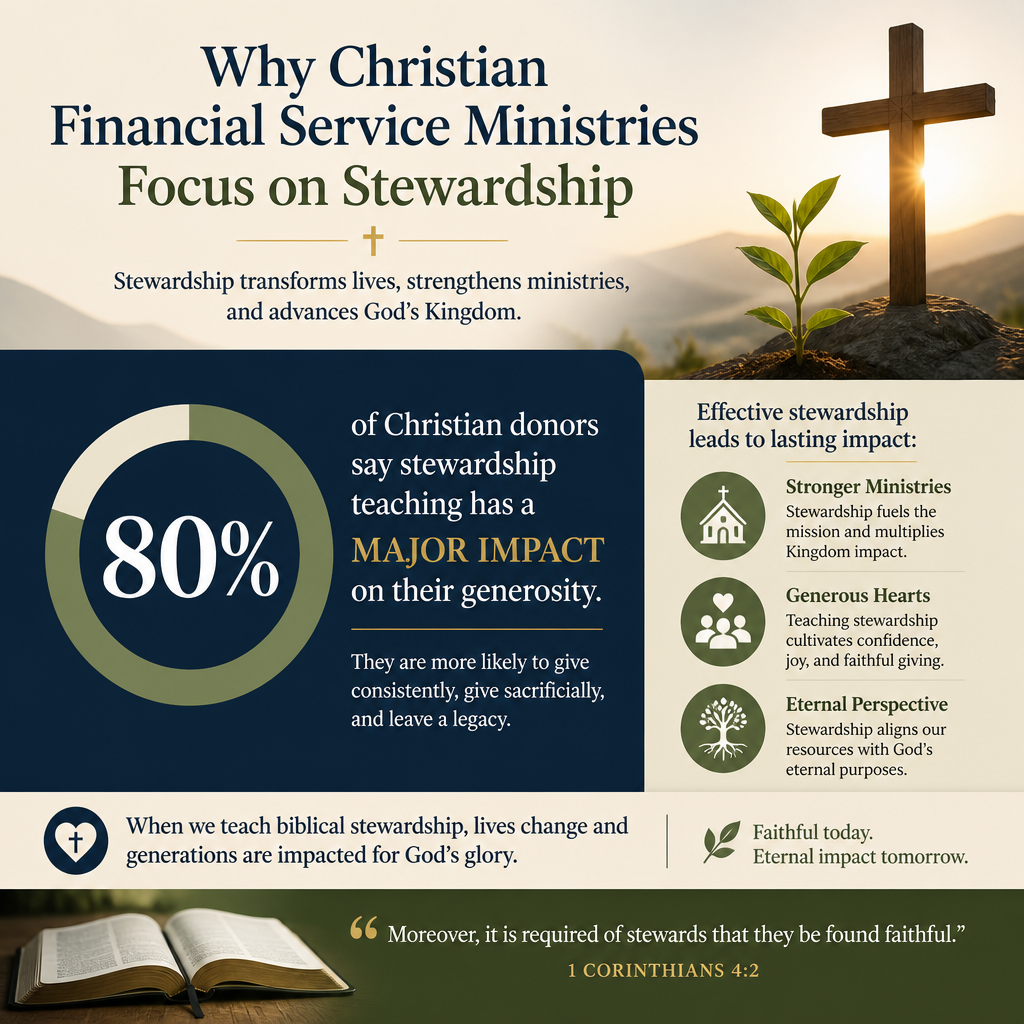
Why Christian financial service ministries focus on stewardship is not a branding choice. It is a theological necessity rooted in the consistent testimony of Scripture that money discipleship is heart discipleship. Donors can rightly ask whether a ministry that touches budgets, debt, and giving is doing “finance” with a Christian label, or whether it is forming people to live under the lordship of Christ.
Stewardship is also where modern Christians often experience quiet shame and confusion. Many donors carry the tension of wanting to give generously while managing consumer debt, supporting aging parents, paying tuition, or recovering from financial decisions shaped more by cultural assumptions than by biblical wisdom. Christian financial service ministries exist to meet that tension with formation, accountability, and practical help.
Stewardship is biblical formation before it is financial strategy
Scripture treats money as a discipleship diagnostic
Jesus spoke about money frequently because money reliably exposes what we love, what we fear, and what we trust. “Where your treasure is, there your heart will be also” is not a fundraising slogan; it is a spiritual diagnosis (Matthew 6:21). The parable of the talents assumes that resources are entrusted by a master and assessed by a master (Matthew 25:14–30). The warnings about greed are not primarily warnings about arithmetic; they are warnings about idolatry (Luke 12:15).
This is why mature Christian financial service ministries resist the reduction of stewardship to “giving more.” Biblical stewardship includes generosity, but it also includes honesty, prudence, contentment, diligence, and justice. A ministry that treats stewardship as a narrow transaction often forms shallow givers rather than faithful stewards.
Stewardship addresses both the heart and the household
The Bible’s economic vision is personal and communal. It addresses the habits of individuals and the health of households, but it also addresses the integrity of communities. In Acts, Christians shared resources in ways that honored both need and responsibility (Acts 2:44–45; 2 Thessalonians 3:10). The point is not that every Christian household will mirror another household’s choices, but that every household is accountable to God for what has been entrusted.
Christians genuinely disagree about some applications: how to think about investing, whether certain financial instruments are wise or morally compromised, how to hold the tension between planning and radical generosity, and how to navigate prosperity teaching that distorts stewardship into entitlement. Responsible ministries name these disagreements plainly and teach principles that can be tested against Scripture and lived in conscience before God.

Donors fund stewardship because financial disorder wounds families and churches
Debt is not only a balance sheet problem
Unmanageable debt frequently brings spiritual and relational consequences: secrecy, conflict in marriage, anxiety that masquerades as control, and reduced capacity for generosity. Scripture’s wisdom literature is not naïve about the bondage created by indebtedness: “the borrower is the slave of the lender” (Proverbs 22:7). That proverb is not an absolute prohibition against borrowing, but it is a sober recognition of what debt can do to human freedom and moral agency.
In the United States, household indebtedness is not a marginal issue. Total household debt recently reached record levels, driven by mortgages, student loans, auto loans, and credit cards Federal Reserve Bank of New York. Christian donors often see the downstream effects: families that cannot absorb job loss, churches with members who avoid transparency, and ministries serving communities where predatory lending has become normalized.
Financial stress reshapes giving and ministry participation
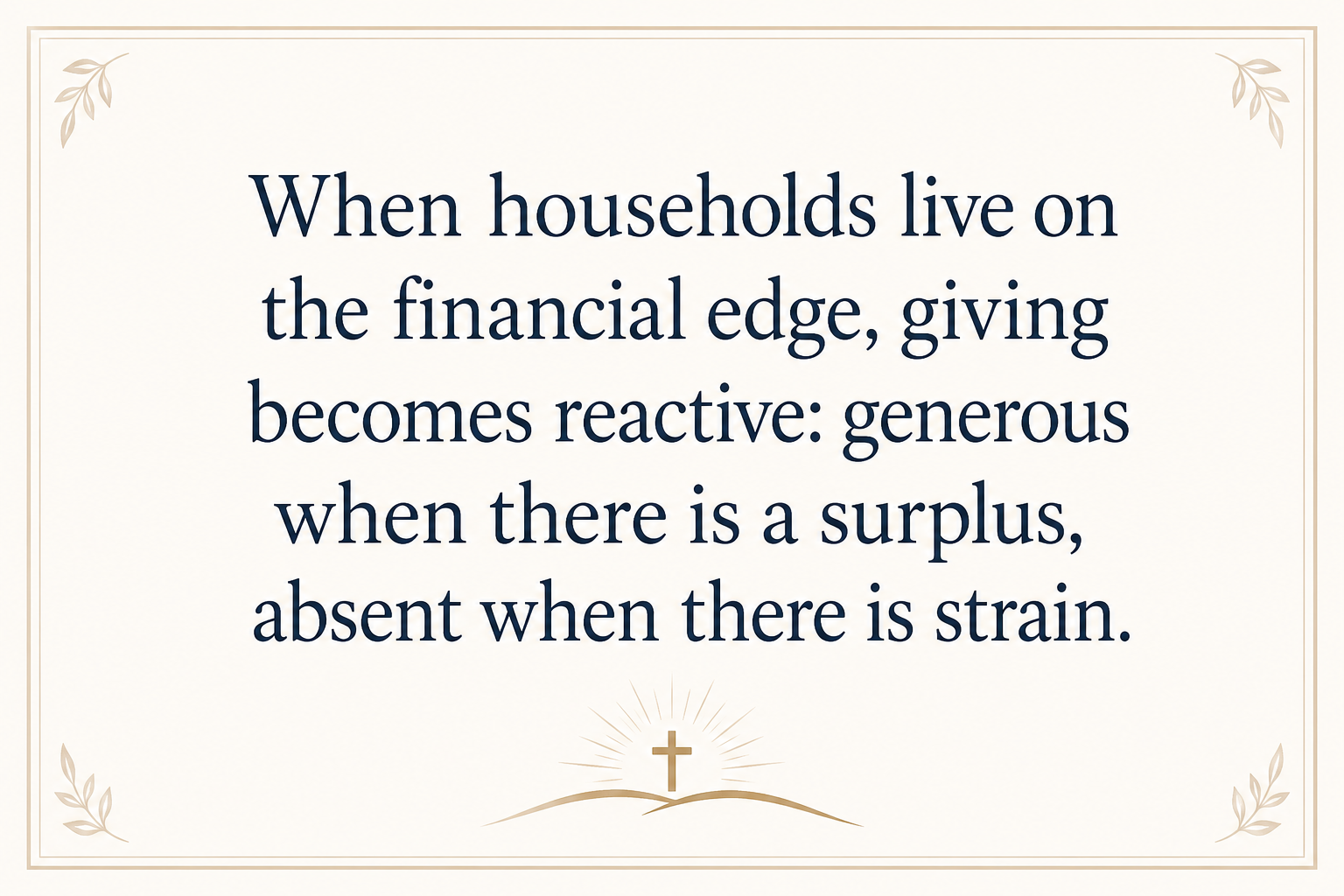
When households live on the financial edge, giving becomes reactive: generous when there is a surplus, absent when there is strain. Many churches and ministries experience this as volatility in support, but the deeper issue is formation. Discipleship that does not touch financial habits will often fail to touch the practical decisions that govern daily life.
This is also where the work becomes morally complex. Some donors worry that stewardship ministries are simply protecting institutional budgets. That concern is not frivolous. A healthy ministry teaches stewardship because God commands it and because people flourish under it, not because organizational leaders need revenue stability. The difference is visible in what a ministry measures, how it communicates, and whether it is willing to tell hard truths that may cost it short-term donations.
Christian financial service ministries operate at the intersection of counsel and care
Practical tools are valuable when they serve formation
Many financial service ministries provide budgeting systems, debt payoff plans, coaching, educational content, and sometimes lending or benevolence structures. Those tools can be genuinely helpful. But donors should evaluate whether the tools are integrated with Christian moral formation or treated as neutral techniques. Scripture never treats money as neutral. Mammon is presented as a rival master (Matthew 6:24). A ministry that provides tactics without addressing worship can unintentionally strengthen self-reliance rather than cultivate dependence on God.
What this means in practice is that the best ministries combine clear counsel with pastoral seriousness. They handle sensitive situations—job loss, medical crisis, addiction, gambling, or the financial fallout of divorce—with both compassion and truth. They recognize that financial discipleship often requires repentance, restitution, and patience, not only “better planning.”
Stewardship ministry can either dignify or shame
There is a real risk that stewardship teaching becomes moralistic: the righteous budget correctly; the foolish do not. Christian ministry should never deny human agency, but it must also reckon with structural realities such as wage stagnation, medical costs, and regional housing markets that can break even disciplined households. A stewardship ministry that ignores these realities can cultivate shame rather than resilience.
In our work at Most Trusted, we see that ministries committed to serious stewardship often build safeguards against shame: confidentiality practices, coaching that distinguishes between sin and suffering, and benevolence policies that preserve dignity. They also avoid simplistic promises. Financial faithfulness does not guarantee financial ease, and donors should be wary of any ministry that suggests otherwise.
Stewardship requires verifiable integrity, not just biblical language
Why financial ministries must be held to a higher evidentiary standard
A ministry that addresses money has unique power. It may receive sensitive information, influence major decisions, and shape giving behavior. That is why Christian donors should expect unusually clear governance, transparent financial reporting, and documented outcomes. Good intentions are not a control environment.
The nonprofit sector has had to reckon with the “overhead” debate, including the joint statement often called the Overhead Myth, signed by organizations such as Charity Navigator and BBB Wise Giving Alliance, arguing that overhead ratios alone are poor indicators of effectiveness Charity Navigator. Christian donors can apply that lesson with even greater care here: stewardship ministries should not be judged only by low administrative costs, but neither should they hide behind mission language when controls and accountability are weak.
What donors should reasonably look for
Across our verification work at Most Trusted, donors tend to ask the right questions when they move from inspiration to evidence. The following indicators are not exhaustive, but they are a practical starting point when evaluating a Christian financial service ministry:
- Clear theological commitments that shape practice, not vague “values” statements
- Audited or reviewed financials and transparent reporting that matches public claims
- Independent governance with documented oversight of conflicts of interest
- Ethical fundraising that avoids coercion, manipulation, or prosperity-style promises
- Evidence of effectiveness, such as measured outcomes from coaching or curriculum use
These concerns connect directly to The Most Trusted Standard, our 15-criteria framework for evaluating ministries across faith commitments, financial integrity, governance, and transparency. Stewardship ministries should welcome this kind of scrutiny because their credibility is part of their pastoral care.
Stewardship is a donor’s concern because giving is part of discipleship
Donors are not only funding services but shaping formation
When donors support Christian financial service ministries, they are supporting a form of discipleship that touches one of the most contested areas of modern life. That includes teaching about giving, but also about earning, saving, planning, and contentment. The donor’s responsibility is not to demand a single template for faithful living; it is to support ministries that handle money with the seriousness Scripture demands.
To situate stewardship within the broader work of these organizations, it helps to understand the wider landscape of Christian Financial Service Ministries and how their missions differ. Some emphasize education; others emphasize debt relief, lending, or coaching; others integrate stewardship with pastoral counseling and church partnerships. Differences in model can be appropriate, but differences in integrity are not.
Healthy ministries resist both cynicism and naivete
Donors can become cynical, assuming that any stewardship emphasis is institutional self-protection. They can also become naïve, assuming that Christian language guarantees faithful practice. Both postures are spiritually and practically costly. Stewardship is too central to discipleship to be left to either suspicion or sentimentality.
What donors should seek is a ministry that makes truth tangible: teaching anchored in Scripture, care shaped by the gospel, and operations that can withstand scrutiny. The more directly a ministry influences financial decisions, the more donors should insist on governance that prevents abuse and transparency that invites accountability. For a broader view of how mission and accountability intersect in this field, see The Mission and Impact of Christian Financial Service Ministries.
FAQs for Why Christian financial service ministries focus on stewardship
Is stewardship teaching mainly about getting Christians to give more?
No. Generosity is essential, but biblical stewardship is larger than donation volume. It includes faithful management of what God has entrusted, truthfulness, contentment, wise planning, and resistance to greed. A credible ministry will teach giving in the context of discipleship rather than pressure.
How can donors evaluate a Christian financial service ministry without becoming suspicious of everything?
Donors can ask for evidence without assuming bad faith. Look for transparent financial reporting, independent governance, clear theological commitments, and measurable outcomes. Ministries that welcome accountability and can explain their safeguards plainly tend to be safer partners for donors who want their giving to strengthen, not distort, Christian stewardship.
Stewardship remains the test case of Christian maturity
Christian financial service ministries focus on stewardship because Scripture treats money as a proving ground for allegiance, trust, and love of neighbor. The question for donors is not whether stewardship should matter, but whether a particular ministry embodies stewardship in both its teaching and its operations. When stewardship is pursued with biblical seriousness and verifiable integrity, donors are not merely funding financial education; they are supporting formation that can heal households, strengthen churches, and free Christians for more faithful generosity.



