
Christian donors prioritize orphan care ministries because the care of children without safe family protection is not a peripheral theme in Scripture; it is a moral test of covenant faithfulness and a public witness to the character of God. The question is not whether the Bible calls God’s people to care for vulnerable children, but how faithful donors should support that work in a world where the word “orphan” can be used imprecisely and where funding can unintentionally distort ministry practice.
For many donors, orphan care also concentrates several convictions into one act of giving: the dignity of the image of God, the priority of family, the church’s responsibility to protect the vulnerable, and the hope of redemption where trauma has hollowed out trust. Yet the modern orphan care field has had to reckon with hard realities: institutionalization harms children, unregulated residential care can incentivize family separation, and heartfelt short-term involvement can injure children through repeated attachment and loss. Serious Christian giving does not avert its eyes from these tensions; it insists on truth as part of love.
Orphan care is a direct biblical mandate, not a donor preference
God identifies himself with the fatherless
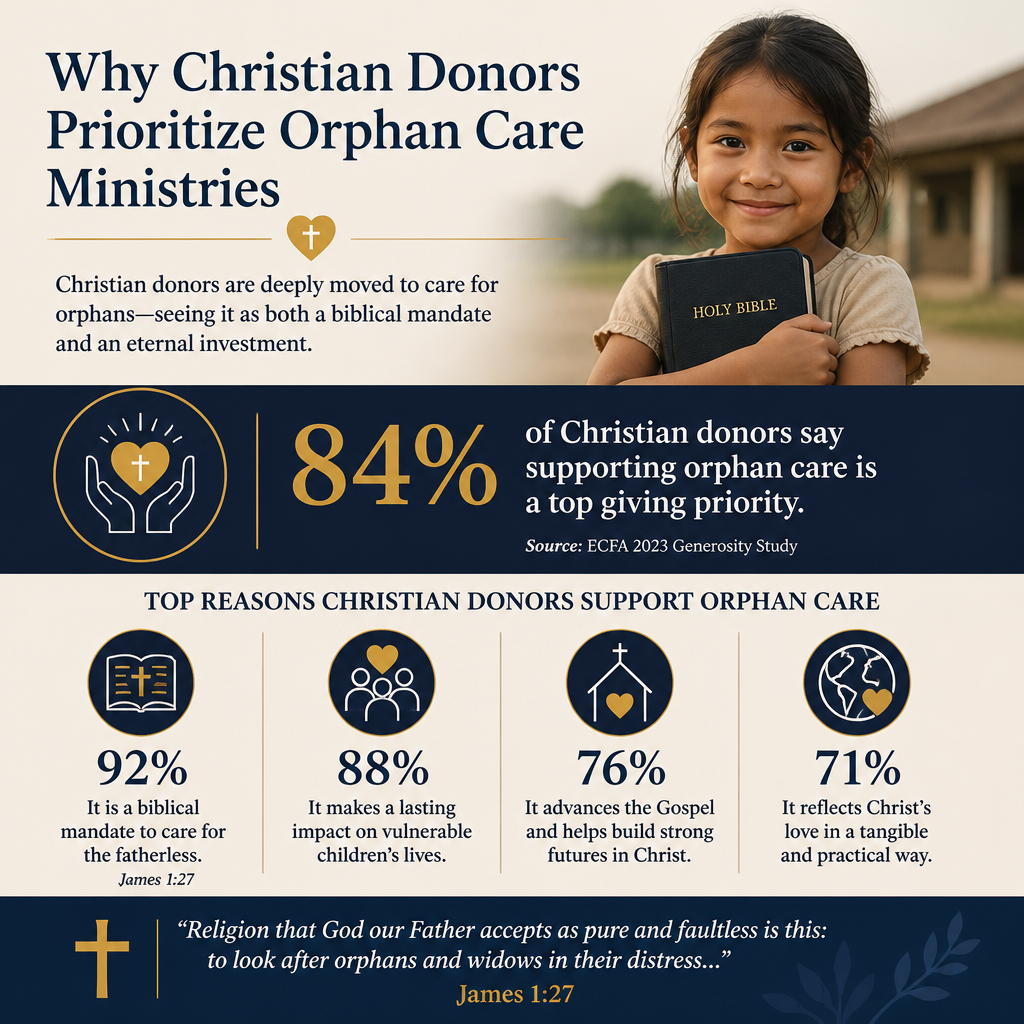
Scripture does more than commend compassion. It ties the care of the fatherless to God’s own self-description and to the integrity of worship. “Father of the fatherless” is not sentimental language; it is covenant language (Psalm 68:5). James is even more explicit: “Religion that is pure and undefiled before God, the Father, is this: to visit orphans and widows in their affliction” (James 1:27). When donors prioritize orphan care, they are often responding to this clarity. Many causes require prudential judgment; this one also requires obedience.
The Old Testament consistently places the fatherless alongside the widow and the sojourner as those most exposed to exploitation. The repeated command is not merely private kindness but public justice: God’s people are warned against systems that prey on those without protection (Deuteronomy 10:18; Isaiah 1:17). Donors who have been formed by Scripture tend to hear orphan care not as discretionary charity, but as part of what it means to fear God and to love neighbor.
The church’s credibility is tied to visible mercy
Christian donors also recognize that care for vulnerable children is an embodied apologetic. The early church’s credibility in the Roman world was strengthened by costly practices of hospitality and rescue. While the modern contexts differ, the principle remains: mercy that is concrete and sacrificial makes the gospel harder to dismiss as mere words.
That credibility is not preserved by emotion alone. It is preserved when donors insist that ministries protect children, tell the truth about outcomes, and submit to governance that resists the temptations of both money and publicity. This is one reason donors seek independent verification rather than relying on inspiring stories.

Modern orphan care requires moral clarity and factual precision
Not every child in an institution is an orphan
Christian donors often begin with a biblical category—“orphan”—and then encounter a modern category—“orphanage.” Those are not the same. In many countries, a significant share of children living in residential care have at least one living parent or extended family who could potentially care for them if poverty and crisis were addressed. A widely cited synthesis by UNICEF reports that the majority of children in residential care worldwide are not “orphans” in the strict sense of having lost both parents; many have a living parent or relatives UNICEF.
This does not eliminate the need for residential care in cases of severe abuse, trafficking, or acute disability. It does mean donors should be cautious about giving that unintentionally rewards family separation. The most responsible ministries speak precisely: they distinguish between children who are truly without family and children whose families need support, reunification services, or community-based care.
Institutionalization has measurable costs for children
The field has also become more honest about the developmental harm associated with institutional care, especially for young children. Major research has shown significant deficits in attachment and development among children raised in institutions compared to family-based settings, even when basic physical needs are met. The Bucharest Early Intervention Project, for example, documented lasting developmental effects and demonstrated improved outcomes when children moved into family care Harvard University.
For donors, this creates a moral obligation to ask not only “Are children being cared for?” but “Are children being raised in the way children are designed to grow?” Christian anthropology is not neutral about this. Humans are made for relational formation; children are not projects to be managed but persons to be bonded with, disciplined, educated, and delighted in within stable love.
Christian donors gravitate to orphan care because it mirrors adoption and the gospel
Adoption language is theological, not metaphorical
Paul’s teaching that believers receive “adoption as sons” (Romans 8:15) is not a decorative metaphor. It is a declaration of status, belonging, inheritance, and the end of fear. That doctrine shapes how many Christian donors read the world. When donors support ministries that keep families together, strengthen foster care, or provide adoption services with integrity, they often see a reflection of God’s own action toward us: not merely rescue from danger, but welcome into a household.
This is also why orphan care giving can be intensely personal even for donors without adoptive experience. The spiritual grammar is shared. The gospel moves toward the vulnerable at cost to the giver; it brings the outsider near; it creates kin. Orphan care resonates because it is a lived parable of grace.
Family preservation and reunification fit a biblical vision of neighbor love
Christians genuinely disagree about how to weigh family preservation against immediate removal in complicated cases. Abuse, addiction, and mental illness are real, and reunification should never be romanticized. Yet where poverty is the primary driver of child separation, supporting families so that children can remain safely at home can be a deeply Christian act. It aligns with the biblical pattern of strengthening households and communities rather than replacing them unnecessarily.
In our verification work at Most Trusted, we see stronger ministries articulate a clear philosophy of care: when they support residential programs, they define the conditions and safeguards; when they support family-based care, they invest in case management, local church partnership, and measurable protection practices. Donors tend to prioritize ministries that can explain their approach with moral seriousness and operational clarity.
Donors also prioritize orphan care because it forces stewardship questions into the open
Compassion must be governed to avoid harm
Orphan care is a sphere where well-intended giving can do measurable damage. The movement has had to confront “orphanage voluntourism,” where short-term visitors create cycles of attachment and loss for children already marked by trauma. It has also confronted financial incentives that can lead institutions to recruit children to fill beds. These are not abstract concerns; they are predictable outcomes when funding follows occupancy.
Christians who give seriously do not want their generosity to become a market signal that increases harm. The stewardship question becomes: does this ministry’s model reduce vulnerability, or does it institutionalize it? That is why sophisticated donors ask for child safeguarding policies, independent board oversight, audited financials, and evidence that the ministry’s incentives align with reunification and permanency whenever possible.
Healthy ministries resist the starvation cycle and tell the truth about costs
Another pressure point is financial. Many orphan care and child welfare ministries operate in emotionally charged environments where donors sometimes expect unusually low overhead. The sector has repeatedly warned that unrealistic restrictions can create underinvestment in staff training, safeguarding systems, financial controls, and outcomes evaluation. The “starvation cycle,” described by Gregory and Howard, names the pattern in which nonprofits underreport true administrative needs and donors reward the distortion, weakening long-term effectiveness Stanford Social Innovation Review.
What this means for donors is straightforward: the most child-protective work is often administratively serious work. Background checks, trauma-informed training, case documentation, legal compliance, and independent monitoring cost money. Ministries that pretend otherwise may be more marketable, but they are not necessarily safer.
For donors seeking a wider view of the ministry landscape, we maintain a central resource on Orphan Care Ministries where the emphasis is on verifiable practices rather than inspiring claims.
Trustworthy orphan care giving requires verification, not sentiment
What donors should expect from ministries that handle children
Because orphan care involves minors and trauma exposure, donors should hold these ministries to a higher standard than generic charitable work. The spiritual impulse to help must be matched by institutional maturity. The ministries most worthy of donor confidence tend to demonstrate a disciplined approach in areas that are not always visible in a brochure.
- Documented child safeguarding policies, including reporting pathways and enforcement
- A governance structure with independent oversight and clear accountability for leadership
- Transparent financial reporting, ideally with audited statements for larger organizations
- A care model that prioritizes family-based solutions where safe and feasible
- Evidence of local partnership and cultural competence rather than imported control
These expectations are not secular intrusions into ministry; they are neighbor-love operationalized. If the church must be above reproach, that must include the way children are protected and the way donor funds are stewarded.
How Most Trusted evaluates confidence-worthy ministries
Most Trusted exists because donors should not have to choose between theological alignment and verifiable integrity. Our evaluations apply The Most Trusted Standard, a 15-criteria framework across four areas: Faith Foundation, Financial Integrity, Governance and Leadership, and Transparency and Effectiveness. This is not a substitute for spiritual discernment, but it is a disciplined aid to it. Good intentions are common; accountable structures are not.
When donors ask why orphan care receives disproportionate attention, the answer is partly biblical and partly practical: the spiritual stakes are obvious, and the operational risks are unusually high. Donors respond by seeking ministries that can demonstrate both compassion and control—tenderness toward children and toughness toward the failures that endanger them.
For donors who want to think through the scriptural logic of giving in this space, we also maintain editorial coverage under Biblical Foundations for Orphan Care Giving, where the goal is not to stir emotion but to form judgment.
FAQs for Why Christian donors prioritize orphan care ministries
Is supporting an orphanage always a faithful way to care for orphans?
No. Christians can support residential care faithfully in situations where children cannot safely remain with family, but the research and field experience strongly caution against assuming institutional care is the default best option. Donors should ask whether the ministry’s model prioritizes permanency, safeguards children from harm, and avoids incentives that increase family separation.
What should Christian donors ask before giving to an orphan care ministry?
Donors should ask how the ministry defines the population it serves, what safeguards protect children, what governance holds leaders accountable, and how outcomes are measured beyond stories. It is also wise to ask how the ministry handles family tracing, reunification, foster care, and adoption partnerships when appropriate, and whether financial reporting is transparent enough to sustain trust.
Why this priority endures
Orphan care remains a priority for Christian donors because it sits at the intersection of biblical command, human vulnerability, and public witness. It also remains a priority because the stakes are high: children can be protected—or harmed—by the systems adults build around them. The most faithful giving in this field is serious about mercy and serious about truth, insisting that compassion be guided by evidence, accountability, and a theology sturdy enough to bear the weight of real lives.



