

Christian apologetics ministries differ in approach because they are answering different kinds of questions for different kinds of audiences under the same Christian confession. Donors often assume “apologetics” is a single category with a single playbook: present evidence, win the argument, secure the outcome. Scripture gives a more textured mandate. Peter calls believers to be prepared to give a reason for their hope, but he binds that readiness to “gentleness and respect” and to a conscience kept clear (1 Peter 3:15–16). Apologetics is not only an argument strategy; it is a form of witness ordered by truth and love.
What this means for giving is straightforward and demanding. Two ministries may affirm the same creeds and defend the same gospel, yet diverge in method because they are shaped by different mission fields, educational philosophies, media incentives, and ecclesial commitments. Mature donors do not need an apologetics style that matches personal preference. They need a ministry whose approach is faithful, governable, and demonstrably effective for its stated purpose.
Different mission fields require different apologetics
Frontier contexts are not the same as church renewal contexts
Apologetics in a university setting, a secular media setting, and a local church setting will not look identical, because the presenting questions are not identical. A campus ministry may focus on the plausibility of the resurrection, the reliability of the Gospels, and the coherence of Christian theism. A church-based apologetics ministry may focus on deconstructing believers, biblical literacy, and the pastoral care of doubt. A ministry engaging a non-Christian religion may prioritize comparative theology and long-term relational credibility.
These differences are not merely tactical. They reflect what a ministry believes is at stake in a given context: intellectual obstacles, moral resistance, spiritual captivity, cultural plausibility structures, or trauma from prior religious experience. Christians genuinely disagree about which obstacles are most determinative in any given moment. That disagreement is not always a sign of compromise; it can be a sign that the ministry is taking the mission field seriously.
Audience formation shapes what a ministry can responsibly attempt
Some apologetics ministries are designed to equip pastors, parents, and lay leaders with tools they can transmit. Others are designed to function as public voices in contested spaces where few Christians can speak with competence. A donor should ask whether a ministry is building capacity in the church or acting as a specialized representative for the church. Both can be legitimate. They are not interchangeable, and they should not be evaluated by the same expectations for breadth, tone, and output.

Methods vary because apologetics is not a single discipline
Historical, philosophical, and experiential approaches answer different questions
Some ministries emphasize historical argument: the resurrection, early Christian testimony, manuscript evidence, and the rise of the church. Others emphasize philosophical argument: the existence of God, the problem of evil, moral realism, consciousness, and the intelligibility of the universe. Others emphasize the “imaginative” or “existential” dimension: meaning, beauty, desire, and the moral credibility of the Christian story in lived experience. These approaches are often associated with different intellectual lineages, but they also reflect different diagnoses of modern unbelief.
The New Testament itself models plurality within unity. Paul reasoned in synagogues and in the Areopagus, adapting his approach to different hearers (Acts 17). He appealed to prophecy and to creation, to Scripture and to conscience. The constant is not a single technique but a faithful proclamation of Christ, joined to honest reasoning and moral integrity.
Debate culture and discipleship culture produce different outputs
Some apologetics ministries are structured around public debates, rapid-response commentary, and media presence. Others are structured around courses, reading programs, and long-term mentoring. Debate-oriented work can clarify issues and expose weak arguments, but it can also reward rhetorical dominance and shorten complex questions into “wins.” Discipleship-oriented work can form durable convictions, but it can also move slowly and fail to meet urgent cultural moments with clarity. A donor should view these as trade-offs, not as a simple hierarchy of better and worse.
For donors seeking a broader map of the field, Christian Apologetics Ministries can be a useful starting point for understanding what ministries claim to do and how those claims differ in scope and accountability.
Theological emphasis drives real differences in tone and priorities
Common doctrine does not erase meaningful emphases
Many apologetics ministries share commitments to biblical authority, historic creeds, and the uniqueness of Christ. Yet the weight they place on certain doctrines can shape their approach. A ministry that emphasizes the noetic effects of sin may stress spiritual resistance and the need for the Spirit’s illumination, treating apologetics as a modest servant of proclamation. A ministry that emphasizes natural theology may invest heavily in philosophical theism as a preparatory ground for the gospel. A ministry shaped by a strong theology of the church may prioritize apologetics that serves pastors and congregational formation rather than primarily addressing the public square.
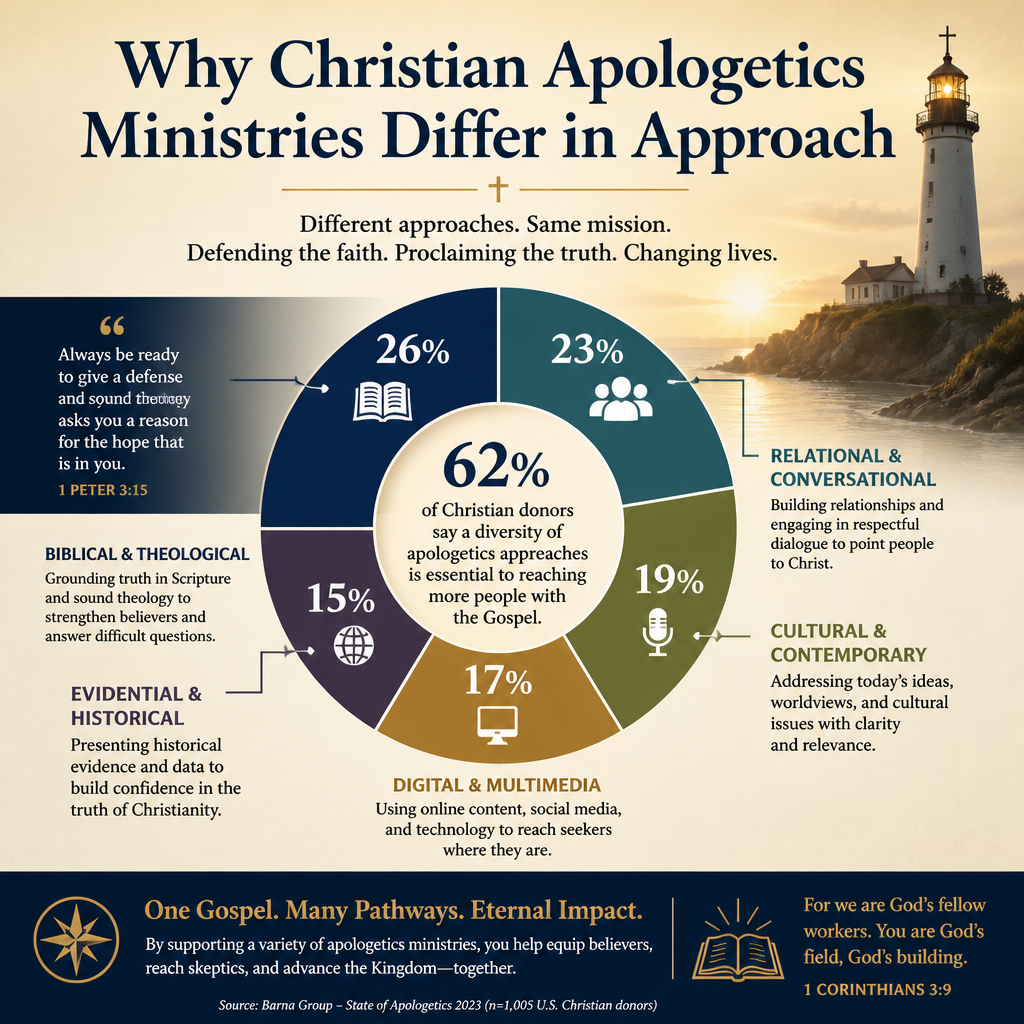
These emphases shape not only content but also posture: whether a ministry tends toward confrontation or persuasion, whether it frames objections as intellectual puzzles or moral and spiritual conflicts, and whether it speaks primarily to skeptics, to doubters inside the church, or to leaders responsible for others.
Scripture sets constraints on method as well as message
Apologetics that is faithful to Scripture will not treat people as projects. It will not confuse humiliation with conviction, or notoriety with fruit. Peter’s command to defend the faith is inseparable from gentleness, respect, and a clear conscience (1 Peter 3:15–16). Paul’s warning that knowledge can “puff up” while love builds up should sober any ministry that traffics in intellectual capital (1 Corinthians 8:1). For donors, tone is not a branding preference; it is an ethical and theological category.
Funding models and media incentives influence what gets produced
Attention economies reward certain kinds of apologetics
Modern communications environments reward conflict, novelty, and speed. That incentive structure can press apologetics ministries toward hot-take commentary, algorithm-friendly controversy, and constant content output. The danger is not that a ministry uses modern channels; it is that the ministry becomes governed by the channels. A donor should ask whether a ministry’s approach is determined by mission or by monetizable attention.
Media incentives also shape staffing. A ministry built around a prominent personality may scale quickly, but it raises governance and succession questions. A ministry built around teams, peer review, and curriculum development may be less visible, but it can be more durable. The donor’s task is not to punish visibility but to ensure that visibility is accountable.
Donor expectations can distort measurement of effectiveness
Apologetics is hard to measure responsibly. Conversions are real and should be celebrated, but ministries cannot control outcomes, and simple conversion counts can reward manipulative practices. Likewise, digital metrics such as views and downloads can indicate reach but not necessarily depth, accuracy, or spiritual fruit. The field has had to reckon with the difference between what is easy to report and what is actually faithful to report.
One helpful corrective in the broader nonprofit world is the “overhead myth” critique: the recognition that simplistic overhead ratios are a poor proxy for effectiveness. Charity Navigator, Candid, and the BBB Wise Giving Alliance jointly warned donors against using overhead alone as an indicator of impact, urging attention to results, transparency, and governance instead (Charity Navigator).
What donors should look for when approaches differ
Clarity, accountability, and spiritual maturity are more diagnostic than style
When donors encounter differing apologetics approaches, the most reliable question is not “Which style do we prefer?” but “Which ministry is demonstrably faithful and responsibly governed for its stated mission?” Across our verification work at Most Trusted, we observe that strong ministries tend to articulate boundaries: what they will address, what they will not, and what they consider success. They also tend to welcome scrutiny, because they understand that apologetics is public witness and therefore accountable witness.
We recommend that donors evaluate apologetics ministries with a disciplined set of questions, especially where a ministry’s work is shaped by a strong public brand or by rapid-response media cycles.
- Faith foundation: Is the ministry’s doctrinal basis clear, substantive, and consistently reflected in its teaching and partnerships?
- Governance: Is there an independent board with real oversight, not merely advisory names that follow a founder?
- Financial integrity: Are audited financials or credible reviews available, and are compensation and related-party transactions transparently handled?
- Transparency: Does the ministry make it easy to understand what programs exist, what they cost, and how funds are used?
- Effectiveness: Are outcomes framed with humility and specificity, using measures appropriate to apologetics rather than inflated claims?
Use a coherent framework rather than episodic impressions
Because apologetics ministries often generate strong reactions, donors can drift into episodic decision-making: a viral clip, a controversy, a compelling book, a disappointing tone. A framework disciplines that volatility. The Most Trusted Standard is designed for that purpose: fifteen criteria across faith foundation, financial integrity, governance and leadership, and transparency and effectiveness. It does not tell donors which apologetics method to prefer. It does help donors identify whether a ministry is structured to be trustworthy over time.
Donors also benefit from category-specific discernment. How to Give Wisely to Christian Apologetics Ministries addresses giving considerations that are distinctive to apologetics, including how to think about “reach,” how to evaluate teaching ministries, and what governance warning signs matter most when a ministry is personality-driven.
FAQs for Why Christian apologetics ministries differ in approach
Is one apologetics approach more biblical than the others?
Scripture gives constraints on faithfulness more than it mandates a single method. The apostolic witness includes historical proclamation, reasoned argument, and contextual persuasion, always ordered by truthfulness, gentleness, and reverence toward Christ (1 Peter 3:15–16; Acts 17). A ministry’s approach becomes unbiblical when it departs from the gospel’s content or violates the gospel’s character through manipulation, contempt, or careless speech.
How can donors evaluate effectiveness when apologetics outcomes are hard to measure?
Responsible evaluation starts with mission clarity and appropriate indicators. A ministry focused on equipping pastors should report different outcomes than a ministry focused on public university engagements. Donors should look for transparent reporting, credible governance, and honest limits in claims. Frameworks such as the “overhead myth” warning from Charity Navigator, Candid, and BBB Wise Giving Alliance can also help donors resist simplistic metrics and ask better questions about results and accountability (Charity Navigator).
Giving with discernment when methods diverge
Apologetics ministries differ in approach because they face different mission fields, draw on different disciplines, and operate under different institutional incentives, even when they share the same gospel commitments. Donors serve the church best by refusing to reduce those differences to taste. The more faithful task is to identify ministries whose approach is theologically serious, governed with integrity, and transparent about what they can and cannot promise. That is how giving becomes not only generous, but trustworthy.



