
When a ministry you’ve supported has a scandal, the immediate questions are both moral and practical: What does faithfulness require now, and what does stewardship require now? Christian donors are rarely deciding between good and evil in the abstract. We are deciding under uncertainty, with limited information, real victims in view, and genuine Kingdom work potentially at stake.
Scripture does not treat scandal as surprising. The New Testament assumes the church will face grievous failures among leaders, and it insists on both truth and repentance. Jesus’ warnings about “wolves” and Paul’s standards for overseers are not cynical; they are pastoral realism. The aim is not donor self-protection as an end in itself, but a form of love that refuses to subsidize harm or excuse sin.
What follows is a disciplined approach we recommend when the headlines break. It is not a recipe for certainty. It is a way to act with integrity when information is incomplete, emotions are strong, and the costs of a wrong decision are borne by real people.
Begin with moral clarity, not brand loyalty
The first temptation in a scandal is to treat the ministry as “ours” and therefore defensible. The second is to treat the entire ministry as irredeemably corrupt and therefore disposable. Christian maturity rejects both reflexes. We can acknowledge good fruit without baptizing wrongdoing, and we can name wrongdoing without denying that God has used imperfect instruments.
Scripture sets the moral baseline. Leaders are held to a higher standard precisely because their role carries spiritual authority and practical power. Paul’s qualifications for overseers in 1 Timothy 3 and Titus 1 are not mere ideals; they are a governance framework for the church. When a ministry’s scandal involves abuse, financial manipulation, deception, or coercive leadership, the issue is not merely “public relations.” It is a violation of moral obligations that Scripture treats as weighty.
Donors also face a stewardship question. Funding is not morally neutral. Giving can either restrain harm or perpetuate it, and donors are not absolved simply because they were not present when the harm occurred. The call to “do justice” and “love mercy” in Micah 6:8 is not limited to personal conduct; it reaches into how Christians participate in systems and institutions that affect the vulnerable.
Different scandals require different responses
Not every scandal is the same, and donors should resist collapsing them into one category. A consensual moral failure by a leader, serious as it is, differs from credible allegations of abuse of minors, spiritual coercion, or retaliation against whistleblowers. Financial mismanagement differs from intentional fraud. Each has distinct implications for public disclosure, legal reporting, restitution, and leadership removal.
Some cases will demand immediate separation and a full freeze of funding because continued support predictably increases risk of harm. Other cases may warrant a time-bound pause while facts are verified and governance responses are evaluated. A ministry’s ability to articulate the difference, and act accordingly, is itself evidence of maturity.
Distinguish repentance from reputation management
Christian language can be used to conceal as well as to confess. “Forgiveness” can be invoked to shortcut accountability; “restoration” can be defined as returning someone to power without demonstrated change; “unity” can be used to silence victims. Donors should listen for the marks of repentance Scripture expects: truth-telling, ownership without minimization, a willingness to accept consequences, and concrete steps to repair harm where possible.
Reputation management often centers the ministry’s mission as the endangered good that must be protected at all costs. Repentance centers those harmed and treats the institution’s survival as secondary to truth and justice. Donors should not accept framing that treats victims as obstacles to the gospel rather than neighbors to be loved.

Stabilize your decision-making before you move money
Most donors do not want to act from panic, anger, or social pressure. Yet the speed of modern media pushes toward instant conclusions. A disciplined response begins by slowing down the parts that should be slow: verifying claims, understanding governance, and determining whether continued funding carries a foreseeable risk of enabling harm.
In practice, we recommend separating three decisions that are often conflated: whether the allegations are credible, whether the ministry’s response is credible, and whether you should continue funding during an investigation or remediation period. You can decide the third prudently even if the first two remain partially unresolved.
Clarify what you do and do not know
Donors should name the difference between allegations, established facts, and interpretations. Court filings, independent investigations, and on-the-record statements are different kinds of evidence than social media threads or anonymous claims. At the same time, “not yet proven in court” is not the same as “not credible,” especially in abuse cases where victims face real barriers to reporting and legal processes can take years.
When allegations involve sexual abuse, the church’s history of mishandling such cases should produce humility rather than defensiveness. Donors may find it helpful to consult established best practices for abuse prevention and response, such as the Evangelical Council for Abuse Prevention standards, which are widely referenced in the field Evangelical Council for Abuse Prevention.
Pause when continued funding increases foreseeable harm
A giving pause is not a verdict. It is a risk decision. If a ministry’s scandal involves credible claims of abuse, systemic deception, or retaliation, donors should assume there may be additional victims and additional risk until an independent process demonstrates otherwise. Continuing unrestricted funding in that window can sustain the very structures that need to be dismantled.
A pause can be time-bound and principled: “We will not give additional unrestricted funds until an independent investigation is completed, results are published with appropriate redactions, governance changes are enacted, and victim care is funded.” This is not punitive. It is stewardship under moral constraint.
Do not confuse compassion with financial continuity
Many donors feel genuine grief for staff, beneficiaries, and missionaries who may be affected by scandal despite personal innocence. That compassion is appropriate. But financial continuity is not the only way to express it. In some cases, redirecting support to alternative organizations serving the same population is a more faithful expression of care.
Christian giving is not meant to function as institutional life support for any single brand. The Kingdom does not depend on one organization’s survival. Donors can lament real losses without treating institutional preservation as the highest good.
What to scrutinize in the ministry’s response
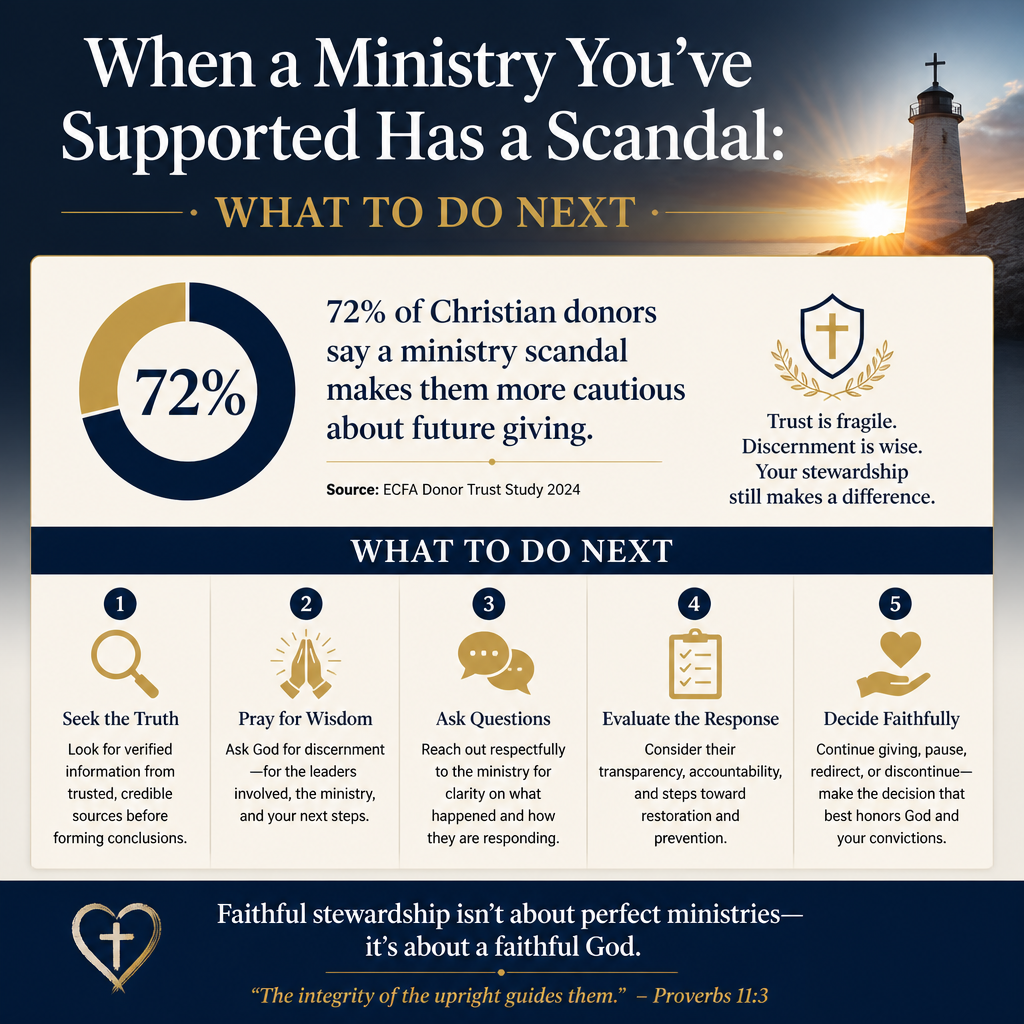
After the initial shock, the decisive question becomes the ministry’s response: whether it tells the truth, protects the vulnerable, and accepts accountability. Mature donors can ask direct questions without cynicism. A ministry worthy of trust should be able to answer them without deflection.
Governance that is independent, not decorative
Many scandals expose boards that function as friends of the founder rather than fiduciaries for the mission. Donors should ask whether the board is truly independent, whether it has demonstrated the ability to discipline leadership, and whether it commissioned an independent investigation with the authority to follow evidence wherever it leads.
Evidence of seriousness includes: removal of implicated leaders from authority during investigation, engagement of qualified outside investigators, and a board-led communications strategy that does not place the accused or their loyalists in control of messaging. Conversely, a board that issues vague assurances while withholding basic facts is signaling that reputation is being prioritized over accountability.
Transparency that addresses substance, not just sentiment
“We take these matters seriously” is not transparency. Substantive transparency includes timelines, descriptions of investigative steps, board actions, and policies that will change. Donors should look for specific commitments: adoption of abuse-prevention training, mandatory reporting protocols, whistleblower protections, and clear conflict-of-interest policies.
Transparency has limits. Legal counsel may restrict details; victims deserve privacy; accusations can be weaponized. Serious transparency names those constraints while still giving donors and the public enough information to evaluate whether justice is being pursued. Silence and vagueness should be treated as risk factors, not as proof of prudence.
Victim care and restitution as moral tests
When harm has occurred, the ministry’s posture toward victims is a moral test. Does it provide trauma-informed support? Does it cooperate with law enforcement when required? Does it avoid nondisclosure agreements that primarily protect the institution? Does it acknowledge that “reputation damage” is not the primary injury?
In financial scandals, restitution is the parallel test. Are funds being recovered? Are donors being informed if restricted gifts were misused? Are auditors engaged? Donors should not be satisfied with a promise to “do better” without measurable corrective action.
How The Most Trusted Standard can guide donor decisions
Most Trusted exists because donors should not have to improvise a verification process every time headlines surface. Across our verification work, we see a consistent pattern: ministries that have done the slow work of governance, financial integrity, and transparency are not immune to failure, but they are more likely to respond in ways that protect people and honor the truth.
The Most Trusted Standard is a 15-criteria framework across four domains: Faith Foundation, Financial Integrity, Governance and Leadership, and Transparency and Effectiveness. When a scandal erupts, those domains become a practical triage tool. They help donors move from reactive judgments to verifiable questions.
Faith Foundation without doctrinal cover for sin
Some ministries possess orthodox statements of faith yet tolerate leadership cultures that contradict the character qualifications Scripture requires. Donors should look for evidence that theology shapes practices: the ministry’s approach to power, confession, repentance, discipline, and the dignity of those served. The test is not whether the organization can quote Scripture, but whether it has built a culture where truth can be spoken without retaliation.
Financial Integrity that can withstand scrutiny
In crisis, donors should prioritize verifiable financial practices: audited financial statements, clear restricted-fund handling, documented internal controls, and conflict-of-interest disclosures. The broader nonprofit sector has repeatedly cautioned against simplistic metrics such as overhead ratios, which can incentivize underinvestment in governance and compliance. The “Overhead Myth” letter—signed by GuideStar, BBB Wise Giving Alliance, and Charity Navigator—articulates why donors should focus on outcomes and accountability rather than a single efficiency number Overhead Myth.
Scandals often involve financial opacity: founder-controlled entities, related-party transactions, or vague reporting that prevents meaningful oversight. Donors should treat “trust us” as insufficient. Mature organizations can show their work.
Governance and Leadership that restrains power
Many Christian scandals are, at root, failures to restrain power. Donors should ask whether the board has demonstrated independence, whether leadership is accountable to written policies, and whether whistleblowers are protected. Policies matter, but enforcement matters more. A ministry can have a handbook and still punish those who tell the truth.
Where leadership is concentrated in a founder, donors should be particularly alert. Founder-led organizations can be fruitful and visionary, but they are structurally vulnerable to unchallengeable authority. Healthy founder leadership is marked by shared decision-making, credible succession planning, and a board that can say “no.”
Transparency and Effectiveness that serve donors and beneficiaries
Transparency is not merely donor service; it is neighbor love for beneficiaries who are often at risk. Donors should look for clear, regular reporting on programs, risks, and results. Effectiveness claims should be appropriately scoped and supported by evidence, not inflated as spiritual triumphalism.
Christians genuinely disagree about how to measure spiritual fruit, and donors should not demand laboratory precision where Scripture calls for faithful witness. But donors can expect honesty: clear definitions, plausible causal claims, and a refusal to manipulate stories for fundraising.
Practical donor options when you are not ready to walk away
Some donors, after evaluation, conclude that immediate severance is necessary. Others conclude that conditional support for a limited period is appropriate, especially when the ministry is serving vulnerable beneficiaries who would be harmed by sudden collapse. The moral question is not whether staying feels loyal, but whether staying is defensible under scrutiny.
Convert unrestricted giving to restricted, time-bound giving
If you continue giving, consider restricting gifts to clearly defined program work with enhanced reporting expectations. In some cases, donors can direct support to third-party victim care funds or independent remediation efforts rather than to general operations. Restrictions are not a substitute for governance reform, but they can reduce the risk of subsidizing harmful structures.
Fund accountability, not just programs
Donors often want every dollar to go “to the field,” yet crises reveal why compliance, HR integrity, safeguarding training, and independent audits exist. Funding these functions is not mission drift; it can be a necessary condition for mission faithfulness. A ministry that refuses to invest in safeguards is implicitly asking beneficiaries to bear the cost of its own dysfunction.
Redirect to parallel work without abandoning the cause
When a ministry fails, the need it served often remains. Donors can redirect giving to other organizations doing similar work with stronger governance and transparency. This preserves the donor’s commitment to the underlying biblical mandate without requiring continued support of an institution under credible moral cloud.
Communicate expectations plainly and in writing
Donors sometimes hesitate to ask direct questions for fear of seeming adversarial. Yet mature ministries do not fear serious donors. A brief written note can clarify expectations: independent investigation, published findings, leadership accountability, policy reform, and victim care. Donors should not negotiate these matters through private influence alone; public accountability is often part of the needed repair.
FAQs for When a Ministry You’ve Supported Has a Scandal: What to Do Next
Should we stop giving immediately when a scandal breaks?
If continued funding creates a foreseeable risk of enabling harm, a pause is often the prudent first step. That is especially true in cases involving credible allegations of abuse, systemic deception, or retaliation. A pause is not a final verdict; it is a stewardship decision while verifiable facts and governance responses are assessed.
What if the ministry says it is being unfairly attacked?
Ministries can be targeted unfairly, and donors should not assume every allegation is true. The test is whether the ministry welcomes independent investigation and provides substantive transparency rather than asking for trust alone. A posture that treats questions as disloyalty is a warning sign, not a defense.
How do we think about forgiveness and restoration for leaders who fall?
Forgiveness does not eliminate consequences, and restoration is not synonymous with returning to leadership. Scripture’s qualifications for overseers emphasize character that is observable over time. In many cases, a leader may be spiritually restored as a brother or sister while remaining disqualified from certain roles of authority, particularly where abuse of power occurred.
What should we ask for before we give again?
Donors can reasonably ask for an independent investigation with credible oversight, board actions that demonstrate independence, clear policy reforms, and evidence of victim care or restitution where harm occurred. We also recommend asking for audited or professionally reviewed financials and governance documentation that shows conflicts of interest are disclosed and managed.
A faithful next step is possible
When a ministry you’ve supported has a scandal, the goal is not to protect your sense of discernment or to preserve an institution at any cost. The goal is to act in a way that honors Christ, tells the truth, and refuses to fund what harms the vulnerable. Donors can grieve, ask hard questions, and make disciplined decisions that keep generosity aligned with righteousness.
Across the Christian nonprofit landscape, we have seen ministries respond to crisis with humility, truth-telling, and reform, and we have seen ministries respond with denial and retaliation. The difference is rarely rhetorical skill. It is whether the ministry has built structures that restrain sin, welcome light, and treat stewardship as an act of discipleship.



