

For many Christian donors, the question of what is the best way to give to Christian development ministries is not primarily tactical. It is a stewardship question: how to direct the Lord’s money toward work that is faithful to Scripture, careful with power, and measurably beneficial to people made in God’s image.
Christian development is also a field where good intentions can produce mixed outcomes. Churches and ministries have sometimes confused relief with development, substituted short-term enthusiasm for long-term capacity, or treated local believers as implementers rather than leaders. The best way to give is the way that keeps Christian compassion tied to truth, accountability, and evidence.
Begin with clarity on what you are funding
Christian donors often evaluate ministries by sincerity, urgency, and storytelling. Those matter, but development work requires additional clarity: are you funding relief, rehabilitation, or development? The answer shapes timelines, metrics, risks, and the kind of leadership required.
Relief and development are not the same assignment
Relief is urgent help in a crisis. Development is long-horizon work that strengthens households, communities, and local institutions so that people can flourish with greater resilience. Christians may support both, but we should not ask a development ministry to perform like a disaster-response agency, and we should not ask a relief ministry to promise multi-year outcomes it is not structured to deliver.
The When Helping Hurts framework, articulated by Steve Corbett and Brian Fikkert, has helped the church recover these distinctions and reckon with the ways giving can unintentionally undermine local agency. Donors do not need to adopt every application of that framework to benefit from its core warning: help that ignores relationships, incentives, and dignity can deepen dependency rather than strengthen capacity.
Give for fruit, not for feelings
Development ministries are tempted to fundraise through emotionally compelling snapshots. Donors are tempted to reward those snapshots. What this means in practice is that wise giving asks for a theory of change: how exactly will the ministry’s activities lead to durable improvements in health, income stability, education, church vitality, or community cohesion? Where the ministry cannot articulate that pathway, donors are often purchasing a moment of inspiration rather than a plan.

Prioritize local leadership and long-term presence
Christian development is at its best when it strengthens what God is already doing through local churches and trusted community institutions. External support can be appropriate, but it should be disciplined, limited, and accountable to the people closest to the problem.
Local capacity is not a slogan
Many ministries say they “empower locals.” The serious question is whether budgets, decision rights, and hiring patterns align with that claim. Donors can ask concrete questions: Who controls program design? Who owns the data? Who has authority to stop a program that is not working? Who is paid, and at what levels, compared to expatriate staff?
Even within the church, Christians genuinely disagree about the best model for cross-cultural partnership. Some prefer direct support to indigenous pastors and practitioners. Others emphasize joint governance with a U.S.-based board to safeguard doctrine and accountability. The best ministries can explain why their model fits their context and how they prevent paternalism, corruption, and mission drift.
Long-term presence changes what can be measured
Development outcomes take time, and faithful ministries resist the pressure to promise quick transformation. In practice, long-term presence often enables more honest reporting: not just how many people attended a training, but whether households adopted practices, whether gains lasted through a shock, and whether local institutions can continue without external subsidy.
Across Christian Relief and Development Ministries, donors will find that the ministries with the strongest record typically combine local partnerships with stable, patient funding and a willingness to publish what did not work. That posture is not fashionable in fundraising, but it is consistent with Christian truthfulness.
Evaluate integrity beyond overhead ratios
Donors often ask, “How much goes to programs?” That question is understandable but incomplete. Financial integrity in development work includes governance, internal controls, reserves, compliance, and whether spending patterns fit the ministry’s stated strategy.
The overhead debate is real, and donors should mature past it
Several major charity evaluators and accountability organizations publicly challenged the idea that overhead percentages are a meaningful stand-alone indicator of effectiveness. Their joint statement, often referenced as the “overhead myth,” argues that administration and evaluation can be essential to results and accountability Charity Navigator.
That does not mean donors should ignore costs. It means we should ask better questions. A development ministry working across multiple countries should have professional finance leadership, serious safeguarding policies, and credible monitoring and evaluation. Those are not distractions from mission; they are part of loving our neighbors without exposing them to avoidable harm.
Ask for audited financials and governance clarity
The best Christian development ministries typically make it straightforward to find audited financial statements, board membership, conflict-of-interest policies, and clear descriptions of how leaders are selected and evaluated. If a ministry is unwilling to provide these, donors are being asked to substitute trust for verification.
At Most Trusted, we evaluate ministries against The Most Trusted Standard, a 15-criteria framework across four areas: Faith Foundation, Financial Integrity, Governance and Leadership, and Transparency and Effectiveness. Donors do not need to become auditors, but we do need a way to confirm that a ministry’s internal life matches its public claims.
Look for evidence of impact and the humility to learn
Christian development ministries should be expected to measure what they can, admit what they cannot, and keep improving. Evidence is not an alternative to faith. It is one expression of honesty and stewardship.
Demand outcome measures, not just activity counts
Counting outputs is easy: wells drilled, trainings held, microloans issued. Outcomes are harder: safe water access sustained, income volatility reduced, child health improved, local church diaconal care strengthened. Not every meaningful outcome can be quantified with precision, but mature ministries can usually provide a disciplined mix of quantitative indicators and qualitative evidence from credible sources.
Development professionals have also warned against simplistic scoring systems. A frequently cited article in Stanford Social Innovation Review describes the “starvation cycle,” where funders’ insistence on low administrative spending can push nonprofits to underinvest in capacity and then underperform Stanford Social Innovation Review. Donors should heed that warning without abandoning scrutiny.
Safeguarding and dignity are impact issues
Impact is not only about economic or health gains. It includes whether people were treated with dignity, whether children and vulnerable adults were protected, and whether community leaders consented to how information and images were used. Donors should ask whether the ministry has written safeguarding policies, reporting mechanisms, and training for staff and partners, and whether these policies are enforced rather than merely posted.
Choose a giving posture that fits development work
Even the best ministries are constrained by donor behavior. Development work is strengthened by giving patterns that are patient, aligned with strategy, and honest about trade-offs.
Prefer durable partnership over one-time transactions
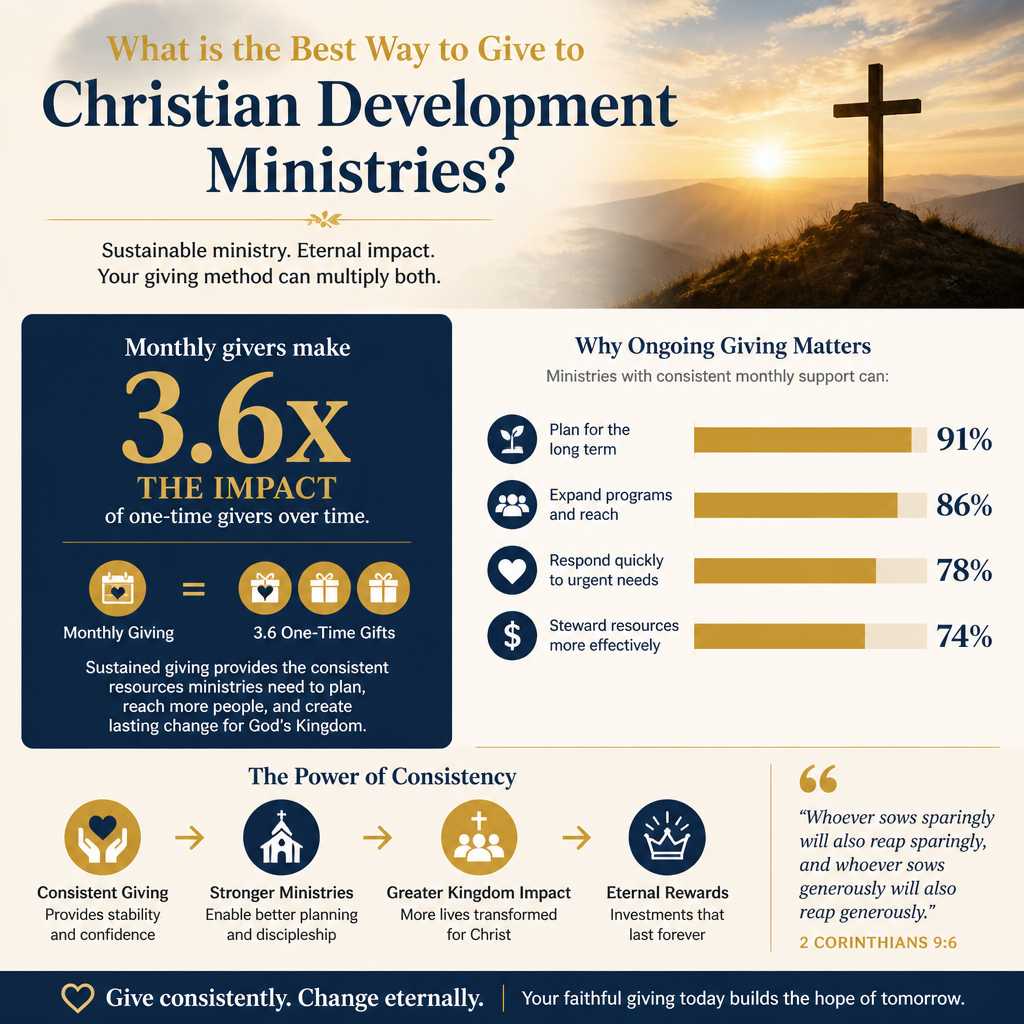
One-time gifts can be appropriate in emergencies, but development ministries often need predictable funding to retain local staff, maintain programs through setbacks, and learn over time. Restricted gifts can be helpful when they match a well-designed plan. They can also be damaging when donors impose narrow constraints that force ministries to chase money rather than serve communities.
A practical checklist for Christian donors
What this means in practice is that donors can ask a short set of questions before making a significant gift:
- Is this ministry clear about whether it is doing relief, development, or both, and does its model fit that claim?
- Are local churches and leaders meaningfully empowered in governance and decision-making?
- Are audited financials, board information, and key policies accessible and current?
- Does the ministry report outcomes and learning, not only activity counts?
- Are safeguarding and dignity treated as non-negotiable, with enforcement mechanisms?
Many donors will also want a structured way to compare ministries without relying on marketing. That is why Most Trusted exists: to help donors give with confidence through verification against The Most Trusted Standard. Within Giving Strategies for Christian Relief and Development, donors can approach giving as an act of worship shaped by both compassion and due diligence.
FAQs for What is the best way to give to Christian development ministries
Should Christian donors give restricted gifts for specific projects?
Restricted gifts can be wise when the project is clearly defined, costed realistically, and integrated into a broader strategy the ministry can sustain. They become counterproductive when restrictions reflect donor preferences more than field realities, or when they prevent the ministry from funding essential capabilities such as local staff development, evaluation, safeguarding, and financial controls. The best practice is to restrict only when you can verify the plan and trust the ministry’s execution, and to consider partially unrestricted support for capacity that protects both beneficiaries and long-term results.
How can we tell whether a ministry is truly effective without reducing everything to numbers?
Effectiveness in development work is rarely captured by a single metric. Mature ministries typically provide a coherent combination: a clear theory of change, credible outcome indicators tracked over time, external or internal evaluations, and transparent reporting about setbacks and adaptations. Donors can also look for evidence that the ministry listens to communities, protects the vulnerable, and avoids manipulative imagery. Where a ministry cannot speak with clarity about what it learns and how it corrects course, donors should be cautious regardless of how inspiring the stories sound.
Giving that honors both compassion and truth
The best way to give to Christian development ministries is to treat giving as stewardship before God and service to neighbors with real names, real agency, and real risk. That means funding work that is theologically grounded, locally led, financially honest, and transparent about results. Donors do not need certainty to give faithfully, but we do need verifiable reasons to trust that our generosity is building up rather than unintentionally harming.



