
What church accessibility upgrades cost is not only a facilities question. It is a discipleship question with budget consequences: whether a congregation will order its life so that people with disabilities can worship, serve, and belong without having to ask for special permission. Churches that treat accessibility as a one-time construction project often spend more over time than churches that treat it as a sustained ministry commitment.
Donors feel the tension. Construction dollars can look like “overhead,” yet Scripture’s vision of the gathered church is unmistakably embodied. When Jesus welcomed those pushed to the margins, he did not merely offer sentiment; he made room at the table. In local churches, “making room” is frequently literal.
1. Costs vary because accessibility is not one problem
Mobility, hearing, vision, cognition, and chronic illness each change the equation
Accessibility is often reduced to ramps and wheelchair seating. Those matter, but the lived realities of disability are broader: hearing loss, low vision, autism and sensory processing differences, dementia, traumatic brain injury, chronic pain, and mental health conditions that affect participation in crowds and noise. The cost profile changes depending on which barriers the church is addressing, and whether it is doing so comprehensively or only when a problem becomes unavoidable.
Across our verification work at Most Trusted, we observe that ministries with mature disability inclusion rarely treat accessibility as a single capital line item. They treat it as a combined set of facility standards, program practices, volunteer training, and ongoing maintenance—then they document it. That documentation matters to donors because it shows intentional stewardship rather than sporadic reaction.
Regulatory baselines exist, but discipleship often asks for more than minimums
Many upgrades are shaped by the Americans with Disabilities Act and related building codes. But donor-supported church projects are often about more than legal compliance. Theologically, the question is whether the church’s common life reflects the honor Scripture assigns to members who are easily overlooked: “those parts of the body that seem to be weaker are indispensable” (1 Corinthians 12:22). Minimum compliance can still leave people effectively excluded by distance, lighting, acoustics, or volunteer practices.
2. The largest costs usually come from three categories
Entrance routes and vertical access
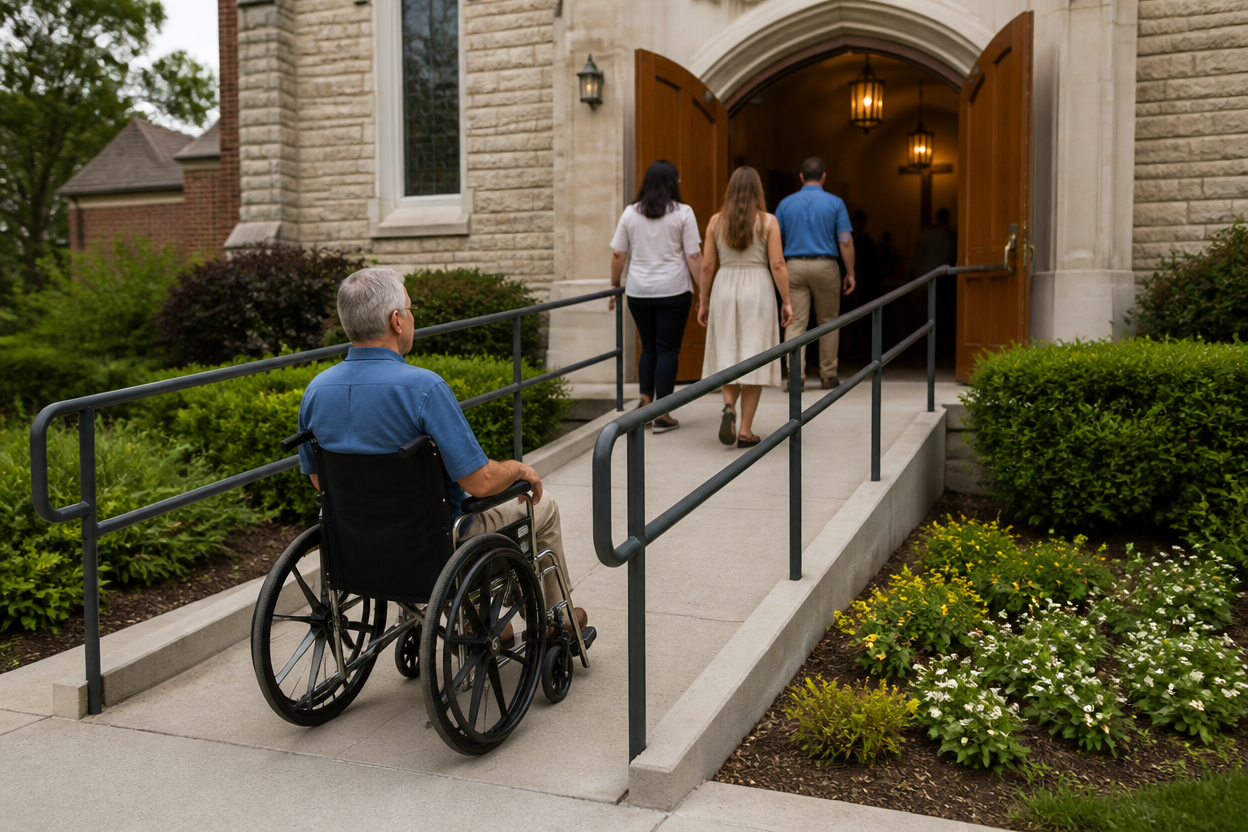
When churches face significant costs, it is often because the “path of travel” is broken. A building can have an accessible restroom and still be inaccessible if the main entrance has stairs, if parking is distant, or if interior routes require navigating narrow doors or level changes.
Typical higher-cost items include adding an elevator or lift, regrading or rebuilding exterior walks, replacing main entry doors, or reconfiguring a lobby. Elevators are expensive not only because of equipment, but because they often trigger structural changes, fire and life safety coordination, and permitting. In older buildings, bringing an entrance route into compliance can expose deferred maintenance that should have been addressed anyway.
Restrooms and classroom environments
Restroom renovations can become costly if plumbing walls must be moved, door swings altered, or fixtures relocated to meet clearance requirements. Classroom and children’s ministry spaces add another layer: accessibility is not only physical access, but also sensory environment, egress safety, and supervision ratios. Churches that want children with disabilities to participate meaningfully often invest in adaptable classrooms, visual schedules, sensory supports, and trained volunteers.
Donors should note the difference between “we built an accessible room” and “we built an accessible ministry.” The first can be done without changing the culture of the program. The second requires training, policies, and careful ongoing leadership.
Sound, video, and assistive technology
Many churches can remove major participation barriers through technology before undertaking large construction. Hearing assist systems, improved sound reinforcement, better lighting for lip-reading, captioning, and clear video feeds can be comparatively affordable, yet they require technical competence and maintenance discipline.
Disability prevalence is significant in the United States; about 13% of the civilian noninstitutionalized population has a mobility disability, according to the CDC’s Disability and Health Data System CDC. That reality means accessibility investments are not niche spending; they are a practical response to the people already present in most communities.
3. A practical cost range for common upgrades
What donors should expect from a responsible budget
Church leaders sometimes ask for a single number. There is not one. Site constraints, existing conditions, local labor markets, and project scope dominate outcomes. Still, donors can evaluate whether a church budget is plausible by understanding the difference between “low-disruption” upgrades and “construction-intensive” upgrades.
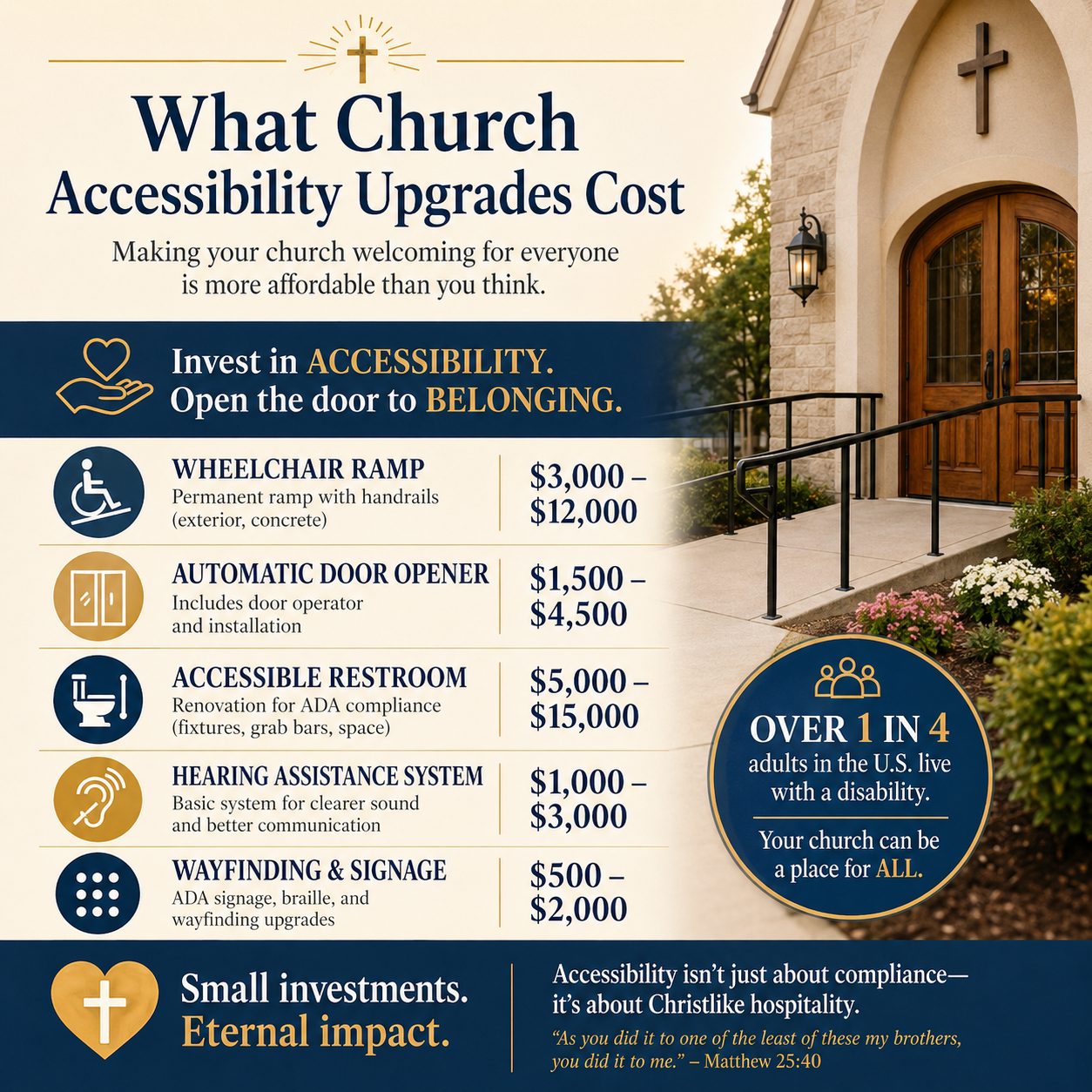
- Low-disruption improvements: signage, paint contrast, portable ramps in limited contexts, door hardware changes, improved lighting, basic hearing assist systems, and designated accessible seating adjustments.
- Moderate renovations: widening doors, reworking a portion of restrooms, re-striping and regrading parking, adding handrails, and improving sound systems for clarity and assistive feeds.
- Construction-intensive work: elevators or vertical platform lifts, reconfiguring lobbies, regrading large exterior approaches, major restroom rebuilds, or significant sanctuary re-sloping.
- Program investments: training, background-checked buddy systems, curriculum adaptation, sensory room buildout, and ongoing staff time for care coordination.
Because donors often fund capital projects, it is easy to overlook program costs. Yet program costs are commonly what make an upgraded building truly usable. In disability inclusion, a polished facility without trained volunteers can still leave families carrying the full weight of participation.
How to sanity-check a proposal without becoming a contractor
We recommend three donor questions that do not require construction expertise. First, has the church obtained an accessibility assessment from a qualified professional and not merely a walkthrough by well-meaning volunteers? Second, does the budget include soft costs—architectural services, permitting, and contingency—rather than only materials? Third, does the proposal explain how the upgrades will be maintained and staffed?
For donors who want the church context behind these decisions, it can be helpful to situate a project within the wider work of Disability Ministries rather than treating it as a standalone remodel.
4. The hidden costs donors should ask about
Maintenance, volunteer training, and ministry operations
Accessibility is vulnerable to neglect. Automatic doors break. Assistive listening devices get lost. Captioning workflows degrade when volunteers rotate without training. Sensory spaces become storage rooms. Responsible churches budget for maintenance and treat the ministry as operationally owned, not merely installed.
Staffing and volunteer formation are not incidental. A well-designed “buddy” approach can support children and adults with disabilities, but it requires screening, training, and consistent oversight. When churches underfund this layer, the burden tends to fall on parents, who already carry complex medical and educational responsibilities through the week.
Insurance, risk, and safeguarding
Safeguarding is a cost, and it should be. Disability ministries can increase one-on-one interactions, transportation needs, and medical considerations. Churches should have clear policies for toileting assistance, emergency plans for mobility limitations, allergy and medication protocols, and appropriate documentation practices. Donors should not penalize ministries for spending on these protections; mature care is rarely cheap.
This is one reason verification matters. At Most Trusted, we evaluate ministries against The Most Trusted Standard, including governance, financial integrity, and transparency. For donors, the question is not simply whether the church can build, but whether it can steward—over years—what it builds.
5. What faithful accessibility funding looks like
Give to plans that are specific, not sentimental
Churches sometimes communicate accessibility with moving stories but vague scopes. Stories have their place, yet donors should expect specificity: what barriers were identified, which standards are being used, what bids were obtained, what trade-offs were made, and what will be done first if funds are partial. The more constrained the budget, the more sequencing matters.
When a church cannot afford everything at once, it should still show a coherent plan: starting with the path of travel, restrooms, and worship participation, then expanding to classrooms and program supports. A project that begins with cosmetic improvements while the main entrance remains inaccessible is usually a sign of disordered priorities.
Fund the ministry, not only the construction
A faithful donor strategy often combines capital and capacity. If a church installs an assistive listening system but cannot train volunteers to deploy and maintain it, the investment will underperform. If a church builds an accessible classroom but has no plan for volunteer recruitment and screening, the room will sit empty during the hour it was meant to serve families.
Donors who want to think more deeply about the church’s responsibilities in this area can also engage Church Accessibility and Disability Inclusion as a category of Christian stewardship rather than a narrow facilities concern.
FAQs for What church accessibility upgrades cost
Should donors prioritize “ADA compliance” or broader disability inclusion?
We recommend treating ADA-related work as a baseline and inclusion as the goal. Compliance addresses minimum access; inclusion addresses meaningful participation in worship, discipleship, and service. In practice, the wisest projects usually start with the path of travel and restrooms, then invest in worship accessibility and volunteer capacity so that the building improvements translate into belonging.
Is it better to fund one large renovation or many smaller accessibility improvements?
It depends on the barrier. If the main entrance route is inaccessible, a major project may be unavoidable, because smaller improvements will not solve the core exclusion. If the building is broadly reachable but participation is limited by hearing, lighting, or volunteer practices, smaller targeted investments can unlock significant impact quickly. A responsible church will explain why its chosen scope matches the most restrictive barriers.
A donor’s best question is whether the church will keep making room
Accessibility upgrades are sometimes framed as a one-time price tag. The deeper issue is whether a church will consistently order its space, its volunteers, and its budget so that people with disabilities are not treated as an exception. Donors should look for projects that name real barriers, present credible plans, and demonstrate the governance and stewardship required to sustain the work long after the ribbon-cutting.



