

How to give monthly to Christian legal services is ultimately a question of faithful presence: will the church sustain the long work of seeking justice, defending the vulnerable, and honoring truth when outcomes are slow and costs are real. Monthly giving is not merely a payment method; it is a covenantal posture that steadies ministries whose caseloads do not fit tidy timelines.
Christian legal aid sits close to several of Scripture’s consistent concerns: the integrity of speech and testimony, the defense of the poor against exploitation, and the protection of the sojourner. “Do not pervert justice… do not accept a bribe, for a bribe blinds those who see and twists the words of the righteous” (Exodus 23:6–8). The legal dimensions of discipleship are not exhaustive of biblical justice, but they are not optional either.
Why monthly support matters in Christian legal services
Legal needs arrive as crises, but resolution requires endurance
A family facing eviction, a refugee navigating status, a survivor seeking protection, or a small church confronting a regulatory dispute typically meets the legal system as a crisis. Yet Christian attorneys and legal advocates cannot resolve most matters quickly without compromising quality or ethics. The reality of court calendars, evidentiary standards, and administrative processes forces a longer horizon than many donors expect.
Monthly giving allows a ministry to accept cases based on need and mission rather than on the volatility of one-time gifts. It also reduces pressure to chase fundraising cycles at moments when staff should be preparing filings, meeting clients, or supervising volunteer attorneys.
Staffing and supervision are mission-critical, not overhead
Christian legal services are unusually dependent on trained professionals, careful supervision, and strict ethical boundaries. Volunteer attorneys can be an extraordinary blessing, but they still require coordination, conflict checks, quality control, and often specialized expertise. A stable monthly base underwrites the less visible work that makes the visible work safe and credible.
The field has also had to reckon with donor habits shaped by simplistic ideas about “overhead.” Charity evaluation leaders have publicly warned that starving administration can distort incentives and harm outcomes. The “Overhead Myth” letter, signed by GuideStar, Charity Navigator, and BBB Wise Giving Alliance, makes the case that financial ratios alone are not a faithful measure of impact GuideStar.

Choosing the right ministry for monthly giving
Start with mission clarity and theological integrity
Not every organization with “Christian” in its name operates with a coherent ecclesial identity or a disciplined understanding of justice. Mature donors should look for a ministry that can articulate how it integrates biblical convictions with the professional obligations of legal practice: truth-telling, confidentiality, conflicts of interest, client autonomy, and the limits of advocacy.
In our work at Most Trusted, we see stronger ministries name these tensions directly. They do not promise outcomes they cannot control, and they do not collapse the gospel into political categories. They speak carefully about what they do: providing counsel, representation, education, and systemic advocacy where appropriate, while remaining accountable to Scripture and the church.
Evaluate financial integrity and governance, not only stories
Christian legal services can produce compelling stories, but stories are not a substitute for verifiable stewardship. Donors should look for audited financials where appropriate, clear board oversight, sensible reserves, and transparent reporting on restrictions and funding sources. A ministry that cannot explain how it budgets for litigation costs, client services, and staff supervision is asking donors to fund uncertainty.
Where available, confirm whether the organization files a Form 990 and makes it accessible. The IRS provides the baseline expectation: exempt organizations must file annual information returns unless a specific exemption applies Internal Revenue Service.
How to structure monthly giving in a tax-smart way
Align the monthly commitment with your broader stewardship plan
Monthly giving should be sized to endure. Many donors start with an amount that feels inspiring for one month and discover it is not durable for twelve. The more faithful practice is to set a commitment that fits within a coherent plan for generosity: church, local mercy, global mission, and specialized callings such as legal aid.
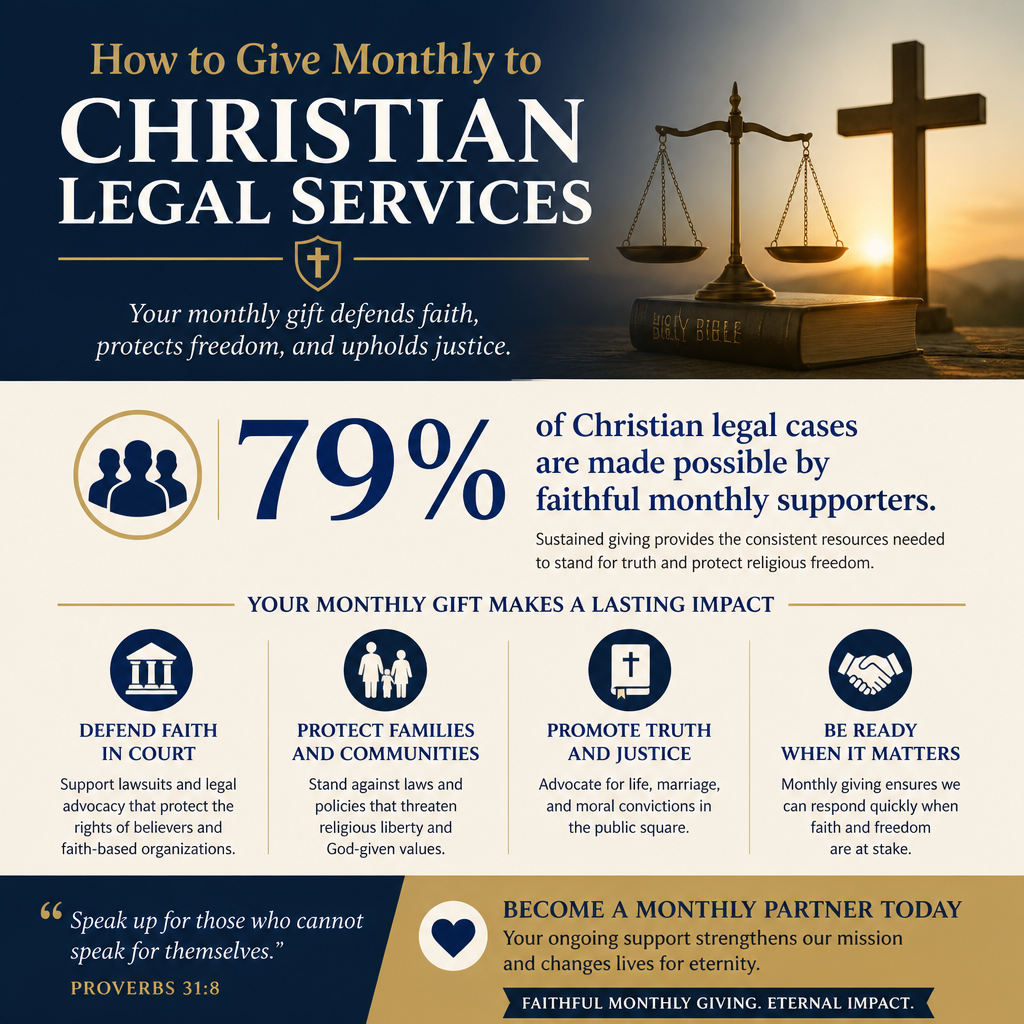
What this means in practice is that some donors will make a modest monthly commitment and supplement it with occasional larger gifts. Others will make the monthly gift the primary channel and reserve special giving for unusually urgent cases or capacity-building opportunities.
Consider giving vehicles that fit your income and season
Tax-smart giving is never the point of Christian generosity, but it can be a form of stewardship. Depending on your situation, a donor-advised fund, appreciated assets, or qualified charitable distributions may allow you to give more with less tax friction. The IRS explains qualified charitable distributions for donors age 70½ and older, including key rules and limits Internal Revenue Service.
Christian donors genuinely disagree about how much planning is appropriate before it becomes self-protective. The healthier approach is not to avoid planning, but to keep planning subordinate to obedience. Monthly giving is often one of the simplest ways to practice that subordination: it disciplines our finances toward regular mercy.
What to ask before you commit to monthly support
Questions that reveal competence and trustworthiness
Legal services ministries operate under constraints that are unfamiliar to many donors. A few precise questions can distinguish a mature ministry from one that relies on goodwill alone. Here are five that tend to surface the core issues:
- How do you screen and prioritize cases, and what happens when needs exceed capacity?
- What professional standards govern your work, and how do you supervise staff and volunteers?
- How do you measure outcomes in a field where results can take years and may be mixed?
- What percentage of your budget is unrestricted, and how do monthly gifts strengthen it?
- What safeguards exist for client confidentiality, conflicts of interest, and complaint resolution?
Ask for transparency that matches the moral weight of the work
Christian legal ministries deal with vulnerable people, contested facts, and adversarial environments. Transparency, therefore, is not a marketing preference; it is a moral obligation. Donors should expect clarity about what the ministry can and cannot disclose, given client confidentiality, while still offering meaningful reporting about caseload categories, staffing, and the use of funds.
Across our verification work, the ministries that meet The Most Trusted Standard tend to document policies that are rarely visible on a donation page: data handling, whistleblower processes, board independence, and clear public explanations of program scope. This level of disclosure is not performative; it is part of credibility.
Making monthly giving spiritually serious rather than automatic
Monthly giving should deepen attention, not replace it
Recurring donations can become a form of conscientious disengagement if they are treated as a substitute for prayer, learning, and periodic reassessment. The New Testament vision of generosity includes both regularity and discernment. “Let each one give as he has decided in his heart, not reluctantly or under compulsion, for God loves a cheerful giver” (2 Corinthians 9:7). The deciding is not a one-time event; it is an ongoing posture of attentiveness.
A sustainable pattern is to pair a monthly commitment with an annual review: read the ministry’s report, ask whether its mission remains aligned with your convictions, and confirm that governance and finances remain sound. This is especially relevant in legal work, where public controversies can tempt ministries toward reactive messaging or mission drift.
Use trusted evaluation without outsourcing moral responsibility
Independent verification is useful because it provides external discipline. At Most Trusted, we evaluate ministries against The Most Trusted Standard, a 15-criteria framework across four essential areas: Faith Foundation, Financial Integrity, Governance and Leadership, and Transparency and Effectiveness. Verification is not a replacement for prayerful judgment, but it can reduce the likelihood that donors fund avoidable risk.
Donors who want to go deeper into the landscape of organizations and models can begin with Christian Legal Services Ministries, then consider giving approaches within Tax-Smart Giving to Christian Legal Services. The aim is not to find a perfect organization, but to give with clear eyes and steady conviction.
FAQs for How to give monthly to Christian legal services
Should monthly giving be restricted to a specific case or kept unrestricted?
Unrestricted monthly giving is often the most strategically helpful, because it allows legal ministries to staff appropriately, respond to fluctuating caseloads, and cover nonnegotiable costs such as supervision and compliance. Restricted giving can be appropriate when a ministry clearly defines the purpose and has the systems to track and report it. If you restrict, ask how the ministry handles situations where the specific need changes or resolves sooner than expected.
How can donors evaluate impact when legal outcomes are slow or uncertain?
Legal impact should be assessed through a mix of outcomes and process indicators: the quality and ethics of representation, the number and type of clients served, durable resolutions achieved, educational efforts that prevent harm, and, where relevant, measured policy wins. Donors should also expect a ministry to name losses candidly. In legal work, faithfulness includes accepting that some cases do not succeed, even when advocacy is competent and necessary.
Monthly giving as durable witness
Christian legal services are rarely glamorous and often misunderstood, yet they serve in places where injustice becomes concrete: contracts, custody orders, immigration files, and courtrooms. Monthly giving is one way donors can refuse the church’s episodic attention span and instead sustain steady service to neighbors whose need is not seasonal. When monthly support is paired with careful evaluation and prayerful seriousness, it can become a durable witness to the justice and mercy of God.



