
When Christians ask how to donate to Christian medical ministries online, they are rarely asking only about payment methods. They are asking how to give in a way that is faithful, secure, and proportionate to the gravity of suffering—without rewarding confusion, inefficiency, or avoidable harm.
Medical ministry sits at an intersection Scripture treats with seriousness. Jesus not only healed; he formed a people who would bind wounds, bear burdens, and honor the dignity of the sick. Yet modern online giving also introduces real risks: spoofed domains, rushed emotional appeals, unclear restrictions, and programs whose measurable outcomes are harder to verify than photographs suggest.
Begin with a theology of mercy and a stewardship ethic
Mercy is not sentiment and stewardship is not suspicion
Christian medical giving is an expression of neighbor-love, not merely a reaction to crisis. The New Testament’s vision of mercy is concrete: the Samaritan pays for care, not a story (Luke 10:25–37). That same passage assumes accountability. The Samaritan makes a specific arrangement with the innkeeper and commits to return. Love can be immediate; it should not be careless.
Stewardship is therefore not a posture of distrust toward ministries. It is a refusal to let urgency replace discernment. Mature donors recognize that health interventions can be lifesaving and still be poorly governed, financially opaque, or designed around donor preferences rather than patient needs.
Clarify what you are trying to fund
“Christian medical ministry” can mean several distinct models: a hospital with a chaplaincy program, a mobile clinic, a surgical mission organization, a medical supply distributor, a community health worker network, or a Christian health insurance sharing ministry. Each model has different cost structures, compliance requirements, and outcome measures. A wise online gift starts with a clear category: direct patient care, prevention and public health, training and capacity building, or emergency response.
For donors who want a broader view of the landscape, our coverage of Christian Medical Ministries is designed to help donors distinguish between common program types and the documentation that normally accompanies each.

Confirm the ministry is real and the donation path is secure
Verify identity before you verify impact
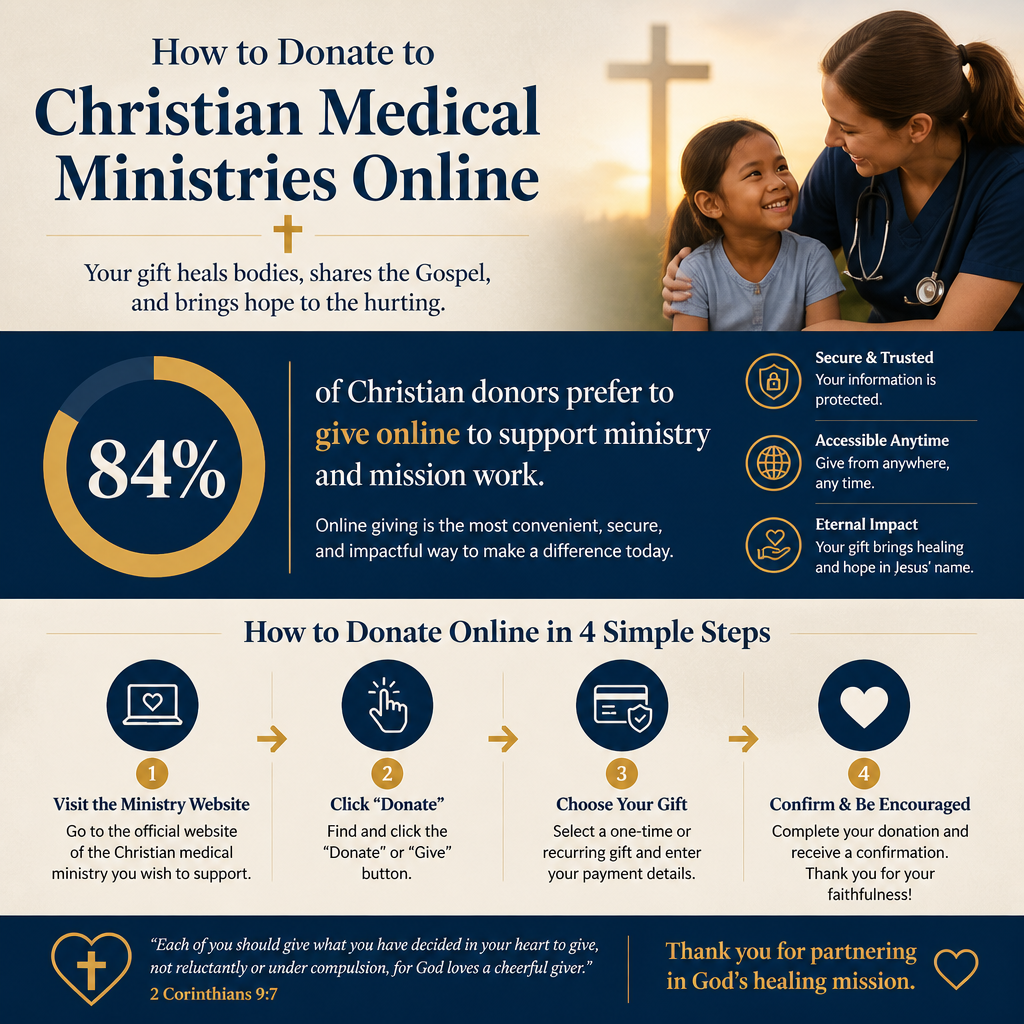
Online giving begins with basic cyber-hygiene. A legitimate ministry can still be impersonated. Before entering payment information, confirm that the domain is correct, the page uses HTTPS, and the donation form appears on the ministry’s official site rather than a lookalike landing page. For gifts initiated through email or social media, do not donate through a link you have not verified; instead, navigate to the organization’s site directly and find the giving page from the main menu.
Donors should also confirm that the organization is registered as a nonprofit where it operates and can provide documentation. In the United States, many donors confirm federal tax-exempt status through the IRS Tax Exempt Organization Search on the IRS website: IRS Tax Exempt Organization Search.
Use payment methods that preserve both security and clarity
Credit cards generally provide stronger consumer protections than debit cards, and reputable giving platforms can be appropriate if they clearly identify the recipient and do not obscure fees. If a giving page is vague about who receives funds, or if the “donate” button routes to a page with a different organization name, treat that as a warning sign. For larger gifts, donors often prefer ACH or checks for lower fees, but online ACH should still be processed through a recognizable, secure provider.
Receipts and confirmation emails should include the legal name of the ministry, a transaction identifier, and language appropriate for charitable contributions. In the U.S., donors should retain documentation consistent with IRS guidance on substantiation of charitable contributions: IRS Publication 526.
Evaluate the ministry against verifiable trust indicators
Move beyond overhead reflexes
Many Christian donors have been trained to equate “low overhead” with faithfulness. The sector has had to correct that assumption. The joint “Overhead Myth” letter signed by GuideStar, Charity Navigator, and the BBB Wise Giving Alliance argues that overhead ratios are a poor proxy for performance and can pressure nonprofits to underinvest in systems that protect beneficiaries and donors: Charity Navigator on the Overhead Myth.
Medical ministries, in particular, must invest in compliance, credentialing, supply chain controls, and patient privacy safeguards. Under-resourcing those functions is not efficiency; it can be negligence.
What credible documentation typically includes
A trustworthy medical ministry can usually provide clear, current documents without defensiveness: audited financial statements when size warrants it, an annual report with program detail, board and leadership transparency, and a coherent explanation of how clinical quality and spiritual care are supervised. Donors should look for consistency across channels: the website, Form 990 (in the U.S.), and public messaging should tell the same story about mission and use of funds.
At Most Trusted, we evaluate ministries against The Most Trusted Standard, a 15-criteria framework that considers faith foundation, financial integrity, governance and leadership, and transparency and effectiveness. What this means for donors is practical: we look for evidence that a ministry’s theological commitments actually shape its conduct, that finances are intelligible, and that leadership oversight is more than nominal.
Make wise choices about restricted gifts and urgent appeals
Restricted giving can strengthen or strain a ministry
Many online forms encourage donors to select a specific project. Sometimes that is appropriate; sometimes it produces a mismatch between donor intent and on-the-ground needs. Restrictions create administrative and legal obligations. If the ministry cannot use restricted funds quickly enough, it may have to hold them, re-negotiate donor intent, or re-allocate other resources in ways that are less strategic.
A disciplined approach is to restrict only when the ministry has clearly articulated the project scope, timeline, and reporting plan. Otherwise, an unrestricted gift—paired with thoughtful questions—often serves patients better.
Discernment during crises
Disaster and conflict generate urgent medical needs and urgent fundraising. Some appeals are legitimate; others are opportunistic. Donors should verify that the ministry has an established presence, relevant medical competencies, and partnerships that enable responsible care. If an organization pivots suddenly into emergency medicine without prior evidence of capacity, caution is warranted.
Before clicking “donate,” we encourage donors to pause long enough to confirm a few essentials:
- The ministry’s legal identity and credible public documentation
- A secure donation path on the official domain
- A clear description of the program and how funds will be used
- Clinical accountability: licensed oversight, protocols, and referral pathways
- Spiritual care practices that respect patient dignity and consent
Practice disciplined follow-through after you give
Expect meaningful reporting, not merely stories
Christian donors are not wrong to respond to stories; Jesus himself used parables to form moral imagination. But responsible medical work should also generate sober reporting: patient volumes with appropriate caveats, quality indicators where feasible, training outcomes, community health measures, and clear financial summaries. Not every good outcome is easily quantified, and ministries working in fragile contexts face real limitations. Still, a pattern of vagueness is not a contextual constraint; it is usually an accountability gap.
Donors can ask direct questions without assuming bad faith: What outcomes do you track? How do you ensure continuity of care? How do you handle complications? How do you protect patient privacy? What partnerships make your work sustainable when foreign teams leave?
Give in a way that forms the church
Medical ministry should not be treated as a substitute for local discipleship or local responsibility. The healthiest ministries we see tend to strengthen local churches, train local clinicians, and build durable systems rather than episodic encounters. Donors who give online can reinforce that long horizon by prioritizing ministries that invest in capacity and accountability, even when the marketing is less dramatic.
For donors specifically comparing giving options, our work in How to Give to Christian Medical Ministries addresses common donor decisions such as recurring giving, project restrictions, and evaluating medical claims with appropriate humility and rigor.
FAQs for How to donate to Christian medical ministries online
Should we donate through a ministry website or a third party platform?
Either can be appropriate if identity and fees are clear. The ministry’s official website reduces the risk of misdirection, but reputable platforms can process secure payments and issue proper receipts. The decisive questions are whether the recipient is unambiguous, the transaction is secure, and the donor can document the gift for tax and stewardship purposes.
Is it better to give to a specific medical project or give unrestricted?
Restricted gifts can be wise when the ministry provides clear scope, timelines, and reporting, and when the restriction matches real operational needs. Unrestricted giving often enables stronger clinical staffing, supply continuity, compliance, and follow-up care. A prudent posture is to restrict selectively and to expect the ministry to explain how restrictions are administered.
Give online with both compassion and verification
Online giving can place help in a ministry’s hands quickly, but speed is not the highest good. Christian donors honor Christ when gifts are both compassionate and accountable—rooted in mercy, attentive to the dignity of patients, and disciplined about evidence. The aim is not to eliminate all risk; it is to refuse avoidable risk when the stakes include human life and Christian witness.



