
How to choose a trustworthy rescue mission to support is not a secondary question of donor preference. It is a stewardship question with moral weight, because rescue missions serve people at acute vulnerability, and donors fund decisions that can either restore or destabilize already-fragile lives.
Christian donors often feel the pressure of urgency: a meal tonight, a bed during a cold snap, a person asking for help at the edge of despair. Scripture does not permit indifference to that urgency. Yet Scripture also refuses sentimentalism. In the language of Proverbs, the wise do not despise the poor, and they do not close their eyes to facts. Trustworthy giving requires both mercy and discernment.
Begin with the mission theology and the ministry model
A rescue mission is not merely a social service vendor with Christian branding. At its best, it is a ministry of mercy rooted in the character of God and the lordship of Christ, serving neighbors in crisis without reducing them to projects. That theological posture shows up in ordinary operational decisions: who is welcomed, what is required, what is offered, and what outcomes are pursued.
Clarify what the ministry believes about the gospel and the person
Rescue missions commonly operate at the intersection of material need, addiction, mental illness, trauma, and spiritual hunger. Christians genuinely disagree about how explicitly Christian a publicly-facing program should be, and how to balance proclamation with compassionate service. A trustworthy mission will not evade the question. It should clearly articulate its statement of faith, its understanding of dignity and agency, and how spiritual care relates to practical help.
What this means in practice is that donors should ask whether the mission’s discipleship claims are credible. Are spiritual practices integrated with humility and consent, or used as coercion for access to shelter? Are guests treated as image-bearers with real choice, or as compliance problems? The answer will often be visible in written policies and in how front-line staff speak about the people they serve.
Assess whether the program model fits the problem it claims to address
Some missions focus on immediate relief: meals, showers, a safe place to sleep. Others provide structured residential programs aimed at recovery and stability. Neither is inherently more “biblical.” Both can serve Matthew 25 mercy in different ways. The question is whether the mission’s model is coherent and appropriately matched to its context.
Donors should ask basic, specific questions. Does the mission partner with medical providers for detox and mental health care when needed? Does it have clear referral pathways for domestic violence survivors? Is there a plan for housing navigation, employment readiness, legal aid, or reunification when appropriate? A trustworthy mission will describe its model plainly, including what it does not do.

Look for evidence of safety, accountability, and neighbor-love in practice
Homeless outreach work is morally serious partly because it is high-risk. Missions handle crises, protect vulnerable guests, and make judgment calls in real time. Trustworthiness is not sentimental tone; it is operational integrity that shows up under pressure.
Ask how the mission protects guests, staff, and the surrounding community
Policies are not a substitute for love, but love without safeguards can become negligence. A mission that operates responsibly should have clear protocols for weapons, overdoses, abuse allegations, minor protection, and mandatory reporting where applicable. Donors should not be embarrassed to ask whether staff and key volunteers pass background checks and receive de-escalation training. Mature ministries welcome these questions because they understand the stakes.
The harder question is how a mission balances safety with accessibility. Strict rules can exclude people who most need care. Lax rules can endanger everyone. There is no perfect equilibrium, but a trustworthy mission will demonstrate that it has wrestled with the trade-offs and can explain its approach without dismissing concerns.
Evaluate whether the mission’s partnerships reflect humility
Rescue missions do not solve homelessness alone, and wise leaders do not pretend otherwise. A credible mission will coordinate with churches, local shelters, workforce agencies, and when appropriate, public systems. Donors should listen for a posture of cooperation rather than empire-building.
Across our verification work at Most Trusted, ministries that meet The Most Trusted Standard tend to document partnerships clearly and define responsibility lines carefully. That is not bureaucracy for its own sake. It prevents duplication, protects guests from falling through gaps, and reduces the temptation to exaggerate impact.
Follow the money, but do not reduce trust to overhead ratios
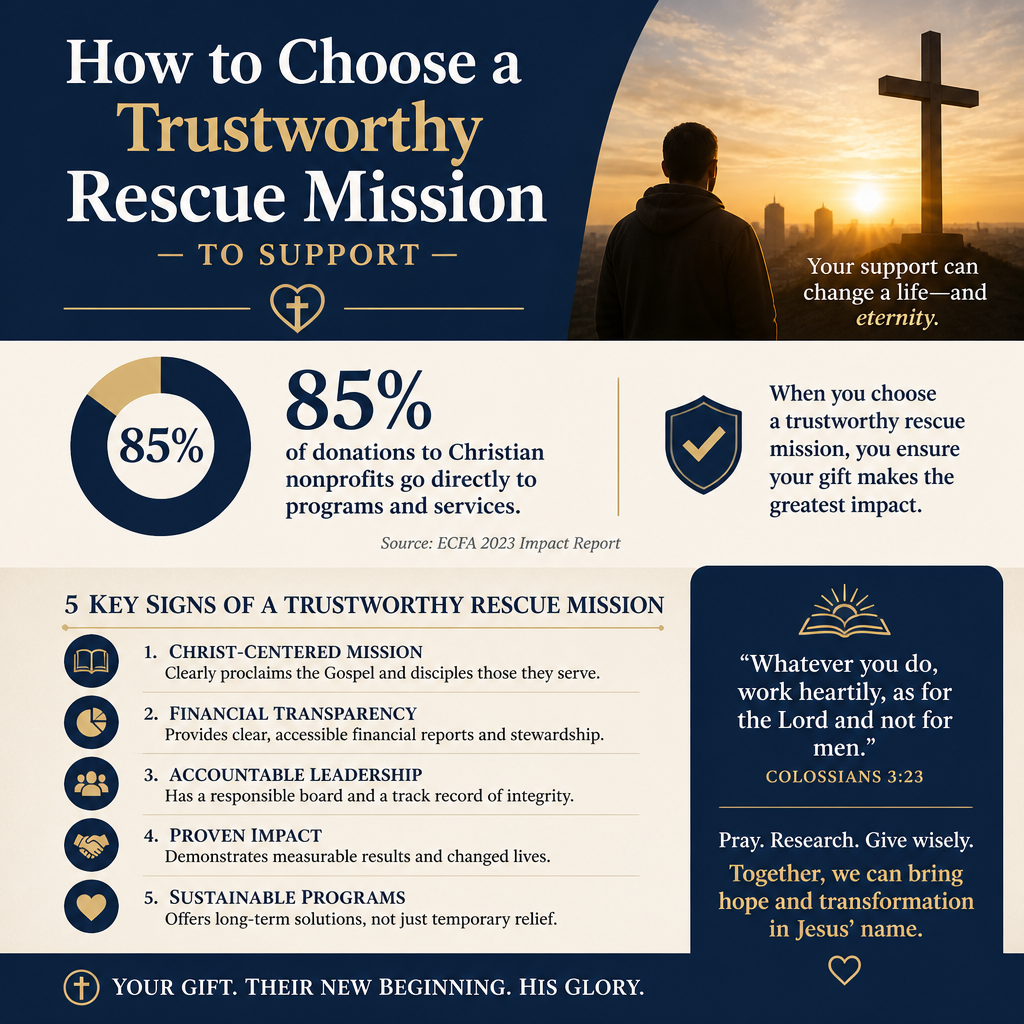
Christian donors are right to care about financial integrity. Scripture treats the handling of funds as a spiritual matter, not a technicality. At the same time, simplistic financial heuristics mislead. A mission can spend little on administration and still be disordered, unsafe, or ineffective. Another mission can spend more on trained staff and controls precisely because it is serious about stewarding people and resources.
Use audited or reviewed financials and clear reporting as baseline indicators
A trustworthy mission should provide current financial statements, an annual report, and a clear explanation of revenue sources and major expense categories. Larger organizations often provide audited financials; smaller ones may provide reviewed statements or other credible documentation. Donors should also check whether the mission files IRS Form 990 and whether governance disclosures are easy to find.
When donors want a grounded framework for thinking about overhead, the widely cited “Overhead Myth” letter is a useful corrective: focusing narrowly on administrative ratios can push charities toward underinvestment in systems that protect quality and results. The letter was signed by leaders at Charity Navigator, GuideStar, and the BBB Wise Giving Alliance, and it remains one of the clearest public statements against simplistic overhead policing (Charity Navigator).
Ask what financial controls exist when the work is cash-intensive
Rescue missions may handle in-kind goods, gift cards, facility donations, and designated gifts that carry restrictions. These realities create opportunities for both confusion and misconduct. A trustworthy mission will be able to describe basic internal controls: separation of duties, board oversight of major decisions, conflict-of-interest policies, and clear rules on restricted funds.
When evaluating whether a mission’s fundraising claims align with reality, donors can also use public-sector context. The U.S. Department of Housing and Urban Development’s Annual Homeless Assessment Report provides national counts and trends, reminding donors that homelessness is complex and regionally variable, and that credible ministries should not speak as though a single program “solves” the whole problem (U.S. Department of Housing and Urban Development).
Governance and leadership are the quiet determinants of trust
Rescue missions rise and fall on leadership integrity more often than donors want to admit. A mission can have a strong origin story and a compelling message, yet drift into dysfunction if accountability is thin. Conversely, a mission with modest visibility can be exceptionally trustworthy because its board and executive team insist on clarity, transparency, and correction.
Examine the board’s independence and the reality of oversight
Donors should ask who sits on the board, how often it meets, and whether it has meaningful independence from staff leadership. Family-dominated boards and boards made up entirely of insiders are not automatically disqualifying, especially in older legacy missions, but they raise questions about oversight. Trustworthy missions can explain how they mitigate concentration of power.
Leadership transitions also reveal governance quality. Is there a clear succession plan? Are executive compensation decisions documented? Are related-party transactions disclosed? These are not merely corporate concerns. In Christian ministry, they are part of guarding against favoritism and hidden self-interest.
Pay attention to how leaders speak about failures and limits
Ministry in homelessness work involves relapse, conflict, and slow change. A mission that claims near-perfect success is likely misunderstanding either the problem or the nature of discipleship. Trustworthy leaders speak with gravity: they name setbacks without excusing them, describe learning without spinning, and refuse to use guests’ suffering as marketing material.
For donors who want to place this work in a wider Christian context, we maintain ongoing coverage of Rescue Missions and Homeless Outreach that reflects both mercy imperatives and the operational realities that shape outcomes.
Transparency and effectiveness require honest measures, not inflated stories
Christian donors often receive emotional narratives and before-and-after testimonies. Testimonies matter; the gospel advances through human lives. But stories cannot substitute for truthful reporting. Trustworthy missions treat impact as something to be measured carefully and described without exaggeration.
Ask for specific outputs and outcomes, and how they are tracked
Outputs include measurable activities: nights of shelter provided, meals served, case-management appointments, program completions. Outcomes include changes that matter: stable housing placements, job retention, reunification, reduction in emergency room usage, sustained recovery engagement. Not every mission will track every outcome, and the research is mixed on which measures are most predictive across contexts. Still, a mission that cannot describe how it evaluates its work is asking donors to fund claims rather than reality.
Because homelessness can be episodic or chronic and is influenced by housing markets, health, and public policy, donors should be wary of simplistic causality. A housing placement is not the same as long-term stability. A program completion is not the same as spiritual maturity. The mission’s credibility increases when it names these distinctions plainly.
Use a disciplined checklist before giving
A short set of questions can prevent many avoidable donor regrets. We recommend looking for evidence in writing, not only verbal assurances:
- Clear statement of faith and a defensible approach to spiritual care that avoids coercion
- Guest safety policies and staff training appropriate to crisis work
- Accessible financial documents and credible external accountability where feasible
- Independent governance practices and disclosed conflicts of interest
- Defined program model with referral pathways and partnerships
- Impact reporting that distinguishes outputs from outcomes without inflated certainty
Our work at Most Trusted is designed to support this kind of discernment. The Most Trusted Standard evaluates ministries across 15 criteria spanning faith foundation, financial integrity, governance and leadership, and transparency and effectiveness. Donors do not need to become investigators, but donors should insist on verifiable signals of trust.
For donors specifically focused on practical due diligence for this field, we also publish resources within How to Give Wisely to Rescue Missions that aim to strengthen confidence without rewarding superficial metrics.
FAQs for How to choose a trustworthy rescue mission to support
Should a Christian rescue mission require chapel attendance or Bible study to receive services?
Christians disagree about this, and donors should not treat it as a simple litmus test. A mission can maintain an unapologetically Christian identity while still offering essential relief without spiritual prerequisites, especially when life and safety are at stake. What donors should insist on is clarity and dignity: the mission should state its expectations plainly, avoid coercion for basic services, and demonstrate that spiritual care is offered with pastoral seriousness rather than used as a compliance tool.
Is it a red flag if a rescue mission spends “too much” on administration?
Not necessarily. Many responsible missions invest in trained staff, financial controls, safety protocols, and data systems because the work is complex and the risks are real. A more reliable question is whether the expenses are explained transparently and tied to mission-critical outcomes. The “Overhead Myth” statement from Charity Navigator, GuideStar, and BBB Wise Giving Alliance remains a helpful reminder that ratios alone do not measure trustworthiness (Charity Navigator).
Choosing with discernment honors the people you hope to serve
Trustworthy giving to rescue missions is not a contest between compassion and caution. It is a form of neighbor-love that refuses to fund harm, refuses to reward manipulation, and refuses to abandon people in crisis to the least accountable options. When donors ask for verifiable integrity, clear theology, credible governance, and honest reporting, they are not withholding mercy. They are directing mercy toward ministries that can bear its weight.



