
How to choose a Christian conflict resolution ministry to support is not merely a question of program fit; it is a question of moral formation, ecclesial health, and public witness. Conflict is unavoidable in a fallen world, but the way Christians handle conflict is meant to be distinctive: truthful, patient, and ordered toward reconciliation rather than victory.
Donors often encounter two opposite temptations. One is to treat reconciliation as a soft good—nice when it happens, but secondary to “real” ministry. The other is to treat peacemaking as an abstract ideal detached from justice, accountability, and the protection of the vulnerable. Scripture refuses both. “If possible, so far as it depends on you, live peaceably with all” (Romans 12:18) does not cancel the Bible’s insistence on truthful witness, wise boundaries, and sober discipline within the church.
Start with a biblical and theological account of conflict
Reconciliation is a gospel implication, not a technique
Christian conflict resolution is not simply a toolkit for lowering the temperature in difficult conversations. It is a practical outworking of the gospel’s claim that Christ has reconciled sinners to God and is forming a reconciled people. Paul links our ministry of reconciliation directly to what God has done in Christ (2 Corinthians 5:18–19). Ministries worth supporting usually have a clear doctrinal account of sin, repentance, forgiveness, justice, and the church’s authority.
The harder question is whether a ministry’s theology has operational clarity. Many organizations can affirm reconciliation in principle while offering methods that default to avoidance, image management, or false peace. Donors can test for seriousness by looking for published statements on repentance and restitution, church discipline, and the protection of those who have been sinned against.
Peacemaking must be tethered to truth and neighbor love
Christians genuinely disagree about how to weigh competing goods in conflict: truth-telling versus discretion, swift action versus patient process, institutional stability versus prophetic exposure. A credible ministry will acknowledge these tensions rather than treating conflict as a simple misunderstanding between equally situated parties.
This is especially urgent when conflicts involve power imbalances or allegations of abuse. A Christian ministry must be able to articulate why “keeping unity” cannot mean pressuring the vulnerable into silence. The ministry’s practical teaching should sound like James: “the wisdom from above is first pure, then peaceable” (James 3:17). “First pure” is a guardrail against reconciliation language being used as a moral cover for minimizing harm.

Evaluate whether the ministry can handle complex cases with integrity
Distinguish everyday disputes from high-stakes harm
Many donor-supported conflict resolution efforts focus on common disputes: employment conflicts within Christian organizations, partnership breakdowns, board disagreements, congregational fractures, or family conflicts around inheritance and caregiving. These cases require skill, patience, and procedural fairness. They do not all require the same safeguards as cases involving sexual abuse, coercive control, or credible threats of violence.
A ministry that claims competence in every type of conflict without differentiating risk categories should raise concern. Mature organizations describe what they do, what they do not do, and what they refer to properly trained professionals or authorities. They will also recognize that some disputes cannot be “mediated” into health because a party refuses truth, accountability, or safety.
Ask what standards govern mediators and processes
Donors should not assume that spiritual sincerity substitutes for professional rigor. In many contexts, mediators follow recognized practice standards that emphasize impartiality, informed consent, confidentiality boundaries, and conflict-of-interest safeguards. In church and ministry settings, additional issues arise: pastoral authority, spiritual counsel, and the pressure participants may feel to comply.
What this means in practice is that donors should ask for the ministry’s written policies: screening for conflicts of interest, processes for complaints, and how they protect participants from coercion. If the ministry trains churches, donors can ask whether training includes clear guidance on when to pause mediation, when to involve attorneys, and when to report to civil authorities. The need for competent safeguards is not theoretical; the U.S. Department of Justice’s Office on Violence Against Women notes that domestic violence is fundamentally about power and control, which can be obscured by “both-sides” approaches in dispute resolution (U.S. Department of Justice Office on Violence Against Women).
Look for evidence of formation, not only settlement
Peace in Scripture is more than the absence of a fight
Christian donors often want to fund measurable outcomes: agreements reached, cases closed, conferences delivered. Those metrics can matter. But they can also tempt ministries to prioritize quick settlement over durable repair. Biblical peace is thicker than a signed agreement. It includes truth, restoration, and a community’s renewed ability to live faithfully together.
A credible conflict resolution ministry will describe outcomes in more than transactional terms. Do they help leaders learn practices of confession and restitution? Do they strengthen congregational governance so conflicts are handled early and wisely? Do they help churches distinguish forgiveness from reconciliation when trust has been broken?
Training should aim at long-term ecclesial health
Some of the most strategic conflict resolution ministries work upstream: training pastors, elders, and boards in healthy decision-making, grievance processes, and the spiritual disciplines needed to endure disagreement without fracture. Donors can ask whether the ministry teaches churches to reduce the conditions that predict chronic conflict: ambiguous authority, weak financial transparency, unaddressed moral failure, and unaccountable charismatic leadership.
Across our verification work at Most Trusted, ministries that meet The Most Trusted Standard tend to describe their work in terms of faithfulness and fruit over time, not merely reputation management in the present. That posture usually shows up in how they talk about hard cases: not as public-relations problems to be contained, but as moral realities to be addressed with truth, humility, and lawful care.
Apply due diligence that matches the moral seriousness of the work
Governance and financial integrity are ministry issues
Peacemaking ministries often work in confidential environments, sometimes with intense relational and institutional pressures. That context makes governance and financial integrity more—not less—important. Donors should look for an independent board, documented oversight of the chief executive, and clear policies on related-party transactions and conflicts of interest. When an organization asks others to practice accountability, donors should reasonably expect the same of the organization itself.
Financial clarity is not a distraction from spiritual aims. Jesus’ teaching makes stewardship a spiritual matter, not a merely administrative one (Luke 16:10–11). Donors can review publicly available filings, audited financials when available, and clarity on how fees and donations interact, especially if the ministry receives payment from one party in a dispute.
Transparency should match the limits of confidentiality
Confidentiality is often necessary for mediation to work. Yet confidentiality can also become a blanket justification for opacity. A trustworthy ministry will distinguish between case-level confidentiality and organizational transparency. Donors should expect clear reporting on overall program activity, leadership structure, safeguarding policies, and the organization’s method for evaluating effectiveness.
The nonprofit sector has also had to correct simplistic donor assumptions about overhead. The Overhead Myth statement—signed by leading charity evaluators—argues that focusing on overhead ratios can undermine nonprofit effectiveness (Candid GuideStar on the Overhead Myth). Donors should still care about frugality and controls, but the more mature question is whether spending patterns support competent staffing, training, and safeguards consistent with the seriousness of the cases.
For donors comparing organizations in this field, we maintain focused coverage of Christian Conflict Resolution Ministries where due diligence questions can be asked with sector-specific clarity rather than generic nonprofit checklists.
Make a support decision that fits your calling as a donor
Support models vary, and each has trade-offs
Some ministries are primarily training organizations. Others offer direct mediation, conciliation, arbitration services, or coaching for leaders. Some are deeply church-based; others work across denominational lines and serve Christian schools, mission agencies, and nonprofits. Donors can choose among these based on where they see the most leverage: strengthening leaders before conflict erupts, or intervening when conflict has already become destructive.
Christians also disagree, at times, about the proper role of formal legal processes versus informal ecclesial processes. A donor should not assume there is one biblically faithful procedural template for every context. What can be assessed, however, is whether the ministry is honest about the limits of its role and whether it honors both biblical responsibilities and lawful obligations.
A practical donor checklist for this ministry category
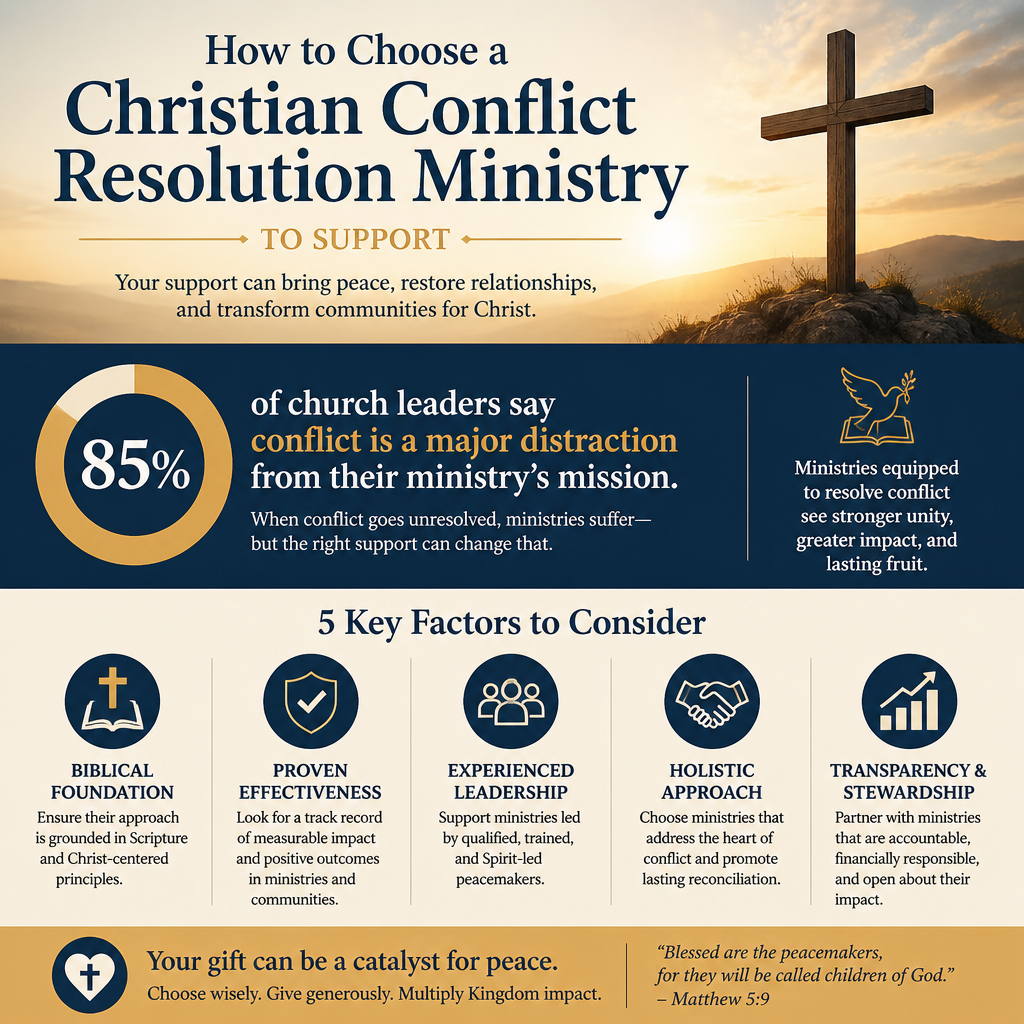
- Theological clarity: A published doctrine of reconciliation that includes repentance, truth-telling, restitution, and protection of the vulnerable.
- Case triage: Written criteria for what the ministry will mediate, what it will not, and when it refers to civil authorities or licensed professionals.
- Process safeguards: Policies on conflicts of interest, informed consent, confidentiality boundaries, and complaint resolution.
- Governance strength: Independent oversight, documented executive accountability, and clear related-party standards.
- Transparent reporting: Clear explanation of programs, finances, and outcome evaluation without using confidentiality to avoid organizational accountability.
Donors who are also thinking about multi-year commitments, bequests, or donor-advised strategies often prefer ministries with stable governance and clear reporting rhythms. Within Donor Partnership and Legacy Giving in Christian Conflict Resolution, we address partnership structures that support long-term faithfulness rather than episodic crisis response.
FAQs for How to choose a Christian conflict resolution ministry to support
Should a Christian conflict resolution ministry ever involve lawyers or civil authorities?
Yes. A faithful ministry distinguishes ordinary interpersonal disputes from allegations that trigger legal duties or raise credible safety concerns. Romans 13 recognizes civil authority as a real instrument of public justice, and most jurisdictions impose reporting obligations in certain circumstances. A ministry’s integrity is often shown in its willingness to set clear boundaries, document decisions, and refer matters appropriately rather than treating every conflict as a private spiritual matter.
What outcomes should donors reasonably expect from reconciliation work?
Donors should expect evidence of careful process and durable formation more than a guaranteed “settlement rate.” Some conflicts resolve with restored relationships; others conclude with clarified boundaries, leadership changes, restitution, or even separation that protects the vulnerable and preserves truth. The most credible ministries report outcomes in categories that reflect the moral complexity of conflict rather than implying that every case ends with relational harmony.
Choosing support with seriousness and hope
Supporting conflict resolution work is an investment in the church’s credibility before a watching world and in the internal health that enables mission. The wisest donor decisions begin with theology, continue with sober assessment of safeguards and governance, and end with a partnership posture that prizes truth and love together. When ministries pursue peace without abandoning purity, the church’s reconciliation message becomes not only proclaimed but practiced.



