

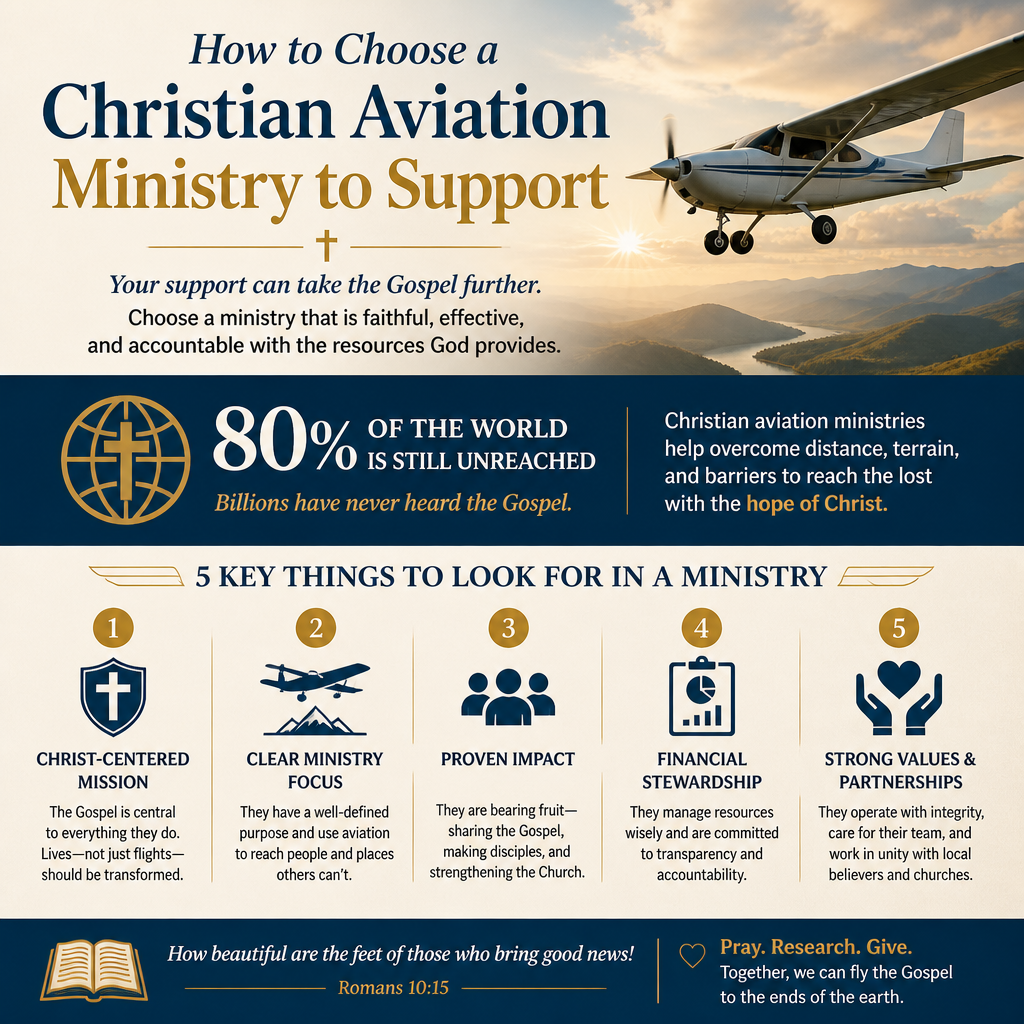
Choosing a Christian aviation ministry to support requires more than admiration for aircraft and courage. It is a decision about stewardship, accountability, and spiritual aims: whether aviation is serving the Great Commission, or whether the aircraft has become the mission. Mature donors can honor the romance of flight while still asking the harder questions Scripture trains us to ask about fruit, integrity, and faithfulness.
Christian aviation sits at an intersection of real need and real risk. Aircraft can compress days of travel into hours, making pastoral care, Bible translation support, medical evacuation, and disaster response feasible in places where roads are impassable or unsafe. Yet aviation also concentrates money, authority, and complexity. The same realities that make aviation effective—specialized skills, opaque logistics, high costs—can also make it difficult for donors to discern whether a ministry is well governed and spiritually anchored.
Begin with the ministry theology, not the aircraft
Christian donors tend to ask, “What does it cost per flight hour?” before asking, “What is this ministry for?” The order matters. Aviation is not morally neutral, but it is instrumental. The central question is whether the ministry’s stated theology of mission, the church, and human dignity is coherent—and whether its operations actually serve that theology.
Clarify what the ministry believes about the church and mission
Strong Christian aviation ministries usually know their proper place: they strengthen the local church rather than replacing it. They can describe how they partner with national believers, how they avoid dependency, and how they think about evangelism and mercy as mutually informing rather than competing priorities. When a ministry can only describe itself as “helping” in general terms, donors should press for a more explicitly Christian account of why aviation is the appropriate tool for the work.
Ask whether aviation is enabling presence, not bypassing it
Aviation can either deepen incarnational ministry or tempt ministries to substitute transport for discipleship. The measure is not how many miles were flown but whether flights support sustained Christian presence: pastors reaching scattered congregations, translators continuing long-term linguistic work, or medical teams supporting local clinics rather than importing episodic care. Christians genuinely disagree about the line between catalytic help and paternalism, but the disagreement becomes fruitful when a ministry articulates its convictions and invites scrutiny.

Evaluate the actual problem aviation is solving
Not every remote area needs an airplane, and not every aviation ministry is serving the same kind of need. Some contexts justify air transport because geography is decisive. Others have functioning roads and health systems where aviation becomes more symbolic than strategic. Donors should look for ministries that define the problem with specificity and can show why aviation is the right intervention.
Look for evidence of access constraints and mission necessity
When ministries operate in places with limited infrastructure, they should be able to name the constraints: seasonal flooding, mountainous terrain, insecurity, or extreme distances between communities. It is reasonable to ask for credible external context for why certain regions remain hard to reach. For example, the World Bank and other development institutions routinely document infrastructure barriers that shape access to health care and markets in low-income regions, and aviation ministries should be able to situate their work within those realities rather than speaking only in inspirational terms.
Distinguish between emergency response and long obedience
Disaster response can be legitimate, and aviation can be uniquely valuable in crises. Yet donors should not assume that a dramatic response necessarily implies lasting impact. Ministries that do long-term work can describe what happens after the emergency: handoff to local institutions, follow-up pastoral care, and the patient work of training and maintenance. The aviation component should be integrated into a broader ministry logic, not treated as its own justification.
Follow the money and the governance with aviation realism
Aviation concentrates financial risk. Aircraft are expensive to purchase, operate, insure, maintain, and staff. The question is not whether aviation is costly; it is whether the ministry manages cost and risk with integrity and competence that can be verified.
Financial integrity is more than low overhead
Many donors have been trained to treat “overhead” as suspect. The nonprofit sector has had to correct that instinct. Leaders from GuideStar, Charity Navigator, and the BBB Wise Giving Alliance publicly argued that “overhead” is a poor proxy for effectiveness and can even encourage underinvestment in accountability and capacity. Their statement is commonly referenced as the “Overhead Myth” letter, and donors can review it through the Candid platform.
For aviation ministries, this matters sharply. Maintenance, safety management, pilot training, and compliance are not moral compromises. They are part of loving one’s neighbor in a high-risk environment. Donors should expect to see adequate investment in safety and internal controls, and should become concerned when a ministry boasts about operating “lean” in ways that suggest corners are being cut.
Governance should match the complexity of the work
An aviation ministry should have a board capable of governing aviation realities: risk oversight, major asset management, executive accountability, and conflict-of-interest discipline. Mature governance is not merely about having a board list on a website. It is about whether the board is independent, engaged, and structured to prevent the common temptations that arise when a charismatic founder controls aircraft, story, and budget.
Across our verification work at Most Trusted, the organizations that meet The Most Trusted Standard tend to show clear decision rights, documented policies, and consistent board oversight in areas that donors rarely see but that determine whether a ministry can be trusted over decades.
Insist on transparency that serves truth, not marketing
Christian donors rightly want stories. Yet aviation ministries can unintentionally cultivate a narrative economy where dramatic flights overshadow sober reporting. Transparency is not a photo stream. It is a disciplined practice of telling the truth about outcomes, failures, and limits.
What credible reporting looks like in aviation ministry
At minimum, donors should expect a ministry to publish timely financial statements and governance information, explain how funds are allocated across regions and programs, and describe measurable outputs that are appropriate to the work. Outputs might include flight hours, passengers carried, patient transfers, tons of cargo moved, or number of partner organizations served. Those figures are not the same as spiritual fruit, but they are basic evidence that operations are real and scaled as described.
Guard against spiritual and humanitarian inflation
Some claims in missions are difficult to verify, and aviation can amplify this challenge because donors are far from the field. Mature ministries resist the urge to inflate conversions, exaggerate the uniqueness of their access, or present complex partnerships as if they were a solo effort. Christians are not served by narratives that treat other ministries, local churches, or civil authorities as props. Truthfulness is not a branding choice; it is a spiritual discipline.
For donors who want a broader landscape view of this field, we maintain editorial coverage and verification context across Christian Aviation Ministries, including the questions we see repeatedly when high-capacity donors evaluate aviation work.
Choose for long-term faithfulness and measurable service
Donor intent often carries an implicit question: “Will this gift still be faithful and effective five years from now?” Aviation ministries can be unusually vulnerable to leadership transitions, capital campaigns, and operational shocks. The wisest support is structured to encourage resilience, integrity, and local ownership.
Practical due diligence questions worth asking
- How does the ministry decide where to fly, and who has authority to approve flights?
- What safety and maintenance standards are followed, and are audits or inspections documented?
- How does the ministry partner with local churches and national leaders in planning and evaluation?
- What portion of funding is restricted for aircraft purchases versus ongoing operations and training?
- How does leadership handle conflicts of interest, especially with vendors, aircraft acquisition, and related-party transactions?
These questions are not adversarial. They are how donors honor the biblical call to wise stewardship. Jesus’s parable of the talents assumes accountability and discernment, not naïveté. A ministry worthy of support will not resent serious questions; it will welcome them as part of shared faithfulness.
How Most Trusted can serve donor confidence
Most Trusted exists because donors should not have to choose between trust and action. Our team evaluates ministries against The Most Trusted Standard, a 15-criteria framework spanning faith commitments, financial integrity, governance and leadership, and transparency and effectiveness. For aviation ministries, that framework helps donors see past compelling storytelling to the verifiable practices that sustain trustworthy ministry over time.
Donors who want to strengthen their discernment in this category can also consult How to Give Wisely to Christian Aviation Ministries for additional context on what responsible support tends to require.
FAQs for How to choose a Christian aviation ministry to support
Should donors prioritize funding aircraft purchases or operating costs?
Operating costs are often the more decisive factor for faithful service: maintenance, fuel, training, insurance, and safety systems determine whether an aircraft serves the mission or becomes a stranded asset. Aircraft purchases can be appropriate when tied to a clear operational plan, verified demand, and the leadership capacity to sustain the asset responsibly. Donors should ask for documented budgets that show how a new aircraft will be supported over its full life cycle.
What are red flags that a Christian aviation ministry is not well governed?
Common concerns include vague reporting, a board that appears closely tied to the founder without meaningful independence, unclear policies around conflicts of interest, and fundraising that relies on dramatic claims without verifiable operational detail. A pattern of treating basic due diligence questions as disloyal is also a warning sign. Trustworthy ministries tend to answer difficult questions directly and can show the documentation that matches their public claims.
Aviation is a means, not a message
The deepest criterion is not whether a ministry can fly, but whether it can tell the truth, submit to accountability, and serve the church with humility. Christian aviation is a powerful tool when it is governed well and ordered toward faithful ends. Donors who choose carefully can support work that genuinely expands access, strengthens local ministry, and honors Christ not only in what is accomplished, but in how it is done.



