
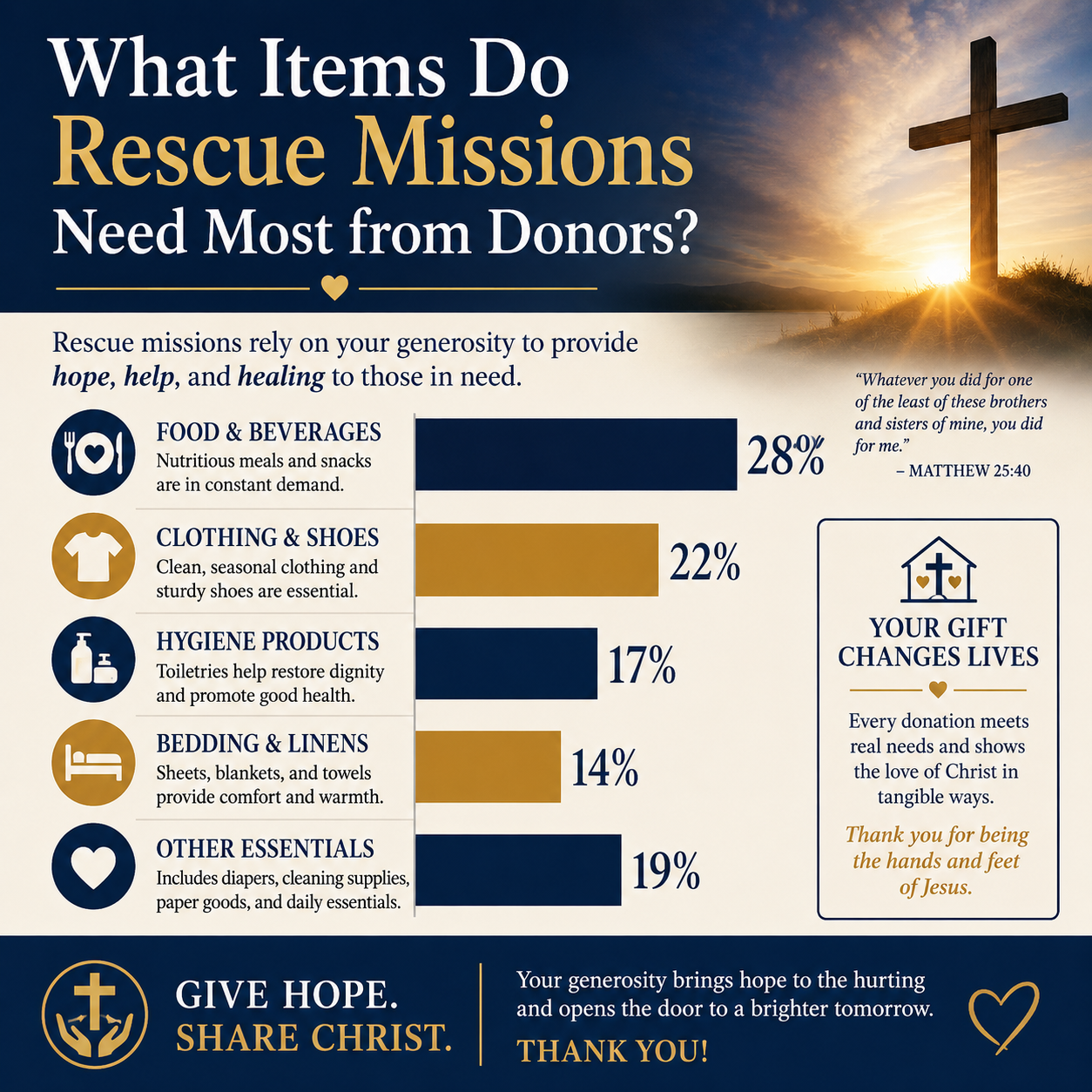
What items do rescue missions need most from donors? The most faithful answer is not a single list of goods, but a set of priorities that protect dignity, meet real operational constraints, and strengthen long-term stability for neighbors who are unhoused. The best rescue missions will tell donors the same thing: what is “needed” changes by season, by local policy, by the facility’s storage capacity, and by whether the mission is focused on emergency shelter, recovery, or family services.
Christian donors often want to give tangible items because the need feels immediate and the act feels personal. That impulse is not wrong. Scripture consistently commends material mercy as a concrete expression of love of neighbor (1 John 3:17). Yet the field has had to reckon with a hard truth: unsolicited goods can create bottlenecks, undermine local markets, and consume staff time that should be spent serving guests. Wise giving learns to ask not only, “What can we give?” but “What will actually help this mission serve well?”
Start with the mission’s actual model of care
Rescue missions are not interchangeable. Some operate low-barrier emergency shelters; others are structured programs that include discipleship, addiction recovery, job readiness, or family reunification. What this means in practice is that “needed items” vary significantly, and donor generosity is most fruitful when it supports the mission’s particular pathway from crisis to stability.
Across our verification work at Most Trusted, we observe that ministries with clear program definitions and published guest expectations tend to have clearer donation policies and better stewardship of in-kind gifts. That clarity is not a branding exercise; it is a safeguard for guests and a service to donors who want their gifts to matter.
Emergency shelter has different needs than recovery
Emergency shelter settings often need high-volume consumables that turn over quickly: clean socks, hygiene supplies, and basic clothing in season. Recovery programs may need fewer consumables but more durable goods that support structure: work boots, interview-appropriate clothing, or curriculum materials used in life-skills classes. Both may need linens, but one may require commercial-grade items that withstand frequent laundering.
Family-focused programs need a different donor imagination
When a mission serves families, the “items” question widens. Diapers in multiple sizes, wipes, and children’s clothing are often pressing. So are items that preserve normalcy: school supplies, lunch boxes, and age-appropriate books. These are not sentimental add-ons; they are part of stabilizing children whose lives have already absorbed more disruption than many adults ever face.
Prioritize dignity and health in the basics
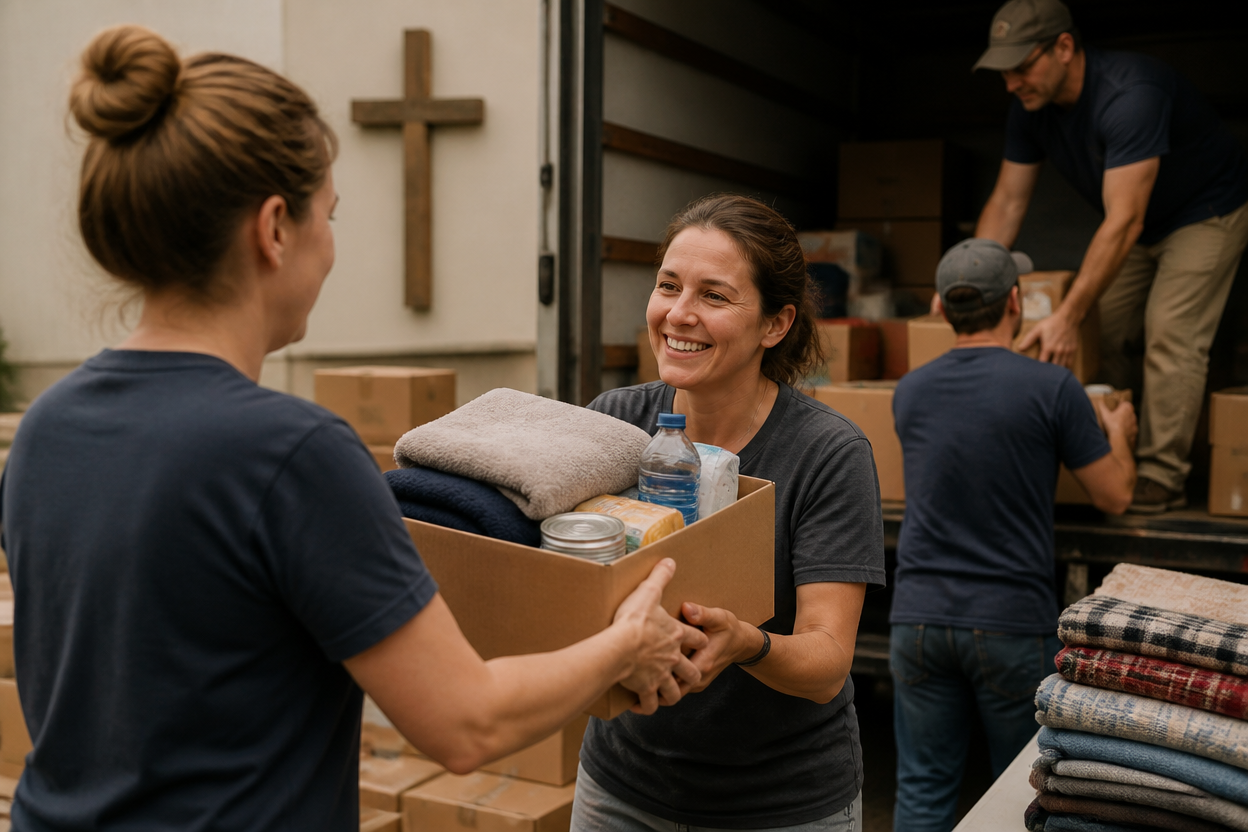
The items that rescue missions need most are frequently unglamorous. They are also the ones that preserve dignity in the first days of crisis. Christian donors sometimes gravitate toward one-time, high-visibility gifts; missions often need replenishment gifts that quietly keep a shelter functional.
Hygiene that can be distributed safely and respectfully
Most missions prefer new, unopened hygiene items for health and liability reasons. Travel-size products are often easiest to distribute, but full-size products can be appropriate when guests have secure storage or are in longer-term programs. Commonly requested items include soap, shampoo, deodorant, toothbrushes, toothpaste, menstrual products, and shaving supplies.
Menstrual products deserve explicit mention. Homelessness for women and girls often includes “period poverty,” and consistent access to products affects health, school attendance, and basic mobility. Donors can strengthen a mission’s capacity by giving these items in bulk, in packaging that allows staff to distribute without sorting loose single units.
Clothing that matches the reality of street life
New socks and sturdy underwear are frequently among the most requested items at shelters, because they are difficult to keep clean without stable access to laundry. Weather-appropriate outerwear matters as well: coats, gloves, hats, ponchos, and thermal layers in cold months; breathable shirts, sun hats, and refillable water bottles in heat.
Donors sometimes assume “any clothing helps.” Missions often cannot use large volumes of used clothing because sorting is labor-intensive and storage is limited. Gently used items may be welcomed if they are seasonally appropriate, clean, and in good repair, but it is wise to treat the mission’s guidelines as part of loving one’s neighbor rather than as inconvenient restrictions.
Give items that reduce operational strain, not increase it
The harder question is not whether a mission can accept an item, but whether the item increases staff workload relative to its value. In-kind giving can be a blessing or a burden. The difference is usually logistics: storage space, staff time, transportation, and the mission’s capacity to distribute without confusion or waste.
Ask how the mission handles intake, storage, and distribution
Well-run missions typically have clear drop-off hours, item lists, and packaging standards. They do this because their primary work is people, not inventory. If a mission asks for items in sealed packages, by size, or in specific quantities, they are protecting their staff and their guests from chaos.
When donors want to understand why cash is sometimes preferred to goods, the reason is frequently operational. The National Council of Nonprofits notes that unrestricted or flexible funding allows nonprofits to respond to needs as they arise, including staffing and infrastructure costs that cannot be met through restricted gifts alone National Council of Nonprofits.
Consider the supplies that keep a facility safe and functional
Some of the most strategic in-kind gifts are not distributed to guests at all. They support the environment where care happens: industrial cleaning supplies, paper goods, trash bags, disinfectant wipes, laundry detergent, and facility maintenance items. Missions may also need commercial kitchen staples if they serve meals at scale.
Because these needs can sound unspiritual, donors sometimes overlook them. Yet hospitality in Scripture is materially grounded: a clean place to sleep, safe water, and food prepared with care are not peripheral to mercy. They are mercy’s infrastructure.
- New socks and new underwear in common adult sizes
- Unopened hygiene kits including deodorant and oral care
- Menstrual products in bulk packaging
- Weather-appropriate outerwear and sturdy shoes
- Laundry and cleaning supplies suitable for high-volume use
Do not neglect the most needed donation category: flexible funding
Many Christian donors ask about items because they want to meet immediate needs with certainty. Yet for many rescue missions, the most needed “item” is often a flexible financial gift that allows leaders to purchase precisely what is missing that week, in the right quantity, with the right specifications.
Christians genuinely disagree about the spiritual meaning of “tangible” giving versus “writing a check.” But the moral question is not whether a gift feels tangible; it is whether the gift strengthens faithful care of people made in God’s image. Some of the most important costs in homelessness outreach are not donation-bin friendly: trained staff, background checks, facility insurance, van repairs, security upgrades, and case management systems.
Why wise missions may ask for money even when item needs are visible
A mission might have racks of donated clothing and still be short on the ability to wash and distribute it. It might have plenty of canned goods but lack the staff hours to prepare meals safely. It might have enough blankets yet need funding to expand women’s shelter capacity or to retain a counselor who helps guests with trauma, addiction, and relapse prevention.
The IRS records show that charitable giving in the United States is substantial, yet much of it is restricted or episodic rather than aligned to long-term capacity Internal Revenue Service. Rescue missions, in particular, can be trapped in a cycle of abundance in donated goods and scarcity in the less visible requirements of faithful operations.
How this connects to The Most Trusted Standard
At Most Trusted, we evaluate ministries against The Most Trusted Standard, a 15-criteria framework that examines whether a ministry’s faith commitments are clear, whether financial practices are sound, whether governance is accountable, and whether reporting is candid and meaningful. In the context of rescue missions, strong transparency includes publishing in-kind donation policies, explaining the rationale for preferred items or gift cards, and showing how goods and funds translate into services without exaggeration.
Donors who want to go deeper into how these ministries operate in the field can explore Rescue Missions and Homeless Outreach as a broader context for wise, durable generosity.
Give with verification in mind, not only with compassion
Compassion is required. Verification is also love, because it takes stewardship seriously. Homeless outreach has faced real scandals and real mission drift. Some organizations do excellent work with limited resources; others rely on vague storytelling, unaccountable leadership, or unclear outcomes. Donors should not be cynical, but neither should they be naïve.
What to ask before giving items
Before organizing a drive or dropping off goods, donors can ask a short set of questions: What items are most needed this month? Are there items you cannot accept? Do you prefer new-only? Do you have size standards? Can you distribute gift cards safely? These questions reduce friction and show respect for staff who are managing complex, high-stakes environments.
Signals of trustworthy item stewardship
Trustworthy missions typically show their work. They publish donation lists that change seasonally, provide clear drop-off procedures, and explain when they prefer funds. They also tend to name partners—local clinics, workforce agencies, or churches—because homelessness is rarely solved by a single institution acting alone.
Wise donors also recognize that “efficiency” is not the only moral metric. The Overhead Myth letter, signed by Charity Navigator, Candid (GuideStar), and the BBB Wise Giving Alliance, explains why focusing narrowly on overhead ratios can mislead donors and punish nonprofits for investing in capacity Candid. A mission that invests in staff training, safety, and data systems may be doing the more responsible work, even if it is less photogenic.
For donors who want to apply this stewardship mindset to day-to-day decisions, How to Give Wisely to Rescue Missions offers the practical giving context many Christians are seeking.
FAQs for What items do rescue missions need most from donors
Should we run a clothing drive or give money instead?
If the mission has requested specific clothing items in specific sizes and has capacity to sort and store them, a targeted drive can be genuinely helpful. If the mission is vague, already overstocked, or short-staffed, flexible funding or gift cards often serve better. The most responsible approach is to follow the mission’s current list and procedures rather than assuming what will help.
Are gift cards appropriate for rescue missions?
Gift cards can be highly effective when a mission has a plan to distribute them safely and equitably, often through case managers. They allow guests to purchase what fits, what is culturally appropriate, and what is immediately needed. Missions vary in whether they can manage gift cards without creating conflict or security risks, so donors should ask about policy and distribution protocols.
Faithful item giving serves the mission, not the donor’s preferences
Rescue missions need donors who will give in ways that strengthen order, dignity, and real pathways out of homelessness. Sometimes that means socks, hygiene kits, and coats. Sometimes it means laundry detergent and paper goods. Often, it means flexible funding that keeps staff trained, facilities safe, and programs stable.
Christian stewardship does not end with generosity; it matures into discernment. The most helpful donors are those who honor a mission’s actual constraints, ask verifiable questions, and give in ways that make it easier—not harder—for a faithful ministry to serve the poor with clarity and reverence.



