

What makes a prison ministry financially accountable is not a cosmetic question about ratios or branding. It is a moral question about stewardship, truthfulness, and the way a ministry handles power on behalf of people who have very little of it. For Christian donors, financial accountability is one of the clearest places where a ministry’s stated theology either takes institutional form or remains a set of aspirations.
Jesus placed “going to those in prison” among the works of mercy by which his disciples are recognized (Matthew 25). That same Jesus also spoke with unusual frequency about money, warning against pretense and calling his people to integrity. A prison ministry can be doctrinally orthodox and still mishandle donor funds. It can also be financially tidy and still drift from its spiritual mission. Mature discernment holds both together: fidelity to the gospel and verifiable stewardship.
Financial accountability begins with clear stewardship commitments
Donors are not purchasing outcomes
Christian giving is never a commercial transaction. Donors are participating in a work of mercy, and ministries are receiving gifts offered to God. That theology raises the standard, not lowers it. “Moreover, it is required of stewards that they be found faithful” (1 Corinthians 4:2). Faithfulness in financial matters is not primarily a promise of success; it is a promise of integrity.
In prison and post-prison settings, the temptation to overstate what a program can accomplish is real. Recidivism is shaped by housing access, employment opportunity, addiction and mental health treatment, community supervision requirements, family support, and local policy. Even strong discipleship programs operate within those constraints. Financial accountability begins when a ministry describes its work without manipulation and budgets accordingly.
A truthful budget reflects the actual work
Across our verification work at Most Trusted, we observe that accountable ministries can explain their budget in plain language and connect it to their stated mission. If a ministry says its primary work is inside prisons but a large share of spending is on conferences, media, or travel, a thoughtful donor should ask for clarity. The question is not whether those line items are always wrong; the question is whether the ministry can justify them as necessary to the work it claims to do.
This is also where overhead conversations require maturity. The long-running debate over “overhead” has often been simplistic, and the nonprofit field has explicitly warned donors not to reduce stewardship to one number. The joint “Overhead Myth” letter, signed by Charity Navigator, GuideStar, and the Better Business Bureau Wise Giving Alliance, argued that overhead ratios alone can mislead and can even pressure nonprofits into unhealthy underinvestment in infrastructure and accountability.Charity Navigator

Strong financial controls protect vulnerable people and donor intent
Controls are a form of pastoral care
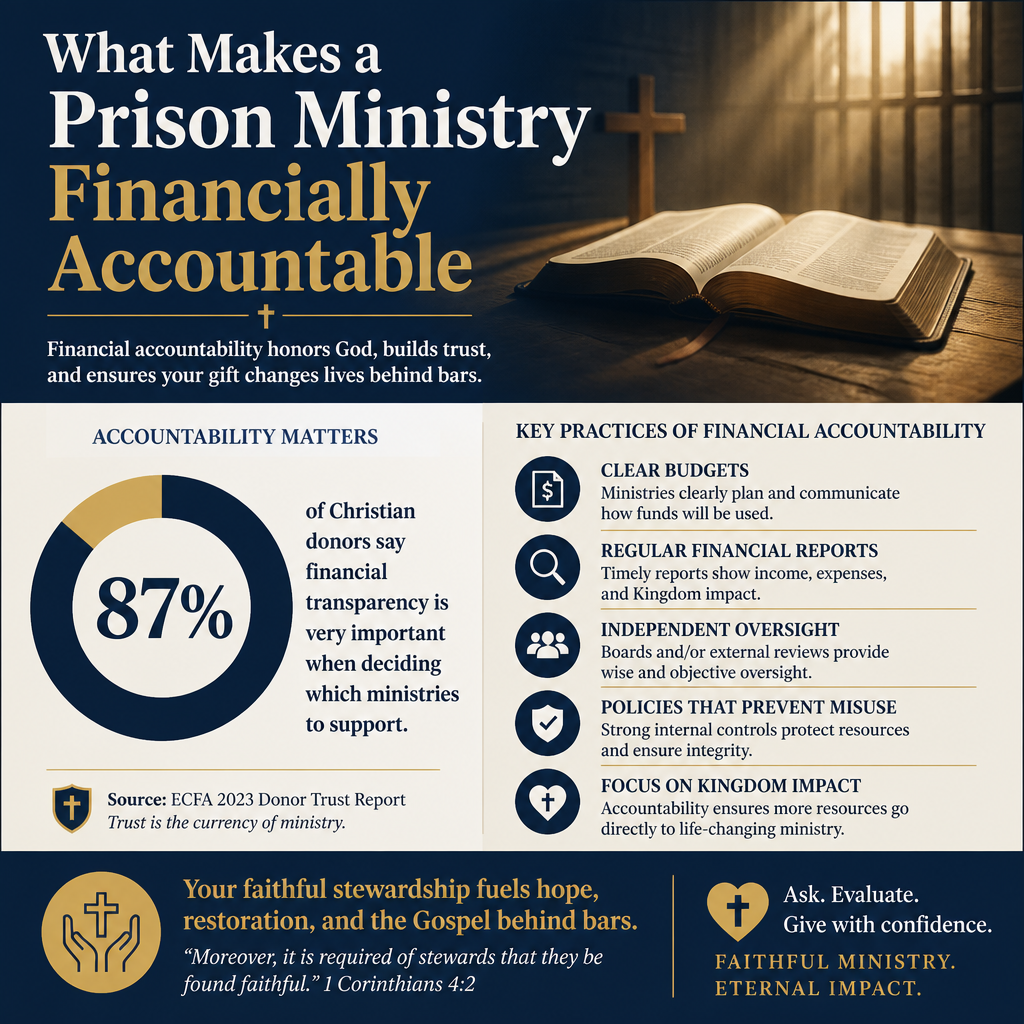
Prison ministries routinely operate with volunteers, restricted-access environments, and relationships where spiritual authority can be misused. Financial controls are not merely administrative; they are a safeguard for the people the ministry serves and for the church members who give. Accountable ministries implement separation of duties, approval thresholds, and documented processes for handling cash, gift cards, in-kind donations, and restricted gifts designated for specific projects.
Many prison-related programs rely on frequent small transactions: transportation assistance, transitional housing costs, job-readiness materials, program curricula, emergency support for families, and communication costs. Those are legitimate ministry expenses, but they also create opportunities for confusion and misconduct if oversight is informal. A mature ministry designs processes that assume human fallibility and reduce temptation.
Restricted gifts are handled with precision
Donors often designate gifts for chaplaincy support, reentry housing, Bible distribution, family visitation initiatives, or specific prison units. Financial accountability means the ministry tracks restricted funds separately and spends them only for their designated purpose. When needs change, accountable ministries seek permission to redirect restricted funds rather than quietly repurposing them.
The harder question is what happens when a ministry raises funds for a specific initiative and cannot execute it as planned because of access restrictions, staffing challenges, or changing prison policies. Financially accountable ministries disclose the change, document board oversight, and communicate with donors in a timely, specific way.
Transparent reporting is specific, comparable, and reviewable
Form 990 is a baseline, not a badge
In the United States, a prison ministry’s Form 990 (for most tax-exempt organizations) is a public record that gives donors a starting point for understanding revenue sources, major expenses, governance practices, and related-party transactions. The IRS requires most tax-exempt organizations to make their annual information return available for public inspection, which is one reason donors can legitimately expect transparency from ministries that solicit broadly.Internal Revenue Service
But 990s have limitations. They can be difficult to interpret, and they do not substitute for audited financial statements, internal policies, or clear program reporting. Financial accountability means the ministry can help a serious donor understand what the 990 does and does not show, without defensiveness.
Audits and reviews are not one-size-fits-all
Not every ministry needs a full independent audit every year, especially at smaller revenue levels. Christians genuinely disagree about when an audit becomes obligatory versus strongly advisable. What is not disputable is the direction of travel: as a ministry grows, the strength of independent financial oversight should increase, not decrease.
Accountable ministries also avoid treating an audit as a public-relations asset. An audit provides reasonable assurance about the financial statements; it does not prove a ministry is spiritually healthy, effective, or free from future risk. The most trustworthy posture is to receive third-party scrutiny as a gift to the ministry and to the donors who sustain it.
Governance practices reveal whether accountability is real
Independent boards and conflict management
Financial accountability is inseparable from governance. A board that is too small, dominated by staff, or composed primarily of family members may still contain godly people, but it is structurally prone to blind spots. Accountable prison ministries build boards that can ask hard questions, review executive compensation, approve budgets, and oversee related-party transactions with independence.
Conflict-of-interest policies matter most when they are actually used. The presence of a policy in a binder is not the same as an annual disclosure process, documented recusals, and a culture where leaders welcome scrutiny. Many ministry failures begin not with overt fraud but with small exceptions that become normal.
Fundraising truthfulness and communications discipline
Accountability includes the way a ministry asks for money. A prison ministry should not imply that every dollar goes “straight to the cells” if it funds staff salaries, training, insurance, background checks, administrative systems, or rent. Those may be necessary and honorable expenses. The moral issue is whether the ministry communicates them truthfully and avoids emotional manipulation of donors.
Prison settings also raise privacy and dignity concerns. Accountable ministries do not use stories of incarcerated people or their families as marketing material without careful consent and protection, particularly when participation in a program can affect parole perceptions or social standing. Financial accountability includes resisting fundraising practices that treat vulnerable people as content.
Accountability serves mission effectiveness, not just compliance
Program reporting should match the realities of prison work
Effective prison ministry is often slow, relational, and difficult to measure with precision. Access can change overnight. A facility can suspend volunteer entry. A program can be moved or canceled for reasons outside a ministry’s control. Donors should not demand certainty where the field cannot offer it.
Yet complexity does not excuse vagueness. Financially accountable ministries report in ways that are concrete and restrained: what programs were delivered, how many participants were served, what partnerships exist with chaplains or departments of corrections, and what follow-up looks like after release. When they cite outcomes, they define terms and avoid inflated spiritual language that cannot be verified.
Practical signals donors can look for
When donors explore Prison and Post-Prison Ministries, the goal is not to become suspicious of every organization. It is to give with confidence and to honor the seriousness of this work. Financial accountability tends to show up through patterns such as these:
- Clear, consistent financial statements and timely public reporting
- Documented policies for restricted gifts, reimbursements, and expense approvals
- Independent board oversight, including conflict-of-interest disclosures
- Fundraising claims that are specific, accurate, and not emotionally coercive
- Appropriate outside review as the ministry grows, such as an audit or financial review
At Most Trusted, our evaluations against The Most Trusted Standard focus on verifiable evidence across faith commitments, financial integrity, governance, and transparency. Donors should expect ministries to welcome that kind of scrutiny because it protects the mission, the people served, and the church members who give.
FAQs for What makes a prison ministry financially accountable
Should a prison ministry have low overhead to be financially accountable?
Not necessarily. Overhead can include legitimate costs such as training, financial controls, insurance, technology, and compliance that protect both participants and donors. The more reliable question is whether spending aligns with the ministry’s stated mission and whether leadership can explain the budget transparently. The nonprofit field has warned that overhead ratios alone can be misleading and can pressure organizations to underinvest in accountability systems.Candid GuideStar
What documents should a serious donor request from a prison ministry?
At minimum, donors can ask for recent financial statements, the most recent Form 990 if applicable, and a clear description of how restricted gifts are tracked and reported. For larger organizations, an independent audit and a board-approved conflict-of-interest policy are reasonable expectations. Donors focused on how funds are handled in practice will often find the most helpful context in How Prison Ministries Use Donor Gifts.
Giving with confidence in a ministry to those in prison
Financial accountability in prison ministry is not a substitute for spiritual fruit, but it is one of the primary ways a ministry demonstrates love of neighbor and fear of the Lord in institutional form. Donors can honor the gravity of Matthew 25 without suspending discernment. The ministries most worthy of trust tend to welcome clear questions, provide reviewable answers, and handle money with the seriousness that Christian stewardship requires.



