
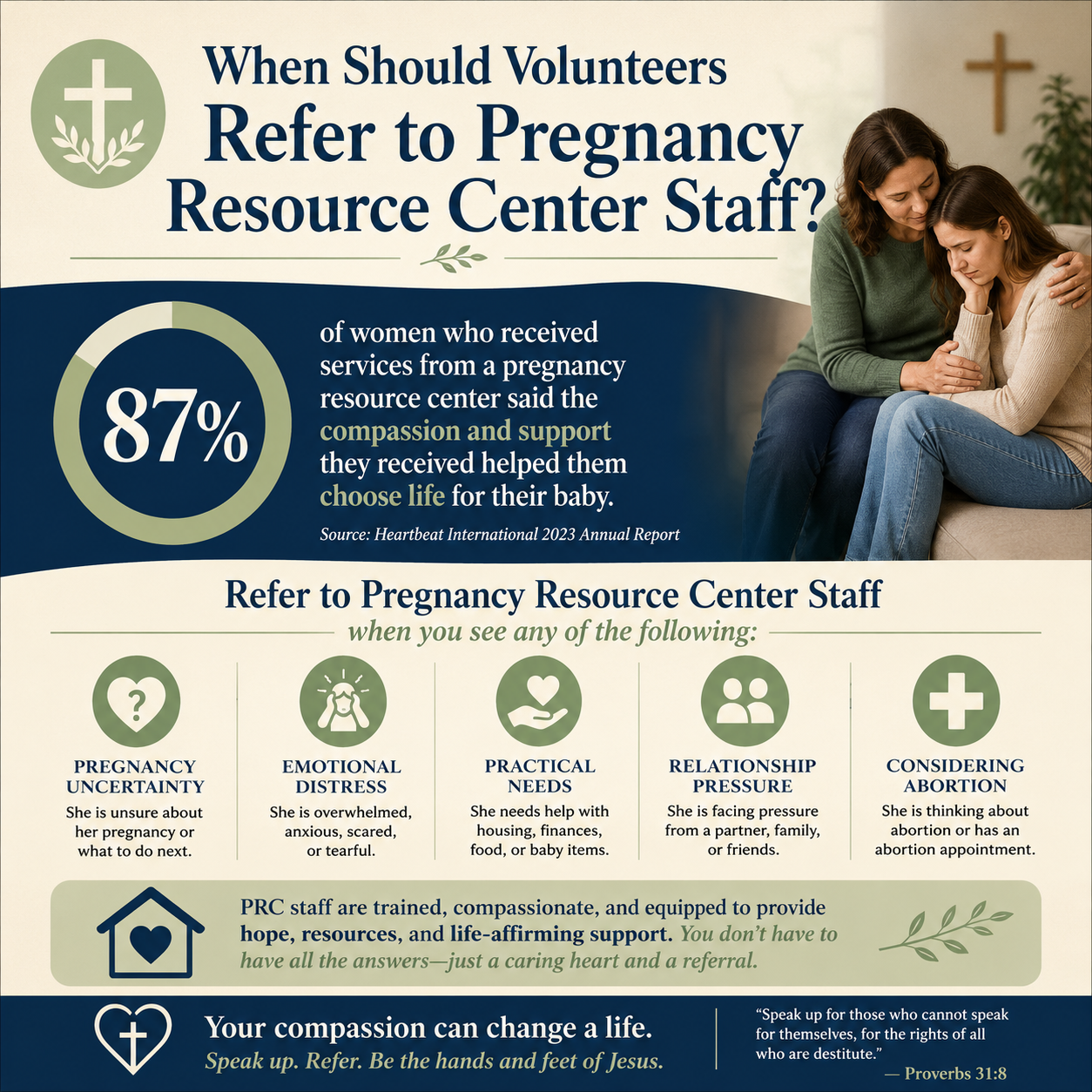
When should volunteers refer to pregnancy resource center staff? The answer is whenever a volunteer is nearing the edge of their role, authority, training, or emotional capacity—and whenever a client’s situation carries clinical, legal, safety, or ethical weight that the ministry must handle with clear accountability.
For Christian donors, this is not a procedural detail. Referral discipline is one of the clearest markers of whether a pregnancy resource center is operating as a ministry of truth and mercy, or drifting into well-intentioned improvisation. Scripture’s call to “speak the truth in love” (Ephesians 4:15) requires competence, humility, and restraint, not only sincerity.
Referral is not a handoff from care but an act of responsible care
Volunteers serve best when the center’s lines are clear
Pregnancy resource centers rely on volunteers precisely because volunteer presence can embody Christian hospitality: a calm welcome, a patient listener, a steady practical next step. But the ministry’s credibility depends on role clarity. Volunteers are often the first point of contact; staff carry the authority to make determinations, document decisions, and apply policies consistently.
What this means in practice is that referring is not a failure of compassion. It is the opposite: a refusal to allow a client’s future to rest on a volunteer’s guess. Centers that earn donor confidence tend to treat referral as a normal rhythm of service, not an escalation reserved only for crises.
Why donors should care about this distinction
From a stewardship perspective, strong referral practices reduce the risk of harm, reputational damage, and mission drift. Many ministries have learned the hard lesson that a single preventable incident can undercut years of faithful service in a community. We see a parallel in broader nonprofit work: public trust in charities is real but fragile, and it often turns on whether an organization has credible safeguards, not just a compelling cause.
Most Trusted evaluates ministries against The Most Trusted Standard, with attention to governance, financial integrity, transparency, and program practice. In pregnancy resource centers, referral protocols are one of the places where those commitments become visible in daily operations, not merely in board minutes or fundraising language.

Refer whenever the topic touches medical, legal, or safety boundaries
Medical questions require qualified staff and approved language
Volunteers should refer immediately when a client asks questions that could be interpreted as medical advice: symptoms, pregnancy viability, miscarriage concerns, sexually transmitted infection risk, medication effects, or anything related to ultrasound findings. Even if a volunteer has a healthcare background, they are not operating as a clinician inside the center unless the center has formally assigned that role and oversight.
This is partly about legal exposure, but it is also about Christian ethics. Truthfulness includes not overstating competence. A ministry that cares for vulnerable women should not allow informal opinions to function as medical counsel, especially in moments when fear can make any confident-sounding statement feel like certainty.
Safety concerns are never “volunteer-level” concerns
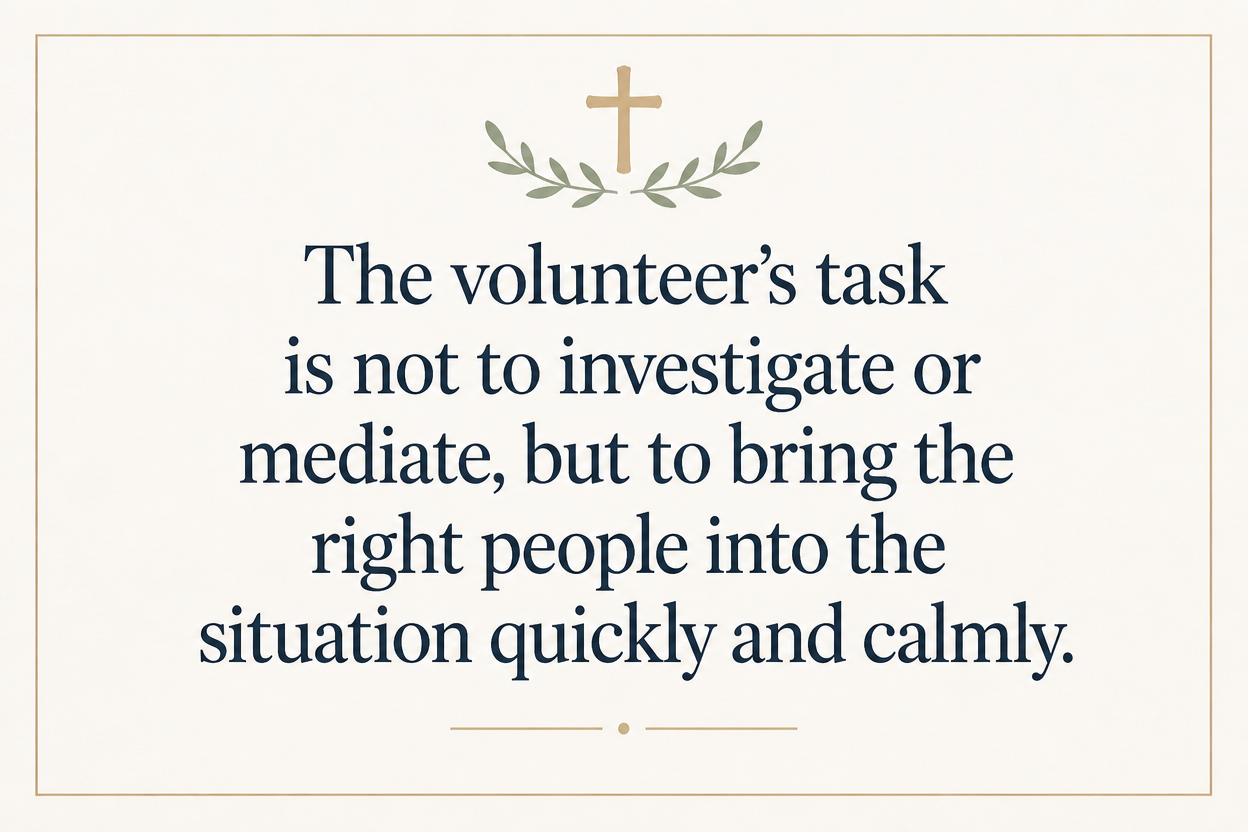
Any sign of immediate danger should go directly to staff: threats from a partner, stalking, coercion, suicidal ideation, self-harm, or fear of going home. The volunteer’s task is not to investigate or mediate, but to bring the right people into the situation quickly and calmly.
The same applies to suspected abuse or trafficking. Reporting duties vary by state, and centers differ in how they structure mandatory reporting responsibilities. But from a donor’s standpoint, a credible ministry will have written policies, staff training, and clear escalation pathways. When those elements are present, volunteers can act decisively without improvisation.
Refer when the client’s story involves trauma, complex grief, or mental health strain
Listening is holy work, but it has limits
Pregnancy decisions are often entangled with abandonment, shame, prior abortion experiences, infertility grief, or earlier sexual trauma. Volunteers may be able to listen with gentleness and pray if the client welcomes it, but they should refer when trauma disclosures arise, when the client becomes emotionally dysregulated, or when the conversation turns to deeper counseling needs.
Christians genuinely disagree about how explicitly pregnancy resource centers should describe their counseling services, and the field has had to reckon with inconsistent training levels across centers. The safest approach is clarity: volunteers offer presence and basic support; trained staff or licensed professionals address trauma counseling and mental health concerns.
When spiritual counsel shifts into counseling claims
Prayer and Scripture can be a true comfort, but volunteers should avoid presenting spiritual counsel as a substitute for clinical care. If a client expresses panic attacks, depression symptoms, intrusive thoughts, or substance relapse risk, the referral should be immediate. This is not secular deference; it is prudent love of neighbor. Proverbs commends wise counsel (Proverbs 15:22), and wisdom includes knowing when specialized care is needed.
- Disclosures of past sexual abuse, assault, or coercion
- Statements suggesting self-harm, hopelessness, or suicidal thoughts
- Severe anxiety, dissociation, or inability to continue a coherent conversation
- Substance use that feels uncontrolled or tied to safety risks
- Complex grief such as miscarriage, stillbirth, or prior abortion trauma needing trained support
Refer whenever a volunteer is being asked to promise outcomes, money, or confidentiality
Material help must be governed, not improvised
Many centers provide tangible support: diapers, formula, parenting classes, referrals for housing, and sometimes direct assistance. Volunteers should never promise benefits, financial help, or timelines. Those commitments belong to staff who can apply policies consistently and document decisions fairly. Donors should want that restraint; it protects clients from favoritism and protects the ministry from quiet drift into unaccountable distribution.
The question is not whether generosity is good. It is whether generosity is governed. Ministries that meet the spirit of The Most Trusted Standard tend to show traceability: who approved aid, under what policy, and with what follow-up expectations, if any. That discipline is not cold; it is what allows a ministry to be faithful over time.
Confidentiality is sacred, but it is not limitless
Volunteers should refer when clients press for confidentiality beyond what the center can ethically or legally offer, or when the volunteer is uncertain about privacy boundaries. A credible center will explain confidentiality clearly, including exceptions for safety and reporting obligations. Volunteers should not improvise assurances such as “this never leaves this room” if the center’s policy includes mandated exceptions.
For donors assessing risk, clarity here matters. According to the U.S. Department of Health and Human Services, mandatory reporting laws vary by jurisdiction and by professional role, and organizations must train workers accordingly; uncertainty is an indicator of governance weakness rather than pastoral sensitivity (U.S. Department of Health and Human Services).
Refer when neutrality is being compromised or the situation is escalating
When a volunteer becomes the center of the decision
Clients sometimes attach quickly to the first person who seems safe. That bond can be a gift, but it can also become dependency if boundaries are unclear. Volunteers should refer when a client asks for personal contact outside the center, requests private meetings, or treats the volunteer as the sole trusted adviser. Staff can help re-center the relationship on the ministry’s care team rather than a single individual.
This is also where donors should think about safeguarding. Ministries that serve vulnerable people should have written boundaries around communication, social media contact, transportation, and after-hours interactions. A center that cannot articulate those boundaries may be placing both clients and volunteers in avoidable danger.
When conflict or pressure rises in the room
Volunteers should refer immediately if a boyfriend, parent, or other party enters and becomes controlling, aggressive, or manipulative, or if there is conflict over the client’s decisions. Staff are trained to de-escalate, to enforce facility rules, and to protect the client’s dignity without escalating risk. Volunteers should not attempt to “handle” intimidation.
What donors often miss is that these situations also affect staff wellbeing. The U.S. Bureau of Labor Statistics consistently lists high rates of workplace violence risk in healthcare and social assistance settings, which is one reason serious ministries invest in training and protocols rather than relying on goodwill (U.S. Bureau of Labor Statistics).
For readers supporting Pregnancy Resource Centers, referral culture is one of the most telling operational signals: it shows whether the ministry understands the weight of its work, and whether it has built the structures necessary to carry that weight faithfully.
FAQs for When should volunteers refer to pregnancy resource center staff
Should a volunteer refer even if the client asks them not to involve staff?
Yes, when the issue involves safety, mandated reporting, medical questions, or any boundary the volunteer is not authorized to manage. A volunteer can honor the client’s dignity by explaining the reason plainly: the center brings staff in to protect the client, ensure accuracy, and keep promises the ministry can actually keep. Respect does not require secrecy; it requires honest boundaries.
What if the volunteer is a nurse, counselor, or attorney in their day job?
The center should still require referral unless that professional role has been formally assigned, supervised, and covered by the center’s policies and liability arrangements. Professional competence does not automatically translate into authorized ministry practice. The ministry’s obligation is not merely to have expertise present, but to have accountability structures around how that expertise is used.
Supporters of Volunteering at Pregnancy Resource Centers should insist on this principle: volunteers serve best when they can be fully present without being forced into judgments they were never trained or authorized to make. Referral is one of the simplest ways a center practices humility, protects clients, and honors the trust donors place in Christian ministry.
Referral discipline is part of Christian witness
Pregnancy resource center work sits at a sensitive intersection of bodily vulnerability, moral conviction, and social pressure. In that context, referral is not merely administrative. It is a form of truthfulness: acknowledging what we do and do not know, what we can and cannot promise, and who must take responsibility for the next step. Donors should support centers that treat referral as a normal expression of mature care, ordered under clear governance and shaped by love of neighbor.



