

A faithful question for Christian donors is what a pregnancy resource center budget includes, and whether those line items reflect both conviction and competence. Budgets are moral documents: they reveal what a ministry believes is necessary to love neighbor well, protect the vulnerable, and operate without manipulation or confusion.
Pregnancy resource centers sit at an unusual intersection of pastoral care, public health realities, legal risk, and contested cultural narratives. That combination produces budgets that can look unfamiliar to donors who mostly support churches, missionaries, or overseas relief. Understanding the major budget categories helps donors evaluate whether a center is prepared to serve clients with dignity, safeguard volunteers and staff, and steward restricted gifts without drifting from mission.
Budget categories reflect both mission and accountability
A pregnancy resource center is typically a local ministry with a clinical-adjacent footprint. Some centers are licensed medical clinics; others are non-medical centers focused on education, material support, and referrals. That distinction matters because it drives major cost differences in staffing, insurance, equipment, and compliance.
Across our verification work at Most Trusted, the centers and networks that meet The Most Trusted Standard tend to treat budgeting as a form of truth-telling. They name real costs, separate restricted funds from general operations, and budget for governance and compliance rather than treating them as optional.
Medical model and non-medical model drive different cost structures
Licensed clinics commonly carry costs associated with medical directors, licensed nurses or sonographers, clinical training, quality assurance, HIPAA-related practices, and medical malpractice coverage. Non-medical centers may still have meaningful professional costs, especially around counseling supervision, mandated reporting training, and facility safety, but they are less likely to carry clinical overhead.
Budgets should be legible to donors without becoming simplistic
Christian donors are often trained to ask about “overhead,” but the field has had to reckon with the fact that a low overhead number can signal underinvestment in controls, staff care, and program quality. The joint statement known as the Overhead Myth, issued by GuideStar, Charity Navigator, and BBB Wise Giving Alliance, warns donors against using overhead ratios as a primary measure of effectiveness and encourages attention to outcomes and governance instead https://www.guidestar.org.
What this means in practice is that a healthy pregnancy resource center budget will include administrative and governance costs that protect clients and donors alike, even when those lines are less emotionally satisfying than diapers or ultrasound images.

Program expenses are more than supplies and appointments
Donors often picture program spending as baby items, pregnancy tests, or ultrasound services. Those can be meaningful components, but the deeper program expense is the cost of providing consistent, trauma-aware care that does not promise what it cannot deliver and does not abandon a client when a relationship becomes complicated.
Client services and care pathways
Many centers budget for a set of core services: options counseling, parenting education, material assistance, community referrals, and follow-up. The cost is not only what is placed in a client’s hands but also the time required to do careful intake, document interactions appropriately, coordinate referrals, and maintain continuity.
Centers that offer ultrasound or other limited medical services often budget for training, equipment maintenance, and quality oversight. A donor evaluating this category should ask whether the center’s service list matches its staffing model and whether the budget recognizes the real cost of compassionate consistency.
Material assistance and program inventory controls
Diapers, wipes, formula, car seats, and maternity clothing are visible expressions of care, but they also require inventory controls. A responsible budget includes shelving and storage, tracking systems, and clear policies for receiving, sorting, and distributing gifts-in-kind.
A well-run center typically distinguishes between program inventory purchased with cash and donated goods received from the community. That distinction protects against inflated reporting and helps the board understand what it actually costs to keep the ministry functioning week to week. Donors interested in how gifts are translated into services often find helpful context in How Pregnancy Resource Centers Use Donations.
- Client education curricula and teaching materials
- Program supplies and medical-adjacent consumables
- Referral partnerships and care coordination time
- Inventory management for donated goods
- Follow-up and post-appointment support
People costs are usually the largest and most mission-critical line
If Christian donors want to know what a center truly prioritizes, staffing is often the clearest window. A pregnancy resource center’s work is deeply relational. That requires emotional steadiness, training, supervision, and structures that protect both the client and the ministry from drift or harm.
Staff roles and compensation philosophy
Common paid roles include an executive director, client services staff, a development or church liaison role, and operations support. Licensed clinics may add nurses, sonographers, a nurse manager, and a medical director. Even when volunteers provide significant capacity, a center usually needs paid staff to ensure consistency, training, documentation, and accountability.
The harder question is not whether a center has volunteers, but whether it has enough skilled leadership to train them and set boundaries. Understaffing can produce spiritualized burnout, high turnover, and inconsistent care. Scripture’s concern for just weights and measures applies here: donors should not quietly pressure ministries to operate on less than is honest.
Volunteer systems, training, and safeguarding
Many centers depend on volunteers for client mentoring, reception, parenting classes, and material assistance programs. A serious budget allocates funds for background checks, volunteer training, supervision, and policies that reduce risk. That includes safeguarding protocols for interactions with minors, clear documentation standards, and escalation pathways when a client discloses abuse or coercion.
Budgets that ignore training and supervision often rely on goodwill to cover what should be planned. Goodwill is not a control environment.
Facilities, insurance, and compliance are part of loving clients well
Pregnancy resource centers frequently operate in older buildings, donated spaces, or repurposed offices. Facility costs may not feel “programmatic,” but they directly shape whether clients are served with dignity and privacy.
Occupancy and client confidentiality
Typical facility lines include rent or mortgage, utilities, janitorial services, security systems, and modest renovations to ensure accessibility and private counseling rooms. Confidentiality is not only an ethical commitment but a practical requirement for a ministry working with sensitive information. A budget that funds privacy measures is funding faithful neighbor-love.
For centers offering clinical services, physical space may need to meet additional requirements around storage, infection control practices, and equipment placement. Those costs are real even when a center is not billing insurance.
Insurance and risk management
Common policies include general liability, directors and officers coverage, property insurance, workers’ compensation, and—where applicable—medical malpractice. Donors sometimes balk at insurance premiums, but insurance is a form of preparedness. It protects the ministry’s ability to continue serving when something goes wrong.
The regulatory environment differs by state and by service model, and Christians genuinely disagree about the best approach to legal and public policy engagement. Whatever a center’s posture, it should budget for appropriate counsel and compliance rather than improvising under pressure.
Development, communications, and governance expenses should be tested for integrity
Pregnancy resource centers must raise funds, communicate clearly, and maintain board oversight. These functions can be done with integrity or with distortion. Budgets provide clues about which path a ministry is taking.
Fundraising is a stewardship function, not a necessary evil
Development costs often include donor software, printing, postage, events, grant-writing support, and staff time spent with churches and individual supporters. The question for donors is not whether fundraising costs exist, but whether the fundraising posture is truthful. Appeals should avoid inflated claims, implied guarantees, or emotional manipulation.
Centers sometimes receive restricted gifts for ultrasounds, building projects, or specific client programs. A responsible budget and accounting system must track those restrictions carefully. Donors can reasonably ask whether restricted gifts are segregated, whether the board reviews restricted fund balances, and whether the ministry communicates clearly when needs change.
Governance, audits, and transparency are not optional line items
Sound governance has costs: board training, policy development, outside bookkeeping support, and—depending on size—financial reviews or audits. Donors should not assume that an audit is required for every small center, but they can ask what external financial oversight exists and why it is appropriate for the organization’s size and risk profile.
Where budgets include executive compensation, related-party transactions, or shared services with a partner organization, transparency is essential. The ministries that meet The Most Trusted Standard tend to disclose these realities plainly because credibility is a ministry asset, not a branding strategy. For broader context on the ministry landscape, many donors also consult Pregnancy Resource Centers as they compare models and practices.
FAQs for What a pregnancy resource center budget includes
What percentage of a pregnancy resource center budget should go to program services?
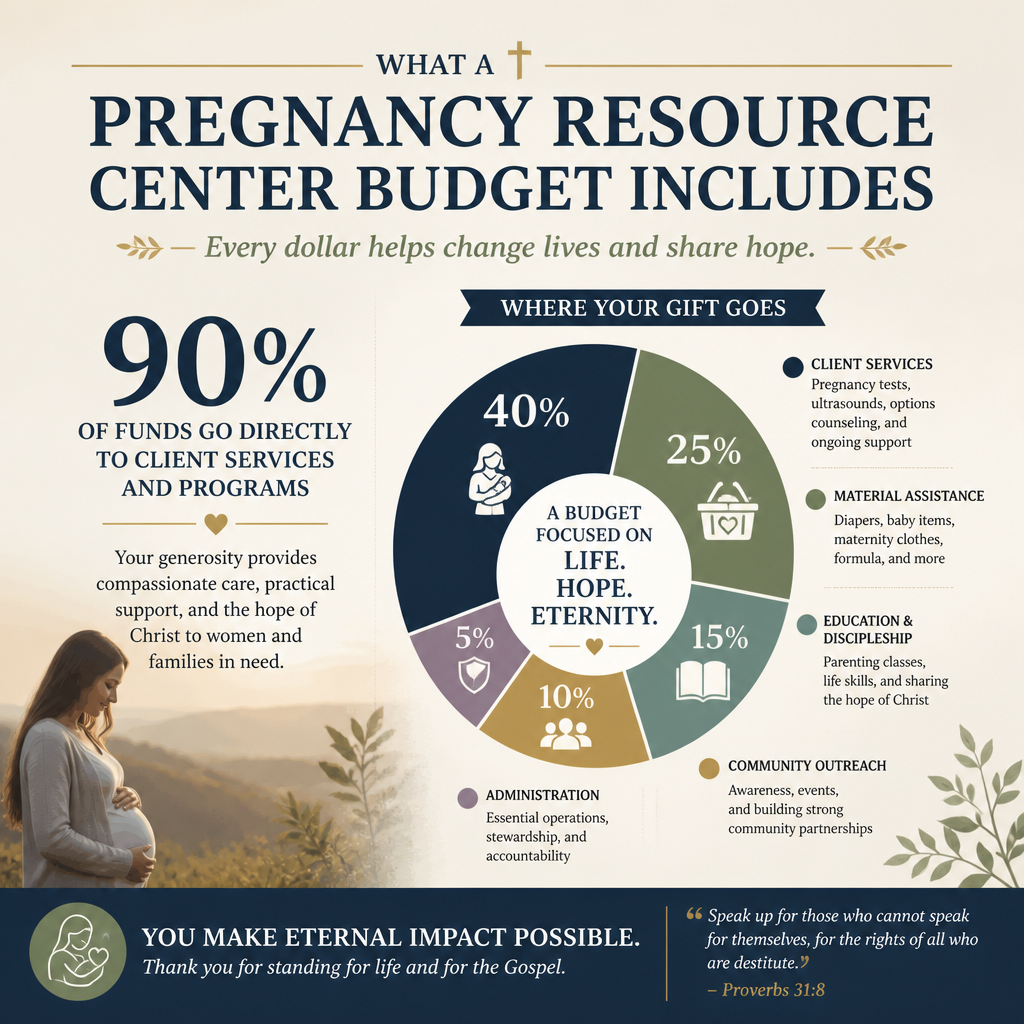
No single percentage reliably indicates faithfulness or effectiveness. Program ratios can be distorted by gifts-in-kind valuation, underinvestment in controls, or a staffing model that cannot sustain quality. We recommend asking whether program spending is defined consistently, whether financial statements clearly separate program, administration, and fundraising, and whether governance and client-safety functions are adequately funded, consistent with the Overhead Myth guidance from GuideStar, Charity Navigator, and BBB Wise Giving Alliance https://www.guidestar.org.
Why do some pregnancy resource centers spend money on marketing or communications?
Centers often need communications to reach clients who are actively seeking help, to inform churches of services, and to correct misunderstandings about what the center does and does not provide. The integrity question is whether communications are truthful, non-coercive, and aligned with the center’s service model. Donors can ask to see sample materials, the policy for medical and non-medical claims, and how the center measures whether outreach is connecting clients to substantive care rather than merely generating attention.
A budget is one of the clearest windows into a center’s theology of stewardship
Christian donors give to pregnancy resource centers because the stakes are personal: mothers, fathers, children, and the church’s credibility in public love. A budget that includes training, safeguarding, transparency, and appropriate professional oversight is not a departure from mission; it is often the cost of honoring the people a center serves. When donors read budgets with both discernment and charity, they are better positioned to fund ministries that pair conviction with competence.



