
When should pastors refer to pregnancy resource centers? Pastoral referral is most appropriate when a church is committed to both moral clarity and practical care, and when a local center has demonstrated the competence, confidentiality, and integrity required to serve mothers, fathers, and families well.
Many Christian donors want to see churches and pregnancy resource centers collaborate, but mature collaboration is not automatic. It requires discernment about clinical boundaries, legal realities, spiritual care, and the difference between compassionate presence and coercive pressure. Pastors are often the first trusted voice a pregnant woman hears; referral practices can either strengthen a woman’s stability or deepen her vulnerability.
Pastoral referral begins with a theology of neighbor and truth
Referral is an act of pastoral care, not a handoff of responsibility
Scripture does not separate truth from mercy. When the people of God are commanded to “open your hand to the poor and needy” (Deuteronomy 15:11), the command assumes proximity and responsibility, not delegation. Pastors refer because the Body of Christ has multiple gifts and competencies, not because the church is absolved of care.
A pregnancy resource center can provide professional services and material support that many congregations cannot sustain: limited medical services where licensed, evidence-based education, case management, fatherhood mentoring, and practical assistance. But referral should be framed as an extension of pastoral care—paired with ongoing church support in friendship, discipleship, and concrete help.
Christians genuinely disagree about tactics, but not about human dignity
The field has had to reckon with public skepticism about whether pregnancy centers are transparent about services, medical oversight, and client confidentiality. Some criticism is politically motivated; some is rooted in documented failures within the broader nonprofit sector. Pastors serve their people well when they name the tension plainly and then act with accountability. Referral is not only about shared convictions; it is about demonstrated practices that honor the imago Dei in frightened, pressured, and sometimes traumatized clients.

Refer when a woman needs specialized care the church should not improvise
Medical, legal, and trauma-informed support require clear boundaries
Pastors are not clinicians, and many situations around pregnancy carry medical and legal implications. Referral is appropriate when a woman needs pregnancy confirmation, ultrasound where offered under licensed oversight, STI testing where available, or care coordination for prenatal services. Referral is also appropriate when there are signs of coercion, domestic violence, trafficking, or acute mental-health risk. Churches can and should be present; they should not pretend expertise they do not have.
Even where a pregnancy resource center is explicitly Christian, it should be able to articulate policies that separate pastoral counsel from medical care, clarify staff credentials, and protect clients from spiritual manipulation. The goal is not to sanitize the gospel; it is to ensure that spiritual care is offered as invitation, not as a condition for receiving help.
When the presenting need is practical stability, not merely a decision
Many women do not primarily need a debate partner; they need stability: housing, food, employment pathways, transportation, and relational support. Pregnancy resource centers vary widely in how well they provide or coordinate these resources. A pastor should refer when the center has demonstrated capacity for ongoing support rather than a single appointment that ends once a pregnancy test is positive.
For donors who care about measurable outcomes, it is worth remembering that the nonprofit sector has learned to value “outputs” less and “actual results” more. The question is not only how many diapers are distributed; it is whether families move toward safety, stability, and durable support.
Refer when the center has earned trust through transparent, verifiable practices
What pastors should verify before recommending a center
Church leaders are stewards of trust. When a pastor refers, the church is implicitly endorsing the organization’s governance, financial ethics, and client care. Across our verification work at Most Trusted, we observe that ministries with mature oversight tend to be more consistent in client experience, less prone to crisis, and more honest about limitations. This is part of why our team evaluates Christian nonprofits against The Most Trusted Standard, a 15-criteria framework spanning faith commitments, financial integrity, governance, and transparency of outcomes.
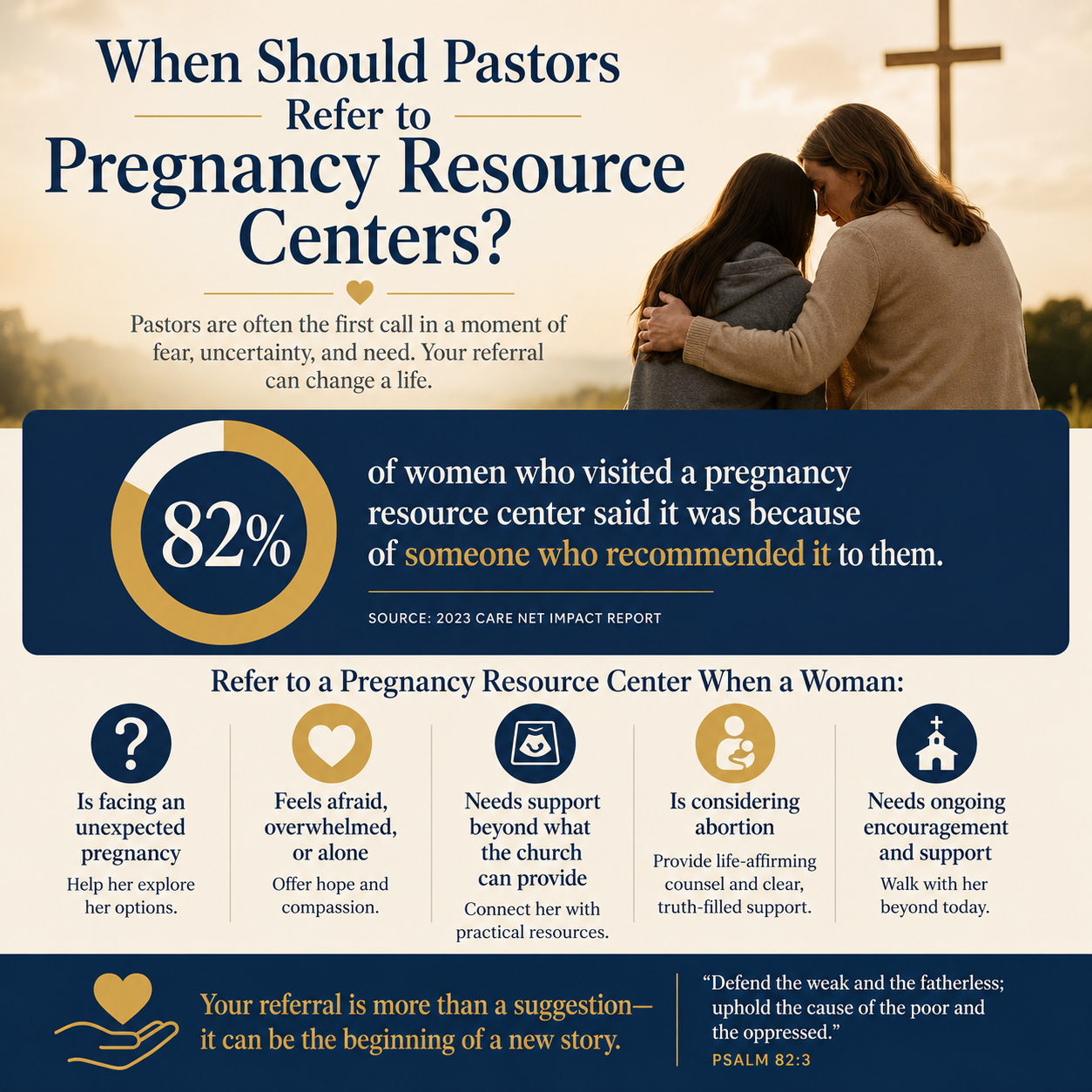
Before building a routine referral pathway, pastors should confirm basic indicators of credibility. A short checklist can prevent long-term harm:
- Clear description of services offered, including what is not offered, stated in plain language
- Written confidentiality policies and a credible approach to mandated reporting where applicable
- Evidence of licensed medical oversight for any medical services claimed
- Transparent financial reporting and accountable governance
- Demonstrated referral network for needs the center cannot meet, including prenatal care and counseling
Public accountability is not a replacement for spiritual discernment, but it is a biblical instinct. Paul’s language about “aiming at what is honorable… in the sight of man” (2 Corinthians 8:21) was written in the context of handling financial gifts. The principle applies to any ministry entrusted with vulnerable people.
A note on outcomes and the temptation to oversimplify
Pregnancy resource centers operate in contested terrain. Some outcomes are hard to quantify: reduced isolation, increased paternal involvement, improved resilience, the rebuilding of agency after coercion. Donors and pastors should resist metrics that reward only volume or speed. We have learned from broader nonprofit research that perverse incentives are real, and that “what is measured” can quietly become “what is valued.”
What this means in practice is that pastors should ask not only, “Does this center share our convictions?” but also, “Can this center show us how it serves clients, what safeguards it uses, and how it learns when it fails?” For donors who want to support this work responsibly, the broader context of How Pregnancy Resource Centers Build Community Partnerships is often where the most revealing signs of maturity appear: strong centers collaborate humbly, refer out appropriately, and maintain clarity about their role.
Refer early, but not indiscriminately
When timing matters for a mother’s safety and agency
Referral is often most helpful early, when a woman is still gathering information and her sense of isolation is acute. Yet “early” should not mean “impulsive.” Pastors should avoid reflexive referrals that treat a complex situation as a single-issue problem. A wise pastoral posture asks questions first: Is she safe? Is she being pressured? Does she have a support system? Does she need medical care immediately? Does she want someone to accompany her?
Donors sometimes assume the only meaningful moment is the decision about abortion. In reality, the decisive moments can occur later: whether she has stable housing at seven months, whether she has childcare options after delivery, whether the father is engaged or exploitative, whether postpartum depression is recognized, whether the church follows through once the crisis feeling subsides.
When referral is not appropriate or should be paired with other action
There are circumstances where referring to a pregnancy resource center alone is insufficient. If there is immediate danger, mandatory reporting issues, or urgent medical need, pastors should prioritize emergency services and professional medical providers. If the center is not medically licensed, it should not be treated as a substitute for prenatal care.
Referral should also be accompanied by pastoral care plans that do not collapse into surveillance. A young woman may fear that her story will become a church project. Churches should model confidentiality, permission-based support, and long-term presence.
Refer as part of a partnership that serves the whole family
Build a two-way pathway, not a one-way pipeline
The healthiest partnerships treat pregnancy resource centers as part of a local ecosystem, not as a vendor. That means pastors and elders communicate with the center about what the church can reliably provide: mentoring, meals, baby showers that preserve dignity, transportation, job connections, adoption and foster care counsel when requested, and spiritual community for those who desire it.
This is also where donors can help churches lead with wisdom rather than emotion. Giving that is tethered to accountability tends to strengthen the long-term viability of local care networks. A clear way to understand the broader landscape is through Pregnancy Resource Centers, where the question is not only whether a center exists, but whether it is governed and resourced in a way that will endure and serve well.
Include fathers, and do not sentimentalize the difficulty
Many centers have expanded fatherhood initiatives because maternal support alone does not address the relational and economic realities many families face. Pastoral referral should include fathers when it is safe and appropriate. It should also acknowledge hard cases: abandonment, manipulation, addiction, and unstable housing. Christian compassion does not require naïveté. It requires truth-telling in the service of genuine healing.
Where churches have the capacity, referral should be paired with tangible commitments that reduce pressure on the mother: rent assistance administered with accountability, skilled counseling referrals, legal aid referrals where appropriate, and a community prepared to remain present after birth. The New Testament’s vision of the church’s life together assumes burdens that are shared rather than outsourced (Galatians 6:2).
FAQs for When should pastors refer to pregnancy resource centers
Should a pastor refer before confirming the pregnancy medically?
Referral can be appropriate even before medical confirmation if the goal is immediate support and accurate information, but pastors should not treat any center as a substitute for prenatal medical care. If the center offers pregnancy testing or ultrasound, pastors should confirm that medical services are provided under appropriate licensed oversight and with clear disclosure about the scope of care.
What should a pastor do if a local pregnancy resource center has a poor reputation?
Pastors should take reputational concerns seriously without surrendering to hearsay. The responsible step is to verify: review public reporting, meet leadership, ask about clinical oversight and confidentiality practices, and speak with trusted local professionals who can assess competence. If concerns remain unresolved, referral should be withheld and alternative pathways pursued through licensed medical providers and vetted community services.
Pastoral referral as faithful stewardship
Pastors should refer to pregnancy resource centers when referral strengthens truth, protects the vulnerable, and connects families to competent care the church should not attempt to provide alone. The church’s calling is not merely to win an argument about life, but to embody a community where life is genuinely bearable. For Christian donors, the most constructive support is often the kind that helps local churches and centers build accountable, enduring partnerships marked by both conviction and mercy.



