
How pastoral counseling works in pastoral support ministries is not primarily a technique. It is a form of spiritual care in which a trained pastor or counselor brings Scripture, prayer, wise listening, and practical support to bear on real human suffering, while also respecting the limits of pastoral competence and the legitimate role of clinical mental health care. Donors often assume “counseling” means a single model; in practice, faithful ministries have to hold together theological conviction, trauma awareness, confidentiality, and clear referral pathways.
What this means for Christian donors is straightforward: the ministries worth supporting do not promise quick fixes, nor do they drift into vague spirituality detached from the local church. They build trustworthy systems for care—systems that protect the vulnerable, honor Christ, and make outcomes and safeguards visible enough for responsible stewardship.
Pastoral counseling begins with a theological view of the person
Pastoral counseling in a Christian ministry starts with anthropology: human beings are created in the image of God, fallen, redeemable, and embodied. A faithful counseling approach refuses two common reductions—treating spiritual struggle as merely psychological, and treating psychological distress as merely spiritual. Scripture names suffering that is moral, relational, spiritual, physical, and social, sometimes all at once (Psalm 42; 2 Corinthians 1:3–4).
Christians genuinely disagree about how to parse categories like “mental illness,” “demonic oppression,” “trauma,” and “sin patterns.” Mature pastoral support ministries do not flatten those disagreements into slogans. They clarify their doctrinal commitments, articulate how they understand sanctification and suffering, and specify how those commitments shape their care practices.
What the care relationship is for
Pastoral counseling aims at more than symptom relief. It seeks renewed love of God and neighbor, truthful self-understanding before God, and wise engagement with the realities that constrain a person’s life. In many settings that includes helping a counselee interpret suffering without despair, repent without self-hatred, and seek reconciliation without enabling abuse.
What pastoral counseling is not
Faithful ministries avoid presenting pastoral counseling as a substitute for medical treatment, licensed psychotherapy, or emergency services. When risk is high—suicidality, active abuse, psychosis, substance withdrawal—pastoral care must be integrated with professionals and, when required, civil authorities. The pastoral role can be vital in those moments, but it is not sufficient by itself.

Sound ministries define scope of care and referral boundaries
The quality of pastoral counseling in pastoral support ministries is often revealed less by what they offer than by what they refuse to do. Clear scope of practice protects the counselee and the ministry. It also protects donors from inadvertently funding harmful overreach.
In the United States, many forms of counseling practice are regulated by state law. Ministries that provide counseling services typically must navigate licensing requirements, mandated reporting, and recordkeeping expectations. When counseling is offered by ordained clergy, there are often specific legal considerations for “clergy counseling,” but those do not eliminate the need for competence and proper safeguards.
Referral networks are a mark of humility, not compromise
The best pastoral support ministries cultivate referral relationships with licensed Christian counselors, psychiatrists, primary care physicians, domestic violence advocates, and local churches. This is not a concession to secularism. It is a recognition that God’s common grace includes legitimate forms of expertise, and that love requires appropriate help when spiritual care alone is not enough.
From a donor perspective, it is worth asking whether a ministry can name the circumstances under which they refer out, how they follow up, and how they prevent counselees from falling through gaps in care.
Why boundaries are spiritually meaningful
Boundaries are not merely legal risk management. They are a form of truth-telling. When a ministry claims authority it does not have, it misrepresents both the nature of pastoral care and the realities of complex suffering. By contrast, ministries that establish boundaries bear honest witness to the limits of human help and the necessity of the body of Christ working in concert.
Effective pastoral counseling uses structured practices, not improvisation
Many donors have seen “pastoral counseling” done as informal conversations with little consistency. Some informal care is appropriate; the danger is that unstructured counseling can become personality-driven, uneven in quality, and difficult to supervise. Strong pastoral support ministries use repeatable practices and supervision that can be explained and evaluated.
Intake, assessment, and goals
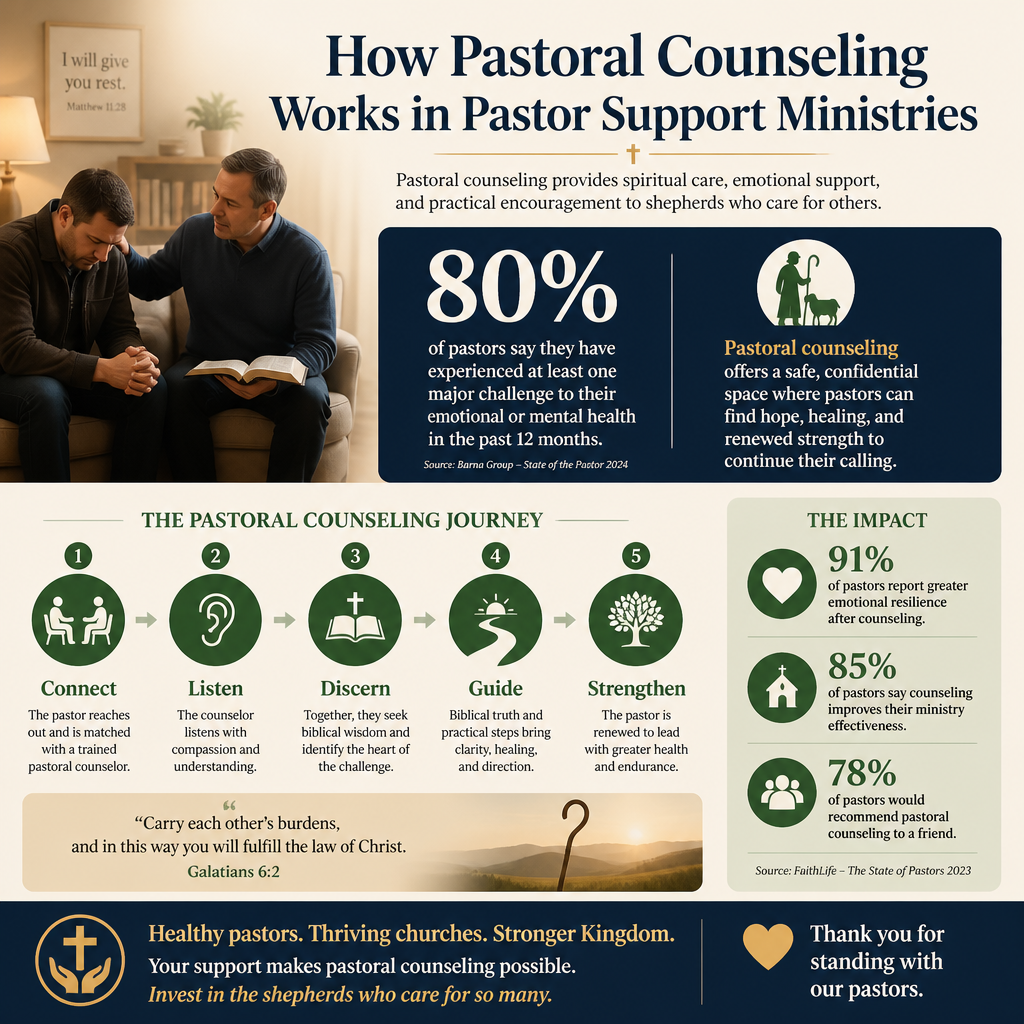
Responsible ministries begin with an intake process that screens for safety risks, clarifies presenting concerns, and sets expectations about confidentiality and its limits. They establish goals that are specific enough to guide care without pretending that spiritual growth can be reduced to metrics. Many ministries use brief screening tools for depression or anxiety as part of a larger pastoral assessment; donors should not expect these tools to replace clinical diagnosis, but they can improve clarity and triage.
When we evaluate ministries at Most Trusted, we look for practices that demonstrate both compassion and order: documented policies, training expectations, supervision, and evidence that leadership understands risk. These are not secondary concerns. They are part of what it means to serve the vulnerable in a way that is worthy of trust.
Core elements in a counseling session
The content of sessions varies by tradition and by the nature of the problem, but mature pastoral counseling commonly includes careful listening, biblical framing, prayer that is neither coercive nor performative, and practical next steps. Theologically serious ministries avoid using Scripture as a blunt instrument. They labor to apply Scripture as the living word that comforts the afflicted and afflicts the comfortable, with discernment about which is needed in a given moment.
- Clarifying the counselee’s story and current pressures
- Identifying spiritual, relational, and behavioral patterns that sustain suffering
- Applying Scripture in context rather than by isolated proof texts
- Practicing prayer and spiritual disciplines suited to the counselee’s capacity
- Assigning practical steps, including reconciliation efforts or protective boundaries
Safeguarding and confidentiality are central to faithful care
Pastoral counseling often brings forward the most sensitive material in a person’s life: sexual sin, addiction, suicidal ideation, marital breakdown, abuse, shame, and spiritual doubt. The moral responsibility here is weighty. Donors should expect ministries to take confidentiality seriously while also communicating clearly that confidentiality has limits—especially where abuse, threats of harm, or mandatory reporting laws apply.
Confidentiality that serves truth and protection
Some church contexts have mishandled confidentiality in both directions: either treating it casually, or treating it as absolute in ways that enable harm. Faithful ministries distinguish between privacy, secrecy, and protection. They explain who has access to records, how information is stored, and what circumstances require disclosure. In the United States, mandated reporting for suspected child abuse is widely recognized across jurisdictions, and ministries should have written procedures that staff can follow under pressure. For general background on child maltreatment and reporting considerations, donors can consult the U.S. Department of Health and Human Services resources on child welfare: U.S. Department of Health and Human Services.
Abuse-informed pastoral care
The church has had to reckon with grievous failures in handling abuse. Pastoral counseling that urges premature reconciliation, ignores power dynamics, or pressures a victim to “forgive and forget” can compound trauma and place people in danger. Sound ministries train staff to recognize signs of coercive control and to prioritize safety. They understand that forgiveness is not the same as access, and reconciliation is not the same as the absence of consequences.
What donors should look for when funding pastoral support ministries
Donors are not expected to adjudicate clinical debates, but donors are responsible to fund ministries that practice care with integrity. The question is not whether a ministry uses the “right” buzzwords. The question is whether the ministry can demonstrate governance, competence, and transparency consistent with Christian ethics and basic public accountability.
Across our verification work at Most Trusted, the ministries that meet The Most Trusted Standard tend to be unusually clear about leadership accountability, financial stewardship, and the line between pastoral care and clinical care. They also tend to communicate about outcomes and safeguards without turning suffering into marketing content.
Due diligence questions that reveal maturity
Before giving, donors can ask a short set of questions that quickly distinguishes mature ministries from improvised ones:
- Who provides counseling, and what training and supervision do they receive?
- What is your written policy on confidentiality and mandated reporting?
- How do you triage high-risk cases and coordinate referrals?
- How do you prevent spiritual manipulation and protect counselee agency?
- How do you measure faithfulness and effectiveness without exploiting stories?
To place these questions in the wider landscape of ministry models and accountability expectations, donors can consult our coverage of Pastoral Support Ministries and our related work on Pastoral Support Ministries for Counseling and Crisis Care.
Why transparency is not a threat to pastoral care
Some leaders worry that transparency will chill spiritual intimacy, turning ministry into bureaucracy. The tension is real: counseling requires privacy, and care cannot be reduced to public reporting. Yet donors have a legitimate interest in whether a ministry has safeguards, qualified leadership, and responsible finances. Transparency does not require publishing private details; it requires publishing policies, governance structures, and credible descriptions of practice.
Independent verification can serve both sides of that tension. Done well, it protects the sacredness of pastoral care while ensuring that funds support ministries that handle people, power, and money with sobriety.
FAQs for How pastoral counseling works in pastoral support ministries
How is pastoral counseling different from professional therapy?
Pastoral counseling is explicitly theological and ecclesial: it aims to bring Scripture, prayer, and Christian wisdom to bear on suffering within a framework of discipleship and spiritual formation. Professional therapy is typically grounded in clinical training, regulated scopes of practice, and evidence-based modalities for diagnosing and treating mental health conditions. Many faithful pastoral support ministries integrate both by offering pastoral counseling while maintaining referral pathways to licensed clinicians when needs exceed pastoral competence.
Should donors prioritize ministries with licensed counselors on staff?
Licensed clinicians can strengthen a ministry’s capacity, especially for complex trauma, severe depression, and risk assessment. However, licensing alone does not guarantee theological fidelity, wise governance, or safe ministry culture. Donors should look for a coherent model: clear doctrinal commitments, qualified care providers, strong safeguarding policies, financial integrity, and transparent leadership accountability consistent with The Most Trusted Standard.
A mature view of pastoral counseling is a stewardship issue
Pastoral counseling in pastoral support ministries is one of the church’s most direct responses to Christ’s call to bind up the brokenhearted and bear one another’s burdens. That calling is too serious for improvisation. Donors serve the church well when they fund ministries that can demonstrate both spiritual depth and operational trustworthiness—care that is tender with people and honest about limits, anchored in Scripture and disciplined by accountability.



