

To set up a legacy gift for pastoral support ministries is to make a long obedience in the same direction: providing for those who labor in preaching, shepherding, and care long after our own giving has ended. Many Christian donors sense a particular urgency here because the strain on pastors is not theoretical; it is borne in bodies, marriages, congregations, and communities, and too often it is carried in isolation.
Legacy giving can meet that strain with a different kind of stability. It does not replace annual generosity, nor does it solve every systemic problem in church life. But it can underwrite the patient work that keeps faithful ministry from becoming unsustainable: counseling access, sabbaticals, emergency grants, spiritual direction, continuing education, and practical care that preserves pastoral integrity rather than merely prolonging burnout.
Why legacy giving belongs in pastoral care
Pastoral support is not ancillary to mission
Scripture refuses to treat shepherding as an optional program. The New Testament assumes that the church will be led, taught, and tended by those set apart for that work, and it instructs believers to honor that labor with concrete provision. When Paul writes, “Let the one who is taught the word share all good things with the one who teaches” (Galatians 6:6), he is not describing a sentimental appreciation. He is establishing a moral economy that recognizes spiritual labor as real labor.
Pastoral support ministries extend that economy beyond a single congregation’s capacity. Some churches can fund sabbaticals and counseling well; many cannot. A ministry designed to carry pastors through crisis, transition, or long seasons of pressure functions as a form of mutual aid in the household of faith—especially where rural pastors, bivocational leaders, and smaller congregations bear disproportionate burdens.
Legacy gifts support long-term formation, not only short-term relief
Christians rightly give toward urgent needs: benevolence, disaster relief, and immediate interventions. Pastoral support ministries often address urgent needs as well, but their deeper work is preventative and formative: helping pastors remain healthy enough to lead wisely. That kind of work rarely fits the attention cycle of modern fundraising.
Legacy gifts can fund the unglamorous essentials: clinician partnerships, vetted retreat centers, spiritual direction networks, and reserve funds that allow a ministry to say “yes” when a pastor calls in distress. This is not about preserving an institution for its own sake. It is about strengthening the means by which Christ continues to shepherd his people through under-shepherds.
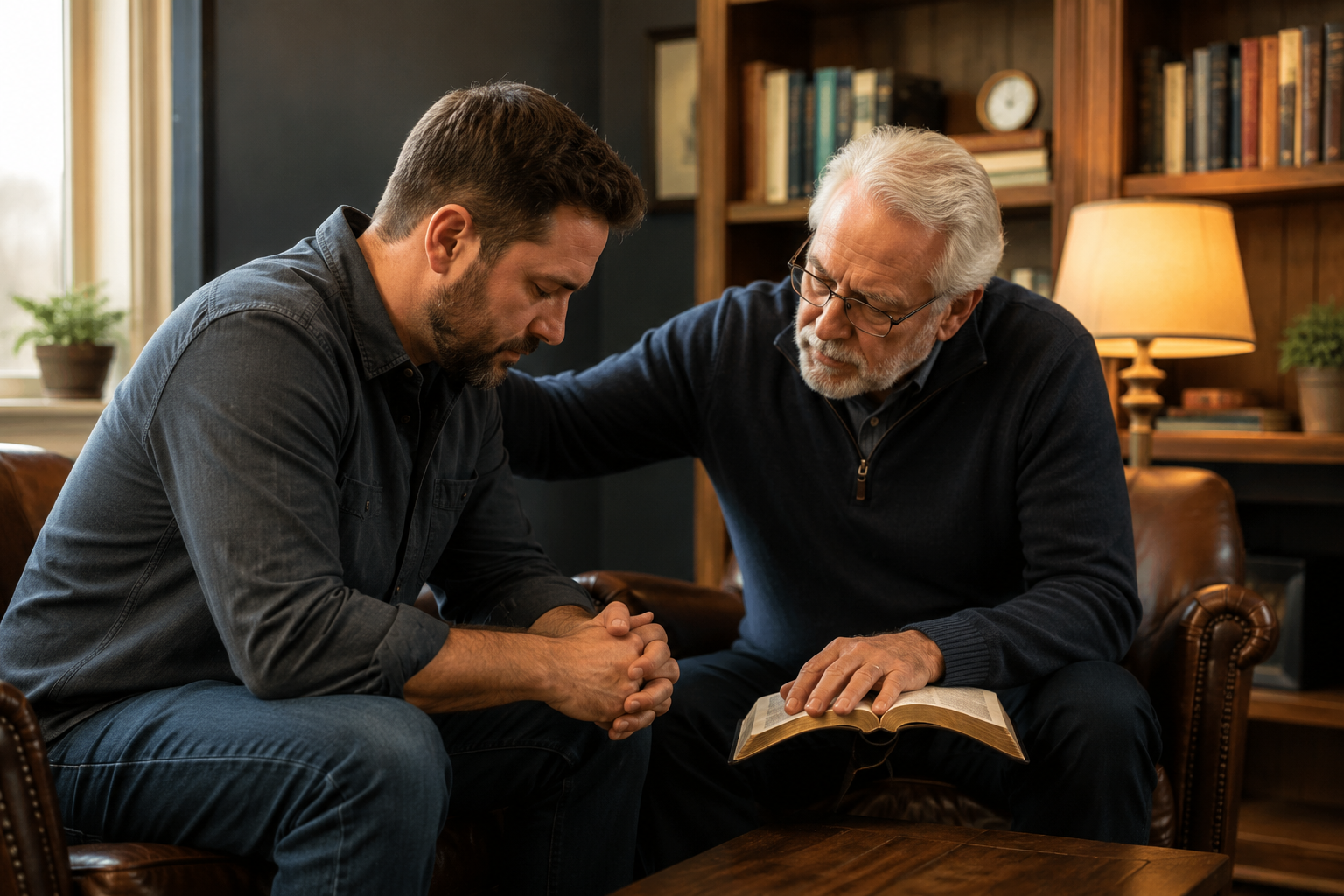
Clarify what you want your legacy gift to accomplish
Define the ministry outcomes you are actually underwriting
The phrase “pastoral support” covers a wide range. Some ministries focus on crisis response and emergency assistance; others focus on long-term pastoral health through coaching, counseling subsidies, peer cohorts, or sabbatical planning. A legacy gift becomes more coherent when it is tied to the kind of support you believe is most needed and most faithful.
Christians genuinely disagree about where to place emphasis. Some prioritize direct financial assistance to pastors in hardship. Others worry that cash assistance can unintentionally keep unhealthy ministry systems in place, and prefer structural supports such as counseling access, training in healthy boundaries, and leadership accountability. A mature legacy plan can acknowledge these tensions by supporting ministries that combine compassion with clear standards and wise triage.
Decide how constrained the gift should be
Donors often ask whether to restrict a legacy gift to a specific program. Restrictions can protect donor intent, but they also carry risk: programs change, needs shift, and a constraint that is too narrow can become unworkable. Many experienced planned giving officers recommend language that is purpose-driven but flexible, such as “for pastoral care and pastoral health initiatives, including counseling, retreat, sabbatical support, and related needs as determined by the board.”
What this means in practice is that the strongest legacy gifts tend to do two things at once: they honor the donor’s theological priorities, and they give the ministry enough discretion to respond to real conditions on the ground. The more long-term the gift, the more important that balance becomes.
Choose the right legacy gift vehicle and document it carefully
Common legacy gift options donors use
Most legacy gifts are not complicated, but they must be precise. The appropriate vehicle depends on your estate, your tax situation, and how you want the gift to function. Your attorney and tax advisor should draft and review the documents, but donors typically consider options such as these:
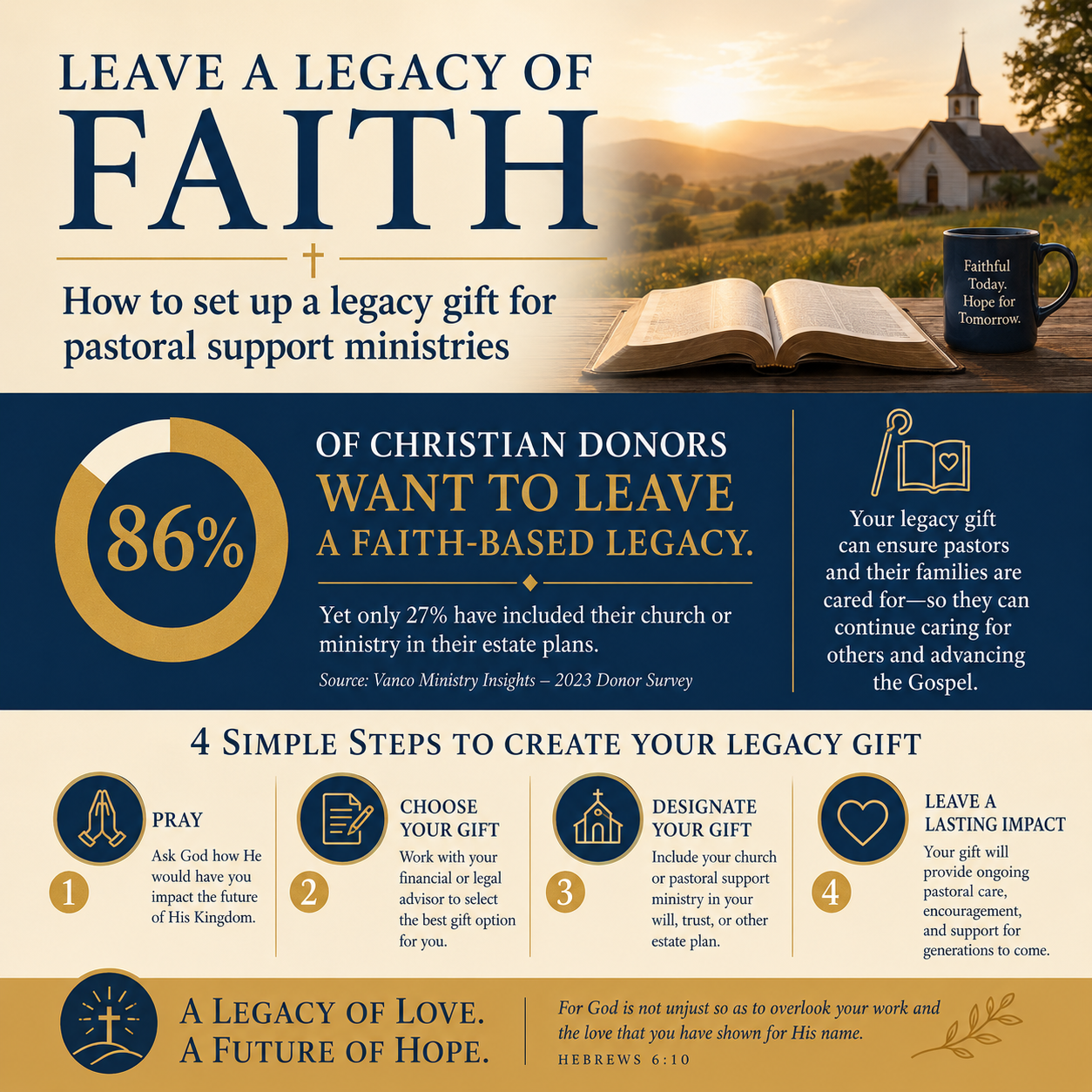
- Bequest in a will or trust: a specific dollar amount, a percentage, or a residuary gift after other obligations are met.
- Beneficiary designation: naming the ministry as beneficiary of an IRA, 401(k), life insurance policy, or donor-advised fund.
- Charitable remainder trust: income to you or others for a term, then the remainder to the ministry.
- Charitable gift annuity: a contract with fixed payments and a remainder to the charity.
- Gift of appreciated assets: property or securities transferred during life or at death, depending on your plan.
Use ministry-verified legal names and clear gift language
Planned gifts often fail in execution for simple reasons: outdated legal names, missing tax identification numbers, or ambiguous instructions. Before signing documents, confirm the ministry’s legal name, address, and IRS status, and store those details with your attorney and executor.
For donors who want to explore the broader landscape of pastoral care work, we maintain editorial research on Pastoral Support Ministries, including the kinds of programs donors commonly fund and the standards that tend to correlate with faithful stewardship.
Evaluate pastoral support ministries with disciplined trust
Legacy giving increases the need for governance clarity
A legacy gift is uniquely exposed to time. Staff will change. Boards will turn over. Strategic plans will evolve. Because of that, legacy donors should not rely on goodwill alone. Disciplined trust asks whether the ministry has structures that can outlast charismatic leadership and the fundraising pressures of any particular decade.
Across our verification work at Most Trusted, we observe that ministries able to steward planned gifts well tend to share certain attributes: clearly articulated theological commitments, independent and competent boards, transparent financial reporting, and evidence that programs are evaluated rather than simply narrated. Those qualities are not a substitute for spiritual fruit, but they create conditions where fruit is more likely to endure.
What to look for under The Most Trusted Standard
The Most Trusted Standard evaluates ministries across faith commitments, financial integrity, governance and leadership, and transparency and effectiveness. For a legacy gift aimed at pastoral support, particular questions deserve attention:
Faith Foundation: Does the ministry define pastoral care in biblically serious terms, including holiness, accountability, and the long view of formation? Or does it merely offer therapeutic relief without ecclesial substance?
Financial Integrity: Are audited financial statements available when appropriate for the organization’s size? Does the ministry explain how restricted funds are handled and how reserves are governed?
Governance and Leadership: Is the board meaningfully independent? Are there conflict-of-interest policies and evidence they are followed? Is there a credible succession plan?
Transparency and Effectiveness: Does the ministry report what it does in measurable terms—number of pastors served, nature and duration of support, referral pathways, follow-up—without violating confidentiality?
The harder question is how donors should treat “overhead” in this space. Pastoral support can be staff-intensive, requiring licensed counselors, vetted care networks, and careful case management. The longstanding “Overhead Myth” critique has argued that simplistic overhead ratios can mislead donors and starve organizations of necessary infrastructure; the core statement was advanced by Charity Navigator, GuideStar, and BBB Wise Giving Alliance in a joint letter hosted by GuideStar (now Candid) (Candid). Legacy donors are often best served by asking whether infrastructure spending is governed, transparent, and tied to outcomes rather than whether it is minimal.
Have the conversations that make a legacy gift durable
Coordinate with your family and fiduciaries
Planned gifts can become relationally fraught when they are discovered as a surprise. Some families rejoice; others interpret the gift as a rebuke or as instability introduced into an estate plan. Wisdom often includes candor: explaining why pastoral support matters to you, and how the gift fits within your responsibilities to heirs and obligations already assumed.
Coordination also reduces execution risk. Provide your executor with the organization’s correct legal name and contact information. If you designate a beneficiary through an IRA or life insurance policy, ensure the designation is filed correctly with the custodian, not merely stated in a separate letter.
Communicate with the ministry without surrendering discretion
Some donors hesitate to inform a ministry of a planned gift, fearing pressure or unwanted recognition. Those concerns are understandable. Still, notifying the ministry can serve stewardship: it allows the organization to confirm details, offer sample bequest language, and plan responsibly for future funding.
When you speak with a pastoral support ministry, ask how they handle restricted gifts, how they invest or reserve large bequests, and how they would honor donor intent if programs change. Ministries that are prepared for these questions tend to have written policies and a calm, accountable posture.
Donors who are weighing these decisions within a broader framework of charitable planning often benefit from reviewing the categories and practices associated with How to Give to Pastoral Support Ministries, especially when balancing local church commitments with specialized care organizations.
FAQs for How to set up a legacy gift for pastoral support ministries
Should we restrict a legacy gift to a specific pastoral support program?
Sometimes, but restraint is warranted. A narrow restriction can protect donor intent, yet it can also make a gift difficult to use decades later if the program changes or the ministry’s model matures. Many donors choose purpose language that is specific about the kind of pastoral care they want to fund while granting the board discretion to apply funds where the need is most faithful and urgent.
Is it better to give a legacy gift through a will or through retirement account beneficiary designations?
Both can be appropriate. Bequests through a will or trust offer flexibility and can be structured as a percentage or residuary gift. Retirement assets can be efficient to give charitably in many situations, because they may carry tax considerations for heirs in ways that charities do not. The prudent approach is to review your full estate plan with qualified legal and tax counsel and ensure the ministry’s legal name and information are correctly recorded with the relevant custodian.
A legacy that strengthens shepherds
Legacy giving for pastoral support ministries is a practical way to honor the biblical conviction that those who tend Christ’s flock should not be left to carry the weight alone. When the gift is carefully documented, wisely constrained, and placed with a ministry that demonstrates accountable governance and clear theological commitments, it can become a quiet form of endurance—supporting pastors not merely to continue, but to continue faithfully.



