
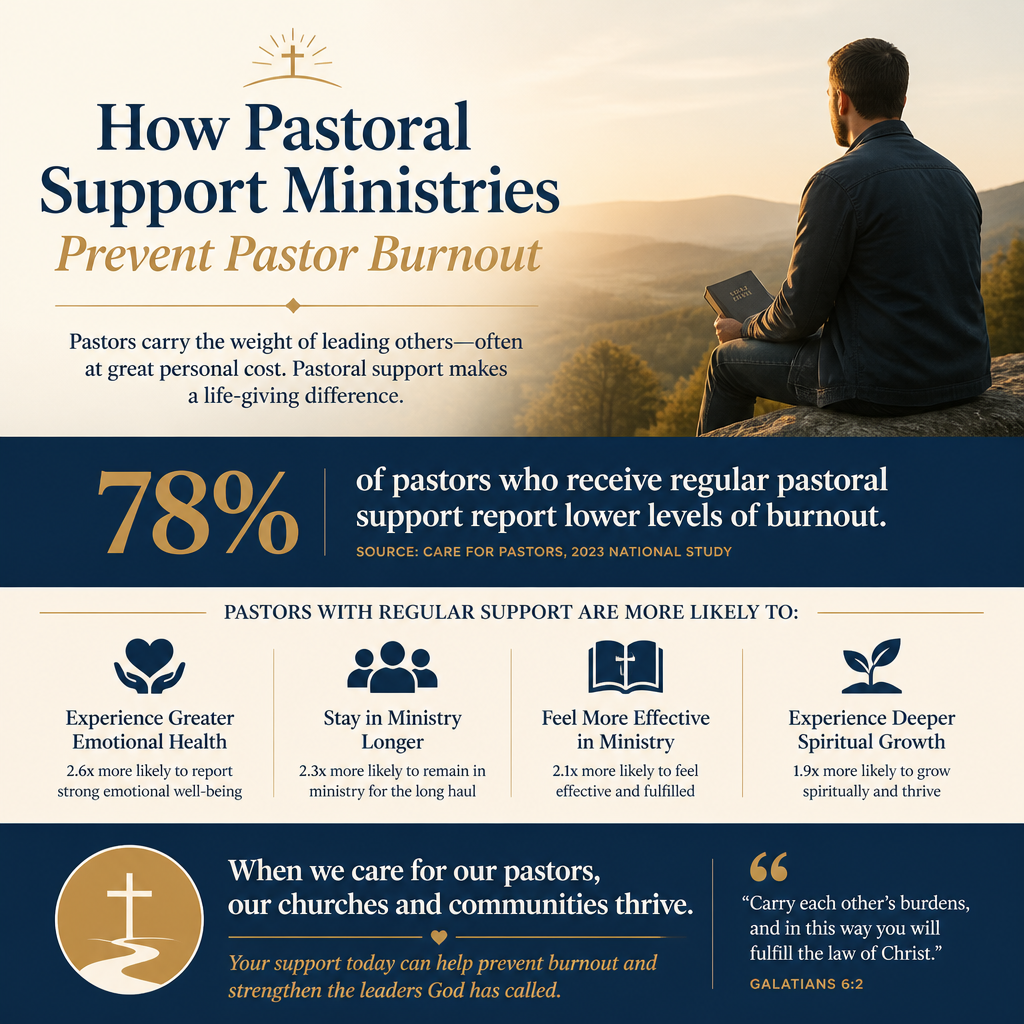
How pastoral support ministries prevent pastor burnout is not primarily a question of tactics. It is a question of whether the church will treat pastoral ministry as a lifelong calling sustained by grace, wise limits, and durable structures rather than by perpetual availability. Donors who care about the health of local churches increasingly recognize that exhaustion in the pulpit rarely stays private; it spills into families, staff cultures, discipleship depth, and sometimes public scandal.
Pastoral burnout is not identical to ordinary fatigue, and Christians genuinely disagree about how to name it. Some emphasize moral failure and spiritual drift. Others emphasize occupational stress and untreated trauma. The best pastoral support ministries refuse the false choice. They address the whole pastor: spiritual life, emotional health, physical limits, family systems, and leadership realities. That combination is often what keeps a season of strain from becoming a collapse.
Burnout is usually a systems problem before it becomes a personal crisis
Pastors are stewards of the gospel, not owners of a church’s demands. Yet pastoral work commonly lives at the intersection of spiritual expectation and limitless need: sermons that must feed, crises that cannot wait, conflicts that drain, and a public role that reduces privacy. What donors sometimes miss is that burnout is often less about a single heavy week and more about chronic conditions: role confusion, unending emotional labor, weak accountability, and isolation.
Research on clergy well-being underscores how pervasive strain can be, even among faithful and resilient leaders. A Duke Center for Health Policy report on United Methodist clergy described higher rates of obesity and chronic disease risk factors compared with the general population, a pattern often connected to stress, disrupted rhythms, and limited time for preventive care (Duke University Sanford School of Public Policy).
Isolation is a risk factor donors rarely see
Pastors spend their days with people, but many do not experience peer-level friendship where they can speak candidly without consequences. The congregation knows them in a role; staff may depend on them; boards may evaluate them. Even when a pastor has close friends, the internal calculus of “What can I share without harming trust?” can quietly shrink the soul.
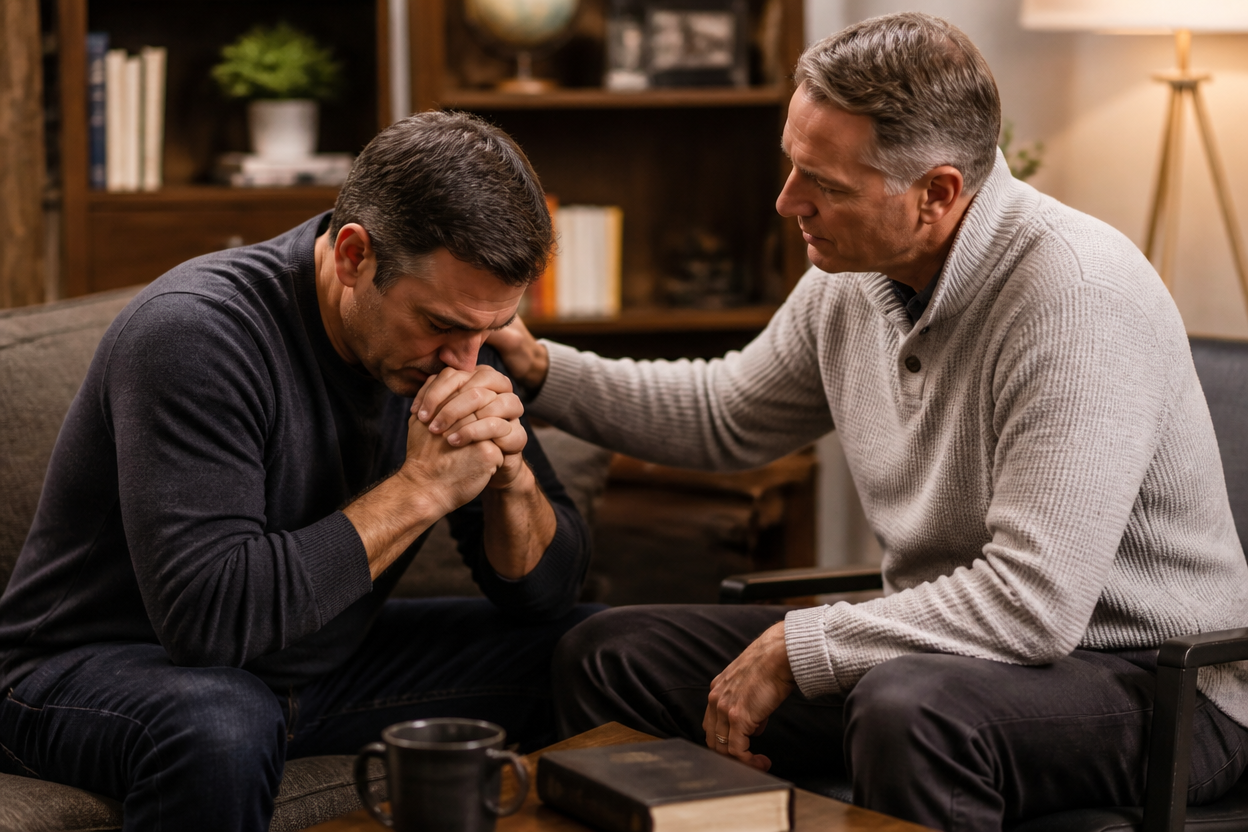
Healthy pastoral support ministries build structured, confidential relationships that do not depend on a local church’s internal politics. They normalize the reality that ministry can involve secondary trauma, moral injury, and chronic grief, even when the pastor is spiritually sincere and the church is doctrinally sound.
Chronic overfunctioning masquerades as faithfulness
Many churches unintentionally reward overfunctioning. A pastor who never stops can be praised as “committed,” while a pastor who sets limits can be viewed as less sacrificial. Christian donors are often sympathetic to missionaries and ministry staff living close to the margin; they should be equally clear-eyed that unbounded expectations can become a form of organizational negligence.
Pastoral support ministries interrupt this pattern by helping churches and leaders articulate what is sustainable. That may include redefining emergency response expectations, clarifying decision rights, or building a rotation of care so a single person is not the default responder for every crisis.
Effective pastoral support ministries combine clinical wisdom with spiritual formation
Burnout prevention fails when it is reduced to either “pray more” or “self-care.” Scripture does not treat embodied limits as unspiritual. Elijah’s collapse in 1 Kings 19 is met with sleep, food, and gentle reorientation before he is given new assignments. Jesus himself withdrew to desolate places to pray, not as a productivity strategy but as communion with the Father and a refusal to be governed by the crowd’s urgency.
The strongest pastoral care ministries integrate spiritual direction, counseling competencies, and a theology of vocation. They honor the pastor’s call while refusing to idolize the pastor’s capacity. They also recognize that some symptoms labeled “burnout” are better understood as depression, anxiety, unresolved grief, or trauma responses, which may require licensed clinical treatment rather than only pastoral encouragement.
Sabbaticals work when they are more than time off
Well-designed sabbaticals are not vacations granted as a reward for survival. They are structured seasons of rest and renewal with clear boundaries, expectations, and reintegration planning. Ministries that support sabbaticals often provide assessment beforehand, a plan for spiritual and relational health during the time away, and a return-to-work process that does not simply reload the same unsustainable patterns.
The difficulty is that sabbaticals can also be used to postpone hard truths. If a pastor is returning to a toxic conflict system, unclear governance, or untreated addiction, time away may merely delay the reckoning. Mature pastoral support ministries name that risk directly and insist on appropriate assessment and accountability.
Pastoral counseling should protect both confidentiality and responsibility
Confidential care is essential, but it is not absolute. Credible ministries establish policies for mandated reporting, imminent risk, and situations where a pastor’s actions put others in harm’s way. Donors should not confuse confidentiality with secrecy, or compassion with enabling.
This is one place where governance matters. Ministries that serve pastors should have clearly documented boundaries, appropriate clinical oversight where counseling is offered, and a transparent approach to safeguarding. When these elements are present, the pastor receives care without the ministry becoming a parallel, unaccountable authority over a local church.
Wise referral protects the pastor, the church, and the witness of the gospel
Churches often wait too long to seek outside support. Leaders may fear stigma, costs, or the implication that “we failed.” Yet the pastoral calling is not served by isolation. Donors who fund pastoral support should understand that timely referral is preventive medicine, not an admission of defeat.
Referral becomes appropriate when the pastor’s functioning is measurably deteriorating, when conflict is escalating beyond internal capacity, or when the pastor’s family system is absorbing ministry stress in damaging ways. In some situations, referral should be immediate: suicidal ideation, substance misuse, credible allegations of misconduct, or patterns of anger and intimidation.
Retreats and intensives can create space for truthful diagnosis
Pastor retreats offered by support ministries vary widely. The best are not spiritual tourism. They create quiet, safety, and skilled companionship so a pastor can face what has been avoided: grief that has accumulated, resentment that has calcified, spiritual dryness, disordered work patterns, or marriage strain. Often a retreat includes guided solitude, teaching on rhythms of ministry, and time with a counselor or spiritual director.
The value is not simply rest. The value is perspective, so that a leader can return with a clearer sense of what must change, what must be confessed, and what must be delegated or discontinued. Donors should look for retreat models that include follow-up, because insight without ongoing support can dissipate quickly under weekly pressures.
Church leaders need help distinguishing sin, illness, and immaturity
Christian communities sometimes misdiagnose what is happening in a pastor. Genuine sin requires repentance and, at times, disqualification from office. Mental illness requires treatment and patient support. Leadership immaturity requires formation and mentoring. These categories can overlap, but they are not interchangeable.
Pastoral support ministries serve the wider church when they help elders and boards respond proportionately: neither minimizing serious wrongdoing nor spiritualizing away legitimate clinical needs. This protects congregations from harm and protects pastors from being crushed by moral categories that do not fit their condition.
Donor support prevents the starvation cycle in pastoral care
Pastoral support ministries tend to operate in a financial tension. The pastors most in need may have limited ability to pay, while the work itself requires trained staff, careful policies, and time-intensive care. Underfunding pressures ministries toward volume over depth, or toward lowering standards in clinical supervision and safeguarding. That pattern resembles what fundraising researchers describe as the nonprofit “starvation cycle,” where unrealistic expectations drive chronic underinvestment in the very capacities that make outcomes trustworthy (Stanford Social Innovation Review).
Donors can break that cycle by funding pastoral care as serious infrastructure for the church, not as discretionary charity. The question is not whether overhead is low; it is whether the ministry is governed well, staffed appropriately, and transparent enough that churches and donors can trust its counsel.
What we look for when we verify pastoral support ministries
Across our verification work at Most Trusted, the ministries that meet The Most Trusted Standard tend to show the same strengths: a clear theological account of pastoral calling and human limits; governance that prevents founder dominance and protects confidentiality without hiding misconduct; financial reporting that is complete and timely; and program design that matches the complexity of pastoral burnout. These are not abstract ideals. They shape whether a ministry’s care is steady over decades and whether it will respond wisely under pressure.
We also pay attention to how ministries measure effectiveness. Not everything that matters is measurable, and donors should be wary of simplistic metrics in soul care. Yet serious ministries can still report meaningful indicators: participation and completion rates in cohorts, the presence of written care pathways, follow-up practices after retreats, safeguarding training, and clear referral protocols for clinical risk.
Funding that strengthens resilience rather than dependency
Donor dollars are most helpful when they increase access for pastors who cannot pay, improve clinical oversight, and strengthen follow-up systems. Funding can also help ministries train church elders and staff teams, which reduces the likelihood that care is outsourced entirely. A local church should not hand off its responsibilities; it should become more capable of bearing them wisely.
For donors discerning where to give, it is reasonable to ask whether a ministry has clear boundaries with churches, whether it coordinates appropriately with local leadership when consent is given, and whether its theology of suffering avoids two errors: treating pain as inherently sanctifying, or treating all discomfort as a pathology to be removed.
Giving that sustains pastors is giving that sustains congregations
Pastoral burnout is rarely a private problem with private consequences. When pastors collapse, churches often fracture, families suffer, and communities lose stable witnesses. Preventing that outcome requires more than encouragement; it requires ministries built for long obedience—spiritually serious, clinically competent, and institutionally trustworthy.
Donors who want to understand this field more fully can begin with Pastoral Support Ministries and then evaluate specific organizations with the same rigor they would apply to any other stewardship decision. The church does not honor Christ by exhausting its shepherds. It honors him by sustaining them in truth, rest, accountability, and hope.



