

How pastoral support ministries measure impact is a stewardship question before it is a reporting preference. Donors are not asking for clinical precision, but for faithful, verifiable evidence that a ministry strengthens those who bear the weight of shepherding Christ’s church.
The challenge is that pastoral care work often targets outcomes that are real and spiritual, yet not easily reduced to a single number: endurance, restored joy in ministry, healthy marriages, freedom from secrecy, and a renewed capacity to preach, counsel, and lead. Scripture itself treats such matters with seriousness. Paul’s charge to the Ephesian elders assumes both spiritual vigilance and embodied limits: “Keep watch over yourselves and all the flock” (Acts 20:28). A ministry that supports pastors should be able to show how it helps leaders keep watch over themselves, not merely how many touchpoints it delivers.
Impact begins with a clear ministry theory and a defensible definition of pastoral health
Effective measurement starts upstream. Ministries that track impact well can articulate a coherent chain from activities to outcomes: what they do, for whom, through which mechanisms, and why those mechanisms should lead to pastoral resilience and fruitfulness. Without that clarity, “impact” becomes a collage of anecdotes and attendance counts that can neither be tested nor improved.
For pastoral support, the outcomes worth tracking typically sit in three overlapping domains: personal spiritual and emotional health, relational stability at home and in the congregation, and vocational sustainability in ministry. Christians genuinely disagree about the best vocabulary for these domains. Some leaders are cautious about importing psychological categories into pastoral life; others insist that mental health language is necessary to name real suffering. A mature impact model does not choose caricatures. It honors the pastoral office as a spiritual calling while recognizing that pastors are not disembodied souls and that exhaustion, depression, and trauma have spiritual and practical consequences.
Distinguish outputs from outcomes
Many pastoral support ministries can report outputs: number of retreats hosted, counseling sessions provided, coaching hours delivered, books distributed, or scholarships granted. These are not meaningless; they demonstrate activity and operational capacity. But they are not the same as the outcomes donors care about. A retreat may be faithfully run and well attended while producing little lasting change if follow-up is absent or the ministry’s approach is mismatched to the pastor’s context.
Outcomes ask a harder question: what changed in the pastor’s life, marriage, leadership, and sustainability because this ministry intervened? The best reporting holds both together. It names the scale of service and then explains, with evidence, whether service translated into strengthened pastoral health.
Define pastoral wellbeing in ways that are biblically serious and measurable
Ministries that measure well avoid vague claims such as “encouraged pastors” without specifying how encouragement was assessed. At the same time, they resist reducing pastoral life to a single wellbeing score. A sound definition often includes measurable indicators such as reduced isolation, improved stress management, more consistent spiritual disciplines, better conflict navigation, and increased intent to remain in ministry.
Where ministries use established instruments, they should name them and disclose how they are administered, stored, and interpreted. Where they use custom surveys, they should demonstrate basic survey integrity: consistent questions over time, defined scales, and clear thresholds for what counts as improvement.
Set expectations for what measurement can and cannot prove
Pastoral support is usually a contributory cause, not an exclusive cause. Many pastors who improve would have improved anyway; many who struggle do so because of factors outside a ministry’s control. The most trustworthy ministries state these limits directly. They report plausible contribution rather than promising certainty, and they design measurement that is honest about attribution.

What credible impact metrics look like in pastoral support work
Once a ministry has defined its outcomes, donors should look for a small set of metrics that are consistent, meaningful, and resistant to manipulation. “More numbers” is not the goal. The goal is a coherent dashboard that reveals whether pastors are becoming more sustainable and whether the ministry is learning over time.
Wellbeing and sustainability indicators that can be tracked over time
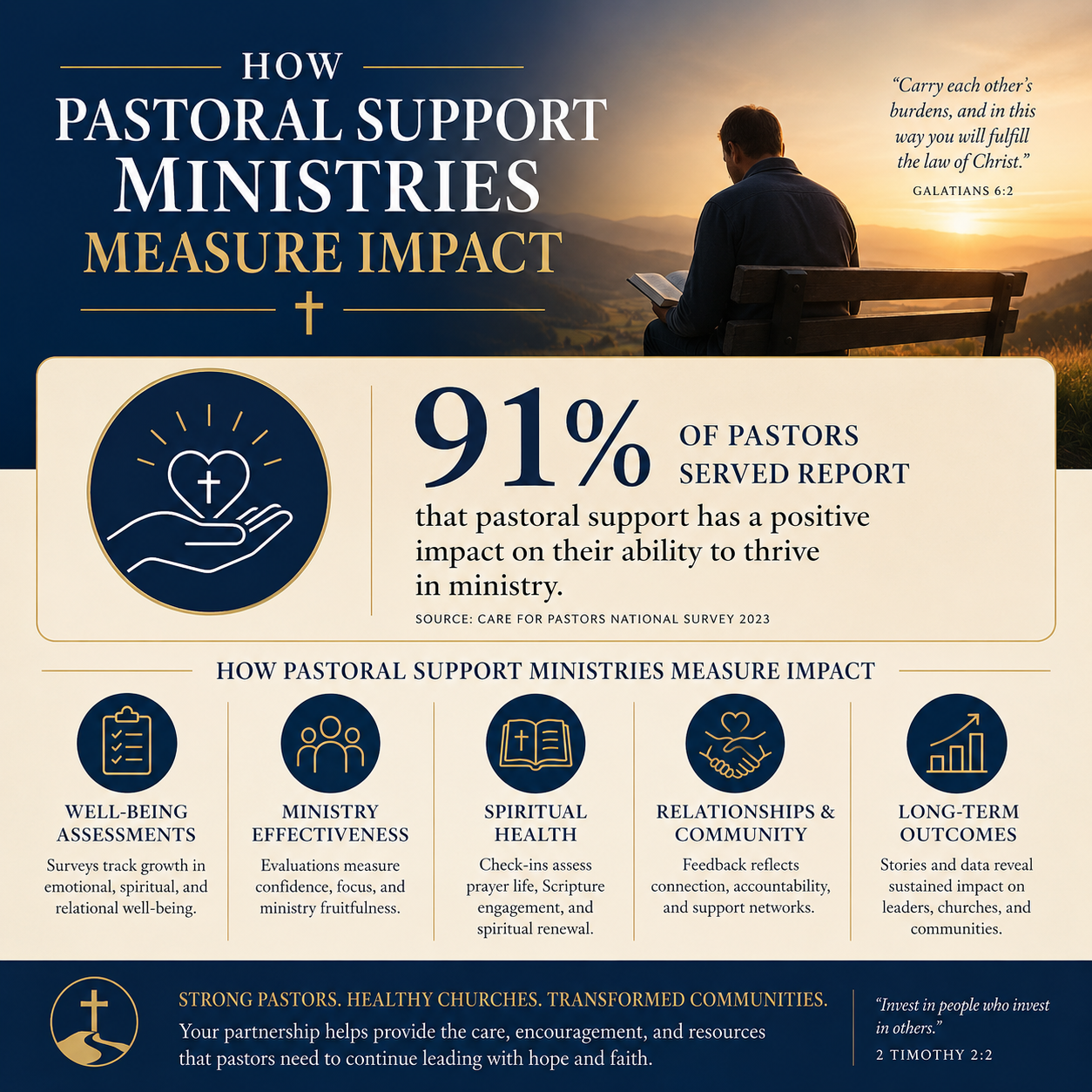
Pastoral support ministries commonly track pre- and post-engagement measures and then follow up at defined intervals (for example, 3, 6, or 12 months). Credible indicators include:
- Burnout risk and emotional exhaustion measured with a consistent scale and disclosed methodology.
- Isolation and support network strength, including whether a pastor has peer relationships and accountability outside their immediate church system.
- Marital and family strain indicators, handled with appropriate privacy protections and referral protocols.
- Vocational sustainability such as intent to remain in ministry or reduced acute crisis episodes requiring emergency intervention.
Donors should be cautious when a ministry reports only satisfaction ratings. Satisfaction matters, but it can reward pleasant experiences rather than transformative ones. A retreat can be “highly rated” while leaving the pastor without a plan for ongoing support.
Program integrity and dosage
Pastoral support work often depends on continuity and trust. Ministries should be able to report participation patterns that illuminate whether pastors receive enough engagement for the model to plausibly work. Examples include coaching session completion rates, counseling adherence where appropriate, peer group attendance consistency, and follow-through on post-retreat plans.
This is also where donors can ask whether the ministry measures the health of its own delivery system: Are mentors trained? Are counselors licensed where required? Are safeguarding policies in place for spiritual abuse, confidentiality, and mandatory reporting? Credible impact is difficult when program integrity is thin.
Church-level outcomes with careful interpretation
Some ministries report downstream outcomes such as improved staff stability, fewer pastoral resignations, or healthier conflict resolution processes in churches. These may be meaningful, but they are also easy to over-claim. When a ministry cites church-level change, the reporting should clarify what was measured directly and what is inferred, and it should avoid implying that pastoral support alone explains complex congregational dynamics.
For donors seeking broader context on how these ministries typically operate and what faithful support entails, our coverage of Pastoral Support Ministries outlines common program models and the verification questions that tend to separate mature practice from well-marketed but thin support.
Why testimonies matter and how trustworthy ministries handle them
Pastoral support is deeply personal, and testimonies can capture dimensions of change that quantitative measures miss: repentance, reconciliation, renewed love for Scripture, and restored courage to lead. In Christian ministry, narrative evidence is not a concession to sentiment; it is one of the ways the church has always borne witness to God’s work.
But testimonies can also be curated to the point of distortion. A wise donor does not dismiss stories, nor does a wise ministry treat stories as a substitute for evidence. The question is whether testimonies are gathered and presented in a way that increases trust rather than exploiting vulnerability.
Testimonies should be specific, not generic
Trustworthy testimonies describe concrete change over time: what the pastor was facing, what support they received, what practices or decisions changed, and what fruit persisted months later. Generic praise—“This ministry saved my life”—may be true, but without context it is difficult to evaluate and can unintentionally pressure other pastors to present crisis as the necessary precondition for receiving care.
Consent, confidentiality, and power dynamics are part of impact ethics
Pastors are public figures in their congregations, and many carry reputational risk if they disclose counseling, burnout, or marital strain. Ministries that handle testimonies well document informed consent, allow anonymity where appropriate, and avoid publishing details that could expose a pastor or family. They also avoid any fundraising posture that treats a pastor’s pain as content.
Use stories to illuminate mechanisms, not to mask weak measurement
The strongest reporting uses testimonies to clarify how change happens. A story can illustrate why peer cohorts reduce isolation, why trauma-informed counseling can stabilize a leader, or why a sabbatical policy can reset destructive rhythms. When stories function this way, they complement metrics rather than replacing them.
How donors should evaluate pastoral support impact reporting
Donors are often placed in an awkward position: asked to fund urgent needs while being given limited insight into outcomes, because confidentiality is real and pastoral crises are sensitive. A mature evaluation approach respects privacy while still requiring transparency about methods, safeguards, and learning.
Ask questions that reveal whether learning is real
Impact reporting is most credible when it shows how the ministry improves. Donors can ask:
- What outcomes does the ministry prioritize, and why are those outcomes theologically and practically appropriate?
- How are baseline and follow-up data collected? What is the response rate?
- What does the ministry do when outcomes are weak or inconsistent?
- How are high-risk cases handled, and what referral relationships exist for clinical care, legal counsel, or safeguarding concerns?
Ministries that meet careful standards tend to welcome these questions because they already ask them internally.
Compare ministries by fit, not only by scale
A large ministry may provide broad access but limited depth; a smaller ministry may deliver intensive care to fewer pastors. Neither is automatically superior. The better question is whether the approach matches the donor’s intent and whether the ministry demonstrates integrity and outcomes for the model it claims to run.
This comparison should also consider denominational context, geographic realities, and theological alignment. A pastoral support ministry serving rural bivocational pastors will likely measure impact differently than a ministry serving urban multi-staff churches, and that difference is not a defect.
Use independent verification when claims are hard to test
Pastoral support ministries often cannot disclose case details, and donors cannot easily observe the work without compromising privacy. That is precisely where independent evaluation helps. Most Trusted reviews ministries against The Most Trusted Standard, a 15-criteria framework that assesses Faith Foundation, Financial Integrity, Governance and Leadership, and Transparency and Effectiveness. When a ministry’s impact reporting is strong, it is usually supported by strong governance, clear financial practices, and leadership accountability rather than by marketing skill.
Faithful impact measurement serves pastors and protects the church
Pastoral support ministries measure impact well when they treat it as a moral responsibility: a way to honor donors, safeguard pastors, and strengthen congregations. Scripture commends careful stewardship because resources are entrusted for the good of Christ’s people, not for the preservation of an organization’s reputation. When a ministry can show, with humility and evidence, how it reduces isolation, strengthens resilience, and supports long obedience in the same direction, donors can give with greater confidence—and pastors can receive care without becoming a fundraising narrative.



