

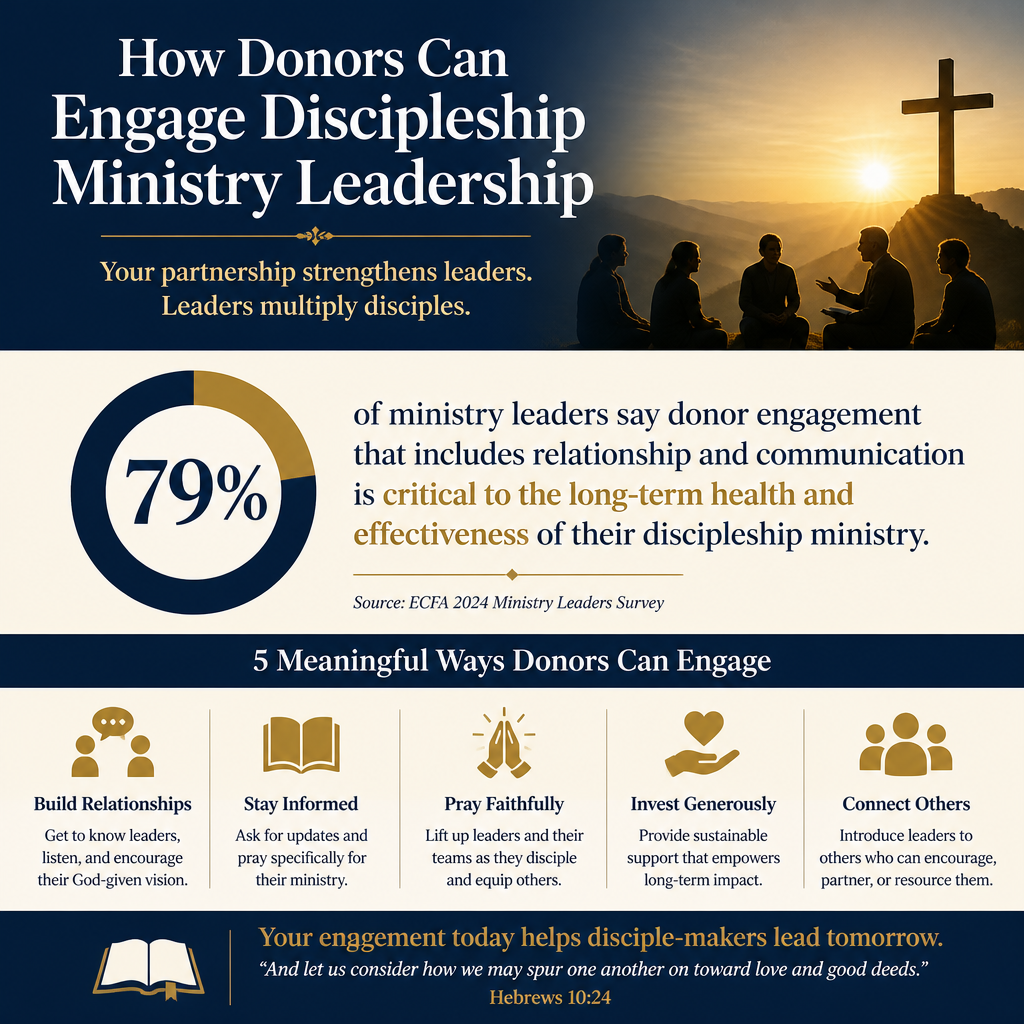
How donors can engage discipleship ministry leadership is not a question of access or influence; it is a question of stewardship. Discipleship is the church’s ordinary work of forming men and women into the likeness of Christ, and donors who fund it are participating in a spiritual responsibility that cannot be reduced to transactions or reporting cycles.
That seriousness also creates tension. Mature donors want accountability, clarity, and evidence of fruit, yet discipleship does not always yield clean metrics on a quarterly timeline. Scripture commends both careful stewardship and patient formation: “one plants and another waters, but God gives the growth” (1 Corinthians 3:6). The task is to engage leaders in ways that protect the ministry’s spiritual integrity while strengthening its governance, integrity, and transparency.
Begin with a shared theology of formation and stewardship
Ask leaders to name the discipleship problem they are solving
Discipleship ministries are often built in response to a real deficit: biblical literacy, fragmented community, a fatherlessness that leaves young men without models of spiritual maturity, or churches that lack trained disciple-makers. Donor engagement begins well when we ask leaders to define the specific formation gap they believe God has called them to address, and why their approach fits the ecclesial context they serve.
This is not abstract. If a ministry is working in prisons, its theory of formation will need to reckon with cycles of trauma, addiction, and the instability of reentry. If it is working with pastors, it must be honest about burnout, moral injury, and the isolation of leadership. The donor’s role is to press for clarity without forcing a simplistic narrative.
Locate funding inside the church’s mission, not alongside it
Discipleship is not merely a “program.” Jesus’ Great Commission is explicitly formative: “make disciples…teaching them to observe all that I have commanded you” (Matthew 28:19–20). Donors can engage leadership by asking how the ministry understands its relationship to local congregations and to the wider body of Christ. Is the ministry equipping churches, substituting for them, or operating independently because church partnership is hard? Each posture carries trade-offs that should be discussed plainly.
Across our verification work at Most Trusted, ministries that meet The Most Trusted Standard tend to articulate this theological and ecclesial posture clearly. Where a ministry cannot explain how its work strengthens Christ’s church, donor confidence should diminish accordingly.

Engage leadership through questions that reveal governance health
Request governance clarity without treating leaders as suspects
Donors sometimes oscillate between deference and distrust. A better approach is principled inquiry. Healthy discipleship ministries welcome questions because spiritual authority does not negate organizational accountability. The New Testament’s qualifications for elders assume observable character and tested credibility (1 Timothy 3:1–13), and modern nonprofit leadership requires comparable clarity about decision-making, controls, and oversight.
In practice, donors should ask leadership to describe how major decisions are made, how budgets are approved, and how conflicts of interest are handled. These questions are not cynical; they protect the ministry from avoidable scandal and protect disciples from the downstream effects of leadership failure.
Pay attention to board posture and composition
Discipleship ministries frequently begin with a founder’s vision, but long-term fruit depends on whether leadership becomes accountable to a governing body with real independence. Donors should ask: Is the board engaged and informed, or ceremonial? Does it include members with financial and legal competence as well as theological maturity? Is there a pattern of related-party transactions that concentrates benefit within a small circle?
When donors engage these questions, they are not trying to run the organization. They are asking whether the ministry’s structures support the kind of integrity Scripture commends. “Moreover, it is required of stewards that they be found faithful” (1 Corinthians 4:2).
Insist on transparency that fits discipleship rather than distorting it
Demand financial reporting that is readable and timely
Discipleship leaders sometimes fear that financial transparency will invite misunderstanding. Donors can reduce that fear by asking for straightforward documents and then reading them with care: audited financial statements when appropriate, recent Form 990 filings for U.S. nonprofits, and a clear explanation of revenue concentration and reserves.
Where donors want a baseline for what disclosure should look like, the IRS requires most tax-exempt organizations to make Form 990 available for public inspection according to the IRS. A ministry that is reluctant to share what regulators already treat as public should be asked why.
Reject simplistic overhead judgments while pursuing effectiveness
Christians genuinely disagree about how to interpret financial ratios. Some donors treat low overhead as a proxy for faithfulness; others see investment in staff and systems as essential for quality and safety. The field has had to reckon with the fact that overhead ratios can be misleading, and that underinvestment can create real harm.
A constructive reference point is the “Overhead Myth” statement signed by leading evaluators, which argues that overhead is not a meaningful measure of impact and can incentivize unhealthy nonprofit behavior as articulated by Charity Navigator. Donors should still ask hard questions about spending, but the right questions are about stewardship and outcomes: Are salaries reasonable? Are controls adequate? Are programs designed for long-term formation rather than short-term fundraising appeal?
Partner in ways that strengthen leaders rather than capturing them
Clarify the donor’s role, rights, and limits
Donors can unintentionally distort discipleship ministries by attaching expectations that are not biblical and not operationally sustainable: immediate scale, constant novelty, or preferential access to leaders and participants. Healthy engagement begins by stating what we are funding, what we are not funding, and what accountability we expect in return. The goal is not control; it is aligned stewardship.
One practical way to formalize this is a written funding agreement for larger gifts that sets reporting cadence, restricted-use terms if applicable, and expectations for integrity and safeguarding. This protects both donor and ministry when leadership changes, economic conditions tighten, or programs need to adapt.
Use a disciplined set of questions in leadership conversations
Discipleship leadership engagement is most fruitful when it is repeatable and focused. We recommend using a small set of questions that touch theology, governance, finances, and formation without overwhelming the relationship:
- What is your definition of a “disciple,” and how does your program embody that definition?
- How do you select, train, and supervise those who lead discipleship relationships?
- What safeguards protect participants from spiritual abuse, boundary violations, or coercive practices?
- Which outcomes are you accountable for, and which outcomes you can only describe narratively?
- What would cause you to change your model, and who has authority to make that call?
These questions are not a checklist for suspicion. They communicate seriousness, and seriousness is a form of respect.
Evaluate discipleship outcomes with humility and rigor
Ask for evidence of fruit that is appropriate to formation
Discipleship produces fruit that is both visible and hidden. Some ministries can responsibly track participation, retention, completion of training, church involvement, and leadership multiplication. Other outcomes—repentance, endurance in suffering, reconciliation, long obedience—are real but not easily quantified. Donors should ask for what can be measured without demanding what cannot.
When ministries present outcomes, donors should also ask about attribution and selection effects. If a program primarily attracts already-motivated believers, positive results may reflect initial conditions rather than program strength. That does not make the ministry worthless, but it does require honesty about whom it serves and how.
Look for patterns of integrity that predict long-term fruit
Because discipleship outcomes are complex, donors should evaluate leading indicators of trustworthiness: transparent communication, consistent reporting, a willingness to name failures, and governance that limits unilateral power. These patterns matter because discipleship ministries trade in influence over souls. The cost of failure is not only financial; it is spiritual damage, public scandal, and cynicism in the church.
In our work, The Most Trusted Standard exists to make these leading indicators verifiable across Faith Foundation, Financial Integrity, Governance and Leadership, and Transparency and Effectiveness. Donors who want to go deeper on the landscape of Discipleship Ministries can use that context to frame conversations with leaders and to compare ministries without reducing discernment to branding.
For donors specifically seeking practical approaches to relationship-building and accountability, the category on Donor Partnership with Discipleship Ministries addresses common engagement points where well-intentioned funding can either strengthen or destabilize leadership.
FAQs for How donors can engage discipleship ministry leadership
Should donors ask discipleship ministries for measurable outcomes?
Yes, with discernment. Donors should ask for metrics that are appropriate to the ministry’s model—training completion, retention, mentor-to-participant ratios, church integration, and leadership multiplication where relevant—while also accepting that some of the most important fruit of discipleship is not reducible to numbers. The goal is not to replace spiritual discernment with dashboards, but to require enough evidence and transparency to justify continued trust.
What is a responsible way to raise concerns with ministry leadership?
Responsible concern begins with specific observations, not insinuation, and it proceeds through the ministry’s stated channels of accountability. Donors should ask who on the board receives complaints, how whistleblowers are protected, and how allegations are investigated. When concerns involve safeguarding, financial misconduct, or abuse of authority, donors should treat them with urgency and insist on independent oversight. Charity must be disciplined by truth, because the vulnerable bear the cost of institutional denial.
Engagement that protects the ministry and honors Christ
Discipleship ministry leadership deserves donors who are neither passive patrons nor informal executives. The most responsible engagement holds together theological seriousness, governance accountability, and patience with the slow work of formation. When donors approach leaders as stewards before God—seeking clarity, integrity, and evidence without demanding control—giving becomes not merely support for a program, but a disciplined participation in the church’s mandate to make disciples.



