

How discipleship ministries equip churches for mission is ultimately a question about formation: what kind of people the church is becoming, and therefore what kind of presence the church can sustain in the world. Churches do not drift into faithful mission. They are made ready for mission through worship, Scripture, prayer, repentance, and the ordinary disciplines that shape desires over time.
Christian donors often feel the pressure of urgency. Crises are visible, needs are immediate, and measurable outputs can seem like the safest place to invest. Yet the New Testament’s own missional vision is inseparable from the patient work of making disciples who obey all that Christ commanded (Matthew 28:19–20). The question is not whether churches should pursue mission, but whether their people have been equipped to carry it with humility, endurance, and theological clarity.
Discipleship is not a preliminary step to mission
Mission without formation tends toward burnout and distortion
When discipleship is treated as a class that precedes “real” ministry, mission becomes a program run by a few, sustained by adrenaline and occasional fundraising. Over time, that pattern predictably yields exhaustion, conflict, and a thin theology of outcomes. The church may still accomplish projects, but it struggles to produce the steady love described in 1 Corinthians 13 and the durable joy described in Philippians.
Discipleship ministries, at their best, restore the biblical order: worshiping communities become witnessing communities. Acts does not portray the church growing through techniques but through a people devoted to the apostles’ teaching, fellowship, prayer, and the breaking of bread (Acts 2:42). That devotion did not distract from mission; it generated it, creating a public credibility that was moral and relational, not merely rhetorical.
Scripture frames mission as obedience before it becomes strategy
Jesus’ Great Commission is not only about going; it is about teaching disciples to obey. Many churches have learned that it is possible to “do missions” without becoming a church that looks like Jesus. Discipleship ministries equip churches for mission by anchoring the church’s outward activity in inward obedience: truth that reaches the will, not only the mind.
For donors, this matters because funding can unintentionally incentivize the opposite order. Projects with public visibility receive support; hidden formation is harder to celebrate. Wise giving recognizes that long-term faithfulness usually looks like slow, disciplined investment in people who can bear responsibility without demanding recognition.

Discipleship ministries create a shared theological imagination
Mission requires doctrinal clarity in contested terrain
Local missions and global missions increasingly operate in complex environments: polarized politics, religious pluralism, trauma, migration, and poverty that cannot be solved with one intervention. Christians genuinely disagree about methods, partnerships, and the relationship between evangelism and mercy. Churches that lack shared theological imagination often default to personalities and preferences rather than principled discernment.
Discipleship ministries equip churches by forming a people who can reason biblically together. That includes a theology of the image of God, a theology of sin that avoids both cynicism and naiveté, and a theology of the church that resists consumer assumptions. When those convictions are shared, mission does not depend on a charismatic leader; it becomes a congregational instinct.
Formation strengthens the church’s witness under scrutiny
In an era when Christian institutions are frequently questioned—sometimes fairly, sometimes opportunistically—mission is sustained by integrity more than messaging. Discipleship ministries attend to the “internal” sins that sabotage public witness: unresolved conflict, financial opacity, domineering leadership, and a failure to practice church discipline with humility and courage.
For donors who are weary of scandal cycles, this is not theoretical. The public cost of failure is real, and the spiritual cost is greater. Discipleship is one of the church’s primary safeguards against treating mission as brand management rather than faithfulness to Christ.
Equipping for mission means developing people, not only programs
Calling is discerned, tested, and strengthened in community
Many mission failures begin with a mismatch between gifting and assignment, or zeal without adequate preparation. Discipleship ministries equip churches by creating pathways where calling is discerned over time: small-group life, mentoring, supervised service, and accountable leadership development. This is how the church learns to send people wisely rather than merely deploying them.
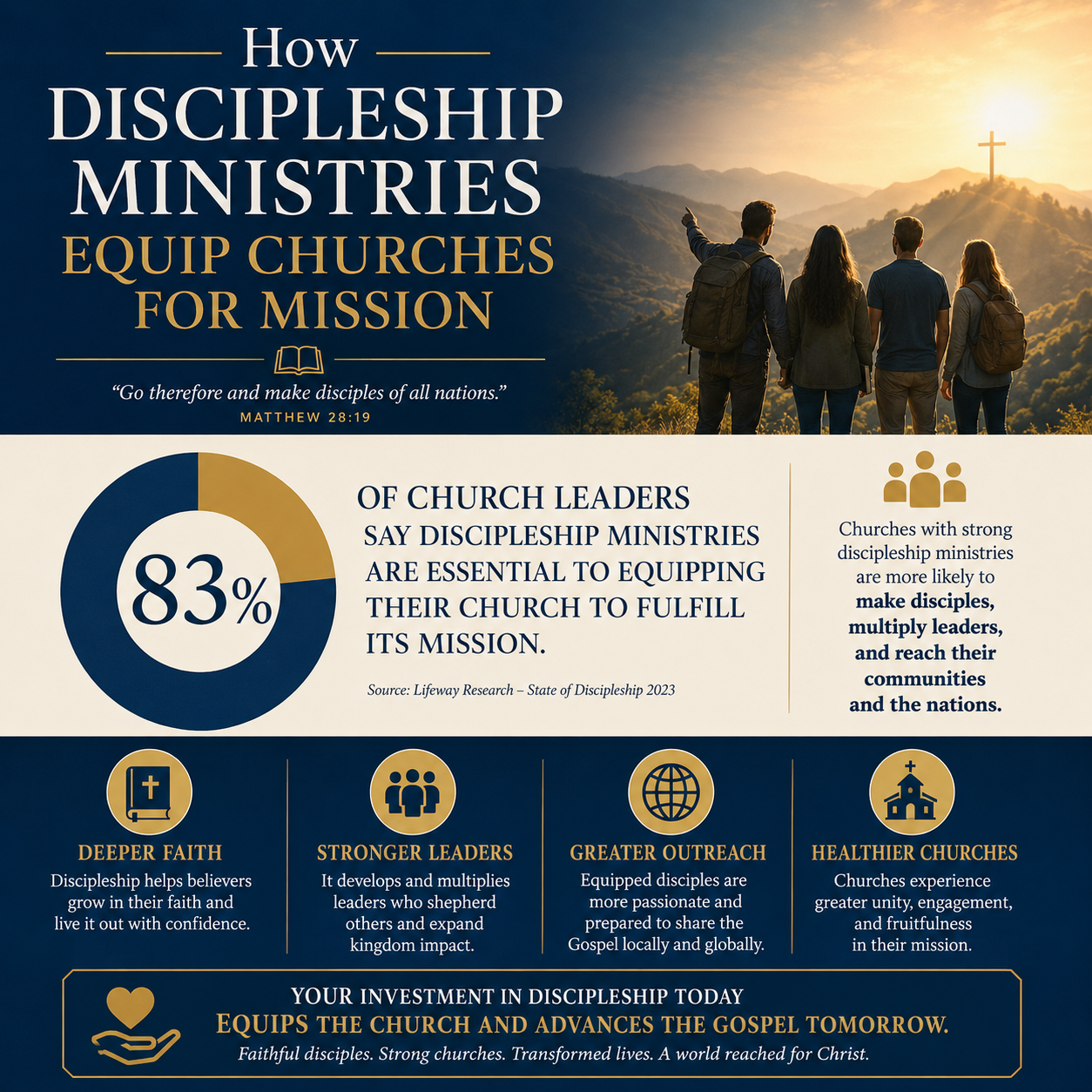
When churches cultivate mature leaders, mission becomes resilient. Church planters endure setbacks without losing hope. Volunteer teams serve without resentment. Mercy ministries avoid savior narratives because volunteers have learned to receive as well as to give. Global partnerships grow from mutual respect rather than paternalism.
Healthy discipleship corrects common missional distortions
The field has had to reckon with how good intentions can cause harm. The When Helping Hurts framework, articulated by Steve Corbett and Brian Fikkert, has shaped many churches’ approach to poverty alleviation by distinguishing relief, rehabilitation, and development, and by warning against doing for others what they can do for themselves. That framework does not solve every debate, but it has helped congregations pursue mercy with greater humility and local wisdom.
Donors can look for discipleship ministries that integrate these lessons into the life of the church rather than treating them as a one-time training. The goal is a congregation with reflexes shaped by Scripture: patience, listening, and a willingness to learn from local leaders.
- Clear theology of evangelism and mercy held together, not traded off
- Leaders trained to handle conflict, power, and accountability before they lead publicly
- Service pathways that begin locally and connect naturally to global partnerships
- Practices that honor the dignity and agency of those being served
- Commitments that outlast a single initiative, season, or personality
Donor confidence rises when discipleship aligns with integrity
Mission funding should follow governance, not bypass it
Many donors have learned that inspiring stories are not the same as verifiable stewardship. Discipleship ministries equip churches for mission in part by strengthening the conditions that make stewardship credible: transparent financial practices, clear decision rights, and accountable leadership. When those elements are weak, even sincere ministry can drift toward confusion and, at times, misuse.
This is where Most Trusted’s work is directly relevant. We evaluate Christian nonprofits against The Most Trusted Standard, a 15-criteria framework that examines faith commitments, financial integrity, governance and leadership, and transparency and effectiveness. Donors do not need perfection, but they do need evidence of faithful oversight.
Across our verification work, we observe that ministries with disciplined discipleship cultures often show the same discipline in governance: written policies, meaningful boards, clean financial statements, and clarity about how outcomes are measured without reducing ministry to metrics. The connection is not automatic, but it is common: formation shapes institutional behavior.
Transparency is not secular compliance but Christian truth-telling
Christian ministry is accountable to God, and therefore it should be accountable before people. Paul’s practice of arranging accountability for financial gifts was not suspicion; it was wisdom “so that no one should blame us” in how resources were administered (2 Corinthians 8:20–21). Donors can reasonably ask for clear reporting, audited or reviewed financials when appropriate, and honest descriptions of both fruit and limitation.
When donors fund mission through ministries that are willing to be examined, they strengthen a culture of truth-telling in the church. That culture is itself missional, because it signals that the gospel is not a tool for fundraising but the reality under which the ministry stands.
What donors can look for when supporting discipleship and mission
Markers of a church equipped for durable witness
Donors often ask what to fund: the visible mission initiative or the “back-end” discipleship work that seems less urgent. The most faithful answer is frequently both, in proper relationship. Mission initiatives can catalyze a church; discipleship can sustain it. Churches that flourish tend to link the two so that mission becomes a training ground for obedience, and discipleship becomes preparation for service.
As donors assess opportunities, it can help to broaden the due diligence lens beyond budgets and brochures. The church’s mission capacity is not only financial; it is moral and relational. A congregation that cannot reconcile internally will struggle to pursue reconciliation externally. A church that mishandles power will export that pattern into partnerships.
Where to deepen understanding and verify integrity
For those evaluating opportunities in this space, it is worth engaging the wider context of Discipleship Ministries as a field: the training models being used, the theological assumptions underneath them, and the practices that form resilient leaders. It is equally wise to examine how mission and community engagement are structured in Discipleship Ministries in Missions and Community, where the practical tensions tend to surface most clearly.
Donors can then pair theological discernment with verification. Ministries that welcome scrutiny, document their claims, and maintain clear accountability structures are better positioned to steward gifts over time. Trust is strengthened when it is supported by evidence.
FAQs for How discipleship ministries equip churches for mission
Should donors prioritize discipleship ministries over direct mission projects?
Donors need not choose between the two as competitors. Direct mission projects can meet real needs and open doors for witness, but they tend to be fragile when churches lack mature leaders and shared theological conviction. Discipleship ministries strengthen the human and spiritual infrastructure that allows mission to endure beyond a single campaign, leader, or funding cycle.
How can donors evaluate whether a discipleship ministry is truly equipping for mission?
Donors can look for evidence that formation is producing obedience and service, not only attendance. Practically, that includes clear training pathways, accountable leadership development, thoughtful partnerships, and honest reporting of both outcomes and limitations. It also includes governance and financial integrity that match the ministry’s claims. Verification against The Most Trusted Standard can help donors distinguish between inspiring rhetoric and demonstrable stewardship.
Mission is sustained by the kind of people discipleship forms
Churches are equipped for mission when discipleship ministries form congregations that love truth, practice repentance, and carry responsibility with humility. This is not slower work than mission; it is the work that keeps mission faithful. Donors who fund formation alongside outreach are not postponing impact. They are investing in the kind of church that can bear witness over the long obedience of decades.



