
Accountability and transparency in discipleship ministries are not administrative virtues; they are moral obligations rooted in the gospel. Donors are not purchasing a spiritual product. They are entrusting resources to a ministry that claims the name of Christ, and Scripture treats that trust as weighty. Paul insisted on careful financial handling “so that no one should blame us” and emphasized doing “what is honorable not only in the Lord’s sight but also in the sight of man” (2 Corinthians 8:20–21). The point is not suspicion. The point is credible stewardship.
Discipleship work often happens in the quiet places: small groups, mentoring relationships, pastoral training pipelines, curriculum development, counseling referral networks, church partnerships, and leadership formation. Much of its fruit is real, but not easily counted. That makes accountability more difficult, not less necessary. When outcomes are hard to quantify, clarity about money, governance, and program logic becomes even more central to donor confidence.
At Most Trusted, we evaluate Christian nonprofits against The Most Trusted Standard, a 15-criteria framework spanning Faith Foundation, Financial Integrity, Governance and Leadership, and Transparency and Effectiveness. Donors routinely tell us the same tension: they want to fund discipleship that is spiritually faithful and measurably responsible, yet they do not want to reduce ministry to metrics. That tension can be handled with maturity, but only when ministries are willing to be examined.
Accountability begins with theology and ends with evidence
Christian donors typically ask “Is this ministry faithful?” and “Is this ministry effective?” Those questions cannot be separated from “Is this ministry accountable?” because stewardship is a theological category before it becomes a financial one. Jesus spoke of money as a revealer of the heart (Matthew 6:21). The early church treated shared resources as sacred trust, not private entitlement. Accountability is one of the ways a ministry demonstrates that it fears God more than it fears scrutiny.
Financial integrity is not the same as low overhead
Many donors have been trained—often by fundraising pressure—to treat a low administrative percentage as the mark of virtue. The sector has had to correct that instinct. Underinvesting in finance staff, internal controls, audits, cybersecurity, and compliance can create the conditions for fraud, misclassification, and chronic inaccuracy. The well-known “Overhead Myth” statement argued that overhead ratios are a poor proxy for impact and can push nonprofits toward unhealthy financial practices; it was articulated jointly by GuideStar (now Candid), BBB Wise Giving Alliance, and Charity Navigator https://www.candid.org/.
For discipleship ministries, the sharper question is whether administrative and program spending categories are truthful and appropriate to the ministry’s model. A curriculum publisher, a church-based mentoring network, and a residential training program will each have different cost structures. Responsible donors look for alignment, not a single ideal ratio.
Controls and clarity protect the ministry and the donor
Basic internal controls are not a sign of distrust in staff; they are a recognition of human frailty. Segregation of duties, documented approval thresholds, clear reimbursement policies, and board oversight reduce the likelihood that temptation becomes scandal. For international discipleship efforts, controls also include partner vetting, currency handling procedures, and documentation for restricted gifts.
Across our verification work, ministries that meet The Most Trusted Standard tend to treat financial accountability as part of discipleship itself. Leaders teach stewardship publicly, and they practice it in the quiet decisions: transparent budget narratives, consistent documentation, and prompt correction when errors are found.

Transparency must be intelligible, not merely available
Some ministries can technically claim transparency because they file a Form 990 or post an annual report PDF. But “available” is not the same as “understandable.” Mature transparency serves donors by making complex realities plain: what the ministry does, how it pays for it, what risks it faces, and what outcomes it can credibly claim.
Where serious donors look for financial reporting
In the United States, a nonprofit’s Form 990 is often the most detailed public financial document. It includes governance disclosures, key compensation reporting, and program descriptions. Donors can access many filings through the IRS Tax Exempt Organization Search https://www.irs.gov/charities-non-profits/tax-exempt-organization-search. The 990 is not perfect, and it is often a year behind. Still, it offers a baseline of comparability and is difficult to reconcile with deceptive storytelling over time.
For churches and certain church-affiliated ministries, 990s may not exist because churches are not required to file. That reality creates a legitimate transparency challenge. When a discipleship ministry is structured in a way that reduces public reporting, responsible leadership typically compensates by offering other credible disclosures: audited statements when feasible, independent board governance, and published financial summaries with meaningful detail.
What transparency sounds like in practice
Good reporting does more than celebrate. It names constraints: staff turnover, program changes, the limits of survey data, the complexities of attribution, and the reality that spiritual formation is often slow. It also shows how restricted donations are handled, whether reserves exist, and how leadership responds to financial volatility. The donor is treated as an adult, not as a marketing audience.
This is also where donors can detect whether a ministry is driven by spectacle. Discipleship is rarely photogenic. Ministries that rely heavily on emotionally intense fundraising without matching operational clarity often create vulnerability—sometimes for donors, sometimes for the people the ministry serves.
What administrative costs actually fund in discipleship ministries
Administrative expense is not a single moral category. In discipleship ministries, administrative spending often determines whether a ministry can scale without collapsing under its own weight. It can also determine whether the ministry is safe for participants and credible to partner churches.
Core functions that donors routinely underestimate
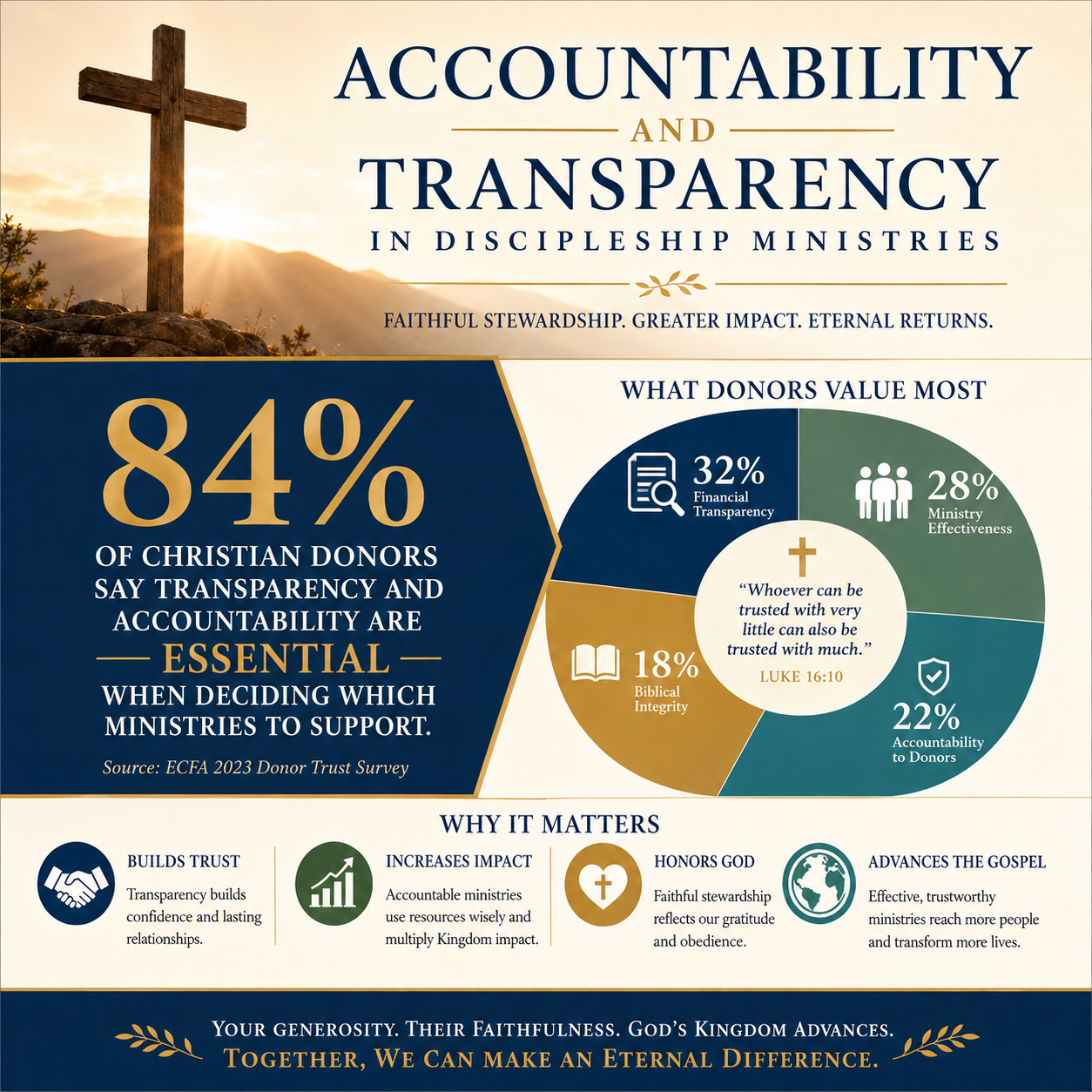
Several “back office” functions directly serve ministry outcomes. Finance and accounting keep restricted gifts properly tracked and ensure accurate reporting. HR systems and training reduce staff burnout and improve hiring discernment. Technology supports donor data integrity, learning management platforms for training cohorts, and secure communications for sensitive pastoral care situations. Legal counsel is not an indulgence when a ministry works with minors, vulnerable adults, or international partners.
Donors sometimes assume that the most faithful ministry is the one that operates with the thinnest infrastructure. But Paul’s collection for the Jerusalem church was handled with procedural care and multiple accountable parties (2 Corinthians 8). Administrative costs can be the means by which a ministry avoids both mismanagement and public reproach.
Training, evaluation, and safeguarding belong to integrity
Discipleship can be spiritually formative and, if mishandled, spiritually coercive. Ministries that train leaders—especially around counseling boundaries, authority dynamics, and reporting obligations—are doing integrity work. Safeguarding policies, background checks where appropriate, incident reporting mechanisms, and clear standards of conduct are part of faithful ministry administration.
The harder question is how ministries evaluate outcomes without turning formation into a factory. Responsible ministries tend to combine quantitative indicators (participation, retention, completion of training modules, church placement where relevant) with qualitative evidence (pastor and participant feedback, documented case studies with consent, and doctrinal coherence in teaching). Donors should expect both humility and rigor.
How donors can verify transparency without becoming cynical
Many Christian donors have learned caution the painful way—through a public scandal, a vague appeal for “the mission,” or a ministry that resisted basic questions. Cynicism is not a Christian virtue, but neither is naïveté. Wise giving treats verification as a form of love: love for the donor’s stewardship, for the ministry’s long-term health, and for the people the ministry serves.
Questions that reveal the true posture of leadership
When donors ask about finances, the most important data point is often the ministry’s tone. Do leaders welcome questions, provide documentation, and explain trade-offs? Or do they spiritualize accountability as “distrust”? A ministry may be imperfect and still be transparent. The danger sign is defensiveness paired with opacity.
Responsible questions are specific: How are restricted gifts tracked and reported? What does the board review regularly? Does the ministry have a conflict-of-interest policy, and is it enforced? Are key related-party transactions disclosed? How is executive compensation determined? For discipleship ministries, it is also appropriate to ask about doctrinal accountability: Who evaluates curriculum content, and how are theological disputes handled?
Why independent verification helps
Donors cannot reasonably conduct a full review of every ministry they support. That reality is one reason independent verification exists. At Most Trusted, we assess ministries against The Most Trusted Standard with attention to governance documentation, financial integrity signals, transparency practices, and evidence of effectiveness appropriate to the ministry’s work. Verification is not suspicion institutionalized; it is stewardship disciplined.
Ministries that welcome third-party review typically understand that credibility is fragile and worth protecting. They also recognize that donors are accountable to God for their giving, and that asking for trust without evidence is not a sustainable moral posture.
Donors who want to deepen their discernment across related concerns—governance, reporting, and effectiveness expectations specific to discipleship—can also situate this topic within Discipleship Ministries as a broader field of Christian work that deserves both theological clarity and operational seriousness.
Accountability sustains discipleship work over the long obedience
Discipleship ministries aim at durable fruit: faithful doctrine, resilient leaders, holy lives, and churches strengthened for the long term. Those ends are undermined when finances are treated casually or transparency is treated as optional. Accountability and transparency in discipleship ministries serve the church by keeping leaders above reproach, donors clear-eyed, and ministry participants protected. When a ministry can show its work—spiritually and operationally—it honors Christ and builds the kind of trust that endures beyond a single campaign or season.



