
Why legacy giving helps disability ministries long-term is not primarily a fundraising question. It is a discipleship question about whether our love of neighbor will outlast our own lifetime, and whether our stewardship will be ordered toward the people whose needs do not fit within a budget year. Disability ministry often requires decades of patient, relational faithfulness, and the financial reality is that decade-long commitments are difficult to fund with annual appeals alone.
Christian donors who care about disability ministries also tend to care about permanence: that a church will remain accessible, that a family will have respite when the parents are aging, that a young adult with an intellectual disability will have stable vocational support long after the first program launch. Legacy giving can strengthen that permanence, but it also introduces risks that wise donors name directly: restricted gifts that handcuff leaders, endowments that substitute for dependence on God, and governance structures that are not prepared to hold long-term funds with integrity. The right question is not whether planned giving is “good,” but whether it is ordered toward enduring mercy, accountable leadership, and faithful witness.
Disability ministry is long-term by nature, not by preference
Time horizons match real lives
Many disability ministries serve people across an entire lifespan: early intervention, inclusive Christian education, respite care, supported employment, housing supports, and pastoral care for aging parents and caregivers. The work is not episodic. It is covenantal in texture, because disability is often not curable and because the social barriers that isolate people with disabilities are stubborn.
That long horizon is not theoretical. In the United States, about 1 in 4 adults live with a disability, a reminder that disability is not a marginal concern but a persistent dimension of our communities, including our churches and donor families (CDC).
Stable capacity is itself a ministry outcome
Donors sometimes evaluate disability ministries primarily by visible program outputs: a camp week completed, an accessible classroom built, a training held. Those are good and measurable. Yet for disability ministry, stability can be an outcome in its own right: the ability to retain trained staff, maintain safe facilities, keep ratios appropriate, and sustain partnerships with churches and families.
Theologically, this aligns with the steady, embodied mercy Christ commends. In Matthew 25, Jesus names visiting the sick and caring for those in need as marks of his kingdom. Those works require not only compassion but continuity. Legacy giving, at its best, underwrites the continuity that short-run giving patterns cannot reliably supply.

Legacy gifts fund the unglamorous costs that keep ministries faithful
What annual budgets struggle to cover
Annual giving frequently follows urgency. Disability ministries, however, carry costs that are both ordinary and essential: background checks, specialized training, adaptive equipment, accessible transportation, higher supervision ratios, ongoing compliance, and facilities maintenance that keeps programs safe and dignifying. These expenses are not optional. They are part of what it means to love neighbors well, especially neighbors who are vulnerable to neglect or exploitation.
Legacy giving can create a steadier base for these costs, reducing the pressure to chase donor attention or reshape programs to fit trends. In our verification work at Most Trusted, the ministries that meet The Most Trusted Standard tend to show financial practices that resist crisis-driven decision-making: clear reserves policies, realistic budgets, and evidence that leadership is not forced into reactive shortcuts when donations fluctuate.
The overhead debate and the ethical reality of care
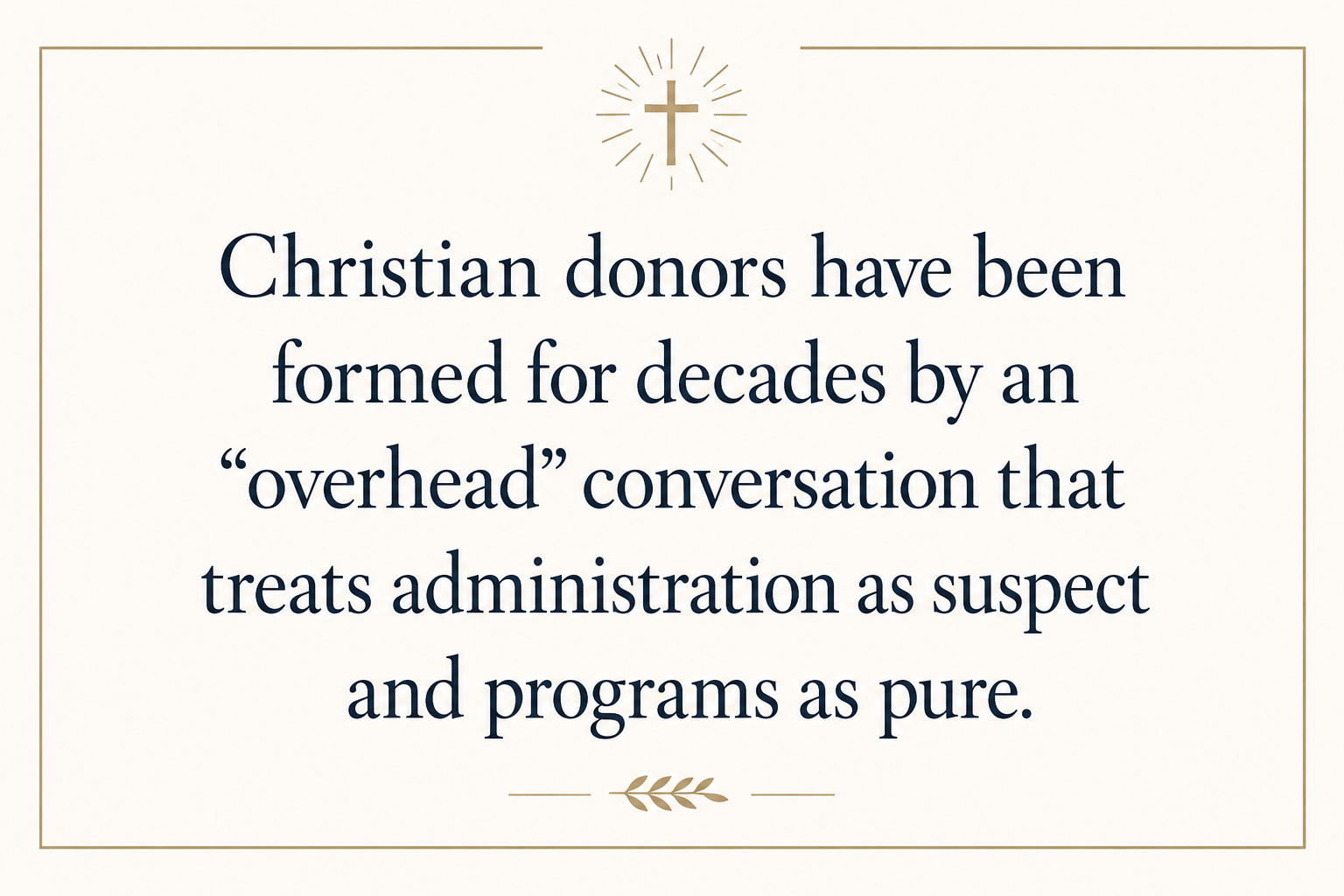
Christian donors have been formed for decades by an “overhead” conversation that treats administration as suspect and programs as pure. The sector has had to correct that framing. Charity Navigator, Candid (formerly GuideStar), and BBB Wise Giving Alliance publicly warned that overhead ratios are a poor proxy for effectiveness and can pressure nonprofits toward unhealthy financial decisions (Charity Navigator).
Disability ministries feel this pressure acutely, because quality care is labor-intensive and requires trained supervision. Legacy gifts can reduce the temptation to underinvest in staff development, internal controls, and program evaluation. For donors who want their generosity to protect the vulnerable rather than expose them to preventable risk, that is not ancillary. It is moral.
Planned giving can protect mission through change and uncertainty
Leadership transitions are predictable, not hypothetical
Disability ministries often carry a founding story that is deeply personal: a parent, a pastor, or a practitioner builds something the local church did not yet know how to build. Over time, the mission must outgrow the founder. That transition can be precarious, because relationships, fundraising, and institutional memory are closely tied to a few people.
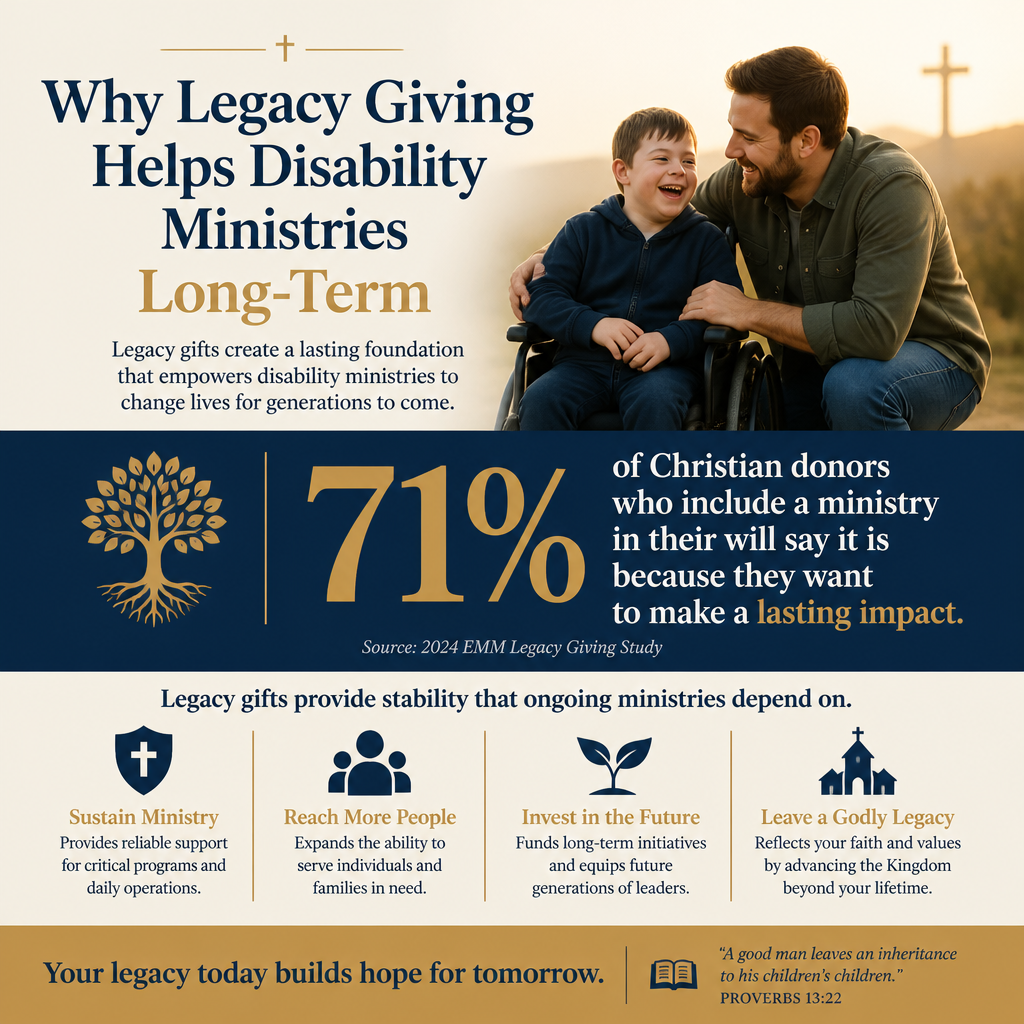
Legacy giving can help a ministry hold steady through leadership change, provided the governance is strong. A mature board, clear succession planning, and transparent financial reporting are not “business additions” to ministry; they are forms of neighbor-love that keep the ministry reliable for families who cannot afford instability. This is one reason we encourage donors to evaluate governance and transparency with the same seriousness they bring to the ministry’s spiritual commitments.
Economic cycles should not decide whether mercy continues
Market downturns and inflation are part of life in a fallen world. They affect donors and ministries alike. The National Center for Charitable Statistics has documented the scale and breadth of the nonprofit sector, and with it the reality that nonprofits operate within economic constraints that can change quickly (National Center for Charitable Statistics).
Legacy giving does not eliminate economic risk, and it should not lead ministries to presume upon future income. Yet it can diversify revenue beyond the annual volatility of year-end giving, especially when legacy gifts are structured prudently and spent according to a clear policy rather than treated as a blank check.
Wise legacy giving requires clarity, restraint, and accountability
Restrictions can serve the mission or silently distort it
Donors often want to restrict legacy gifts to protect intent. That impulse can be honorable. It can also become a burden if it funds yesterday’s priorities rather than today’s needs. Disability ministry changes with best practices, regulation, community partnerships, and what families actually require. A gift restricted too narrowly can force leaders to maintain programs that no longer serve people well.
We generally see healthier outcomes when donors distinguish between “purpose” and “method.” A purpose restriction might be to sustain respite care for families affected by disability. A method restriction might dictate a particular curriculum, facility, or staffing model for the next forty years. The former gives faithful direction. The latter can become an unintended constraint.
Questions donors should press before making a legacy commitment
Legacy giving is most fruitful when it is paired with disciplined due diligence. Within How to Give to Disability Ministries, we return often to the principle that generosity without verification can drift into sentimentality. Before naming a ministry in a will, trust, or beneficiary designation, donors should ask for verifiable clarity on matters like these:
- Does the board provide meaningful oversight, with documented conflict-of-interest policies and independent review?
- Are audited financial statements or a credible independent review available, and are they understandable to a non-specialist?
- Is there a written policy for reserves and for how one-time gifts are handled?
- Does the ministry report outcomes in a way that respects the dignity of people with disabilities, avoiding exploitation in storytelling?
- Are safeguarding and abuse-prevention practices explicit, trained, and enforced?
These are not hurdles erected against ministry. They are part of what it means to “do justice” and to act with integrity, particularly where vulnerable people are involved. Across our team’s evaluation work, we find that ministries prepared to receive legacy gifts are typically those already practicing transparency when it is not convenient.
Legacy giving is a form of formation for donors and families
What we love will be revealed in what we leave
Scripture consistently treats money as spiritually diagnostic. Jesus’ warnings about treasure and the heart are not aimed at guilt; they are aimed at clarity. A legacy plan can function similarly. It forces decisions about what will be funded when our immediate preferences no longer govern the checkbook, and it invites a family to articulate what they believe Christian mercy requires.
For disability ministry, that mercy includes resisting the subtle cultural habit of treating people with disabilities as objects of charity rather than full members of the body of Christ. Planned gifts that underwrite inclusive worship, accessible discipleship, and stable community life can be a quiet testimony that the church intends to remain faithful to every member, including those who are often left to the margins.
Discernment includes the next generation of stewards
Legacy giving can also become a discipleship tool for heirs. Some donors choose to write a letter of intent that explains why disability ministry matters theologically and personally, without binding future leaders to unnecessarily narrow restrictions. Others set aside a portion for ongoing family giving, inviting children and grandchildren to participate in review and decision-making over time.
The harder question is whether the ministry itself is positioned to steward that gift in a way that honors both donor intent and the needs of future participants. That is where independent verification can serve the church. Most Trusted exists to help donors evaluate Christian nonprofits against The Most Trusted Standard, so that planned generosity is anchored not only in goodwill but in governance, financial integrity, and transparent effectiveness.
FAQs for Why legacy giving helps disability ministries long-term
Should a legacy gift go to an endowment or to current operations?
Either can be faithful, depending on the ministry’s maturity and the donor’s purpose. Endowments can stabilize long-term ministry capacity, but they require clear spending policies, strong oversight, and disciplined investment governance. Operating support can be equally strategic for disability ministries with ongoing staffing and safety requirements. The central issue is whether the ministry can demonstrate accountable stewardship and whether the gift structure supports durable service rather than institutional inertia.
How can we evaluate a disability ministry before including it in our estate plan?
Donors should look beyond inspiring stories to verifiable practices: independent financial review, board independence, conflict-of-interest policies, safeguarding protocols, and transparent reporting about outcomes and finances. It is also prudent to confirm how the ministry handles restricted gifts and whether it has a policy for one-time gifts and reserves. Within Disability Ministries, we encourage donors to treat planned giving as a high-trust act that deserves correspondingly rigorous due diligence.
Legacy giving that lasts is legacy giving that can be trusted
Legacy giving helps disability ministries long-term because it can fund continuity where continuity is itself a form of mercy: stable staffing, safe programs, accessible spaces, and leadership that is not forced into short-term compromises. Yet long-term funding amplifies both strength and weakness. It strengthens faithful ministries and can entrench unhealthy ones.
Christian donors serve the church best when legacy gifts are paired with clear purpose, restrained restrictions, and credible accountability. When that happens, planned giving becomes more than financial planning. It becomes a durable commitment to honor the image of God in people with disabilities, not only for this year’s budget, but for the generations who will need the church’s faithfulness after we are gone.



