
How to choose a disability ministry to support is not primarily a question of sentiment; it is a question of faithful stewardship. Christian donors often feel the weight of competing needs, competing narratives, and the limits of any one gift. Yet Scripture does not treat weakness and dependence as peripheral realities. The risen Christ still bears wounds, and the church is commanded to honor the members that seem weaker (1 Corinthians 12:22–23).
Disability ministry sits at the intersection of theology, pastoral care, education, medicine, and public policy. Some ministries focus on accessible worship and belonging; others on respite for caregivers; others on advocacy or international medical care. These are not interchangeable strategies, and not every organization that speaks the language of disability is prepared to serve people with significant support needs with safety, competence, and long-term faithfulness.
Start with a Christian definition of disability and the church
Disability is not a niche issue in the body of Christ
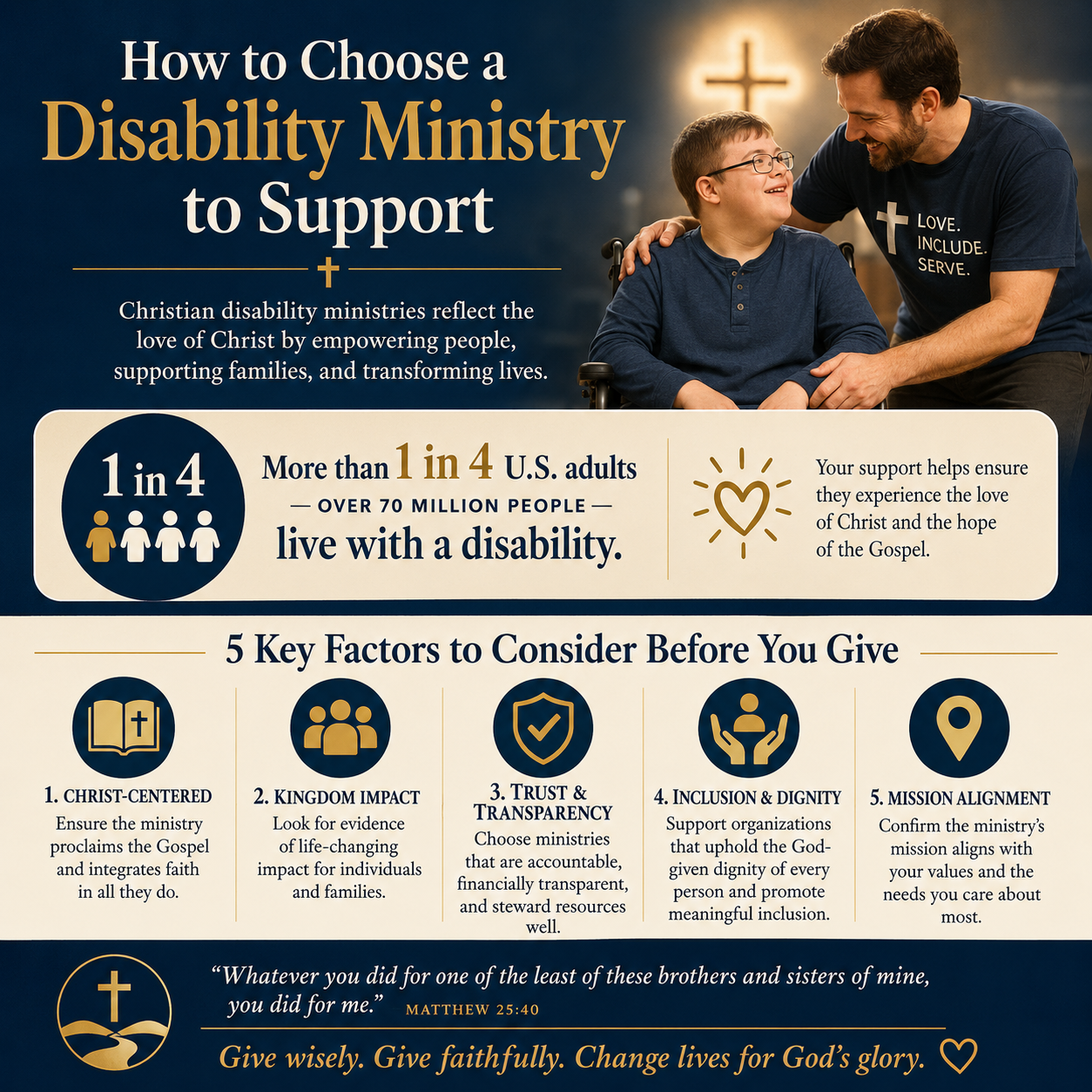
A credible disability ministry begins with a biblical understanding of the image of God. People with disabilities are not primarily recipients of charity; they are members of Christ’s body, called to worship, serve, lead, and be received as gifts. When Jesus’ disciples pressed for a moral explanation of disability, Jesus refused their reductive frame and redirected attention to God’s work and glory (John 9:1–3). That reorientation guards donors from funding programs that subtly treat disability as a problem to be removed rather than a reality to be honored with presence, adaptation, and love.
Good theology also resists two distortions that appear in Christian fundraising. The first is a triumphalism that treats disability as a faith defect, implying that the absence of healing is spiritual failure. The second is a sentimentalism that treats people with disabilities as inspirational symbols rather than neighbors with agency and ordinary complexity. Both distort the gospel, and both tend to produce unhealthy ministry cultures.
Clarify what kind of support you are actually seeking to fund
Disability ministry is a wide field. A donor may want to strengthen local church inclusion, underwrite special needs education, support job training for adults, or fund counseling and respite for caregivers. These aims overlap, but they are not identical. The clearer the ministry’s theory of service, the easier it is to evaluate whether the organization is resourced and governed to do what it claims.
For readers exploring the broader landscape, our Disability Ministries topic page collects the main types of work donors commonly encounter and the questions each type tends to raise in practice.

Evaluate the ministry model, not only the mission statement
Ask what changes for a person or a family because this ministry exists
Many organizations can articulate a mission statement that sounds faithful. The harder question is whether the ministry has a coherent, practical model for serving people with disabilities and their families over time. In our verification work at Most Trusted, ministries that meet The Most Trusted Standard tend to show alignment between their theological claims, their program design, and the lived experience of the people they serve.
Donors can ask concrete questions that reveal whether a ministry’s work is disciplined or improvised: What does a typical participant experience in a month? What support do caregivers receive beyond a single event? How does the ministry coordinate with local churches, schools, clinicians, or disability service agencies when those partnerships are appropriate? Where does the ministry draw the line between pastoral care and clinical care?
Notice whether the ministry treats caregivers as part of the mission field
Family disability life is often marked by chronic fatigue, financial stress, and isolation. Respite is not a luxury; it can be the difference between stability and crisis. A mature ministry does not romanticize caregiving or assume every family has the same capacity. It speaks honestly about the long obedience of care, and it structures programs so that parents and siblings are not invisible.
When a ministry is built around occasional high-impact experiences, it can inadvertently produce a cycle of brief encouragement followed by long stretches without support. This does not make the ministry illegitimate, but it does change what a donor should expect. Some donors prefer to fund the steady, less visible work that keeps families connected to worship and community week after week.
Insist on safety, competence, and accountability
Vulnerable people require more than good intentions
People with disabilities are often more vulnerable to abuse and exploitation, particularly when they rely on others for personal care, communication support, or transportation. Donors should treat safety policies as a first-order issue, not a bureaucratic detail. Safeguarding is a spiritual matter because it reflects whether a ministry understands authority as service and takes seriously Christ’s warning about causing little ones to stumble (Matthew 18:6).
Verifiable evidence suggests that people with disabilities face disproportionate risk of victimization; the U.S. Department of Justice has reported higher rates of violent victimization among persons with disabilities than among persons without disabilities in multiple annual analyses (Bureau of Justice Statistics). The ministry’s duty of care should match that reality.
What to look for in policies and practice
Policies matter only if they are implemented and audited. Donors should look for clarity about staff screening, volunteer training, incident reporting, and supervision ratios, especially in overnight respite, transportation, or any context involving personal care. In church-based programs, donors should also ask whether the ministry is integrated with the church’s broader child protection and safe environment practices rather than operating as an exception because it is “special.”
A short set of indicators can clarify whether a ministry is likely to be safe and accountable:
- Written safeguarding policies that are publicly accessible or available on request
- Background checks and reference checks for staff and volunteers in roles of direct care
- Training that addresses disability-specific vulnerabilities, communication, and boundaries
- Clear reporting pathways, including how allegations are handled and escalated
- Appropriate insurance coverage and documented risk management practices
Follow the money and the governance, without reductionism
Stewardship requires transparency, not a simplistic overhead test
Christian donors sometimes default to one metric: the overhead ratio. The field has had to reckon with the fact that this can mislead. In 2013, Charity Navigator, GuideStar, and the BBB Wise Giving Alliance jointly warned donors against using overhead as the sole measure of nonprofit performance, arguing that pressure to minimize administrative costs can undermine effectiveness and accountability (Candid GuideStar).
What this means in practice is that donors should look for financial integrity and appropriate investment in staffing, training, compliance, and evaluation. Disability ministry often requires specialized competence, adaptive equipment, and higher supervision ratios. A ministry that appears “lean” may simply be under-resourced, placing participants and caregivers at risk.
Governance signals whether a ministry can be trusted with power
Disability ministry frequently involves asymmetry of power: one person has the ability to include or exclude, to interpret communication, to set boundaries, to control schedules and access. Governance is the donor’s window into whether a ministry understands that power must be checked. Healthy boards provide meaningful oversight, address conflicts of interest, and ensure that executive leaders cannot operate without accountability.
At Most Trusted, we evaluate ministries against The Most Trusted Standard, a 15-criteria framework spanning Faith Foundation, Financial Integrity, Governance and Leadership, and Transparency and Effectiveness. Donors do not need to replicate a full verification process, but they should expect a ministry to answer basic questions: Are audited financials available when appropriate? Is the board independent? Are related-party transactions disclosed? Does the organization provide clear, consistent reporting on how funds are used?
Prioritize evidence of fruit, not only stories
Stories can be true and still incomplete
Disability ministry fundraising often relies on narratives, and narratives are not wrong. The Gospels themselves bear witness through particular lives and particular healings. Yet donor discernment requires more than moving stories, especially when the people featured may have limited ability to consent or to control how their image is used.
A mature organization can show fruit in multiple forms: retention of families over years, training outcomes for volunteers, church culture change, increased accessibility, and partnerships that reduce duplication. It can also speak honestly about what has not worked and what it has changed as a result. That kind of candor is a mark of integrity, not weakness.
Ask how the ministry listens to people with disabilities
Christians genuinely disagree about the best vocabulary for disability, and there are meaningful debates about person-first language, identity-first language, and the role of “healing” language in public worship. The more important question is whether the ministry listens carefully to people with disabilities and their families, especially those with high support needs and those whose communication looks different from the majority culture.
We recommend asking whether people with disabilities hold real influence in the ministry’s life: advisory councils, staff roles, leadership development pathways, or formal feedback mechanisms. Representation is not a token. It is a safeguard against ministries that unintentionally serve their own sense of purpose rather than the people they claim to serve.
FAQs for How to choose a disability ministry to support
Should we prioritize church-based disability ministry or specialized nonprofits?
The answer depends on what need is most pressing and where accountability is strongest. Church-based disability ministry can foster durable belonging and spiritual formation, which families often cannot find elsewhere. Specialized nonprofits may offer clinical expertise, respite capacity, or employment programs that a church cannot responsibly run. Many of the strongest ecosystems involve partnership: churches providing community and worship, nonprofits providing specialized services, and both maintaining clear boundaries and safeguarding.
How can we assess impact when disability ministry outcomes are hard to measure?
Some outcomes are measurable and should be measured: training completion, participation frequency, volunteer screening compliance, caregiver respite hours, and accessibility improvements. Other outcomes are less quantifiable but still discernible: whether families remain connected to worship, whether participants are treated with dignity, whether the ministry’s culture is safe and stable, and whether leaders are responsive to concerns. Donors can ask for a small set of consistent indicators reported over time, paired with a clear explanation of what the ministry considers faithful success.
A faithful choice is a careful choice
Choosing a disability ministry to support is an opportunity to fund work that reflects the kingdom’s reversal: honor given where the world often withholds it, and belonging extended where exclusion is routine. The most trustworthy ministries combine theological seriousness with operational competence, because love requires both. For donors discerning where to give within this field, our How to Give to Disability Ministries category page outlines additional questions that experienced givers use to assess fit, risk, and long-term fruit.



