

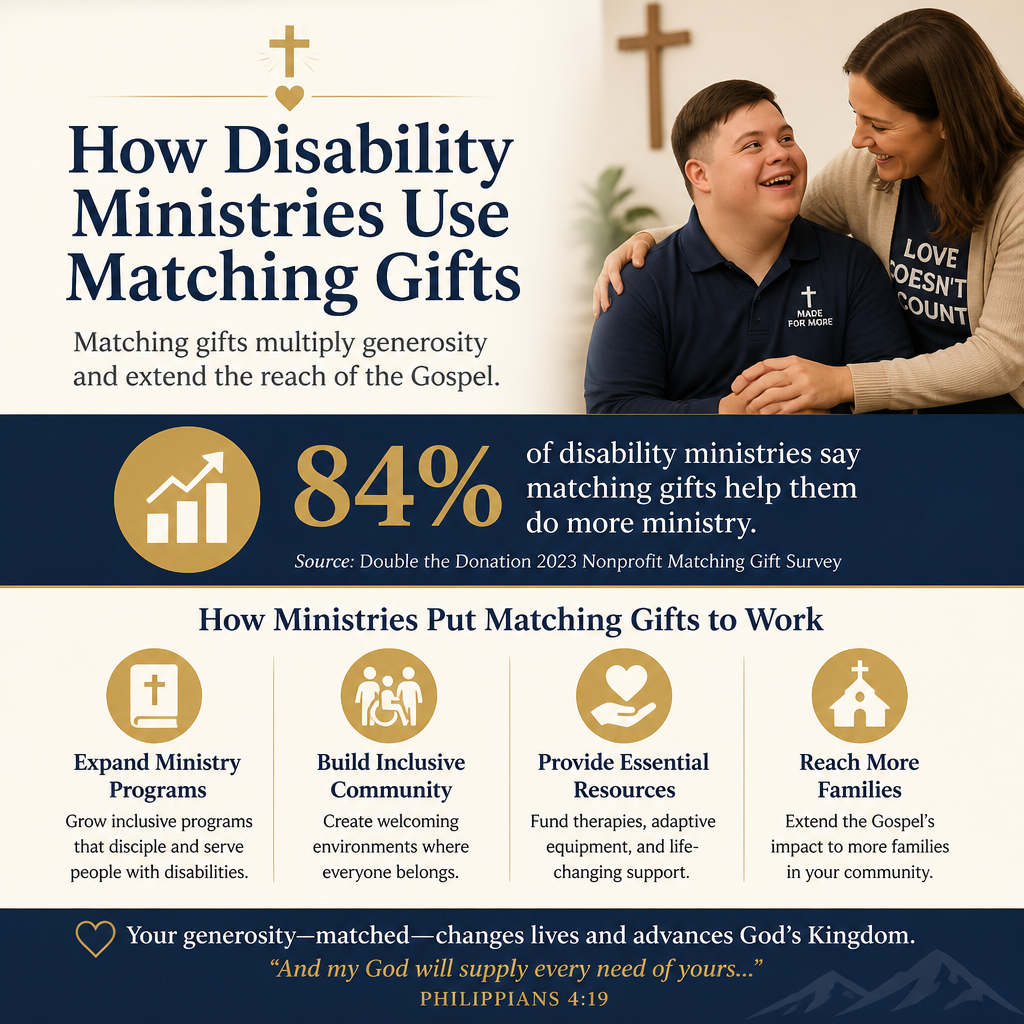
How disability ministries use matching gifts is not a fundraising trick; it is a stewardship question. When matching is handled with integrity, it can widen participation, stabilize cash flow for under-resourced programs, and invite donors into shared responsibility for neighbors too often overlooked.
Disability ministry is also a field where trust and clarity matter unusually. Families affected by disability have endured church misunderstanding, program gaps, and the quiet exhaustion of navigating systems that do not fit. Donors want to help without unintentionally funding paternalism, segregation, or vague “awareness” messaging untethered from real, dignifying support. Matching gifts can serve the good, but only when the ministry’s theology of personhood and its financial practices are both coherent and verifiable.
Matching gifts in disability ministry are a stewardship instrument
Why matching works when it aligns with Christian formation
At their best, matching gifts translate an ancient Christian instinct into modern practice: “let us not love in word or talk but in deed and in truth” (1 John 3:18). A match can move a donor from sympathy to concrete action, and it can lower the barrier for first-time givers who are testing whether a ministry is trustworthy.
What this means in practice is that matching is less about urgency language and more about participation. Disability ministry often requires consistent, patient investment: accessible transportation, trained respite volunteers, sensory supports, adaptive curriculum, and staff who can walk with families over years. A match can help a ministry fund these “unseen” costs without turning every appeal into crisis rhetoric.
The most common matching models disability ministries use
Across the field, matching tends to fall into a few recognizable patterns. Each has benefits and corresponding risks, especially when donors assume a match automatically signals financial strength.
- Employer matching (a donor’s company matches their personal gift): often the most scalable, but it depends on donor follow-through and administrative competence.
- Challenge grants (a major donor matches gifts up to a cap): effective for expanding a donor base, but it can create pressure to over-promise outcomes.
- Board or leadership matching: can signal governance ownership, but it becomes problematic if presented as a substitute for regular operating support.
- Time-bound matches: can accelerate giving, but they can also train donors to wait for the next match rather than give consistently.
- Program-specific matches: helpful when the program is concrete (respite nights, accessible retreats), yet risky if restricted designations starve core operations.

Disability ministry adds ethical constraints that donors should name
Matching can unintentionally commodify people
The disability community has long warned against fundraising that treats disabled people as objects of inspiration or pity rather than neighbors with agency. A matching campaign can intensify that temptation because it rewards emotionally “high-performing” stories. Christian donors should resist the false choice between compelling storytelling and truthful storytelling. Ministries can tell stories with consent, dignity, and theological clarity, and donors can ask for that standard.
Scripture’s vision is not that some are fully human and others are “projects.” Every person bears the image of God (Genesis 1:27), and the church is called to honor the members who seem weaker (1 Corinthians 12:22–23). Matching campaigns should reflect that ecclesiology: disability ministry is not merely charity; it is the life of the body.
Restricted matching can weaken the very programs families rely on
Families frequently need support that does not fit neat budget lines: a coordinator who follows up, volunteer training that prevents harm, background checks, secure data practices, and the slow work of building accessible community. When a match is restricted to a narrow program, leadership may feel pressure to redirect staff time toward what is “matchable” rather than what is most needed.
Christians genuinely disagree about how much giving should be restricted versus general. The wiser question is whether the ministry can explain, in plain terms, how restricted gifts will be managed without hollowing out operations. Ministries that meet The Most Trusted Standard tend to communicate these trade-offs candidly, because transparency is not an accessory to mission; it is a moral obligation to the donor and to the people served.
What to verify before you give to a matched disability campaign
Confirm that the match is real and clearly governed
A match should never be a vague promise. Donors should be able to find a clear statement of the match amount, the time window, and what happens if the goal is not met. When terms are not disclosed, donors are being asked to trust what cannot be tested.
We also recommend verifying who controls the matching funds and whether there is a written agreement. A challenge match from a major donor is common and legitimate, but the ministry should be able to state, without hedging, whether the matching funds are already committed and whether the match is contingent on anything beyond ordinary fundraising performance.
Verify organizational health beyond the match itself
Matching can mask structural weakness if donors treat it as a seal of approval. A sophisticated donor looks for evidence of governance, financial integrity, and theological accountability that stands whether or not there is a match.
That is one reason Most Trusted exists. We evaluate Christian nonprofits against The Most Trusted Standard, a 15-criteria framework across Faith Foundation, Financial Integrity, Governance and Leadership, and Transparency and Effectiveness. The match may motivate a gift; verification should inform it. For donors supporting a range of organizations working in Disability Ministries, comparable standards make responsible generosity more practical.
How to give through matching gifts without reinforcing harmful patterns
Prioritize belonging over programming
Many disability ministries do valuable “program” work—respite nights, buddy systems, camps, job readiness, caregiver support groups. Yet the church’s deeper calling is belonging. Donors can look for ministries that treat accessibility as part of discipleship rather than a separate department.
Practically, this means asking whether the ministry is integrated with local congregations, whether disabled leaders have real influence, and whether the ministry’s language reflects the New Testament’s vision of mutuality. A matching campaign that raises funds for a sensory room can be good; a campaign that raises funds for durable inclusion in worship and community is better.
Fund the unglamorous work that prevents burnout and harm
Caregivers often carry chronic strain, and volunteer teams can burn out without training, boundaries, and pastoral care. Matching campaigns frequently prefer visible deliverables. Donors can push against that by giving to costs that make ministry safe and sustainable.
We recommend asking a ministry to name what they have learned about volunteer training, safeguarding, and caregiver support. Where applicable, donors can ask how the ministry handles mandatory reporting, background screening, and incident response. These are not distractions from mission; they are expressions of love of neighbor ordered by wisdom.
Using matching gifts to strengthen trust with donors and families
Transparency is pastoral care
Disability ministry is relational by nature. Families are entrusting a ministry not only with money, but often with their children, their confidentiality, and their hope. A matching campaign that is vague about outcomes or finances undermines that trust. Clear reporting—what was raised, what was matched, and what changed as a result—is a form of respect.
The same principle applies to overhead debates. Many donors have been trained to treat “overhead” as suspect. Yet leaders across the nonprofit sector have argued that simplistic overhead ratios mislead donors and can damage organizations’ long-term health, as reflected in the “Overhead Myth” statement published by major charity evaluators and sector leaders (Candid GuideStar). Disability ministries, in particular, may have legitimate administrative costs tied to safety, specialized staffing, and accessibility.
Matching should deepen discipleship, not train consumers
Time-bound matches can teach donors to wait for incentives. That is understandable in a culture shaped by discounts and promotional cycles, but Christian giving is not consumer behavior. Ministries can frame matching as an invitation to shared sacrifice rather than a bargain. Donors can respond by giving consistently, even when no match is available, and by encouraging ministries to present giving as worshipful stewardship.
For donors who want to think carefully about practices like restriction, reporting, and sustainable funding in this space, we have found it helpful to situate matching within the broader questions covered in How to Give to Disability Ministries.
FAQs for How disability ministries use matching gifts
Should we only give when there is a matching gift?
We do not recommend treating matching gifts as the primary reason to give. A match can be a wise moment to act, especially for a first-time donor, but long-term disability ministry requires steady support. If the ministry is trustworthy and the need is durable, consistent giving often serves families better than episodic, incentive-driven giving.
How can we tell whether a matching gift claim is credible?
Credible matching campaigns state the match amount, the donor or fund providing the match in general terms, the time window, and what counts toward the match. They also report results afterward. When the details are missing, donors should ask direct questions before giving, because ambiguity in financial claims is not a minor communications issue; it is a governance issue.
Matching gifts can serve disability ministry when they serve the truth
Matching gifts can enlarge generosity toward disability ministries, but they do not absolve donors of discernment or ministries of clarity. The church’s calling is not merely to fund good intentions, but to practice love ordered by truth, accountability, and honor for those the world too easily sidelines. When matching is governed transparently and rooted in a theology of belonging, it can become one more instrument for the church to embody the care Scripture requires.



