
Giving options for disability ministry donors are not merely tactical decisions about payment methods. They are spiritual and fiduciary choices about how to sustain long-term, dignified care for image-bearers whose needs are often complex, underfunded, and misunderstood. Many Christian donors also carry a quiet burden: the fear that sincere compassion may still produce dependency, inefficiency, or harm if it is not coupled with discernment.
Scripture’s moral center of gravity is clear. Jesus repeatedly identifies care for the vulnerable as a mark of faithful discipleship, including those who live with illness and weakness (Matthew 25:36). The church’s calling is not only to feel compassion, but to order resources in a way that honors dignity, strengthens families, and builds trustworthy institutions.
Start with purpose and outcomes, not with a payment method
Disability ministry spans a wide range: respite programs for exhausted caregivers, accessible discipleship for those with intellectual disabilities, inclusive church training, job readiness, accessible Bible translation, residential supports, mental health counseling, and advocacy in public systems. The giving option that best serves a ministry depends on what the work requires most: predictable cash flow, specialized equipment, trained staff, transportation, or a reserve that can absorb volatility without cutting services.
The harder question is whether the ministry can show that its work is effective and protective of those it serves. Across our verification work at Most Trusted, the ministries that meet The Most Trusted Standard tend to describe outcomes plainly, disclose finances without defensiveness, and demonstrate governance that can withstand the pressures that often accompany highly emotional giving categories.
Clarify what kind of need you are funding
Some needs are episodic and measurable: a wheelchair ramp for a family, hearing devices, accessible transportation for a program, or scholarships for a respite retreat. Others are ongoing: caregiver support groups, community-based day programs, inclusive Sunday school staffing, or supported employment coaching. Short-term needs may align with one-time gifts. Ongoing needs frequently require recurring support, multi-year commitments, or endowment-like stability.
Distinguish pastoral care from clinical care
Disability ministries often operate near the boundary between spiritual formation and clinical or therapeutic services. That boundary matters. Donors should understand whether services are delivered by licensed professionals, trained volunteers, or a mix, and what safeguards and referral protocols exist for high-risk situations. A ministry can be deeply faithful and still be operating outside its competency if it implicitly substitutes spiritual care for clinical treatment.

Recurring giving and multi-year commitments stabilize care
Many disability programs are people-intensive. Staff and volunteer coordination, background checks, transportation, and training do not scale cleanly. Recurring support often does more for quality and safety than a single large gift, because it reduces the disruptive cycle of hiring freezes, program cancellations, and reactive fundraising that can compromise continuity for vulnerable participants.
From a donor’s perspective, recurring giving is also a discipline of stewardship. It treats care as a covenantal commitment rather than an annual impulse. The pattern resembles the New Testament churches’ practice of regular collections for enduring needs (1 Corinthians 16:1–2).
What recurring gifts make possible
- Retaining trained staff and key program leaders
- Consistent respite availability for families under chronic strain
- Safer environments through ongoing screening and training
- More predictable planning for accessible transportation and supplies
- Program evaluation that improves effectiveness over time
When multi-year commitments are appropriate
Multi-year commitments fit especially well when a ministry is expanding capacity, launching a new site, or building a pipeline for trained volunteers. They can also be an appropriate way to fund a ministry’s internal strengthening: better financial controls, improved reporting, strengthened safeguarding policies, and more rigorous outcome measurement. These are not “administrative extras.” They are often the difference between compassionate intentions and sustainable, trustworthy service.
Non-cash gifts can fund access and dignity when structured carefully
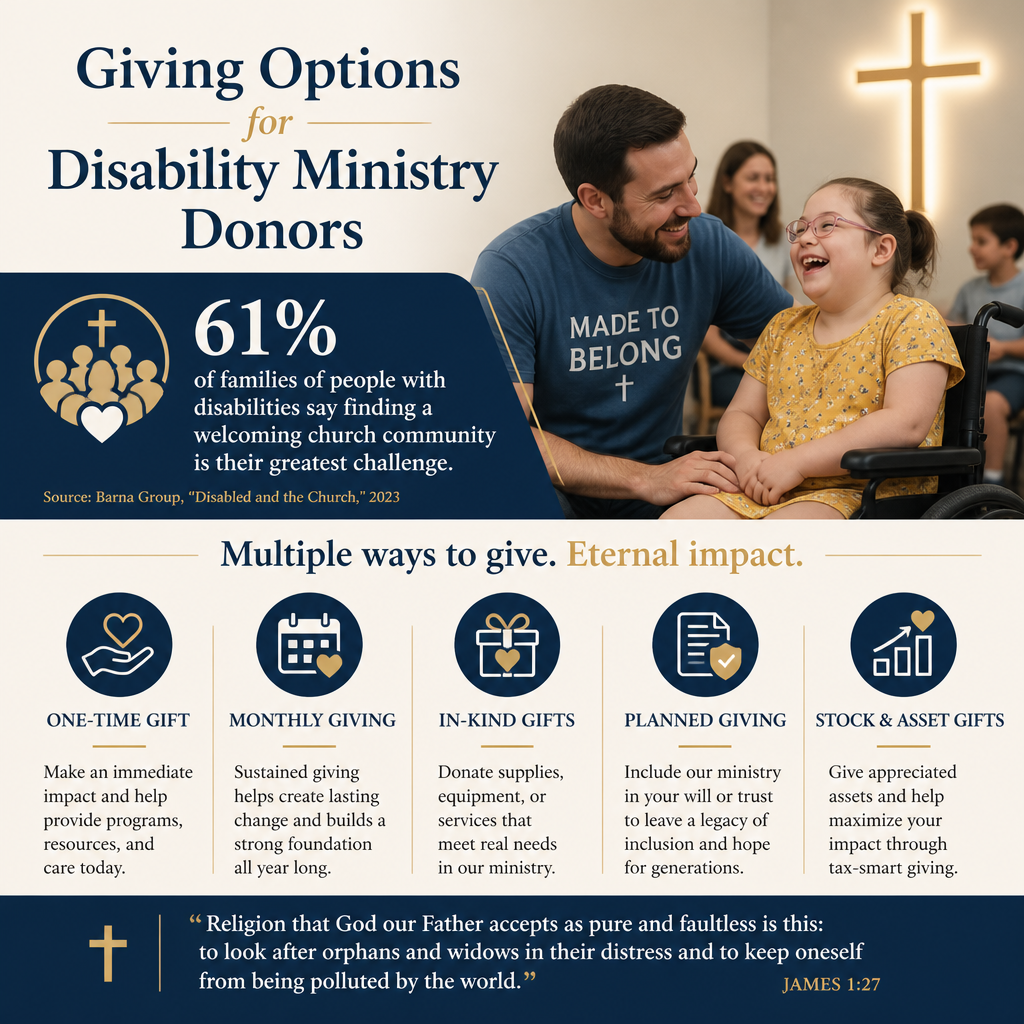
Disability ministry needs are often capital-intensive. Non-cash gifts can be a wise way to fund specialized equipment, accessible spaces, or durable program infrastructure without forcing a ministry to choose between immediate services and long-term capacity. The trade-off is complexity: valuation, liquidity, restrictions, and timing can all create friction if a gift is offered without prior coordination.
Appreciated assets and donor-advised funds
Gifts of appreciated securities are often efficient for donors and flexible for ministries, provided the ministry can receive and liquidate them promptly. Donor-advised funds can also be helpful when donors want a disciplined, planned approach to giving across several ministries while maintaining a posture of generosity. The practical caution is that donor-advised funds can unintentionally distance a donor from the relational accountability that should accompany Christian stewardship.
Christians genuinely disagree about how public policy should treat donor-advised funds, but the moral question for donors is less political than pastoral: is the account being used as a staging ground for deliberate generosity, or as a way to delay the transfer of resources while still receiving immediate tax benefit? For donors seeking theological clarity on the calling and complexity of disability-focused work, see Disability Ministries.
In-kind giving and the limits of donated goods
In-kind gifts can be appropriate when they meet a ministry’s stated needs, arrive in usable condition, and do not create disposal or storage burdens. Many ministries quietly absorb significant costs handling unsuitable donations. A wise donor asks what is needed, in what quantity, and by what date. In-kind giving should honor the ministry’s operational reality rather than impose the donor’s surplus.
Restricted gifts, designated gifts, and the ethics of donor control
Disability ministry often draws donors who are personally connected to disability through family experience. That can be a holy motivation. It can also intensify the desire to control outcomes. Restrictions can be ethically appropriate when they protect the intent of a gift and align with the ministry’s strategy. They become harmful when they force a ministry into unsustainable commitments, distort priorities, or complicate care delivery.
Ask how a restriction will be governed
A restriction is only as responsible as the governance that will oversee it. Who approves exceptions when circumstances change? How will unused funds be handled? What reporting will be provided, and at what cost to staff time? In disability contexts, needs can change quickly: a participant’s condition worsens, a family relocates, a program model proves ineffective, or a regulatory environment shifts. Good restrictions anticipate real-world change without undermining accountability.
Be cautious with funding that pressures metrics
Donors often want clean measures: “How many people were served?” “How many professions of faith occurred?” Some measures matter, but the field has had to reckon with the fact that disability ministry outcomes are not always linear. Faithful presence, durable inclusion, and strengthened family systems can be more meaningful than easily counted events. A responsible ministry can still report outcomes, but it will resist reducing people to numbers.
For donors weighing how to structure gifts without undermining the ministry’s long-term health, see How to Give to Disability Ministries.
Due diligence is part of love of neighbor
Disability ministry sits close to vulnerable adults and children, and that proximity increases the moral stakes of governance, safeguarding, and transparency. Donors sometimes fear that due diligence signals distrust. In reality, careful verification is one way donors honor those being served. Scripture condemns both exploitation and negligence; both can be present where money flows quickly and oversight is thin.
American giving remains substantial, but concentrated wealth and complex nonprofit ecosystems can obscure accountability. Total charitable giving in the United States was estimated at $557.16 billion in 2023, according to Giving USA. Scale creates opportunity, but it also creates room for ministries to operate without meaningful external scrutiny.
What The Most Trusted Standard emphasizes
Most Trusted evaluates Christian nonprofits against The Most Trusted Standard, a 15-criteria framework across Faith Foundation, Financial Integrity, Governance and Leadership, and Transparency and Effectiveness. In disability ministry, several criteria become especially relevant:
- Safeguarding policies and practice for children and vulnerable adults
- Board independence and documented oversight of risk
- Clear doctrinal commitments paired with respectful service
- Financial statements and disclosures that can be understood and verified
- Evidence that programs are doing what the ministry claims
Beware the overhead reflex
Donors often ask, “How much goes to programs?” The question is understandable, but it can become a category error when it treats staff training, screening, financial controls, and evaluation as distractions from ministry. The broader philanthropic field has explicitly warned against this reductionism. Charity Navigator, Candid, and the BBB Wise Giving Alliance jointly argued that focusing narrowly on overhead is misleading and can create perverse incentives, urging donors to consider results and accountability instead of simplistic ratios (Charity Navigator).
Disability programs frequently require higher staffing ratios, specialized training, and accessible facilities. These legitimate costs can make a ministry look “less efficient” by superficial measures while actually being more responsible.
FAQs for Giving options for disability ministry donors
Should we prioritize giving to disability programs within local churches or to specialized nonprofits?
Both can be faithful, and the choice often depends on the gaps in your community. Local churches are uniquely positioned for long-term belonging: consistent relationships, worship, and pastoral care that cannot be replicated by service organizations. Specialized nonprofits often provide technical expertise, therapeutic support, and scaled services that churches cannot easily sustain. Many donors choose a blended approach: they support a church’s inclusion efforts while also funding a nonprofit that provides training, respite, or specialized programming. What matters is whether each organization can demonstrate competent leadership, appropriate safeguarding, and transparent stewardship.
Are designated gifts for one family or one individual wise in disability ministry?
They can be, but they should be structured with care. Direct aid can relieve acute burdens and reflect biblical mercy, especially when a family is facing sudden medical costs or accessibility needs. The risk is inequity and precedent: if aid is not governed consistently, ministries can unintentionally favor the most visible stories or the most connected families. We recommend asking how the ministry assesses need, protects dignity, avoids conflicts of interest, and ensures that designated support does not undercut long-term program stability.
A mature generosity seeks both compassion and accountability
The church’s calling to welcome and honor those with disabilities is not an optional ministry preference; it is an expression of the kingdom’s moral order. Giving options for disability ministry donors should therefore be chosen with a clear view of what sustains faithful care over time. One-time gifts, recurring support, non-cash giving, and carefully bounded restrictions all have a place when they serve dignity, protect the vulnerable, and strengthen trustworthy institutions that can endure.



