

Why disability ministries need unrestricted giving is not a fundraising slogan. It is a theological and operational claim: if the church intends to honor the image of God in people with disabilities, it must fund the ordinary, ongoing work that makes belonging possible.
Many Christian donors prefer designated gifts because they feel concrete. We understand the impulse. Disability ministry, however, is often built from a thousand unglamorous decisions—staffing ratios, training, transportation, safety policies, adaptive communication, caregiver support, and the patient work of trust. The giving that sustains those decisions is usually unrestricted.
Disability ministry is ordinary discipleship work with extraordinary constraints
The ministry is the person, not the program line item
Scripture does not treat weakness as a peripheral matter. Jesus consistently receives those pushed to the margins and makes their presence a sign of the Kingdom. Paul’s teaching is even more direct: “Those parts of the body that seem to be weaker are indispensable” (1 Corinthians 12:22). Disability ministry is not an optional add-on to the life of the church; it is a test of whether we mean what we confess about the Body of Christ.
Yet donors often encounter disability ministries primarily through visible programs: a respite night, a sensory-friendly service, a summer camp week, a wheelchair ramp. These matter. But the deeper work is personal and relational: a volunteer who learns to use a communication board, a pastor who understands guardianship realities, a children’s leader who can de-escalate anxiety without shame, a congregation that learns to move at the pace of love rather than efficiency.
Constraints are real, and they change faster than designated budgets
Disability ministries operate under constraints that do not yield to enthusiasm. Screening and training are not optional; they are part of care. Policies must be maintained. Background checks must be current. Facilities must be accessible. Transportation must be reliable. When a family’s situation shifts, the ministry must respond quickly if it intends to remain trustworthy.
Restricted funding can unintentionally freeze a ministry into last year’s assumptions. Unrestricted funding gives leaders the capacity to respond to what is actually happening in the lives of families now.

Restricted gifts can unintentionally undermine the very outcomes donors want
The starvation cycle is especially damaging in disability ministry
Many donors have been trained to treat overhead as suspect. But the sector has had to reckon with the damage caused by this assumption. Stanford Social Innovation Review described the “nonprofit starvation cycle,” where pressure to minimize administrative costs leads organizations to underinvest in infrastructure, which then reduces effectiveness and reinforces donor mistrust (Stanford Social Innovation Review).
In disability ministries, underinvestment shows up quickly: inconsistent volunteer support, inadequate training, brittle safety practices, poor data stewardship for sensitive family information, and staff burnout. Donors rarely intend these outcomes, but restricted gifts can create them when they keep ministries from paying for the systems that make care safe and sustainable.
The overhead myth letter clarified what mature donors should ask for
There is also an important correction from within the charity evaluation world itself. In the widely cited “Overhead Myth” letter, Charity Navigator, GuideStar, and the BBB Wise Giving Alliance urged donors to stop using overhead ratios as the primary measure of nonprofit worth and to focus on transparency, governance, and results (Charity Navigator).
That counsel is particularly relevant for disability ministry because quality depends on staffing, training, and risk management—categories donors sometimes label “overhead” but families experience as trustworthiness.
Unrestricted funding pays for the hidden work of accessibility and safeguarding
Accessibility is not a one-time purchase
Donors often imagine accessibility as equipment: ramps, hearing assistance, sensory tools, adaptive devices. Those are important, and sometimes they are best funded through designated campaigns. But accessibility is also a discipline: maintaining inclusive systems over time as needs change, volunteers rotate, and families come and go.
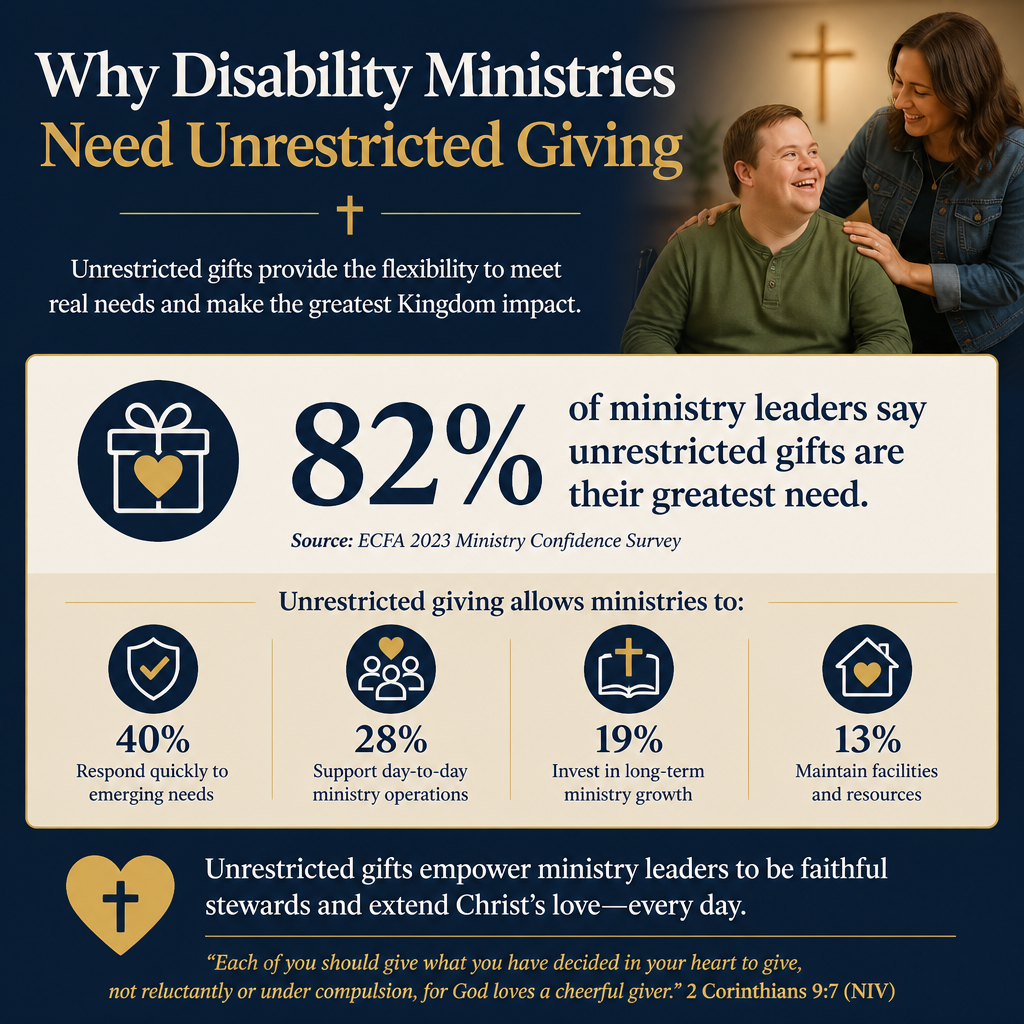
Unrestricted funds keep that discipline from collapsing between special projects. They support the planning meeting that is not inspiring but prevents harm. They pay for the staff time required to coordinate with a school IEP team, consult an occupational therapist, or update a check-in process for a child who elopes when overstimulated.
Safeguarding is costly, and it should be
Disability ministries frequently serve people who are at increased risk of abuse and exploitation, including those with limited communication. The church has learned, sometimes through grievous failures, that safeguarding must be proactive. That means screening, training, supervision, documentation, clear reporting pathways, and periodic review of policies.
Those costs do not map neatly onto a donor’s preferred designation. Unrestricted giving allows leaders to fund safeguarding as a non-negotiable baseline rather than a discretionary add-on.
- Volunteer screening and recurring background checks
- Specialized training for de-escalation and communication supports
- Staff supervision time and adequate adult-to-participant ratios
- Secure systems for handling sensitive family and medical information
- Transportation contingencies and emergency readiness
What we look for at Most Trusted when unrestricted giving is requested
Unrestricted giving requires verifiable trust
Not every organization has earned the right to ask for unrestricted support, and mature donors are right to test that request. Across our verification work at Most Trusted, we find that the healthiest ministries do not treat unrestricted funding as permission to be vague. They treat it as responsibility to be clear—about mission, financial controls, leadership accountability, and measurable faithfulness.
That is why our evaluations are structured around The Most Trusted Standard, a 15-criteria framework that examines faith commitments, financial integrity, governance and leadership, and transparency and effectiveness. Unrestricted giving becomes prudent when a ministry can show, with evidence, that it is governed well and communicates honestly.
Markers of a ministry that can steward unrestricted gifts well
Donors should not be asked to choose between compassion and rigor. When disability ministries are stewarding unrestricted funds faithfully, we typically see several patterns: clear statements of theological purpose, sober acknowledgment of risk, budgets that reflect real costs, leadership that welcomes oversight, and reporting that tells the truth about both progress and limitation.
For donors who want a broader frame for giving in this field, it can be helpful to review Disability Ministries and consider how different models of care and inclusion shape financial needs over time.
How donors can give unrestricted funds without giving blindly
Designations can still serve, but they should follow strategy
Christians genuinely disagree about how much control a donor should retain after giving. Some emphasize the donor’s stewardship responsibility to specify intended use; others emphasize the church’s responsibility to deploy resources where leaders have the fullest information. In practice, many mature donors do both: they provide a meaningful base of unrestricted support and then add targeted gifts for defined needs that do not distort the operating budget.
What this means in practice is that a donor can fund the “boring” necessities without abandoning accountability. A ministry can be asked to report on outcomes, safeguarding, and the concrete ways unrestricted funds stabilized or improved care.
Questions that clarify whether unrestricted support is warranted
Before increasing unrestricted support, donors can ask questions that reveal whether a ministry has the clarity and controls to steward flexible funding:
- How does leadership determine priorities when needs exceed resources?
- What safeguarding policies govern volunteer engagement, and how are they enforced?
- What percentage of the budget is dependent on restricted gifts that cannot cover core operations?
- How does the ministry measure participation, caregiver relief, spiritual formation, or belonging without overstating claims?
- What financial statements and governance documents are available for review?
Donors who want to see how ministries describe the use of funds across common disability programs may also consult How Disability Ministries Use Donations and compare the logic of the budget to the realities of care.
FAQs for Why disability ministries need unrestricted giving
Is unrestricted giving less accountable than restricted giving?
Unrestricted giving is not inherently less accountable; it is accountable in a different way. The burden shifts from donor-controlled line items to organizational governance, financial controls, and transparent reporting. For that reason, unrestricted gifts belong with ministries that can demonstrate sound oversight, clear decision-making, and truthful communication about results and limitations.
Should donors stop making restricted gifts to disability ministries?
Not necessarily. Restricted gifts can be appropriate for capital needs, accessibility upgrades, scholarships, or time-bound initiatives when the restriction matches the ministry’s strategy and does not starve core operations. Many ministries are healthiest when donors provide a stable base of unrestricted support and then add designated gifts that do not create long-term obligations without long-term funding.
Unrestricted giving is often the difference between a program and a ministry
Disability ministry is sustained by continuity: trained volunteers who stay, staff who are not consumed by turnover, safeguarding that is funded rather than improvised, and families who learn that the church’s welcome is not seasonal. Unrestricted giving is the financial form of that continuity. When it is paired with verification, transparency, and governance worthy of trust, it becomes one of the most practical ways donors can strengthen the church’s capacity to honor those Scripture calls indispensable.



