

Funding disability ministry programs is one of the most concrete ways Christian donors can honor the image of God in every person and strengthen the church’s witness to a watching world. The question is rarely whether the work matters. The harder question is how to fund it in a way that is faithful, effective, and appropriately accountable.
Disability ministry often sits at the intersection of pastoral care, special education, family support, clinical realities, and church culture. It is rarely inexpensive, and it is rarely simple. A mature funding strategy resists both sentimentality and suspicion. It asks what outcomes are being pursued, what safeguards protect vulnerable people, and what kind of Christian community is being built over time.
Start with a biblical anthropology that shapes funding priorities
Disability ministry is not an optional compassion project
Scripture does not treat weakness as a detour from the life of God. It treats weakness as a setting in which the power of God is displayed and the people of God learn dependence. Paul’s testimony that Christ’s power is made perfect in weakness (2 Corinthians 12:9) makes disability ministry a spiritual matter, not merely a program category.
This matters for donors because it clarifies what we are funding. We are not buying “access” as a consumer service. We are supporting the church’s vocation to welcome, disciple, and equip believers with disabilities, and to care for families bearing heavy, long-term burdens.
Prioritize dignity, belonging, and discipleship over visibility
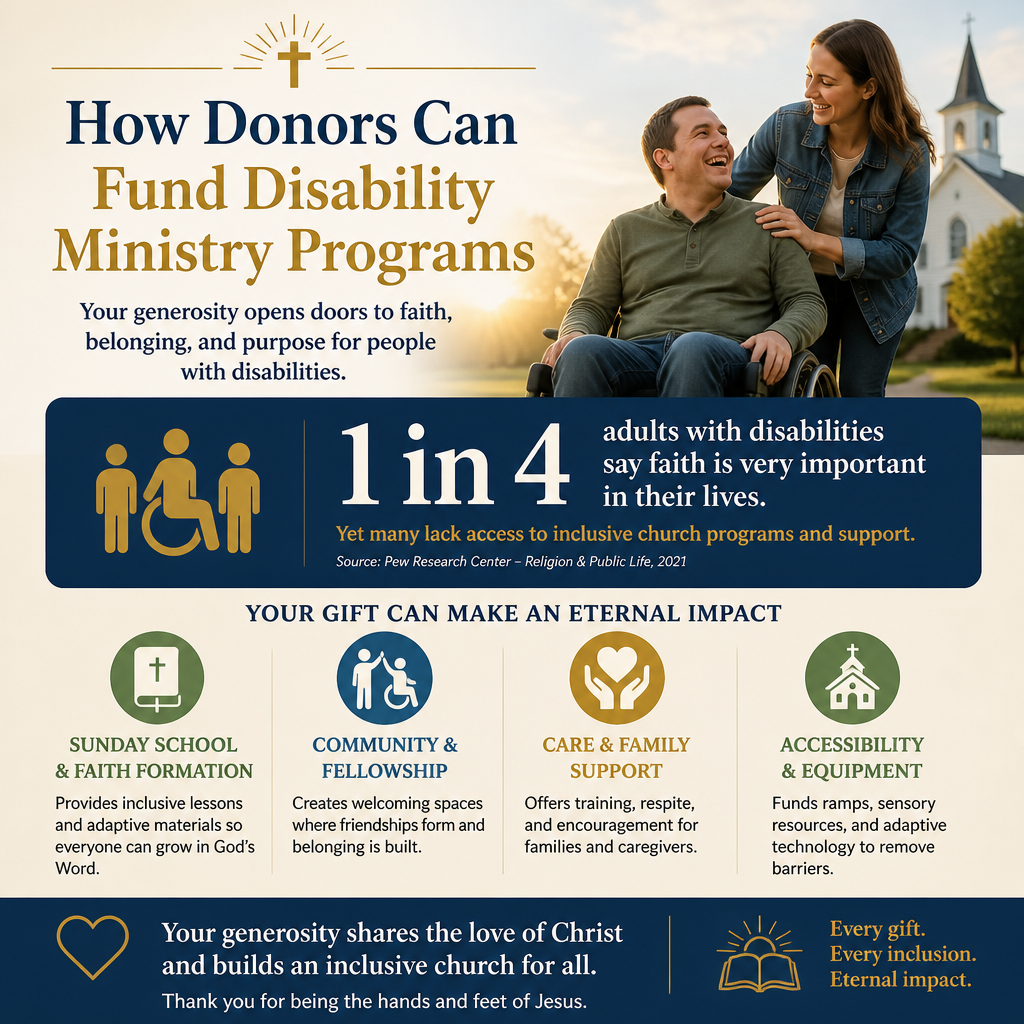
Many donors want to fund what can be photographed: a new sensory room, adaptive playground equipment, or a highly produced special-needs event. Those can be wise investments. But disability ministry becomes thin when it is reduced to intermittent programming. Christian maturity looks more like patient inclusion, trained volunteers, stable routines, and relational continuity.
What this means in practice is that donors should ask whether a ministry’s budget supports long-term pastoral presence, not just short-term experiences. The question is whether people with disabilities are being treated as full participants in the body, with spiritual gifts to offer, rather than as recipients of care only.

Fund what families actually need, not only what feels inspiring
Respite, caregiver support, and case coordination are often the most urgent gaps
Many disability ministry programs function as a form of practical theology for families: a weekly environment where a parent can worship without constant vigilance, or a trained volunteer team that makes church attendance possible. These services are not glamorous, but they are frequently decisive.
Donors sometimes hesitate to fund staffing, training, and policies because they prefer “direct ministry.” That distinction can be misleading. In disability contexts, “direct ministry” often depends on behind-the-scenes infrastructure: screening volunteers, maintaining appropriate adult-to-child ratios, training for de-escalation, and building consistent communication with caregivers.
Acknowledge the economics of disability without reducing people to costs
The financial pressure on families is real. In one nationally cited analysis, raising a child with a disability was associated with substantially higher out-of-pocket costs over time than raising a child without a disability (CDC). The exact figures vary by diagnosis, insurance coverage, and geography, but the underlying reality is consistent: disability often brings sustained financial strain alongside emotional and spiritual strain.
Faithful funding recognizes that strain without commodifying it. The goal is not merely to subsidize needs. The goal is to build a community that carries burdens together in a way that reflects the gospel.

Give toward capacity, not only events, and insist on safeguards
Training and volunteer development are ministry, not overhead
Effective disability ministry depends on competency. Churches and nonprofits that serve people with disabilities must train volunteers in basic disability awareness, communication practices, safety protocols, and the spiritual posture of presence. Donors can accelerate that work by funding training curricula, background checks, and ongoing supervision.
The broader philanthropic field has had to reckon with the “overhead” fixation. Charity Navigator, Candid (formerly GuideStar), and the BBB Wise Giving Alliance have jointly warned that judging nonprofits primarily by low administrative ratios can push organizations to underinvest in the very systems that enable effectiveness (Charity Navigator). Disability ministry is a clear example: underfunding training and supervision is not frugal; it is reckless.
Safeguarding is an ethical requirement, not a preference
Christians should be candid about risk. People with disabilities can be more vulnerable to abuse and exploitation, and families are often forced to trust systems they did not design. Verifiable evidence suggests that donors should treat safeguarding as a first-order question: policies for reporting, supervision practices, volunteer screening, and clarity about boundaries in one-on-one settings.
Funding can strengthen safeguards. Donors can underwrite trauma-informed training, professional consultation, and program evaluation. They can also ask whether the ministry has a documented process for responding to concerns, not merely a statement of values.
- Fund volunteer screening and recurring background checks.
- Support ongoing training, not only initial orientation.
- Provide budget for professional supervision and consultation.
- Underwrite accessible communication tools and sensory supports.
- Strengthen documented safeguarding and incident-response processes.
Use restricted gifts sparingly and build for sustainability
Restricted funding can help, but it can also distort
Donor restrictions are not inherently wrong. In some settings, a restricted gift for accessibility modifications, adaptive curriculum, or a respite night can provide clarity and momentum. The tension is that heavy restrictions can also force ministries to chase donor preferences rather than respond to families’ changing needs. Disability ministry rarely fits cleanly into annual project cycles.
Mature donors ask what portion of their giving should be unrestricted so the organization can staff appropriately, respond to emergent needs, and invest in systems that keep people safe. A ministry that cannot retain trained leaders will struggle to serve families consistently, no matter how attractive its programs appear.
Plan beyond the first year
Disability ministry programs thrive on continuity. Families need to know that supports will not disappear after a fundraising push. Donors can strengthen sustainability by funding multi-year staffing, scholarship funds for families who cannot afford program fees, and shared services such as curriculum development or volunteer training that benefits multiple sites.
This is also where discernment about partnership matters. When multiple churches and nonprofits operate separately, families may face duplication in some areas and gaps in others. Strategic donors can convene collaboration, fund shared training, and encourage referral pathways that reduce fragmentation.
Give with confidence by verifying faithfulness, integrity, and outcomes
What to examine before making a significant gift
Disability ministry invites generosity, but it also requires prudence. Christian donors are not called to cynicism, yet Scripture commends careful stewardship. The question is not whether a ministry tells moving stories. The question is whether its life and governance bear the weight of the trust it is asking families and donors to place in it.
Across our verification work at Most Trusted, we observe that ministries capable of sustained, safe, spiritually serious disability programs tend to be clear about doctrine, consistent in financial reporting, governed by qualified leaders, and willing to publish measurable indicators of effectiveness. Those are not bureaucratic preferences. They are expressions of truthfulness and accountability.
How The Most Trusted Standard can serve donors in disability ministry giving
Most Trusted evaluates Christian nonprofits against The Most Trusted Standard, a 15-criteria framework spanning Faith Foundation, Financial Integrity, Governance and Leadership, and Transparency and Effectiveness. In disability ministry contexts, this framework helps donors ask the questions that are easy to neglect when needs are urgent: Who oversees safeguarding? Are financial statements available and intelligible? Is leadership accountable? Are outcomes defined in ways that respect human dignity rather than treating people as metrics?
Many donors also want to situate disability giving within a broader theology of mercy and justice in the church. The wider landscape of Disability Ministries includes program models that range from church-based inclusion supports to specialized residential services and therapeutic initiatives. Each model carries distinct risks, costs, and accountability needs.
In the same way, donors often want to understand how their dollars translate into concrete ministry inputs: staffing, training, accessibility, family support, and discipleship resources. The category How Disability Ministries Use Donations frames those patterns in a way that supports wise, sustained generosity.
FAQs for How donors can fund disability ministry programs
Should donors prioritize church-based disability ministry or specialized nonprofits?
Both can be faithful, and the best choice often depends on what gap is most acute in a family’s local ecosystem. Church-based programs can strengthen belonging and discipleship within the body. Specialized nonprofits may provide clinical expertise, respite capacity, or intensive supports that a local church cannot sustain. Donors should evaluate safeguarding, leadership accountability, and clarity of outcomes in either case, and resist assuming that “closer to church” automatically means “safer” or “more effective.”
Is it wise to fund staffing and training, or should gifts focus on direct services?
In disability ministry, staffing and training are frequently direct services in practice because they determine whether programs are safe, consistent, and sustainable. Donors can still designate gifts for tangible needs such as accessibility modifications or respite events, but a mature funding approach usually includes meaningful support for the supervision, training, and reporting systems that protect vulnerable people and enable long-term discipleship.
A faithful funding posture for disability ministry
Disability ministry programs are funded well when donors hold together compassion and accountability, dignity and evidence, urgency and patience. The church’s calling is not merely to accommodate disability, but to welcome brothers and sisters as full members of Christ’s body. Giving that strengthens safeguarding, builds durable capacity, and insists on transparent integrity is not a distraction from that calling. It is one of the ways Christian stewardship protects it.



