

Why Christian donors create giving mission statements is not a trend toward self-branding. It is a sober response to the moral weight of stewardship, where money becomes a form of discipleship and giving becomes a spiritual practice that can either clarify or confuse a household’s loyalties.
Many donors already feel the pressure: a constant stream of urgent appeals, good causes that outnumber available resources, and genuine disagreement among faithful Christians about what priorities should come first. A giving mission statement does not eliminate those tensions. It names them, orders them, and places them under Scripture, prayer, and accountable decision-making.
Giving mission statements are a stewardship discipline before they are a planning tool
Scripture treats money as spiritually diagnostic
Jesus consistently taught that money reveals and shapes the heart. “Where your treasure is, there your heart will be also” (Matthew 6:21). A giving mission statement is one practical way to treat that teaching as operational rather than inspirational: it asks, in writing, what we are seeking first, what we are refusing to seek, and what kinds of outcomes we are prepared to fund.
Christian donors often carry an unspoken assumption that the main moral test is whether they gave anything at all. Scripture presses further. The question is not only “Did we give?” but “What story did our giving tell about God, neighbor, and the Kingdom?” When donors articulate a mission for their giving, they are acknowledging that generosity is not morally neutral. It forms people and it forms families.
A mission statement protects giving from mood and momentum
Without a defined purpose, giving easily becomes reactive: a response to the most recent email, the most compelling photograph, the most persuasive fundraising copy. That can produce sincere generosity, but it also tends to produce drift. Mature stewardship does not despise emotion, yet it refuses to let emotion govern.
In practice, a mission statement gives donors a way to honor urgent needs without allowing urgency to become the only criterion. It can also clarify what “no” means. A Christian donor cannot fund everything. The ability to decline a worthy request without cynicism is a mark of responsible stewardship.

Christian donors write mission statements because giving now competes with deeper cultural formation
Generosity has weakened in many congregations
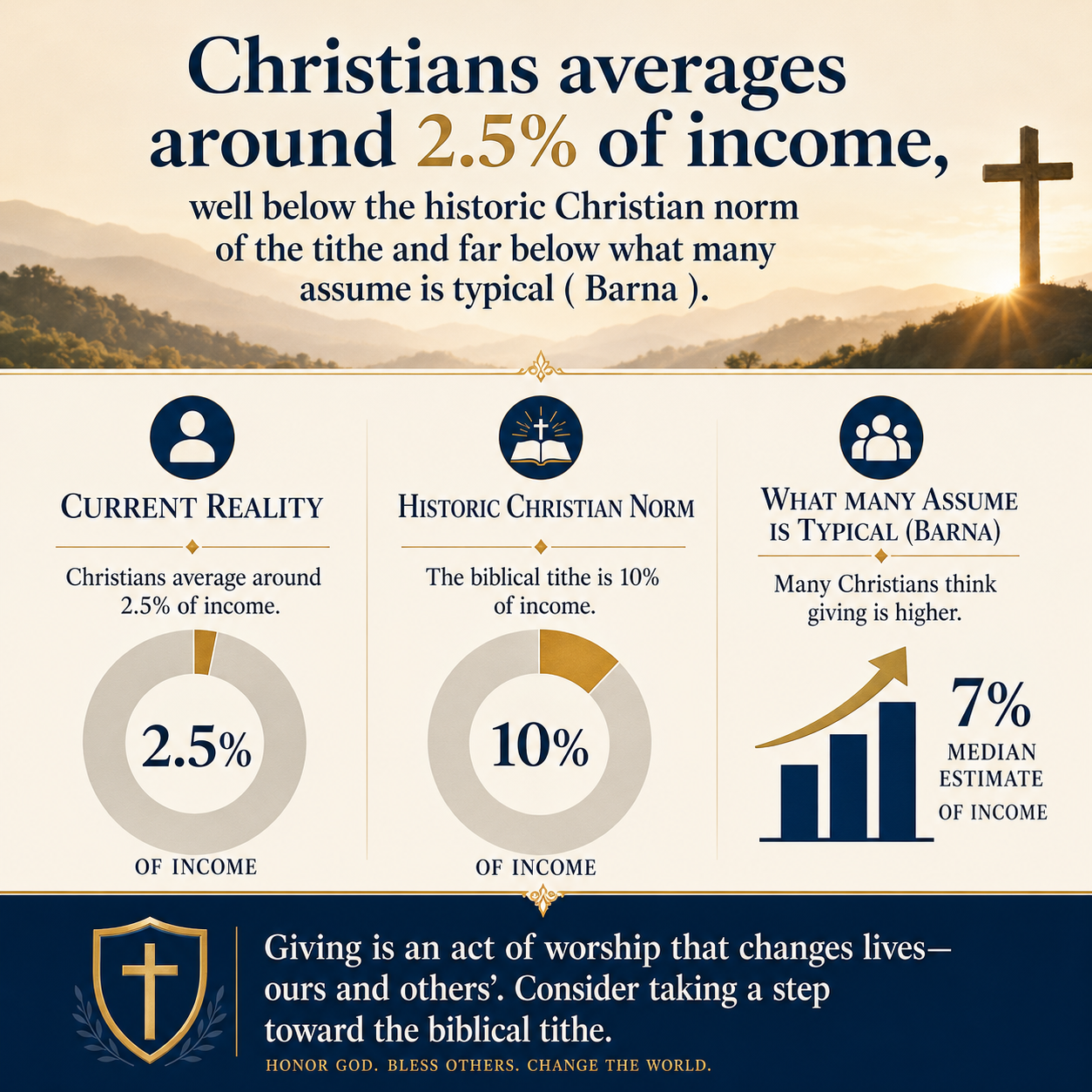
Many churches and donors have had to reckon with discouraging giving patterns. For example, one analysis reported that giving among U.S. Christians averages around 2.5% of income, well below the historic Christian norm of the tithe and far below what many assume is typical (Barna). The exact percentage varies by study design and sample, but the direction is consistent: many believers are less formed by biblical generosity than they intend to be.
The reasons are not simplistic. Household budgets are stretched, consumer debt is normalized, and the language of “financial freedom” can quietly replace the language of contentment and sacrifice. A giving mission statement functions as a counter-formation practice. It makes a household put first things first in writing, which is often the only way competing priorities become visible.
Modern giving options multiply faster than discernment
The contemporary donor is not choosing between two or three charities. They are choosing among dozens of ministries, each with specialized programs, geographic focus, theological commitments, and fundraising styles. In that environment, discernment is as important as generosity.

What this means in practice is that donors benefit from anchoring decisions to a defined set of commitments: biblical convictions, a view of human need shaped by the imago Dei, and a practical approach to effectiveness that does not reduce ministry to mere metrics. For donors wanting a broader framework for stewarding family resources across seasons, Legacy and Family Giving Through Christian Stewardship Services is one way to situate giving decisions within a longer arc than the next campaign.
A mission statement helps donors unite theology, family formation, and legacy
Giving catechizes children and grandchildren
Christian donors often underestimate how much their giving practices teach. Children learn what matters by what gets funded and by how decisions are made. If giving is sporadic, hidden, or framed as an obligation, the next generation will likely inherit the same posture. If giving is transparent, prayerful, and connected to Scripture, children learn that money is a servant, not a master.
A mission statement can create a shared language for a household: why we give, what we prioritize, and what faithfulness looks like when resources are limited. It also provides continuity when leadership transfers from one generation to the next. Many donors care about legacy, but legacy is rarely sustained by vague intentions.
It clarifies what counts as faithfulness when outcomes are hard to measure
Christian philanthropy sits in a complicated space. Some ministries can report clear outputs—meals served, Bibles distributed, students enrolled. Other work is harder to quantify: pastoral care, prison ministry, church planting, reconciliation efforts, long-term discipleship. Christians genuinely disagree about how much “measurable impact” should govern funding decisions in such cases.
A giving mission statement allows donors to make those convictions explicit. Some donors will emphasize mercy ministries as an expression of Matthew 25. Others will prioritize theological education or evangelism. The point is not to force a single hierarchy on all Christians, but to ensure that a donor’s hierarchy is examined, defensible, and accountable.
Mission statements create a framework for discernment, not merely distribution
They help donors decide what to support and how to support it
A mature mission statement does more than list causes. It defines a posture toward partnership: whether a donor primarily makes unrestricted gifts, prefers project-restricted funding, supports capital needs, or funds capacity building. It can also spell out how a donor thinks about overhead, recognizing that effective ministry requires competent administration and that the “low overhead equals high virtue” assumption has been publicly challenged by major nonprofit evaluators (Charity Navigator).
Because giving can become abstract, donors often benefit from translating the mission statement into a small set of decision rules. For example:
- We will prioritize ministries that clearly articulate their doctrinal commitments and pastoral accountability.
- We will fund work that treats recipients as image-bearers rather than as marketing assets.
- We will prefer long-term partnerships over one-time transactional gifts, when appropriate.
- We will ask for clarity on how programs are evaluated and what outcomes are realistically expected.
- We will not fund organizations that refuse basic transparency about governance and finances.
They reduce the risk of manipulation and burnout
Many Christian donors have experienced some form of fundraising pressure: spiritualized guilt, exaggerated claims, or appeals that imply God’s favor hinges on a gift size. Not every urgent appeal is manipulative, but urgency is an easy tool to misuse. A mission statement gives donors a way to resist that pressure without becoming cynical about real need.
It also addresses a quieter problem: donor fatigue. When giving is driven primarily by impulse and guilt, donors often oscillate between overgiving and withdrawal. A clear mission can stabilize generosity, making it sustainable and joyful rather than episodic and resentful.
Verification matters because a mission statement without due diligence can still fund harm
Intentions do not guarantee integrity or effectiveness
Christian donors typically assume that shared faith implies shared standards. Yet the Christian nonprofit landscape includes everything from exemplary ministries to organizations with weak governance, unclear financial practices, inflated claims, or insufficient safeguarding. The desire to “trust believers” is understandable; the call to wise stewardship is equally biblical.
Across our verification work at Most Trusted, we find that donors are most helped when they separate two questions: “Is this mission worthy?” and “Is this organization trustworthy and competent to carry it out?” Both matter. A giving mission statement often clarifies the first question. Verification and due diligence address the second.
Due diligence becomes more consistent when anchored to defined standards
Many donors do some research, but the research is frequently inconsistent: intense scrutiny for one gift, almost none for another. A mission statement can include a commitment to accountability and verification, ensuring that trust is earned and maintained.
Most Trusted exists to serve that purpose for Christian donors by evaluating ministries against The Most Trusted Standard, a 15-criteria framework across four domains: Faith Foundation, Financial Integrity, Governance and Leadership, and Transparency and Effectiveness. Donors do not need to become auditors to give wisely, but they do need a disciplined way to ask: Who leads this ministry? How is money handled? How are claims substantiated? How is spiritual authority exercised? Those questions protect both donors and the people the ministry intends to serve.
For donors who want their broader stewardship decisions to be coherent across callings and life stages, Christian Stewardship Services is a natural place to connect giving philosophy with practical guardrails.
FAQs for Why Christian donors create giving mission statements
Is a giving mission statement only for wealthy donors?
No. A giving mission statement is most valuable when resources are limited, because scarcity forces trade-offs. The discipline is not about complexity; it is about clarity. A household giving $50 a month can still define priorities, resist manipulation, and practice consistent generosity as a form of discipleship.
Should a giving mission statement prioritize evangelism over mercy ministry?
Faithful Christians land differently, and Scripture holds both together. The New Testament repeatedly commends care for the poor and vulnerable, and Jesus explicitly names works of mercy as marks of his disciples (Matthew 25:35–36). The Great Commission also carries undeniable authority (Matthew 28:18–20). A responsible mission statement does not dismiss either mandate. It clarifies a donor’s convictions, names the reasons, and ensures that actual giving aligns with those convictions over time.
Mission statements are one way to make generosity accountable to the gospel
A giving mission statement does not sanctify a donor’s preferences, and it does not guarantee perfect decisions. It does, however, require donors to bring their giving out of improvisation and into the light of Scripture, prayer, and accountable standards. For Christian donors who want their generosity to be faithful, sustainable, and worthy of trust, that clarity is not optional. It is part of stewardship.



