
How Christian stewardship services manage donor-advised funds is ultimately a question of trust: who holds legal control, what guardrails govern grants, and whether the donor’s intent is honored with both theological seriousness and regulatory precision. A donor-advised fund can serve Christian generosity well, but only when it is administered with clarity about ownership, accountability, and the real-world constraints that come with the tax code.
Scripture treats stewardship as a moral category, not a mere technique. Jesus’ repeated teaching about money presses beyond outcomes into motives, faithfulness, and integrity (Luke 16:10–13). Donor-advised funds sit at that intersection: they can help donors give thoughtfully over time, but they can also tempt us toward control, delay, or opacity if a sponsor’s practices are weak or a donor’s posture becomes possessive.
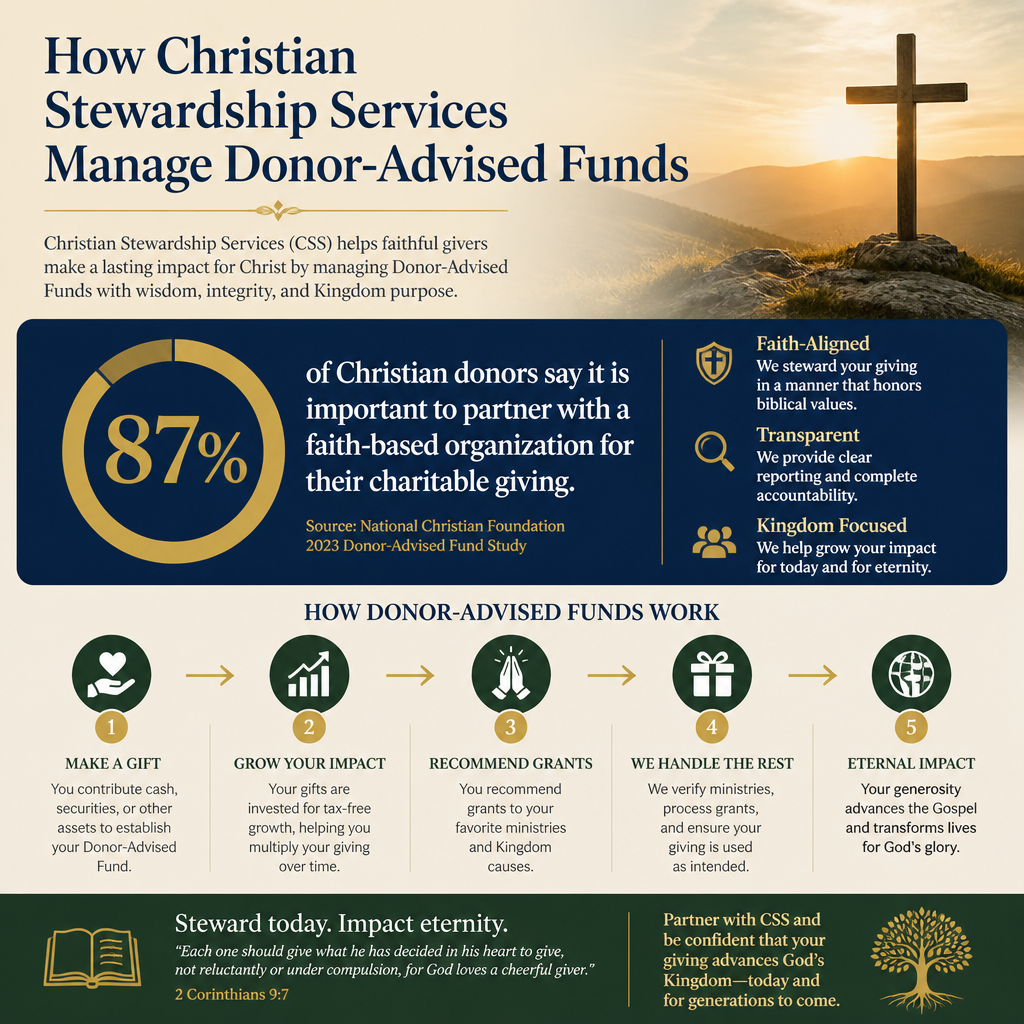
Stewardship services administer a DAF by holding assets and applying a rulebook
A donor-advised fund is not a donor’s personal account. It is a charitable account owned by the sponsoring organization, with the donor retaining advisory privileges. That legal fact explains most of what a Christian stewardship service does day to day: it receives irrevocable contributions, safeguards and invests those assets, issues tax substantiation, and processes grant recommendations in accordance with IRS rules and the sponsor’s own policies.
DAFs have grown rapidly in the broader philanthropic landscape, which raises the stakes for careful administration. The National Philanthropic Trust’s 2024 Donor-Advised Fund Report is a standard reference for DAF data and trends, including aggregate grantmaking and asset levels across the sector (National Philanthropic Trust).
Step one is a clean transfer and defensible receipts
Stewardship services typically accept cash, publicly traded securities, and in some cases complex assets such as closely held business interests or real estate. The more complex the asset, the more the sponsor must ensure a defensible valuation process, clear documentation, and an appropriate liquidation pathway. Christian donors should expect the sponsor to be conservative here; an aggressive posture may create downstream risk for the donor and for the sponsor’s charitable standing.
For gifts of non-cash property, the sponsor’s procedures need to align with IRS substantiation requirements and qualified appraisal rules where applicable. Donors do not need to master the code, but they do need to understand that “easy” is not always faithful or safe when the asset is hard to value.
Step two is investment oversight, not spiritual neutrality
Once a contribution is made, the sponsor determines the investment options and manager oversight. In a faith-based context, this can include screens or strategies that avoid certain industries or emphasize shareholder engagement. Christians genuinely disagree about the best approach to faith-consistent investing, and a sober stewardship service should acknowledge those disagreements rather than treating any one screen as a badge of orthodoxy.
What donors can reasonably insist upon is governance: clear investment policy statements, transparent fee schedules, and evidence that the sponsor is acting prudently as a fiduciary for charitable assets. Prudence is not a secular concept; it is a moral one when these are resources set apart for the Lord’s purposes (Proverbs 21:5).
Step three is grant processing with enforceable restrictions
Grant processing is where theological intent and regulatory constraints most often collide. The sponsor must ensure grants go only to eligible recipients, are not used for prohibited benefits to the donor, and are documented properly. This includes rejecting recommendations that would result in impermissible benefits such as event tickets, tuition payments, or satisfaction of legally binding pledges.
Many donors assume a DAF can fund any “good Christian cause.” In reality, a DAF is constrained to charitable recipients as defined by law and by the sponsor’s policies. A serious Christian stewardship service will not apologize for those constraints; it will explain them plainly and apply them consistently.

They protect donors by enforcing compliance and resisting common misuses
The donor-advised fund structure is designed to separate tax-advantaged charitable giving from private benefit. Stewardship services safeguard that separation by applying compliance checks at intake and at grant time, maintaining records, and training staff to recognize prohibited transactions. These practices are not bureaucratic overhead; they are part of what keeps charitable capital credible in the public square.
One of the most common donor misunderstandings is the idea that a DAF allows a donor to “control” giving indefinitely while retaining practical ownership. The legal reality is different: once contributed, the funds belong to the sponsor. The donor advises; the sponsor decides. Responsible sponsors make that distinction explicit because clarity protects both parties from confusion and from the temptation to treat charitable funds as personal reserves.
Private benefit rules are where many donors stumble
DAF compliance is often tested at the edges: paying for gala tables, receiving goods or services in exchange for grants, directing a grant to satisfy a pledge, or routing money through a charity for a family member’s benefit. A Christian stewardship service should be able to articulate these boundaries without condescension and without ambiguity.
The IRS has increased attention to certain DAF practices in recent years, and donors should expect more guidance rather than less. A sponsor that treats compliance as an inconvenience is not serving donors well.
Grant restrictions must be honored without becoming domination
Many Christian donors want to restrict giving: a certain program, a particular geography, a season of crisis response, or a doctrinal commitment. Stewardship services can help donors write grant letters that are specific enough to guide the ministry and auditable enough to be meaningful, without becoming so controlling that the recipient cannot responsibly carry out the work.
Here the moral tension is real. Donors have a duty to steward resources carefully. Ministries have a duty to lead responsibly and not become captive to donor preferences. Wise stewardship services help donors set restrictions that are clear, necessary, and proportionate.
They also manage the slower risks: dormancy and delayed generosity
A donor-advised fund can encourage long-term, thoughtful giving, especially when a donor faces a one-time liquidity event or wants to build a multi-year plan. It can also become a mechanism for deferring difficult decisions. Christian tradition has long treated hoarding as spiritually dangerous, not merely financially inefficient (Luke 12:15–21).
We do not treat every unspent balance as a moral failure; timing can be responsible. But a sponsor’s policies and pastoral posture should help donors move toward generosity rather than rationalizing indefinite delay.
They vet ministries, but the quality of that diligence varies widely
Many donors choose faith-based sponsors because they want alignment with Christian conviction and because they want help evaluating ministries. That desire is legitimate. It also raises a hard question: what does “vetting” actually mean, and how do we know it is more than a doctrinal statement and a tax determination letter?
Across our verification work at Most Trusted, we see that donors often assume a ministry is sound because it is recommended by a respected network or platform. Sometimes that confidence is warranted. Sometimes it is not. Verification is strongest when it is criteria-based, documented, and willing to name both strengths and risks.
Doctrinal alignment is necessary, but it is not sufficient
Christian donors rightly care about faith commitments. A stewardship service may require agreement with a statement of faith, evidence of church connection, or adherence to certain ethical standards. Those are meaningful screens, particularly when donors are supporting evangelism, discipleship, or theological education.
But doctrinal alignment does not automatically imply financial integrity, healthy governance, or truthful reporting. Mature stewardship requires attending to all of those realities because Scripture requires integrity in weights and measures, not merely in confessional language (Proverbs 11:1).
Financial controls and governance are where many failures originate
In ministry scandals, problems often surface first as governance breakdowns: conflicted boards, founder dominance, weak internal controls, or blurred lines between personal and organizational funds. A stewardship service that cannot assess basic governance and financial integrity is leaving donors exposed.
This is where independent evaluation can add real value. At Most Trusted, we evaluate ministries against The Most Trusted Standard, a 15-criteria framework spanning Faith Foundation, Financial Integrity, Governance and Leadership, and Transparency and Effectiveness. The point is not to replace spiritual discernment with metrics; it is to make integrity verifiable where evidence is available.
Effectiveness must be handled carefully in Christian ministry
Measuring ministry outcomes is not always straightforward. Evangelistic fruit, spiritual formation, and long-term community renewal resist simplistic quantification. Christians genuinely disagree about what “success” should mean in different callings.
Yet the absence of easy metrics is not permission for vague claims. Strong organizations can describe their theory of change, report outputs honestly, and avoid manipulating stories for fundraising. Donors should expect clarity about what a ministry does, how it knows, and what it does when results are mixed.
What donors should ask before recommending grants through a stewardship service
The sponsor’s theology matters, but so does its operational discipline. Christian donors can honor the Lord and protect their giving by asking a small number of pointed questions. The answers will often reveal whether a sponsor is governed with rigor or with sentiment.
Ask who has final authority and how exceptions are handled
Every sponsor should state plainly that it retains legal control over assets and final discretion over grants. Donors should also ask whether the sponsor has a consistent exception policy and a documented process for rejecting grants that create private benefit or reputational risk.
Transparency here is a form of respect. If a sponsor cannot explain its decision rights, it is not prepared to hold charitable assets on the donor’s behalf.
Ask what vetting is performed on ministries and what evidence is reviewed
Some sponsors conduct minimal checks: tax status, basic doctrinal alignment, and sanctions screening. Others review governance practices, financial statements, leadership accountability, and public communications. Donors should ask what documents are required, what triggers deeper review, and how frequently re-evaluation occurs.
When donors want independent assurance on a specific ministry, it is reasonable to consult a third-party verification organization. Many donors begin that work through our research at Most Trusted, and then coordinate their grantmaking through a stewardship service once they have confidence in the recipient’s integrity.
Ask about fees, investment options, and what faith-consistent investing means in practice
Fees are not merely a cost question; they are a governance question. Donors should request a full fee schedule, including administrative fees and investment expense ratios, and should ask how managers are selected and monitored. Where faith-based investing is offered, donors should ask what screens are used, how exceptions are handled, and whether the approach is primarily exclusionary screening, active engagement, or a blend.
Clarity allows donors to make an informed decision without moralizing secondary judgments.
For donors comparing different sponsors and service models, it can be helpful to view donor-advised funds alongside other forms of faith-based giving support. Our coverage of Christian Stewardship Services addresses the broader ecosystem in which DAF administration sits.
Stewardship that honors both the donor and the ministry
A well-run donor-advised fund can help Christian donors give with discipline, humility, and foresight. It can also help ministries receive support that is timely, well-documented, and free of impropriety. The same structure can become spiritually distorting when it fuels control, delay, or performative certainty.
Christian stewardship services manage donor-advised funds well when they combine theological clarity with operational rigor: legal ownership made explicit, compliance enforced without favoritism, and vetting grounded in evidence rather than reputation. Donors seeking to give with confidence should expect nothing less, because the credibility of our witness is not separate from the integrity of our giving.



