

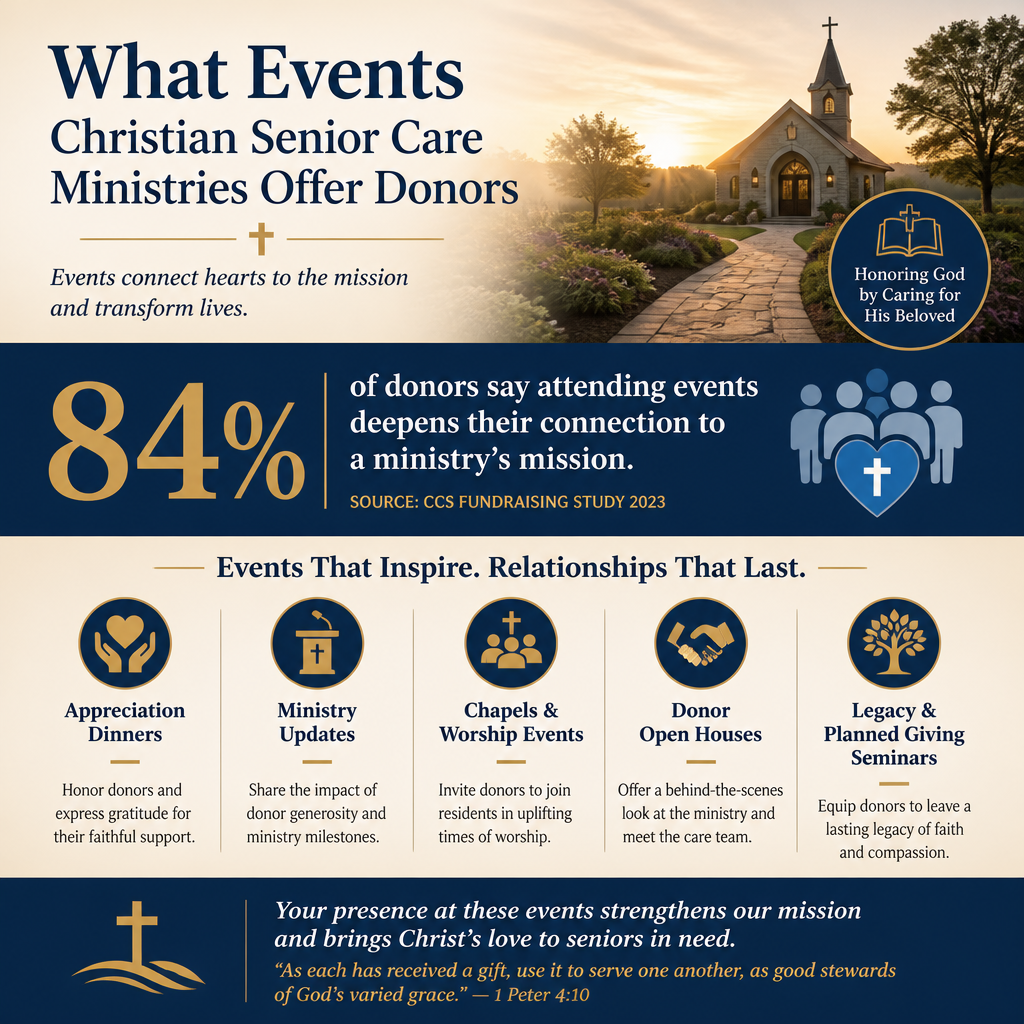
When donors ask what events Christian senior care ministries offer donors, they are usually asking a deeper question: where is the work truly happening, and how can we see it without turning elders into a fundraising backdrop. Senior care is one of Scripture’s clearest tests of moral seriousness—honoring father and mother, defending the vulnerable, and refusing the quiet discarding of those no longer “productive.” The events a ministry chooses either illuminate that calling or obscure it.
Most ministries in this field offer a familiar menu—banquets, tours, galas, golf outings, and giving days. The stronger ministries, however, design events that protect resident dignity, strengthen pastoral care, and give donors verifiable access to the ministry’s spiritual and operational integrity. Across our verification work at Most Trusted, we find that donor events are most trustworthy when they are built around evidence, shepherding, and governance rather than emotion, urgency, or insider access.
Events that let donors see the mission without commodifying residents
Campus visits and guided tours with clear boundaries
Ministries often invite donors to tour a campus, skilled nursing facility, memory care unit, or affordable housing community. A credible tour does not treat residents as exhibits. It explains the continuum of care, staffing model, clinical partnerships, and pastoral care rhythms, and it names what the ministry will not do: surprise room visits, unconsented photos, or emotionally manipulative storytelling.
Donors should expect a careful consent policy and staff-led interpretation. The best tours include time with leadership to discuss admissions criteria, charity care policies, and how the ministry handles hard cases—residents with complicated families, mental health concerns, or limited resources. A tour that avoids these realities is not “positive”; it is incomplete.
Open houses focused on care standards and resident protection
Open houses can be an appropriate way to welcome a broader community—especially when they prioritize resident privacy and use public spaces. Ministries with mature governance tend to use open houses to explain safety practices, staff training, and oversight mechanisms. They describe how they handle complaints, how they prevent financial exploitation of seniors, and how pastoral care is integrated into daily life without coercion.
For donors, this is also an opportunity to ask concrete questions about quality and accountability. In the United States, nursing homes are regulated and inspected, and basic facility-level information is often publicly visible. When a ministry operates a nursing facility, donors can compare what they hear at an open house with publicly available inspection and quality information from Medicare.gov.
Events that build shared spiritual formation and vocation for giving
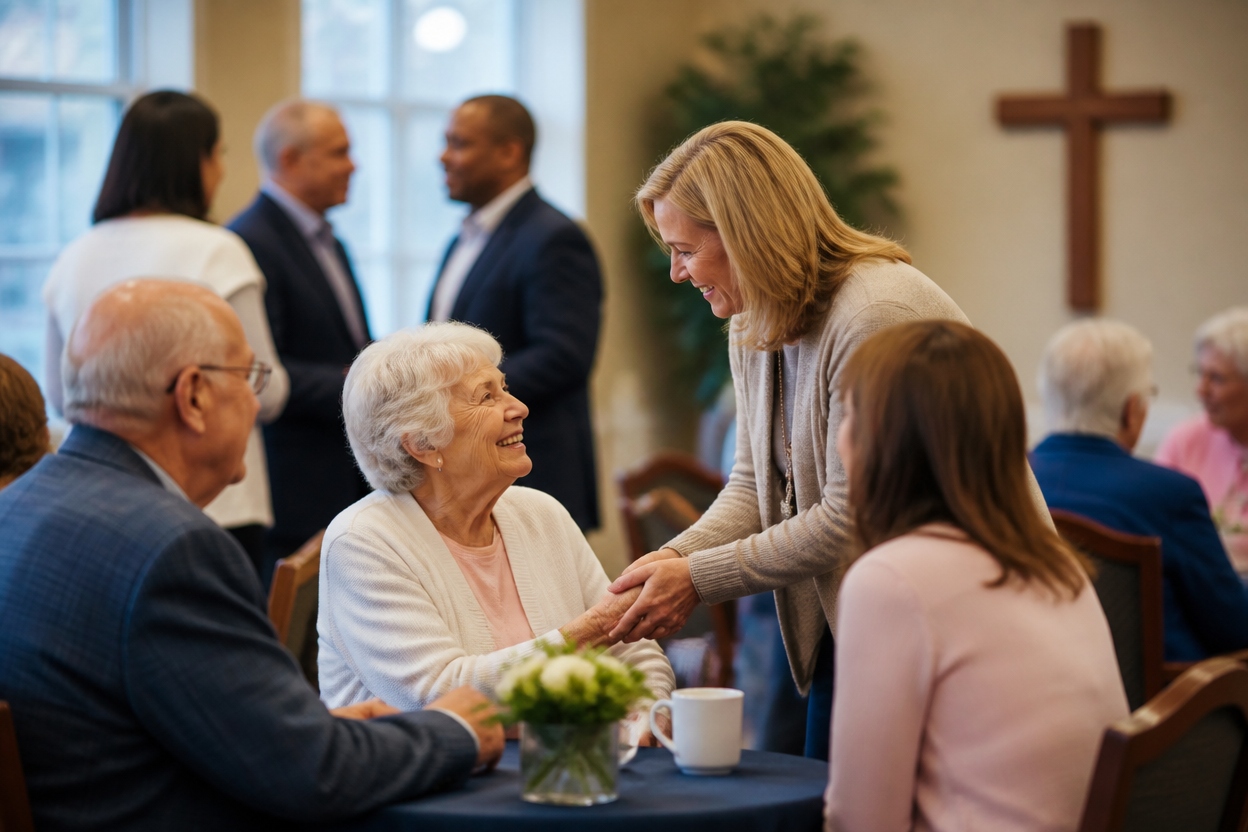
Prayer gatherings and pastoral briefings grounded in Scripture
Some ministries convene donors for prayer—not as a sentimental moment, but as formation in the Christian duty of mercy. When Jesus described the judgment of the nations, he treated visiting the sick as a mark of genuine discipleship (Matthew 25). A prayer gathering that takes this seriously will pray for residents by category of need, for families carrying moral injury and exhaustion, for staff turnover and burnout, and for faithful leadership when financial pressures rise.
These gatherings can also include pastoral briefings on contested questions: end-of-life decision-making, dementia and personhood, loneliness and meaning, and how to speak truthfully about “successful aging” without denying suffering. Mature donors often want that theological candor more than another success story.
Learning events that address aging, family systems, and stewardship
Senior care ministries sometimes host seminars with geriatric clinicians, social workers, chaplains, or Christian ethicists. These events serve donors well when they are not disguised solicitations but genuine education: what dementia changes and what it does not, how grief affects family conflict, how Medicaid and Medicare constraints shape care, and what “charity care” can realistically cover.
For many donors, such events also clarify vocation. Scripture treats wealth as a stewardship trust, not private insulation. When donors understand the pressures families face, they can give with both compassion and realism—supporting resident benevolence funds, staff formation, and capital needs without being captured by pity or urgency tactics.
Events that demonstrate integrity in finances, leadership, and outcomes
Donor briefings that walk through audited financials and key ratios
Christian senior care is operationally complex: labor costs are high, regulations are stringent, and margins can be thin. The strongest ministries invite donors into this reality with clarity. A serious donor briefing should include a plain-language walkthrough of audited financial statements, reserves, debt, major revenue streams, and how restricted gifts are handled. It should also explain the ministry’s pricing philosophy and how it avoids shifting burdens onto the poorest residents.
Donors often assume that a “low overhead” number is the primary measure of integrity. The field has had to correct that assumption. The open letter commonly called “The Overhead Myth,” signed by major charity evaluators, argued that overhead ratios are a poor proxy for effectiveness and can pressure nonprofits into underinvesting in systems and staffing needed for real accountability Candid GuideStar. Senior care ministries, in particular, should be able to justify investments in compliance, training, cybersecurity, and internal controls as safeguards for vulnerable people.
Board and leadership forums that allow sober questions
Some ministries host a “state of the ministry” event where board members and executive leadership take substantive questions. Donors should regard this as more than a courtesy. Governance is moral infrastructure. A ministry that welcomes scrutiny about conflicts of interest, executive compensation philosophy, related-party transactions, and succession planning is usually one that expects integrity to be measurable.
Across ministries that meet The Most Trusted Standard, we see a pattern: leadership does not confuse loyalty with secrecy. They can explain how the board exercises oversight, how whistleblowing is handled, and how the organization avoids a culture where the mission language becomes a shield against accountability.
Events that honor residents and strengthen community without turning need into spectacle
Resident-centered celebrations with consent and dignity
Christian senior care communities often hold Christmas programs, hymn sings, anniversary celebrations, memorial services, and intergenerational gatherings. Donors are sometimes invited, and these can be profoundly appropriate—if residents are not pressured to perform gratitude. Theologically, elders are not objects of charity; they are neighbors and, in many cases, teachers in the faith (Titus 2). An event that treats them as image-bearers will protect their agency and privacy.
Healthy ministries set boundaries: no filming residents without explicit permission, no “sad story” scripting, and no staff coercion to generate donor-facing narratives. They also invite families and local churches, reinforcing that care is shared responsibility rather than institutional replacement for Christian community.
Volunteer orientations that train donors to serve wisely
Many donors want to do more than write a check. Ministries may offer volunteer orientations for visitation teams, music programs, transportation support, or respite for caregivers. The quality of training matters. Seniors are vulnerable to loneliness, but also to boundary violations, spiritual manipulation, and financial exploitation. Volunteers should be trained in confidentiality, appropriate touch and conversation, dementia awareness, and mandated reporting requirements where applicable.
When volunteer programs are mature, donors can often choose among roles that match their gifts without creating dependence on any single volunteer. That structure reduces harm when volunteers inevitably come and go.
How donors should evaluate events as signals of trustworthiness
What to look for in invitations, programming, and follow-up
Events communicate what a ministry believes about power, truth, and the people it serves. Some events are designed to generate warmth; others are designed to generate understanding and accountable partnership. The difference is visible if donors know what to watch for.
- Clarity about resident dignity: consent, privacy, and boundaries are explicit, not implied.
- Substance over spectacle: leadership explains constraints, trade-offs, and risks, not only wins.
- Access to decision-makers: appropriate interaction with board or executive leadership is available.
- Financial transparency: audited statements, clear restricted-gift practices, and realistic budgets are discussed.
- Spiritual seriousness: pastoral care is described as a real ministry, not a decorative chapel.
When these markers are absent, donors should not assume malice. Some ministries simply have not developed the institutional maturity to communicate their work responsibly. But donors should treat the absence as a reason for further diligence, not as a neutral stylistic difference.
Where Most Trusted fits in donor engagement
Events are not verification. A well-produced banquet can mask weak governance, and a modest campus tour can reflect deep integrity. This is one reason Most Trusted exists: to help donors give with confidence by evaluating ministries against The Most Trusted Standard, a 15-criteria framework covering Faith Foundation, Financial Integrity, Governance and Leadership, and Transparency and Effectiveness.
For donors assessing senior care organizations, it is wise to pair relational engagement with verifiable documentation. Attendance at a ministry event should lead to specific next steps: reviewing audited financials, confirming board oversight practices, and understanding how outcomes are defined for resident well-being and spiritual care. Many donors begin that broader review through Christian Senior Care Ministries, and then continue with more specific questions inside Donor Engagement with Christian Senior Care Ministries.
FAQs for What events Christian senior care ministries offer donors
Are galas and banquets a red flag in Christian senior care?
Not necessarily. A gala can be a legitimate way to fund benevolence care, capital improvements, and staff development. The credibility question is whether the event is tethered to transparent financial reporting, restrained storytelling that protects resident dignity, and real opportunities for donors to ask governance and care-quality questions.
What is a reasonable way to meet residents without exploiting them?
The most appropriate settings are resident-led and consent-based: optional meet-and-greets in common areas, intergenerational worship services where participation is voluntary, or small group visits coordinated by staff who understand each resident’s needs and limits. Donors should be cautious about settings that create pressure for residents to perform gratitude or disclose personal trauma for donor engagement.
A faithful event strategy serves truth, not sentiment
Christian senior care ministries will continue to need donor partnership. The question is whether donor-facing events reinforce the gospel’s moral clarity about honoring the vulnerable, or whether they drift into a marketplace of emotions. Donors can ask for better: events that respect elders, disclose realities, and invite accountable participation. Those expectations do not burden ministries; they strengthen them.



