
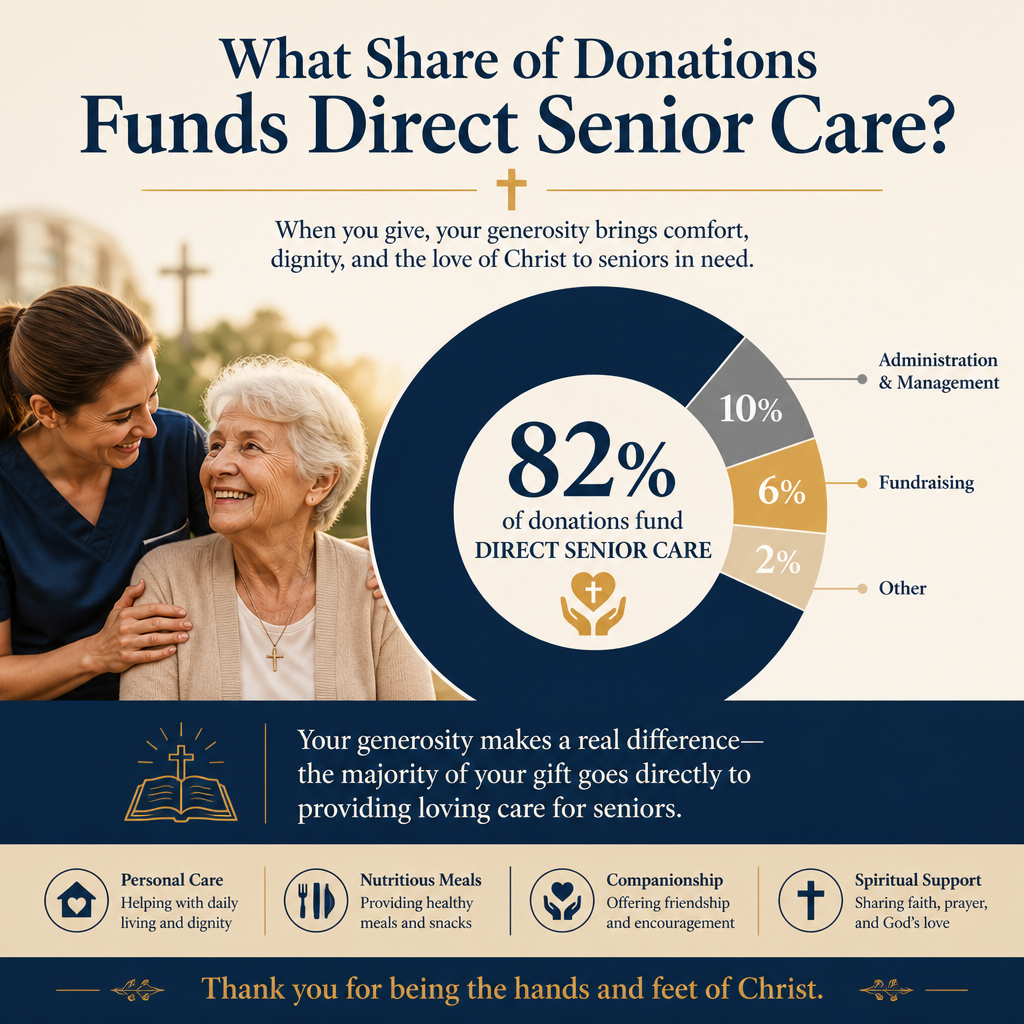
When Christian donors ask what share of donations funds direct senior care, they are rarely asking for a single percentage to reassure them. They are asking whether a ministry’s spending patterns reflect the biblical weight Scripture places on honoring the aged, protecting the vulnerable, and carrying burdens without exploiting sentiment.
The honest answer is that there is no universal “right” share. Senior care ministries sit at the intersection of medical complexity, regulatory compliance, staffing realities, and pastoral vocation. A higher percentage to direct care can indicate disciplined operations. It can also indicate underinvestment in training, safeguarding, and oversight. A lower percentage can signal bloat. It can also reflect the real cost of qualified clinical leadership and accountable governance.
Direct senior care is not one line item
Why definitions determine the percentage
Ministries often report “program expense” as the proxy for direct care. But “program” can include several layers between a donor and a bedside. In senior care, the category may include nursing staff, meals, medication management, transportation, dementia programming, chaplaincy, social work, case management, family support, and facility costs directly tied to resident wellbeing.
For donors, the first question is definitional: what does the ministry count as direct senior care, and is that definition consistent year to year? Under U.S. accounting norms for nonprofits, financial statements typically follow functional expense categories—program services, management and general, and fundraising—under guidance codified in GAAP and nonprofit reporting practice. A ministry’s audited financials and Form 990 (for those required to file) should clarify how expenses are allocated and which costs sit inside program services. The IRS overview of Form 990 and its purpose is a useful reference point for what is disclosed and why (IRS).
Senior care includes “hidden” care costs that are still care
Some of the most essential senior care work is not visibly “hands-on.” Dementia safety protocols, staff background checks, medication reconciliation systems, infection control, and incident reporting are not optional administrative layers; they are part of keeping image-bearers safe. A ministry that pushes these costs out of program reporting to inflate a “direct care” share may look efficient while becoming less trustworthy.
In our work at Most Trusted, we find that clarity beats impressiveness. Ministries aligned with The Most Trusted Standard tend to describe their cost allocations plainly, defend them coherently, and show that program reporting is governed rather than marketed.

The percentage is a signal, not a verdict
Why overhead ratios can mislead faithful donors
Christian donors have been trained for decades to treat overhead as suspect. The sector has had to reckon with the damage this can do. A widely cited statement signed by Charity Navigator, GuideStar, and the BBB Wise Giving Alliance warns that overhead ratios are a poor standalone measure of nonprofit performance and can create perverse incentives to underinvest in capacity (Charity Navigator).
Senior care intensifies this problem. A faithful, clinically responsible ministry may spend more on compliance leadership, training, and quality systems than a loosely managed alternative. Those costs may appear as “management” even when they exist to protect residents. The share of donations funding direct care is meaningful only when paired with the question: what outcomes, safeguards, and integrity practices are those dollars buying?
Direct care is not the same as restricted care
Another tension is donor restriction. Many donors prefer funding “beds,” “meals,” or “nursing hours.” Yet senior care requires flexibility: a staffing shortage, a new infection control requirement, or an unexpected clinical need can shift priorities overnight. Excessively restricted giving can force ministries into fragility. Mature stewardship often means funding care and the systems that keep care faithful and safe.
What a trustworthy share tends to include
How to read program spending in senior care ministries
Donors commonly ask for a target number. We are cautious about prescribing one across a diverse field. A residential skilled nursing model, a home-based support model, and a church-anchored volunteer companionship model will carry different cost structures. What can be evaluated is whether the reported “direct care” share is credible, consistently defined, and supported by governance and transparency.
When reviewing senior care ministries, we recommend looking for a coherent narrative that connects dollars to actual care delivery. That narrative should be supported by documents a donor can verify: audited financial statements where feasible, board-approved budgets, and a Form 990 for U.S. organizations required to file. For larger nonprofits, Form 990 is often the most accessible window into functional expenses and governance practices (IRS).
- Program definitions that match the mission: clear explanation of what counts as direct senior care and why.
- Consistency across documents: website claims align with audited statements and IRS filings.
- Reasonable fundraising practice: fundraising costs are disclosed without defensiveness or evasion.
- Investment in staff formation: training and supervision are treated as part of care quality, not as a regrettable cost.
- Evidence of governance: board oversight of budgets, conflicts of interest, and executive compensation.
How donors can ask better questions than “What percent”
“What share funds direct care?” is a good starting question. The stronger follow-up questions are moral and practical at once: Are residents safer because of how this ministry spends? Are staff supported and supervised? Is there an honest accounting for how resources reach the elderly who have limited advocates?
For donors seeking a broader view of the space, it can help to situate a single ministry’s finances in the wider landscape of Christian Senior Care Ministries, where models of care differ substantially and the same ratio can mean very different things.
The deeper accountability question is whether care is faithful
Why Scripture presses beyond financial efficiency
Scripture’s concern for the vulnerable is not merely that resources are spent, but that people are honored. The fifth commandment’s call to honor father and mother is not suspended by frailty. The church’s care for widows in the apostolic era was organized, accountable, and contested enough to require clear distribution practices (Acts 6:1–6). The pattern is instructive: mercy work demanded administration, and administration was accountable to the community of faith.
That is why we counsel donors not to treat “overhead” as an enemy category. A ministry serving seniors well will often require unglamorous infrastructure: policies, audits, staff supervision, complaint pathways, and governance. When these are absent, the ministry may appear efficient until a crisis exposes what was never built.
Effectiveness must be transparent, not asserted
Senior care ministries can be tempted to substitute sentiment for evidence: photos of smiling residents, moving testimonies, and heartfelt appeals. Those may be genuine, but they do not replace credible reporting. The question is whether the ministry can show, in plain language, what care it provides, who receives it, and what safeguards surround it.
This is where the broader commitments of The Most Trusted Standard matter. Financial integrity is inseparable from faithfulness in leadership and truthfulness in public communication. A ministry’s share of donations going to direct care should be one piece of a larger, coherent account of trustworthiness.
How Most Trusted evaluates direct care claims
Verification requires documents, not impressions
Most Trusted exists to help Christian donors give with confidence by evaluating ministries against The Most Trusted Standard, a 15-criteria framework spanning faith foundation, financial integrity, governance and leadership, and transparency and effectiveness. In direct senior care claims, we examine whether a ministry’s reported spending is supported by verifiable records and whether the ministry communicates limitations honestly.
We also pay attention to what the ministry does when the numbers are not flattering. Trustworthy organizations do not hide their trade-offs. They explain them. They show how leadership is accountable for them. And they invite scrutiny without treating legitimate donor questions as adversarial.
Why category context matters for donor discernment
Donors often encounter senior care organizations through a single appeal: “Help us care for elders.” Yet accountability questions differ across models—residential facilities, community day programs, home repairs for aging in place, hospice chaplaincy support, and subsidized housing each carry distinct risks and cost drivers. For donors focused on governance, disclosures, and clear reporting, the broader lens of Accountability and Transparency in Christian Senior Care Ministries is often where the most illuminating comparisons emerge.
FAQs for What share of donations funds direct senior care
Is a higher percentage going to direct senior care always better?
No. A higher reported share can reflect disciplined operations, but it can also reflect underinvestment in training, compliance, safeguarding, and oversight—costs that often protect seniors and strengthen care quality. Mature evaluation asks whether the allocation is credible, consistently defined, and governed well, not merely whether it is high.
What documents should donors request to verify direct care spending?
For U.S. nonprofits, a Form 990 is often the most accessible starting point for functional expense reporting and governance disclosures (IRS). When available, audited financial statements add credibility. Donors can also look for a board-approved annual report that explains programs with enough specificity to connect spending to real care delivery.
Giving for senior care with clear-eyed confidence
“What share of donations funds direct senior care” is a necessary question, but it is not sufficient. The better aim is faithfulness that can be tested: transparent accounting, honest definitions, accountable governance, and outcomes that reflect honor for elders rather than efficiency theater. When donors insist on that standard, they strengthen not only the ministries they support, but the church’s public witness in how it treats the aged among us.



