

Questions about what administrative costs fund in Christian senior care often reveal a deeper concern than ratios: whether a ministry treats vulnerable elders as image-bearers rather than line items. Donors are right to probe this category. Administrative spending can conceal waste and self-dealing. It can also represent the quiet infrastructure that prevents abuse, protects residents, and sustains faithful care when health needs intensify and families are exhausted.
Christian donors have been trained by decades of fundraising rhetoric to distrust “overhead.” Yet the field has had to reckon with what Charity Navigator, Candid, and BBB Wise Giving Alliance described as the “Overhead Myth”: the idea that low administrative costs automatically signal integrity and effectiveness. Their joint letter warned that focusing on overhead alone can “starve” organizations of the capacity required for impact and accountability (Charity Navigator). In senior care, that starvation is not merely organizational; it can become clinical and spiritual.
Administrative costs are often the costs of keeping promises
Why senior care is not a simple program model
Christian senior care ministries operate across a spectrum. Some manage residential campuses with skilled nursing, memory care, and assisted living. Others deliver home-based support, transportation, meals, or pastoral visitation. Many partner with churches to keep older adults connected to worship and community. In each case, “the work” includes more than direct services. It includes systems that ensure those services are safe, lawful, and consistently provided.
This is where donors can become understandably uneasy. “Administrative” can sound like bureaucracy detached from compassion. But in senior care, the administrative layer often carries the obligations that make compassion durable: credentialing, documentation, risk management, compliance, staffing, and financial controls. When those functions are weak, residents and families pay first.
The theological logic of competence
Scripture does not oppose administration. It dignifies wise stewardship. Joseph’s governance stored grain so the vulnerable would live through famine. The early church appointed deacons so that widows would be served without partiality. “Whatever you do, work heartily, as for the Lord” (Colossians 3:23) is not a slogan for personal effort; it is a mandate for faithful workmanship, including the unglamorous work of oversight.
For donors, the practical implication is clear: a Christian ministry’s administrative spending should be evaluated not by whether it exists, but by whether it is proportionate, transparent, and ordered toward resident welfare and mission fidelity.

What administrative costs typically fund in Christian senior care
Governance, finance, and controls that prevent harm
In our verification work at Most Trusted, the ministries that meet The Most Trusted Standard tend to treat financial administration as a ministry of protection. That includes internal controls, independent audits, segregation of duties, and conflict-of-interest governance. These are not optional formalities; they are the guardrails that reduce the risk of fraud, misuse of restricted gifts, and improper private benefit.
Administrative costs also cover board governance: meeting preparation, policy development, legal review, and documentation. In senior care, these functions are especially significant because ministries frequently manage large physical plants, complex reimbursement streams, and sensitive health information. Strong governance is one of the primary ways a ministry honors its duty of care to residents and its duty of truthfulness to donors.
Staffing systems that make care sustainable
Many donors instinctively want dollars to go “to caregivers, not the office.” Yet the office is often where caregivers are recruited, trained, and retained. Administrative spending commonly funds human resources, scheduling systems, credential verification, continuing education, and supervision. These functions shape staff-to-resident consistency and clinical competence, which are among the most meaningful drivers of resident wellbeing.
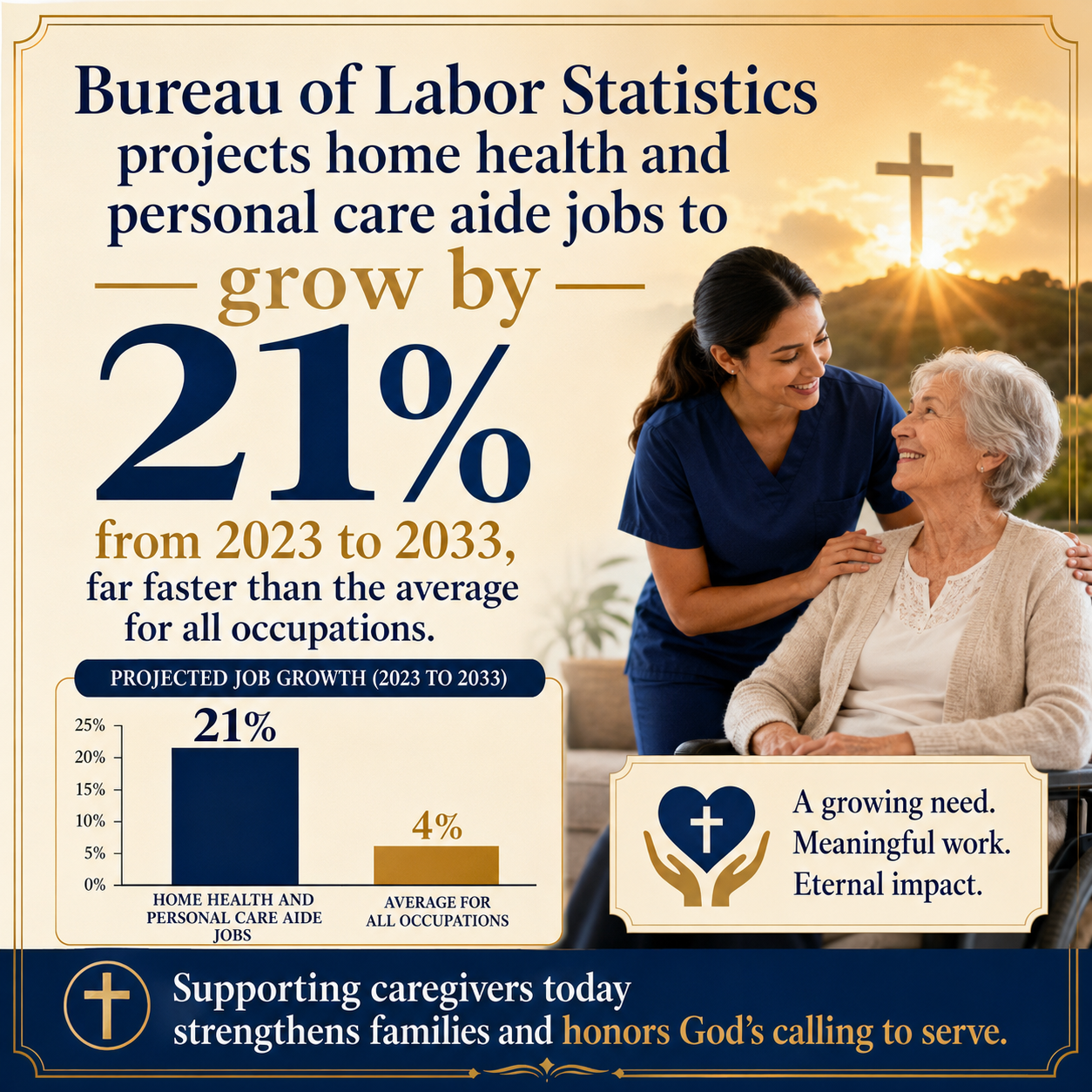
The workforce pressures in elder care are real. The U.S. Bureau of Labor Statistics projects home health and personal care aide jobs to grow by 21% from 2023 to 2033, far faster than the average for all occupations (U.S. Bureau of Labor Statistics). Growth at that scale increases competition for labor and makes recruitment and retention systems more—not less—essential. Administrative dollars often fund the very capacity that keeps a ministry from chronic understaffing.
- Billing, accounting, and restricted-fund tracking
- Compliance, licensing coordination, and policy management
- HR, training, credentialing, and staff scheduling
- Quality assurance, incident reporting, and corrective action processes
- Technology for records, communications, and cybersecurity
The donor question is not whether these functions exist, but whether the ministry can explain them plainly and show how they serve resident care rather than institutional self-preservation.
Administrative costs that should raise donor concern
When overhead becomes opacity
Administrative costs become troubling when they reduce clarity rather than increase it. Excessive related-party transactions, unusually high executive compensation without clear benchmarking, and a pattern of delayed or incomplete disclosures are not merely “differences in style.” They are risk indicators. For Christian donors, this is not about suspicion as a posture; it is about prudence as a form of love.
Transparency is a moral category. Scripture consistently condemns dishonest scales and hidden gain. Ministries that serve older adults carry a heightened ethical burden because families are often under stress, residents may have cognitive impairment, and the power imbalance is significant. A ministry should be able to show, with verifiable documentation, how funds are governed and why the administrative structure is necessary for safe care.
When overhead starves frontline care
The overhead debate cuts both ways. Underinvesting in administration can harm residents, but so can administrative expansion that crowds out frontline capacity. When administrative headcount grows faster than care capacity, when program staff lack tools and supervision, or when donor restrictions are routinely treated as inconvenient, the mission begins to drift.
This is one reason sophisticated donors should not evaluate a ministry solely by one ratio. The better question is whether the ministry’s spending patterns align with its stated model of care, its resident outcomes, and its theological commitments. The category of Accountability and Transparency in Christian Senior Care Ministries exists because donors are not merely buying services; they are entrusting resources to an organization claiming Christ’s name.
How to evaluate administrative spending with discernment
Ask for evidence, not assurances
Christian senior care ministries vary widely in their accounting methods and revenue sources. Some rely heavily on philanthropy; others combine donations with resident fees, government reimbursements, or investment income. These realities shape financial statements and can make comparisons difficult. Discernment requires questions that produce documents and verifiable practices, not only narratives.
We recommend that donors ask for:
- The most recent audited financial statements and management letter, if available
- The organization’s IRS Form 990 and an explanation of any unusual line items
- A clear definition of what the ministry counts as “administration” and “program”
- Board policies on conflicts of interest, related-party transactions, and whistleblowing
- Evidence of quality and safety monitoring, including how incidents are handled
These questions are not adversarial. They are consistent with biblical stewardship. Donors are accountable before God for how they give, and ministries are accountable before God for how they receive and deploy what is entrusted to them.
Compare against a coherent standard
Because senior care is complex, donors benefit from an evaluation framework that accounts for theology, governance, finance, and transparency together. Most Trusted exists to help donors give with confidence by evaluating ministries against The Most Trusted Standard, a 15-criteria framework that examines faith commitments, financial integrity, governance and leadership, and transparency and effectiveness. The goal is not perfection. The goal is verifiable trustworthiness.
What this means in practice is that administrative costs should be judged in context: whether the ministry’s infrastructure is adequate to protect residents, truthful in its communications, and governed with independence and accountability.
Why Christian donors should care about administration in elder care
Elders are not a secondary obligation
Scripture’s concern for older adults is explicit. “Show respect for the aged” (Leviticus 19:32) sits within a broader call to holiness expressed through concrete social ethics. The church is commanded to honor widows and provide orderly care (1 Timothy 5), not haphazard attention sustained by sentiment. Administrative competence is one way a ministry turns that biblical honor into steady practice.
Christian senior care also intersects with family pressures that many donors understand personally: adult children navigating work, caregiving, and financial strain; spouses facing long seasons of decline; congregations uncertain how to support members with dementia. Administrative capacity can be the difference between a ministry that responds with clarity and one that improvises amid crisis.
Trust is formed where money and vulnerability meet
Senior care is a setting where financial decisions touch profound vulnerability. That is precisely where Christian witness must be most credible. Ministries that invest appropriately in governance, compliance, and quality assurance are often less visible in marketing but more resilient in real life. Their administration is a form of neighbor-love expressed through prevention: fewer errors, clearer communication, and more faithful delivery of promised care.
Donors who want to follow this work more broadly can explore Christian Senior Care Ministries and evaluate organizations with an eye toward both compassion and competence.
FAQs for What administrative costs fund in Christian senior care
Is a low overhead ratio always better in Christian senior care?
No. A low overhead ratio can indicate efficiency, but it can also indicate underinvestment in compliance, staff training, financial controls, and quality assurance. Charity evaluators have warned that an overhead-only focus can pressure nonprofits to underinvest in the capacity required for integrity and impact (Charity Navigator). In senior care, the consequences of that underinvestment can be borne by residents.
What should donors ask when a ministry says administrative costs are necessary?
Donors should ask for specific documentation and clear definitions: audited financials when available, the Form 990, how “administration” is classified, board conflict-of-interest policies, and evidence of resident safety and quality monitoring. The aim is not to interrogate, but to confirm that the ministry’s infrastructure is ordered toward faithful care and transparent stewardship.
Stewardship that honors elders and tells the truth
Administrative costs fund far more than paperwork in Christian senior care. At their best, they fund the systems that keep promises: governance that resists self-dealing, controls that protect restricted gifts, staffing structures that sustain competent care, and accountability practices that respect the vulnerable. Donors need neither cynicism nor naivete. We need standards, evidence, and the moral clarity to insist that ministries bearing Christ’s name serve elders with both compassion and competence.



