

Donor engagement with Christian senior care ministries is not a marketing problem to solve so much as a pastoral reality to honor. Older adults carry histories, losses, and hopes that cannot be managed as “donor touchpoints,” and donors who support senior care are often navigating their own grief, family complexity, and questions about what faithful care looks like at the end of life.
Scripture does not treat aging as an administrative inconvenience. “Do not cast me off in the time of old age; forsake me not when my strength is spent” (Psalm 71:9) places the vulnerable older person’s plea before God and therefore before God’s people. The command to “honor your father and your mother” extends beyond sentiment to concrete responsibility, especially when strength and independence diminish (Exodus 20:12). Christian donors often sense this weight. The harder question is how to engage in ways that strengthen dignified care rather than inadvertently burdening the very people a ministry exists to serve.
Engagement begins with theological clarity and a sober view of aging
Many donors come to senior care ministries through personal proximity: a parent with rising care needs, a church member entering assisted living, a spouse facing cognitive decline. Those experiences make generosity urgent, but urgency can also collapse discernment. Engagement that lasts tends to begin with theological clarity: older adults are not primarily recipients of services; they are image-bearers with vocation, agency, and a continuing place in the body of Christ.
Contemporary America adds pressures that ministries cannot simply “program” their way out of. The number of Americans age 65 and older is projected to rise from 58 million in 2022 to 82 million by 2050, a demographic shift that will strain families, workforce capacity, and care systems U.S. Census Bureau. Donors who understand that senior care is a long-duration, labor-intensive ministry are better prepared to support institutions and local programs with patience and steadiness rather than with episodic intensity.

Respect for older adults must govern donor expectations
Some engagement models subtly train donors to expect access: frequent visits, public stories, or emotional “wins” as evidence that giving mattered. In senior care settings, those expectations can collide with privacy obligations, clinical realities, and the dignity of residents. A ministry’s integrity may show up precisely in what it refuses to do: sharing identifiable details, staging sentimental moments, or applying pressure to vulnerable people to perform gratitude.
Donors can treat these constraints not as barriers but as evidence of maturity. Where medical information is involved, federal privacy law rightly restricts what can be shared in fundraising updates U.S. Department of Health and Human Services. A ministry that honors these limits is often a ministry that has learned to protect people when no donor is watching.
Most effective engagement is often ordinary and consistent
Senior care ministries frequently describe the same quiet needs: transportation that is dependable, volunteers who return, pastoral presence that is faithful, and benevolence funds that can cover a gap without humiliation. Donors sometimes underestimate how spiritually significant ordinary consistency can be. In a context where loneliness and dislocation are common, “showing up” becomes a form of mercy.
Discernment requires attention to what the ministry is actually providing
“Christian senior care” spans a wide range: residential communities, home-based respite, adult day programs, hospice chaplaincy partnerships, church-based visitation, and caregiver support networks. The donor’s engagement should match the program’s nature. A homebound senior visited weekly requires a different posture than a resident in skilled nursing receiving complex medical care. Clarity here reduces frustration on both sides and protects the ministry from being pulled into donor-driven activity that does not serve residents.
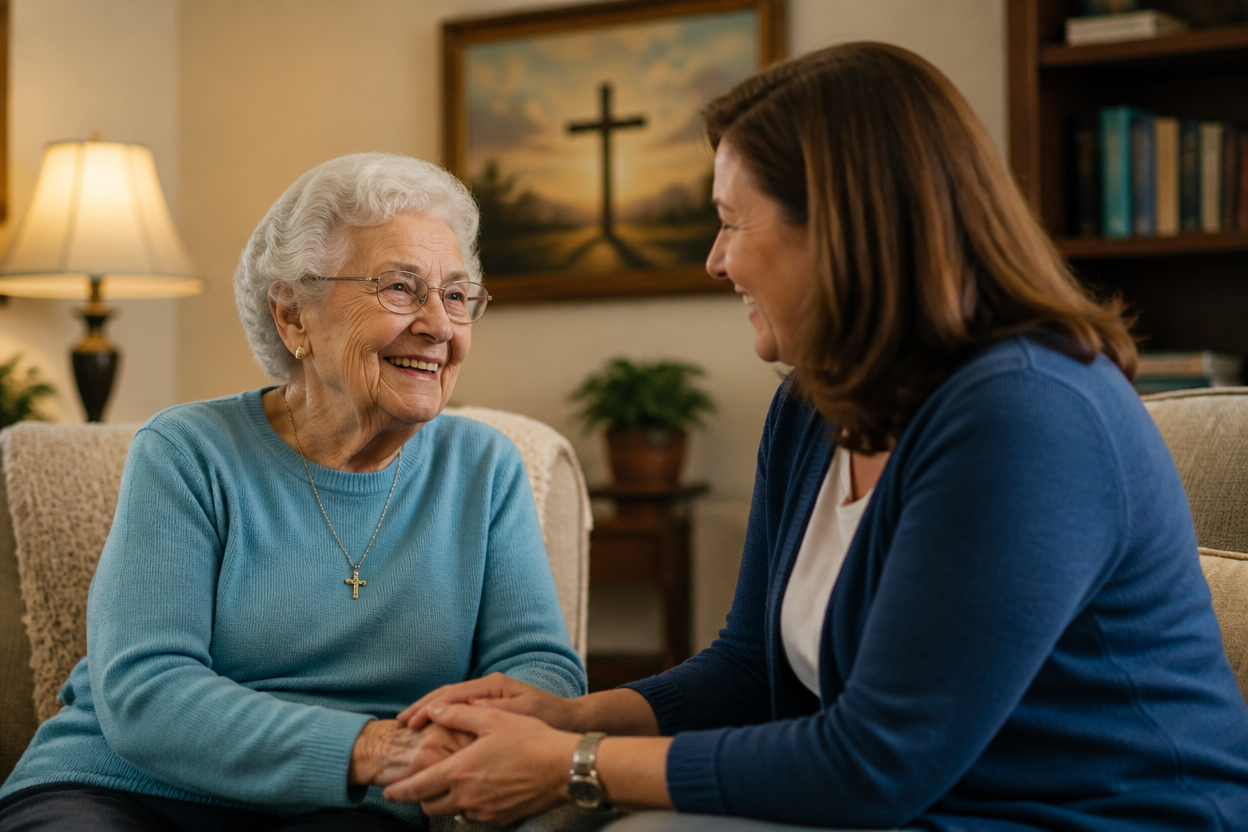
Healthy donor pathways include volunteering, events, and church-based partnership
Most senior care ministries need more than money; they need relational capacity. Donor engagement is healthiest when it invites participation that strengthens the ministry’s mission rather than distracting staff from it. The practical question becomes: how can a donor’s time, presence, and influence be offered in ways that reduce strain on frontline caregivers?
Volunteering that honors boundaries and continuity
Volunteering in senior care is not a short-term “experience” in the way some volunteer models assume. Residents can experience repeated introductions and disappearances as another form of loss. Ministries that do this well tend to screen volunteers carefully, require training, and emphasize consistency over intensity. Donors who volunteer should expect that safeguards will exist—background checks, orientation, health protocols, and supervision—and should interpret those safeguards as part of ethical care, not as institutional coldness.
Volunteer roles vary: friendly visiting, wheelchair assistance for community activities, letter-writing, technology help, music ministry, reading aloud, or respite support for caregivers. The most valuable volunteers are often those willing to serve under staff direction, accept correction, and return over time. This is particularly important when cognitive impairment is present; the Alzheimer’s Association notes that dementia affects memory, language, and judgment in ways that change relational dynamics and require patience and skill Alzheimer’s Association.

Events that tell the truth without sentimental distortion
Events can be legitimate touchpoints for donor formation—if they resist the temptation to market suffering. Strong senior care ministries use events to communicate the actual work: caregiver support, quality standards, spiritual care, benevolence policies, and the daily discipline of dignified assistance. Donors can ask for substance: What training do caregivers receive? How is spiritual care integrated without coercion? What protections exist against elder abuse? How does the ministry handle end-of-life decision-making with families?
The best events also honor older adults as participants rather than objects. A resident choir, art exhibit, or intergenerational gathering can display meaning and joy without violating privacy or turning a person into a fundraising illustration.
Church partnership as an extension of pastoral care
Many donors are most influential inside their congregations. Senior care ministries frequently rely on churches for volunteer recruitment, pastoral referrals, and caregiver support. Donors can advocate for structured church involvement: rotating visitation schedules with training, prayer teams that coordinate with chaplaincy staff, and tangible support for family caregivers in the congregation.
Where appropriate, donors can encourage their church to treat elder care as part of discipleship rather than as a specialized ministry for “people who are good with seniors.” The New Testament’s repeated emphasis on honoring older men and women in the community assumes a church that does not sideline the aged (1 Timothy 5:1–2).
What donors should evaluate before deepening commitment
Engagement grows when trust grows, and trust is rarely built on emotion alone. Senior care is costly, regulated, and ethically complex. Mature donors should ask questions that reflect that complexity. At Most Trusted, our verification work exists to help donors give with confidence by evaluating ministries against The Most Trusted Standard, a 15-criteria framework spanning Faith Foundation, Financial Integrity, Governance and Leadership, and Transparency and Effectiveness. The aim is not suspicion; it is stewardship.
Some donors hesitate to ask rigorous questions because they fear appearing uncharitable. Scripture does not frame discernment as cynicism. It frames it as wisdom. “The simple believes everything, but the prudent gives thought to his steps” (Proverbs 14:15). Senior care ministries that welcome scrutiny tend to be the ones that understand the moral gravity of their work.
Financial clarity without reductionism
Donors often ask about overhead, and the sector has rightly warned against simplistic overhead ratios. The “Overhead Myth” letter—signed by GuideStar (now Candid), Charity Navigator, and the BBB Wise Giving Alliance—argued that judging nonprofits primarily by overhead can punish investments in staff, systems, and evaluation that protect beneficiaries and improve outcomes Candid. In senior care, underinvestment in training, compliance, and supervision is not virtue; it can become risk.
What this means in practice is that donors should ask how money supports quality: staffing levels, caregiver training, spiritual care provision, facilities maintenance, and safeguards for vulnerable adults. A ministry’s audited financial statements, board-approved budgets, and clear explanations of restricted gifts are often more informative than a single percentage.
Governance, safeguarding, and family-facing ethics
Senior care ministries sit at the intersection of family systems and institutional responsibility. Decisions about admission, discharge, behavioral challenges, or end-of-life care can become contested. Donors should want to know whether the ministry has a functioning board, conflict-of-interest policies, clear complaint pathways, and a culture that takes reporting seriously.
Safeguarding is not only a children’s ministry concern. Older adults can be vulnerable to neglect, abuse, and financial exploitation. Donors can ask for evidence of staff screening, mandatory reporting training, and documented incident-response practices. Strong ministries do not treat these questions as hostile; they treat them as part of neighbor-love.
Spiritual care that is explicit and noncoercive
Christian senior care ministries often include chapel services, pastoral counseling, prayer visits, and sacramental care within their tradition. Donors should affirm spiritual care as central while also recognizing the ethical line between ministry and coercion. Residents may be cognitively impaired, emotionally fragile, or dependent on caregivers for basic needs. The integrity question is whether spiritual practices are offered with clarity and compassion, without pressure, and with respect for conscience.
Ministries that meet The Most Trusted Standard tend to articulate their faith commitments transparently and describe how those commitments shape care for every resident, including those who do not share the ministry’s convictions.
Deep engagement grows through visits, stories, and fundraisers ordered by dignity
Donors often want proximity: to see programs firsthand, to hear stories, to rally others through fundraising. These are good desires when ordered by dignity and truth. They become corrosive when driven by the need for emotional certainty or public validation.
Visiting programs as a posture of learning
Visiting a senior care program can clarify what a brochure cannot: the tone of staff-resident interactions, the cleanliness and safety of spaces, the presence of spiritual care, and the seriousness of leadership. Donors should approach visits as guests, not inspectors and not VIPs. A well-run ministry will provide clear guidelines: where you may go, whom you may speak with, and what can or cannot be photographed.
Donors can also ask to see the ministry’s less visible work: caregiver training schedules, policies for medication management (if applicable), procedures for handling falls, and chaplaincy integration. A ministry that can explain these calmly is often a ministry that is governed thoughtfully.
Impact stories that protect the vulnerable and tell the truth
Donors should expect stories, because testimony matters. Yet senior care stories must be handled with restraint. Older adults deserve more than being cast as symbols of decline or objects of pity. Ethical storytelling includes consent, privacy protection, and a refusal to exaggerate spiritual outcomes for fundraising effect.
Donors can ask ministries to describe impact at multiple levels: resident well-being, family caregiver support, community partnerships, and staff retention. Where quantitative outcomes are difficult, qualitative evidence can still be disciplined: documented case notes, chaplaincy activity summaries, family satisfaction processes, and third-party inspections where relevant.
Fundraisers that strengthen, rather than distort, the mission
Many donors can start fundraisers through their church, workplace networks, or family events. The decision point is what the fundraiser signals. A “sponsor a room” campaign, for example, can be effective if it is truthful about costs and does not imply ownership or access. A benevolence fund appeal can be powerful if it explains how grants are decided and how dignity is protected when assistance is given.
Because senior care costs are ongoing, donors should consider recurring giving and multi-year commitments when the ministry has demonstrated capacity and integrity. A ministry cannot hire and retain excellent caregivers on sporadic income. Donors who understand the economics of care often become the most stabilizing partners.
For donors seeking ministries with demonstrated credibility, our team at Most Trusted encourages beginning with verified evidence. Many donors start by reviewing Christian Senior Care Ministries and then engaging directly with leadership, asking the kinds of questions that reveal how theology, governance, and care practices actually meet on the ground.
Engagement that endures reflects the long faithfulness of care
Christian senior care is not primarily a problem to solve; it is a field of mercy to sustain. The donor who engages well will often look less like a patron and more like a steady companion—supporting the ordinary labor of caregivers, honoring the dignity of residents, and insisting on truthfulness in how ministries represent their work.
When donor engagement is shaped by reverence for older adults, seriousness about stewardship, and confidence that God is present in hidden acts of care, it becomes more than philanthropy. It becomes a participation in the church’s long obligation to honor those who have borne the heat of the day, and to do so with integrity.



