

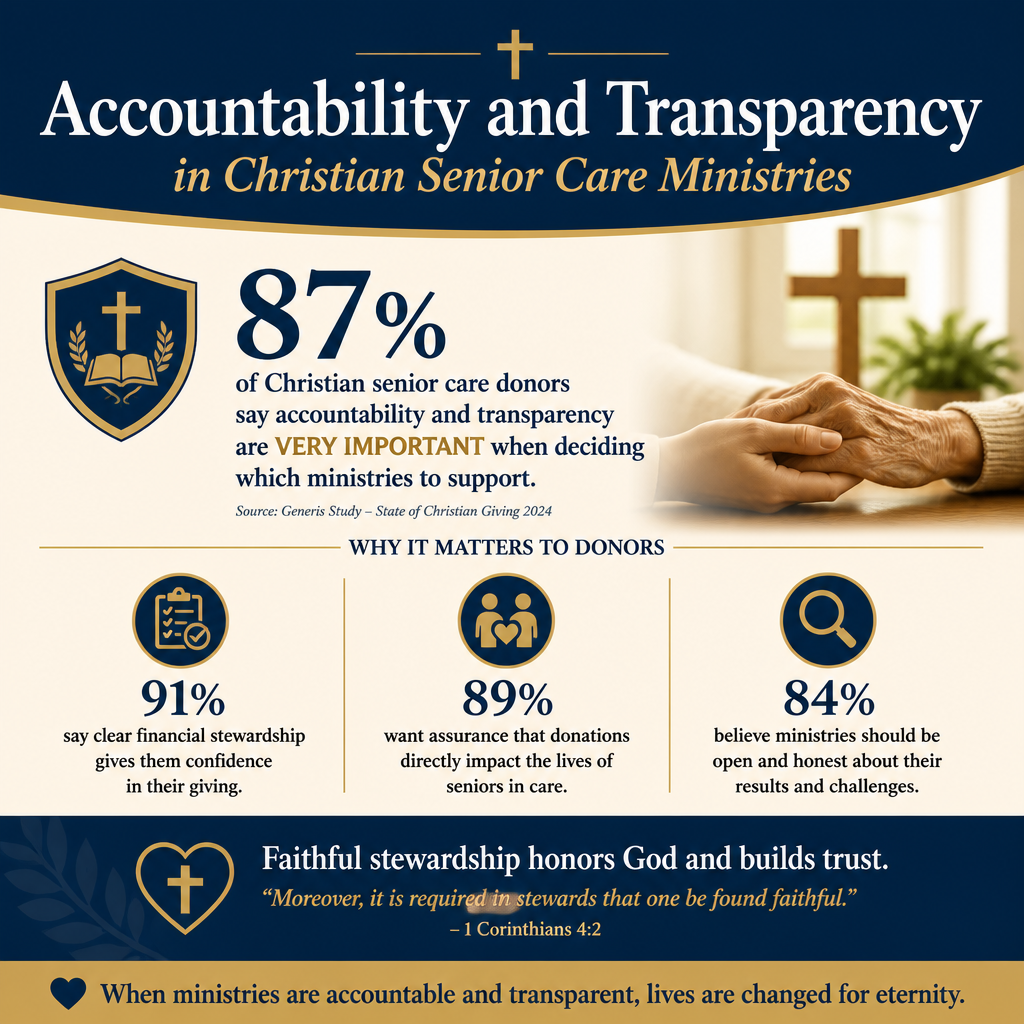
Accountability and transparency in Christian senior care ministries are not public-relations accessories; they are part of Christian obedience in how a ministry handles the widow’s portion, the family’s trust, and the community’s witness. Donors are rarely asking for perfection. They are asking for verifiable signals that a ministry’s financial decisions, governance choices, and care practices can withstand light.
Senior care sits at the intersection of mercy and complexity. Costs are real and rising, care is regulated in uneven ways, and the people served are often medically fragile or socially isolated. That makes the stakes higher for both the ministry and the donor. Scripture does not allow us to treat stewardship as a private matter. “It is required of stewards that they be found faithful” (1 Corinthians 4:2) is a standard that naturally presses toward traceable decisions and accountable leadership.
Transparency is a moral obligation and a practical safeguard
Christian donors often give to senior care because they see Matthew 25 as a direct call: to visit, to feed, to care for the sick, and to treat the vulnerable as neighbors rather than burdens. Yet the same passage warns that service is not merely a feeling; it is a measurable posture. In senior care, transparency is one of the ways that posture becomes visible: a ministry discloses what it does, how it pays for it, and who is responsible when something goes wrong.
Donors are not buying outcomes they cannot examine
Many ministries do meaningful work that is difficult to quantify. Spiritual encouragement, companionship, and pastoral presence are real goods. But donors still have a right to understand the basic contours of operations: the population served, the cost drivers, the safety policies, and the financial model. A ministry that refuses to disclose ordinary information is asking donors to substitute trust for evidence.
When donors ask, “How much of my gift goes to care?” they are often asking a deeper question: “Will this ministry keep faith with the people it serves?” The field has had to reckon with the limitations of simple ratios. The widely discussed “Overhead Myth” letter—signed by GuideStar (now Candid), BBB Wise Giving Alliance, and Charity Navigator—argues that overhead ratios are a poor proxy for impact and can incentivize underinvestment in governance, systems, and staff competence (GuideStar/Candid). Transparency, properly practiced, does not hide administrative costs; it explains them.
Senior care multiplies risk without clear disclosure
Unlike many program types, senior care can involve medication management, personal care, fall prevention, dementia support, and transportation. Each area creates potential for harm if policies are weak or staffing is unstable. Mature donors do not assume that a “Christian” label eliminates operational risk. They look for evidence of discipline: clear incident reporting, staff screening, training expectations, and appropriate insurance coverage.
Some ministries operate residential facilities. Others provide in-home support, care coordination, respite for caregivers, or pastoral visitation networks. The appropriate transparency varies by model, but the principle remains: donors should be able to understand what the ministry actually does and how it governs that work. Where the ministry’s website is vague, the next step is often to examine public filings and board oversight rather than relying on messaging.
Transparency also protects the ministry’s witness
Christian ministries do not operate in a vacuum. When a senior care organization mishandles funds, obscures outcomes, or neglects accountability, the damage is not confined to a balance sheet. It hardens skepticism toward Christian charity more broadly. The church’s credibility is affected by how Christian organizations respond when questioned: with clarity, humility, and evidence, or with deflection and moral pressure.

Financial accountability begins with readable, verifiable documents
Financial integrity is not primarily a matter of sophisticated finance; it is a matter of whether ordinary donors can follow the money. For U.S. nonprofits, the baseline is public information: governance details, revenue sources, expense categories, and whether the organization is current in required filings. A ministry that welcomes scrutiny generally has fewer reasons to fear it.
What Form 990 can and cannot tell you
For many ministries, IRS Form 990 is the backbone document. It is imperfect, sometimes dated, and often hard to read. Yet it provides a consistent set of disclosures: program service revenue, grants, fundraising expenses, related-party transactions, top compensation, and board independence. Donors should expect a ministry to make the most recent Form 990 easy to locate and to answer questions that naturally arise from it.
Form 990 is not filed by churches and some church-affiliated organizations, which creates a real tension for donors: there can be faithful senior care work happening under church structures with limited public reporting. In those cases, donors should look for functional equivalents: audited financial statements, clear governance documentation, conflict-of-interest policies, and a willingness to provide financial summaries upon request.
Audits, reviews, and why they matter for senior care
Where budgets are substantial or operations include facilities, an independent audit is a meaningful signal. An audit does not guarantee virtue; it provides external testing of controls and financial statements. Donors should also understand that smaller ministries may not be able to afford full audits. The question becomes whether the ministry scales accountability in proportion to complexity and risk. A multi-site senior living operation without external financial oversight is a different concern than a small visitation ministry run through a local church.
When donors evaluate financial statements, the objective is not to punish ministries for spending money on staff, systems, or compliance. The objective is to see whether financial choices make sense relative to mission claims. If a ministry says it is expanding care to low-income seniors, donors should see resources moving in that direction through program spending, subsidies, or documented partnerships.
Unrestricted gifts and the temptation to underfund the core
Many donors prefer restricted gifts because they feel more concrete. Yet senior care ministries often need a meaningful share of unrestricted funding to keep commitments: staffing stability, facility maintenance, compliance work, and emergency assistance that cannot be predicted. Chronic restriction can create what Stanford Social Innovation Review describes as the “nonprofit starvation cycle,” in which organizations underinvest in essential infrastructure to satisfy donor expectations (Stanford Social Innovation Review).
Accountability here is not merely a request for more unrestricted giving. It is a call for ministries to be candid about what core operations cost and why. Donors can be generous about overhead when the rationale is clear and when governance provides evidence that overhead is not a hiding place for inefficiency or self-dealing.
Governance is where accountability becomes real under pressure
Financial documents can be clean while culture is brittle. The ministries that remain steady over time usually have governance that can withstand uncomfortable questions: a board that is not captive to a founder, conflict-of-interest practices that are more than paperwork, and a leadership ethos that expects scrutiny rather than resents it.
Board independence and conflicts of interest
Senior care ministries often emerge from sincere pastoral concern, a visionary founder, or a family-led initiative. That origin story can be a gift. It can also become a governance liability when board members are financially intertwined with leadership, vendors, or property arrangements. Donors should expect clear disclosure of related-party transactions and written conflict-of-interest policies that are enforced, not merely filed.
Healthy governance does not mean leaders are distrusted. It means they are protected from the temptation to become indispensable. In Christian terms, accountability is a form of love: it restrains the ministry from turning into an extension of one personality and keeps authority answerable to the community and the mission.
Safeguarding donor funds in complex operations
Protecting donor funds is not limited to preventing theft. It includes budgeting discipline, segregation of duties, authorization controls, and realistic reserves for maintenance and emergencies. Ministries that manage facilities face capital needs that can be deferred for a season and then arrive as a crisis. Donors should look for evidence that leadership is planning for those realities rather than relying on last-minute appeals.
Fraud risk is not theoretical in the nonprofit sector. The Association of Certified Fraud Examiners reports that organizations lose an estimated 5% of revenue to fraud each year across sectors, a benchmark that has shaped internal control expectations (Association of Certified Fraud Examiners). The point for donors is not to assume corruption, but to ask whether the ministry’s controls are proportionate to the dollars and responsibilities entrusted to it.
Accountability to seniors and families, not only to donors
Transparency that serves donors but ignores residents and families is incomplete. In senior care, the people served are not abstract beneficiaries; they are image-bearers with rights, histories, and often diminished capacity. Mature ministries make it easy for families to understand policies, grievance processes, and care standards. They communicate clearly about what they can and cannot provide, which is a form of honesty that prevents spiritualized overpromising.
Christians genuinely disagree about how much performance reporting is appropriate for ministries that emphasize relational care and pastoral presence. Yet few disagree that families should be able to raise concerns without fear, and that documented processes should exist for addressing neglect, abuse, or chronic understaffing. Accountability is measured most clearly in how a ministry responds when trust is strained.
What donors should look for when evaluating transparency
Most donors do not have time to become auditors. What they need is a disciplined way to ask the right questions and to recognize common warning signs. Across our verification work at Most Trusted, the ministries that meet The Most Trusted Standard tend to treat donor questions as normal stewardship, not as hostility. They provide documentation promptly, explain trade-offs candidly, and show consistency between their spiritual language and operational practice.
A practical transparency checklist for senior care giving
- Clear legal identity: The organization’s exact legal name, EIN, and governance structure are readily available, along with current nonprofit status where applicable.
- Accessible financial reporting: Recent Form 990s (when required), annual reports, and either audited statements or a credible explanation of why an audit is not feasible at the current scale.
- Program clarity: A straightforward description of services, eligibility, and what a donor’s gift makes possible, including the limitations imposed by staffing and regulation.
- Governance disclosures: Board roster, leadership bios, conflict-of-interest policy posture, and disclosures of related-party transactions when present.
- Fundraising ethics: Accurate claims, no inflated impact promises, and no manipulative pressure that trades on guilt or fear.
How to interpret administrative and fundraising costs without cynicism
Donors should resist simplistic rules such as “administration must be under X%.” In senior care, administrative spending can include clinical supervision, compliance, background checks, training, quality assurance, billing staff for Medicaid-related processes, and facility safety requirements. A ministry with unusually low administrative costs may be underinvesting in precisely the systems that protect seniors and prevent misuse of funds.
At the same time, overhead can hide bloat, patronage, or executive insulation if governance is weak. The question is whether the spending categories match operational realities and whether leadership can explain them with specificity. A ministry that cannot explain its own budget is not ready for growth, and it is not a safe steward of donor trust.
Where to go deeper when a ministry is difficult to verify
Some Christian senior care work is conducted through hybrid structures: church-affiliated entities, networks of local chapters, or partnerships with secular providers. These arrangements can be legitimate and even wise, but they complicate visibility. When public filings are limited, donors should request written financial summaries, governance documents, and evidence of policies that protect seniors and funds. Refusal to provide reasonable documentation is itself a form of information.
For donors wanting a single place to orient their giving within this field, we maintain resources related to Christian Senior Care Ministries. Our aim at Most Trusted is not to replace discernment, but to strengthen it with verification practices shaped by The Most Trusted Standard.
Accountability is part of honoring the elderly and the giver
Christian senior care ministries exist to honor people who are often unseen and to bear witness to the dignity of aging in a culture that prizes productivity. Accountability and transparency are not distractions from that calling. They are ways a ministry demonstrates that care is not sentimental but faithful, that power is answerable, and that money given in the name of Christ is handled in the light.
Donors who ask careful questions are not weakening Christian charity; they are helping it mature. When ministries welcome that scrutiny and provide verifiable evidence, generosity can rest on more than hope. It can rest on stewardship that is visible, consistent, and worthy of trust.



