
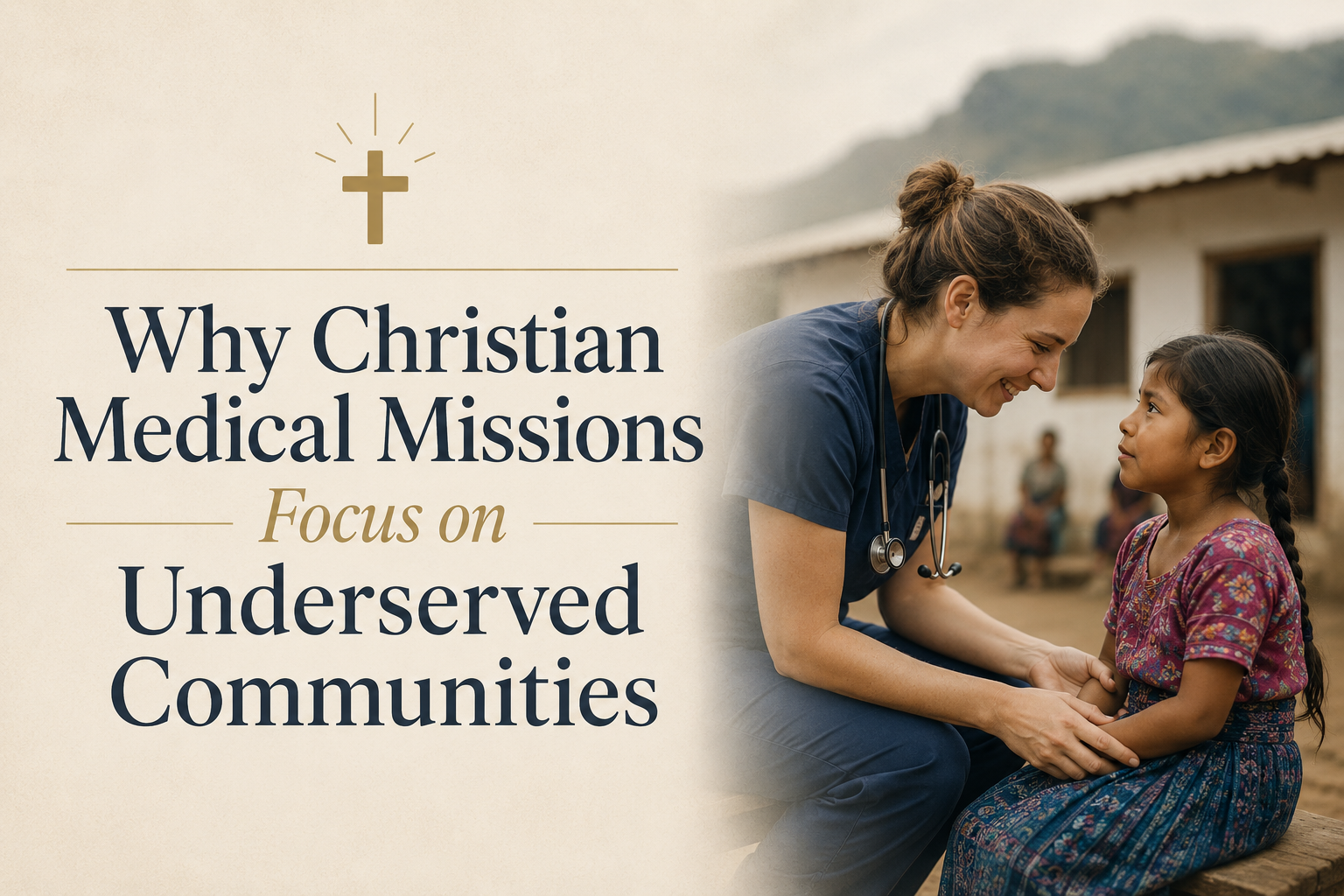
Why Christian medical missions focus on underserved communities is not first a branding question. It is a question of Christian obedience in the face of unequal access to care, and of whether our giving will bear the marks of mercy Jesus himself named: “I was sick and you visited me” (Matthew 25:36).
Underserved communities are not only distant places. They include rural counties without obstetric services, refugee families navigating unfamiliar systems, and neighborhoods where clinics are scarce and chronic disease is common. Christian medical missions operate in that reality because the gospel compels proximity to suffering, and because credible evidence shows how deeply health outcomes track with poverty, geography, and social marginalization. Serious donors should also ask a harder question: which models of “medical mission” actually strengthen communities rather than creating dependency, distortion, or a short-lived surge of services that cannot be sustained.
The biblical logic is mercy with particular attention to those pushed aside
Scripture is clear about the moral priority of the vulnerable
The Old Testament does not treat poverty as a mere condition; it treats the poor as neighbors whose treatment reveals whether a people fear God. The law repeatedly names the widow, the orphan, and the sojourner—groups without the usual protections of land, kin, or social standing. The prophets condemn a worship that keeps its liturgy while neglecting justice. The New Testament continues the pattern: the Jerusalem church organizes care for widows, and James links “pure and undefiled religion” to concrete protection of the vulnerable (James 1:27).
That is why “underserved” is not a technical term Christians borrow from public health; it names a moral reality Scripture has always recognized. When a community lacks reliable prenatal care, safe surgery, or basic antibiotics, Christians do not need to invent a rationale for attention. We need to ensure our attention is wise, truthful, and ordered toward long-term good.
Mercy is personal, but it is not only personal
Christian medical work has always carried a double charge: to treat the person in front of us, and to tell the truth about the conditions that make sickness predictable. The parable of the Good Samaritan turns on an individual act of compassion, but the road itself remains dangerous. In practice, mature missions increasingly pair clinical care with public health, local capacity, and referral networks. Treating infections while ignoring clean water is not compassion; it is a cycle.
Christians genuinely disagree about the proper balance between proclamation and service, and about how directly ministries should address social structures. But few disagree that the Lord’s concern reaches both the body and the soul, and that our love must become legible in the places where suffering concentrates.
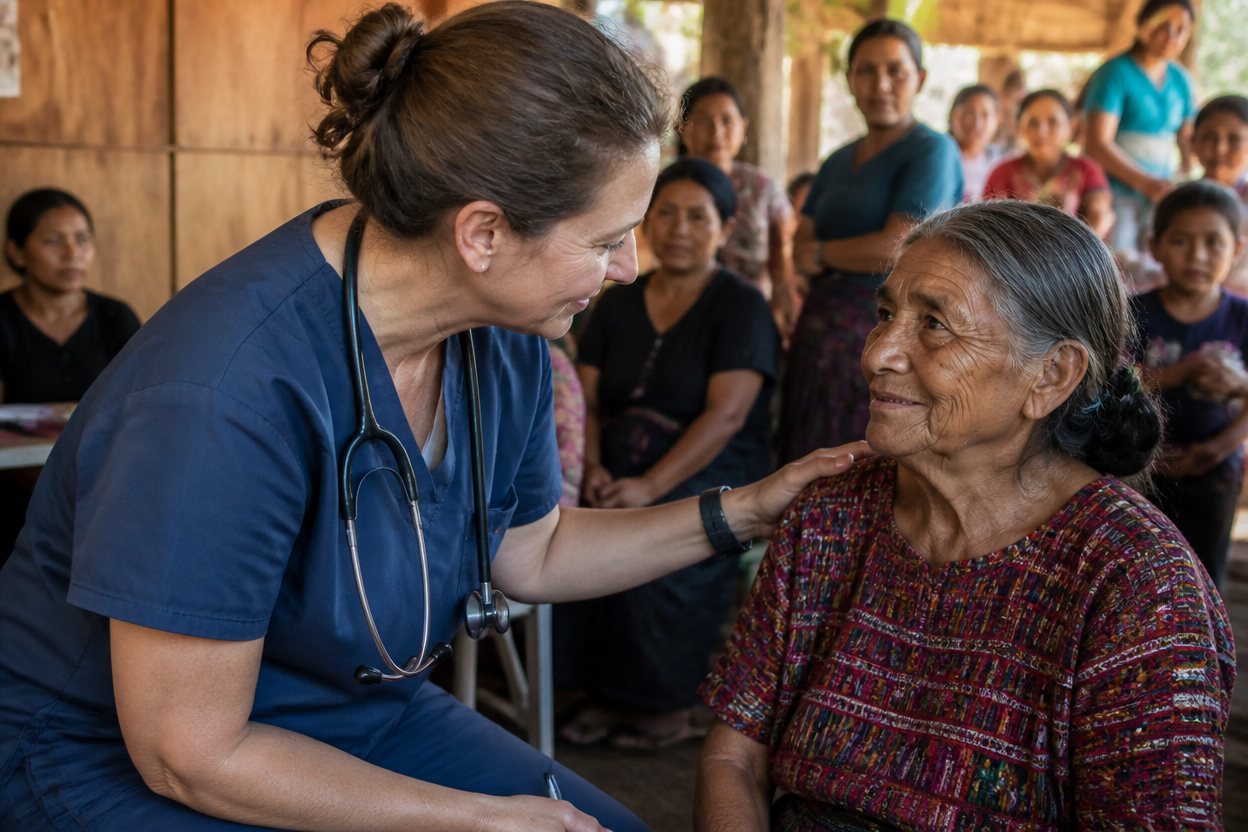
Underserved communities bear the heaviest health burdens
Access gaps are measurable and they change outcomes
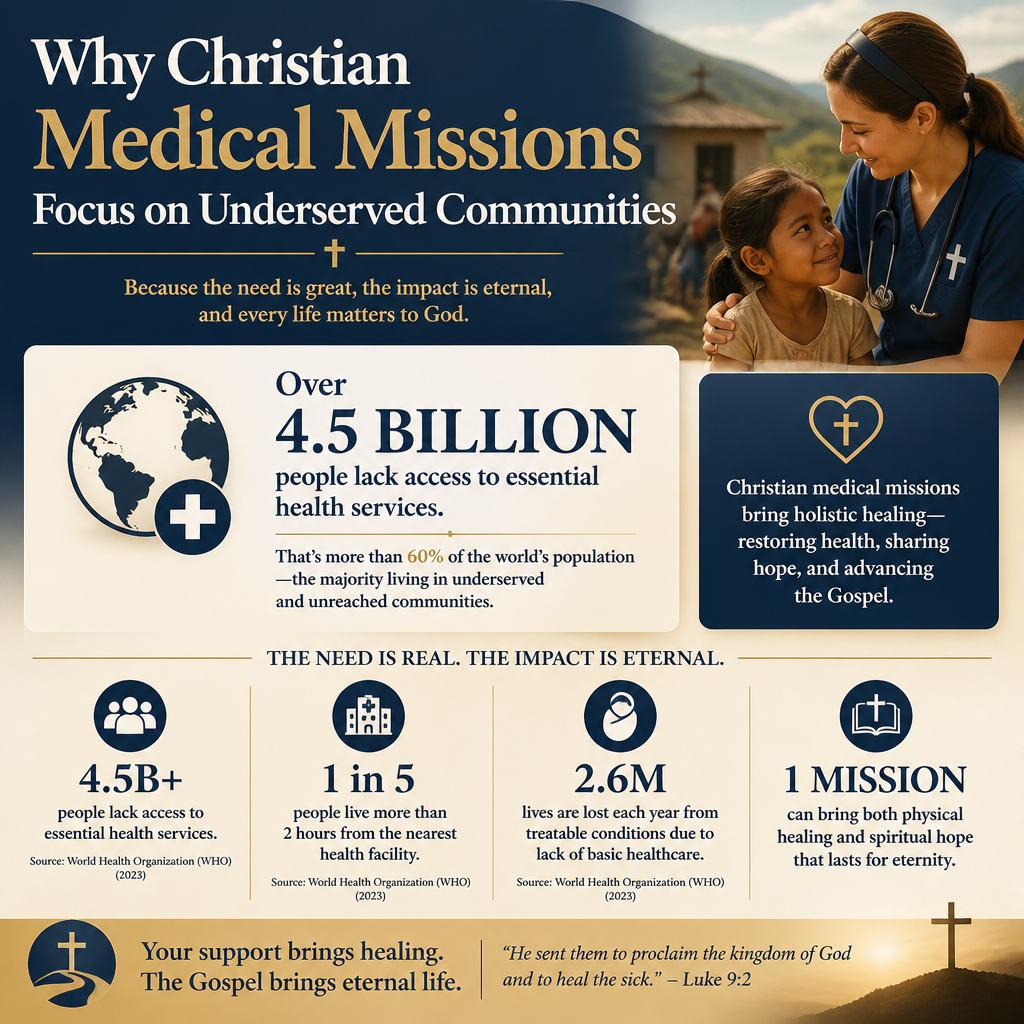
Christian donors are right to want more than sentiment. The unequal distribution of care is not speculative. For example, the World Health Organization reports that at least half of the world’s people do not receive the health services they need, and that health spending pushes nearly 100 million people into extreme poverty each yearWorld Health Organization. Those are not abstract figures. They translate into untreated hypertension, births without skilled attendance, infections that become lethal, and injuries that would be survivable with timely surgery.
In the United States, “underserved” often means geographic scarcity and cost barriers. Federal health policy uses “Health Professional Shortage Areas” precisely because primary care and mental health clinicians are unevenly distributedU.S. Health Resources and Services Administration. Many Christian medical ministries work domestically for this reason, often in partnership with local churches that can provide continuity and trust.
Poverty and health reinforce one another
Medical missions often begin with illness, but they quickly confront economics. Sickness reduces earning capacity; lost income then delays care; delayed care worsens disease. This is one reason the best ministries do not treat clinical work as a stand-alone intervention. They pay attention to transportation, follow-up, patient education, and community health workers, because the barrier is rarely “lack of compassion” alone. It is the absence of systems that make care reachable.
For donors, this reframes the question from “How many patients were seen?” to “Was care appropriately targeted, medically responsible, and connected to a path for ongoing treatment?” That is where discernment matters.
Effective missions aim for presence, partnership, and local capacity
The field has matured beyond the one week clinic model
Short-term medical trips can relieve acute suffering, especially in disaster response or in places with long waits for basic services. They can also cause harm if they displace local clinicians, dispense medications without follow-up, or perform procedures without adequate continuity of care. The field has had to reckon with these tensions, and much of that reckoning is informed by the “When Helping Hurts” framework articulated by Steve Corbett and Brian FikkertChalmers Center.
Across our verification work at Most Trusted, the ministries that meet The Most Trusted Standard tend to articulate a theory of change that goes beyond episodic care. They describe how clinical services connect to local health systems, how patients are referred and followed, how local staff are trained, and how outcomes are measured without inflating claims.
Partnership is a theological and practical discipline
Christian mission is not a project outsiders do to others. It is a participation in what God is already doing, often through local churches and local clinicians whose faithfulness long predates outside attention. Partnership has practical benefits—language fluency, cultural competence, local legitimacy—but it also guards against a subtle spiritual error: assuming the “sender” is the primary actor and the “receiver” is the passive beneficiary.
Donors can ask whether a ministry’s local partners have real authority: Do local leaders shape program design? Are local clinicians compensated fairly? Does the ministry invest in training, equipment maintenance, and supply chains that can be sustained? Those questions separate durable health work from well-intentioned activity.
Stewardship requires donors to measure harm risks as well as impact
Medical work carries distinctive ethical responsibilities
Unlike some forms of aid, medicine can injure quickly when done poorly. Antibiotics given without diagnosis can accelerate resistance. Procedures without sterility can spread infection. Volunteers practicing beyond their licensure can create legal and clinical crises. For Christian donors, this raises the stewardship bar, not because we distrust mercy, but because we fear God and love our neighbors.
Strong ministries treat clinical standards as part of their Christian witness. They use credentialed clinicians, adhere to scope of practice, secure informed consent, protect patient privacy, and maintain appropriate pharmaceutical controls. They also plan for referral when a case exceeds what the team can responsibly handle.
What careful donors should look for in a medical missions ministry
Our team encourages donors to evaluate medical missions with questions that align both with Christian ethics and with basic accountability. The following indicators tend to distinguish responsible ministries:
- Clear clinical governance, including credential verification and medical oversight
- Continuity plans for follow-up care, referrals, and medical records
- Evidence of partnership with local health systems and local churches
- Transparent reporting that avoids inflated patient counts or spiritual claims
- Safeguarding practices appropriate to vulnerable adults and children
These considerations overlap with the concerns donors already bring to Christian giving: financial integrity, leadership accountability, and truthful communication. In our work, The Most Trusted Standard provides a consistent way to examine those questions across ministries without reducing mission to spreadsheets.
Underserved focus is also about credibility in Christian witness
Mercy that bypasses the neglected can become self-referential
Christian donors often support medical work because it is an embodied sign of the kingdom: pain relieved, dignity honored, fear answered with presence. But when ministries gravitate toward places with easier logistics, better publicity, or lower complexity, they risk drifting from the pattern of Christ, who did not choose his neighbors based on convenience.
Focusing on underserved communities keeps Christian medical missions aligned with the central Christian confession that God moves toward those without power. It also keeps ministries honest about costs. Work in underserved places is slower, more relational, and more administratively demanding. The very difficulty can be a marker of seriousness, though it is never proof on its own.
How Most Trusted fits into donor discernment
Many donors have learned that moving stories are not the same as trustworthy operations. Claims about “thousands treated” or “revival through medicine” can conceal weak governance, vague financial reporting, or outcomes that cannot be verified. Most Trusted exists to serve donors who want to give with confidence by evaluating ministries against The Most Trusted Standard across faith commitments, financial integrity, governance and leadership, and transparency and effectiveness.
For donors seeking a wider view of this field, Christian medical missions can be understood within Christian Medical Ministries as a category that includes hospitals, mobile clinics, training programs, and public health initiatives. Each model carries different risk profiles, ethical demands, and partnership requirements.
It also helps to place specific ministries within How Christian Medical Ministries Deliver Care, where questions of delivery model—short-term teams, permanent facilities, community health workers, telemedicine, and referral networks—often determine whether care is episodic relief or a durable contribution to local health.
FAQs for Why Christian medical missions focus on underserved communities
Is focusing on underserved communities a form of political activism rather than gospel mission?
It depends on how it is framed and practiced. Addressing underserved health needs can be a direct expression of Christian mercy without collapsing into partisan agendas. Scripture consistently binds love of God to love of neighbor in tangible form, and Jesus explicitly named visiting the sick as a mark of faithful discipleship. The risk is not that underserved focus is inherently political; the risk is that a ministry’s rhetoric becomes ideological, or that it substitutes structural commentary for concrete, accountable care.
How can donors tell whether a medical missions ministry is helping rather than harming?
Responsible ministries can explain their clinical standards, credentialing, follow-up plan, and partnerships with local clinicians. They report outcomes with humility and specificity, and they make financial and governance information accessible. Donors should look for evidence of local authority, continuity of care, and transparency about limits. Where those elements are absent, the ministry may still be sincere, but sincerity is not the same as stewardship.
A faithful focus is proximity shaped by wisdom
Christian medical missions focus on underserved communities because that is where suffering is concentrated and where access to care is often least available. The biblical impulse is not generic compassion; it is love that moves toward the neglected. For donors, the calling is to fund that love in forms that are medically responsible, locally grounded, and verifiably trustworthy, so that mercy is not only felt in the moment but endures in the life of a community.



