
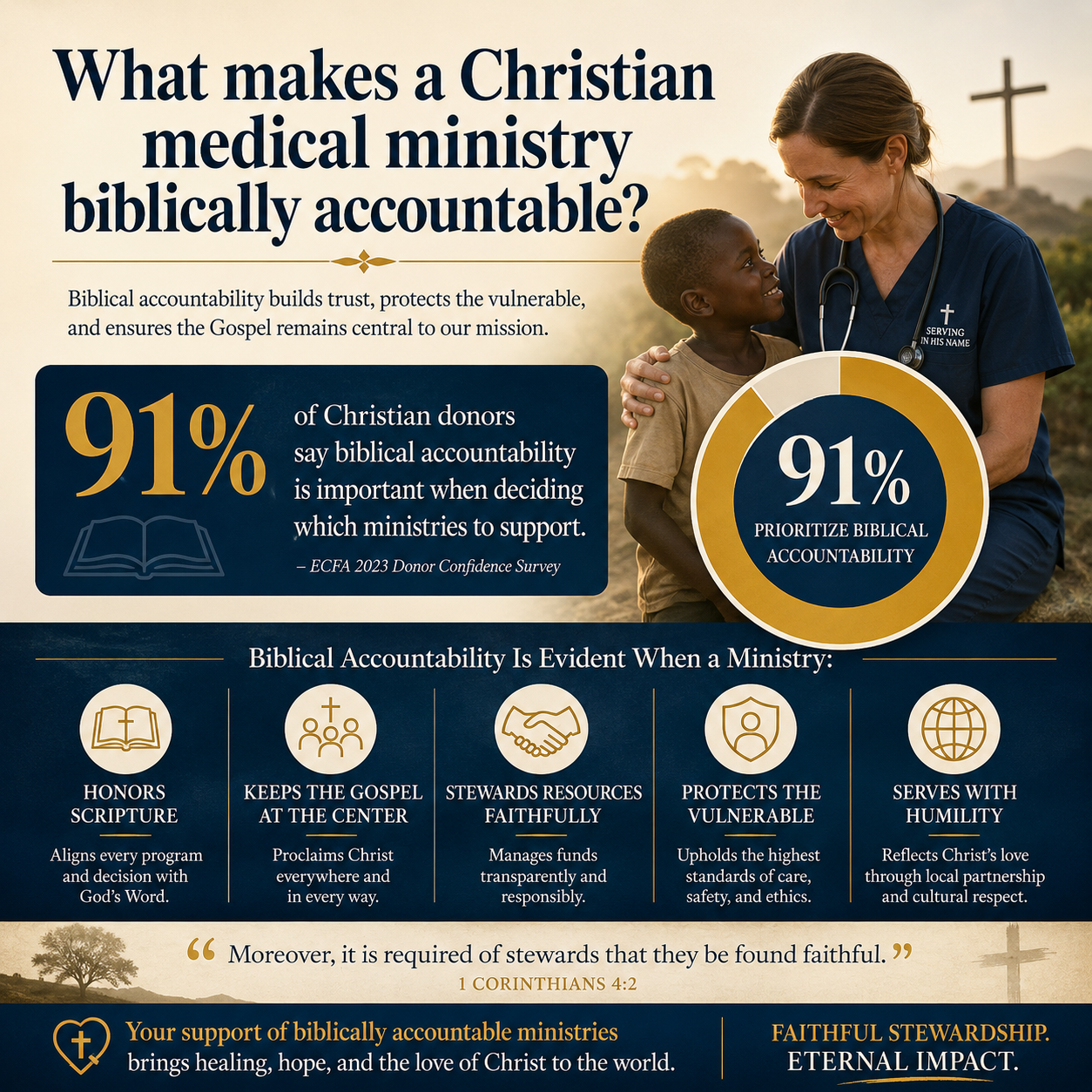
What makes a Christian medical ministry biblically accountable is not first the size of its budget or the sophistication of its clinics, but whether its care can be traced to truth: a public confession of Christ, a disciplined stewardship of resources, and a pattern of mercy that withstands scrutiny. Donors who want to honor God with their giving are right to ask for more than inspiring stories, because Scripture treats money, leadership, and justice as spiritual matters, not administrative details.
Medical work is also a setting where good intentions can produce avoidable harm. Clinical decision-making is complex; cultural dynamics shape outcomes; and power differentials between givers and recipients are real. A biblically accountable ministry does not deny these tensions. It names them, governs them, and submits its practices to the light.
Biblical accountability begins with a clear theology of healing and the gospel
Christian medical ministries sit at an intersection where the church’s mercy meets the body’s vulnerability. The Gospels present Jesus as one who heals with compassion and authority, and they present healing as a sign of the Kingdom rather than a replacement for repentance and faith. A ministry is biblically accountable when it refuses the false choice between evangelism and embodied care, and instead understands both within the whole counsel of God.
Confession and mission alignment are not optional
A Christian medical ministry should be explicit about what it means by “Christian.” That clarity typically includes a statement of faith, a doctrinal posture regarding the authority of Scripture, and a mission statement that describes how spiritual care relates to clinical care. Donors should not have to infer theological commitments from branding.
Across our verification work at Most Trusted, ministries that meet The Most Trusted Standard tend to show alignment between confession and practice: their hiring, partnerships, and program decisions are intelligible in light of their stated beliefs. Where alignment is missing, drift tends to follow. That drift may look like subtle pressure to soften doctrine for funding access, or it may look like spiritual language used to sanctify programs that are never meaningfully evaluated.
Christian mercy is never coercion
Christians genuinely disagree about the best models for integrating spiritual care within medical services, especially in pluralistic contexts. But coercion is not a faithful option. Biblically accountable ministries set expectations plainly: patients receive care because they bear God’s image, not because they will listen to a sermon, sign a form, or perform gratitude.
Donors should expect policies that protect patient dignity: informed consent, privacy standards, and a clear separation between clinical eligibility and religious participation. The ministry’s witness is strengthened, not weakened, by ethical clarity.

Stewardship requires financial integrity that can be verified
Jesus spoke with unusual directness about money because money reveals what a heart trusts. Donors are not merely “funding programs”; they are entrusting a portion of God’s provision to others for kingdom purposes. Biblical accountability therefore demands financial practices that can bear examination.
Controls matter because temptation is ordinary
Scripture’s warnings about partiality, dishonest scales, and love of money assume what experience confirms: leaders are human, pressures are real, and the appearance of good can conceal damaging patterns. A biblically accountable medical ministry treats internal controls as a form of discipleship, not an insult to leadership.
At a minimum, donors should look for audited financial statements when scale warrants it, clear segregation of duties, and a board that understands its fiduciary responsibilities. When a ministry cannot explain how money flows from donor intent to patient care, the problem is rarely only administrative.
Overhead ratios do not substitute for honesty
Many donors were trained to equate “low overhead” with faithfulness. The sector has had to reckon with how misleading that can be. The “Overhead Myth” letter—signed by GuideStar (now Candid), BBB Wise Giving Alliance, and Charity Navigator—argued that focusing on overhead alone can punish necessary investments in governance, evaluation, and staff capacity that actually protect beneficiaries and improve outcomes Candid.
For medical ministries, this is not theoretical. Quality improvement systems, pharmacy compliance, credentialed supervision, and secure patient records cost money. Biblical accountability does not mean spending as little as possible on administration; it means spending transparently, honestly, and in ways that serve mission rather than ego.
Governance and leadership must be ordered toward truth, not personality
Medical ministry often attracts unusually gifted founders: clinicians, pastors, entrepreneurs, and philanthropists who can mobilize resources quickly. That strength also carries a familiar risk—personality-driven governance that becomes difficult to correct. In Scripture, leadership is measured not by charisma but by character, and authority is bounded by accountability.
The board must be real, independent, and informed
A biblically accountable ministry has a functioning board with independence from paid staff, documented oversight, and the competence to govern a medical organization. Donors should ask whether the board reviews executive compensation, approves budgets, monitors conflicts of interest, and receives meaningful program reporting.
Independence is not hostility; it is protection. It protects the mission from self-dealing. It protects staff and patients from unexamined decisions. And it protects donors from being asked to fund a narrative that cannot be audited by reality.
Leadership integrity includes treatment of people close to the work
Power in ministry is most clearly tested not in fundraising appeals but in the way leaders treat employees, volunteers, and local partners. In a medical setting, that includes how clinicians are supervised, how complaints are handled, and whether whistleblowers are protected. A ministry that preaches compassion while silencing internal concerns is not merely unhealthy; it is contradicting its own witness.
Governance should also cover medical ethics: credential verification, scope-of-practice compliance, and protocols for adverse events. Where such systems are absent, the ministry may still do visible good, but it will be doing it without the kind of ordered wisdom Scripture commends.
Patient dignity and wise practice distinguish mercy from harm
Christian donors give because they want suffering relieved. Biblical accountability requires that relief be real, not merely photographed. Medical intervention touches bodies, families, and communities; it can heal, and it can also destabilize local systems if it is careless. Mature ministries pay attention to second-order effects.
Quality of care must be defined and measured
Medical ministries should be able to describe the standard of care they aim to provide, the training and credentialing of their providers, and how they handle follow-up. Short-term medical trips and mobile clinics can be appropriate in certain contexts, but they require disciplined planning: continuity of care, referral pathways, pharmacy management, and culturally informed communication.
The World Health Organization has warned that poor-quality health services can lead to avoidable suffering and loss of life, emphasizing that quality is not a luxury but central to health outcomes World Health Organization. Donors do not need a ministry to operate like a major hospital, but they should expect humility about clinical limits and seriousness about patient safety.
Wise compassion avoids creating dependency and distortion
Christians have learned, across multiple fields, that giving can unintentionally undermine local agency. The When Helping Hurts framework, articulated by Steve Corbett and Brian Fikkert, has shaped many ministries’ thinking about dependency, dignity, and the difference between relief and development Moody Publishers. In medical work, this often shows up in how services are priced, how local clinicians are engaged, and whether the ministry strengthens or competes with existing health systems.
Practical signs of biblically accountable medical practice include:
- Clear clinical protocols, including triage, referral, and follow-up plans
- Appropriate credentialing and supervision for all providers
- Pharmacy controls that prevent misuse and protect patient safety
- Safeguards for minors and other vulnerable patients
- Partnership structures that honor local church and community leadership
Transparency and effectiveness make accountability visible to donors
Donors cannot directly observe most medical care. They rely on trust, and trust requires more than assurances. Biblically accountable ministries make their governance, finances, and outcomes accessible enough for a serious donor to evaluate without special access.
Public reporting should match the weight of the work
At a minimum, donors should expect readily available governing documents, current leadership lists, and clear descriptions of programs and geographies served. For ministries of meaningful size, transparency should extend to audited financials, conflict-of-interest policies, and a candid accounting of risks.
What this means in practice is that a ministry’s website should not function primarily as a fundraising platform. It should also function as a window into stewardship. This is one reason Many donors seek independent verification. Most Trusted evaluates nonprofits against The Most Trusted Standard to help donors distinguish between compelling communication and demonstrated accountability.
Effectiveness is not a slogan
Measuring outcomes in medical missions is difficult. Attribution is limited, follow-up can be costly, and many ministries work in unstable contexts where data collection is legitimately constrained. Yet biblical accountability does not permit evasion. A ministry should be able to state what success looks like, which indicators it tracks, and what it has learned when results fell short.
The ministries that treat evaluation as a gift—not a threat—tend to mature over time. They also tend to communicate with sobriety: they describe patient volumes and services accurately, avoid inflated claims, and distinguish between outputs (visits, procedures) and outcomes (health improvement, sustained access to care).
Donors who want additional context on the broader field can explore Christian Medical Ministries, where we track common models of care and the accountability challenges that recur across contexts.
FAQs for What makes a Christian medical ministry biblically accountable
What documents should donors expect from a biblically accountable Christian medical ministry?
Donors should expect, at minimum, a clear statement of faith and mission, a current board and leadership list, and accessible financial information appropriate to the ministry’s size. For larger organizations, audited financial statements, conflict-of-interest policies, and documented safeguarding and medical ethics policies are reasonable expectations. Accountability is not only a private matter between leaders and God; it is also a public stewardship responsibility.
How should donors think about short-term medical mission trips and biblical accountability?
Short-term trips can be faithful when they are part of a continuity plan: local partnership, appropriate credentialing, clear follow-up pathways, and patient safety protocols. They become questionable when they function as episodic “events” driven by volunteer experience rather than clinical necessity, or when they bypass local health systems in ways that create dependency. Donors should look for ministries that can explain how short-term efforts serve long-term health and local capacity.
A biblically accountable ministry invites the light
Christian medical ministry is a work of mercy that should deepen the church’s credibility, not strain it. The question is not whether a ministry’s leaders feel sincere, but whether their theology, finances, governance, and clinical practice are ordered toward truth and open to examination. The ministries most worthy of donor trust are those that can articulate their commitments, document their stewardship, and receive correction without defensiveness.
For donors comparing models of care and the ways ministries deliver services in practice, How Christian Medical Ministries Deliver Care provides additional categories for evaluating both compassion and competence.



