
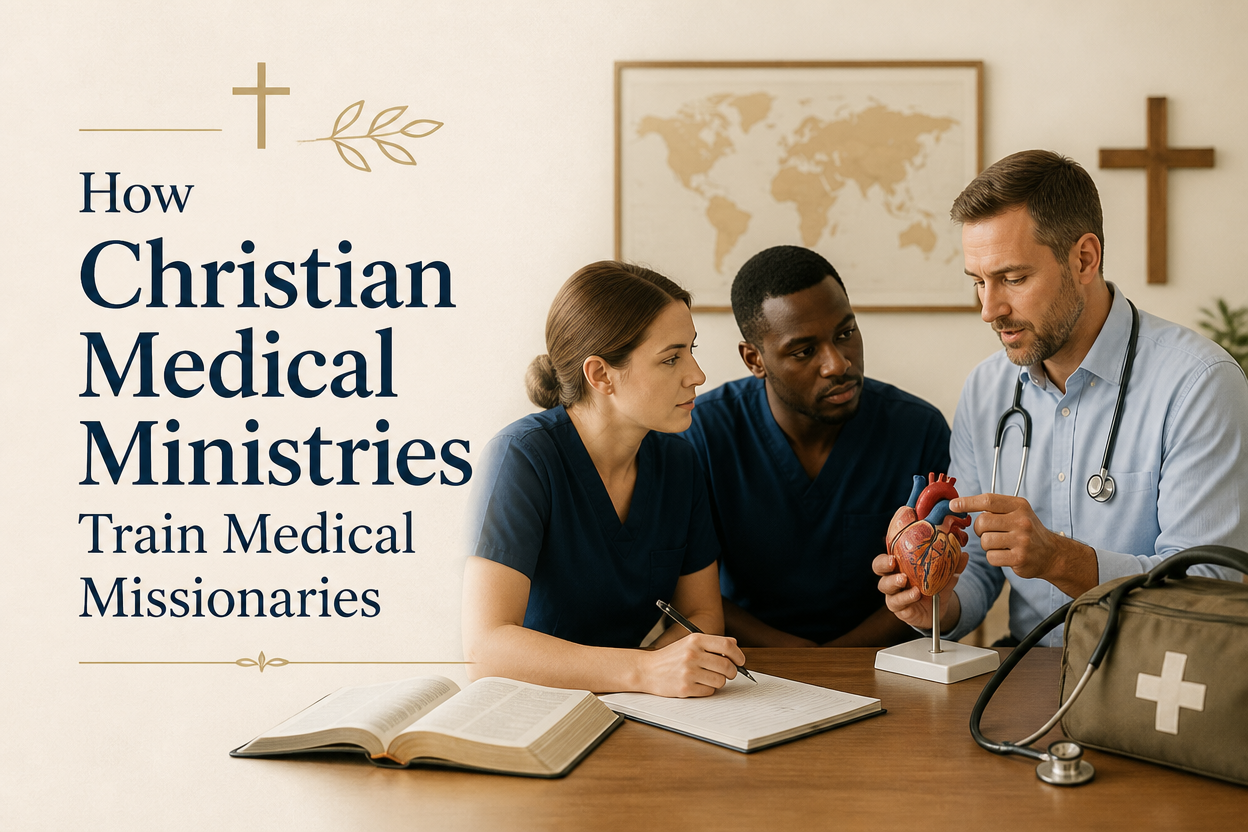
How Christian medical ministries train medical missionaries is not a secondary operational detail; it is one of the clearest predictors of whether donors are funding faithful witness and competent care, or funding avoidable harm. A ministry may carry the name of Christ, but if it sends clinicians into complex clinical and cultural settings without formation, accountability, and safeguards, the results can compromise both patient safety and gospel credibility.
Medical mission work sits at a demanding intersection: clinical standards, cross-cultural humility, spiritual formation, trauma awareness, and the long history of missions—both its graces and its failures. Mature donors sense this tension. We can hold Matthew 25’s summons to visit the sick together with James’s warning that teachers will be judged more strictly, and conclude that a ministry’s training is not bureaucracy; it is stewardship.
Training begins before the plane ticket with calling, competence, and ecclesial accountability
Effective medical missionary training starts with discernment. Christian medical ministries that endure tend to ask two questions before logistics: Is the candidate clinically prepared for the work they will do, and is the candidate spiritually and relationally formed enough to represent Christ under pressure? This is not gatekeeping for its own sake. It is a practical acknowledgement that the field is demanding, morally complex, and often isolated.
Clinical readiness is a matter of justice
Good intentions do not substitute for standards of care. A mature training pipeline verifies licensure, scope of practice, and current clinical competence, and it clarifies what will and will not be done on-site. Many ministries also use a “practice as you practice at home” ethic, with explicit prohibitions against improvising beyond training simply because oversight is limited.
Medical ethics training is part of this readiness. Issues such as informed consent, confidentiality, triage, and referral do not become simpler across borders; they become harder. Ministries that train well do not treat these as technicalities. They treat them as expressions of neighbor-love.
Calling is tested, not presumed
The local church remains the primary community of discernment. Strong ministries require pastoral references, a record of congregational involvement, and evidence of teachability. The goal is not to produce spiritual résumés; it is to ensure candidates are under shepherding and can receive correction. Christians genuinely disagree about the proper relationship between evangelism and humanitarian care, but most agree that credibility in word is linked to integrity in life.
Across our verification work at Most Trusted, we observe that ministries aligned with The Most Trusted Standard tend to document these readiness thresholds rather than rely on informal confidence. That documentation matters to donors because it demonstrates discipline that is costly to maintain and difficult to fabricate.

Formation includes theology of healing, suffering, and witness
Medical missionaries carry more than medical skills. They carry theological assumptions about the body, suffering, prayer, and the nature of Christian witness. When those assumptions are thin, patients can become projects, and clinical encounters can become coercive. Training that is worthy of donor confidence names these risks directly.
A biblically grounded theology of embodied care
Scripture does not treat physical need as a distraction from spiritual reality. The Gospels present Jesus healing as a sign of the Kingdom and as compassion for persons made in God’s image. Yet Scripture also refuses the fantasy that faithful ministry eliminates suffering in the present age. A sound training curriculum equips missionaries to pray with hope while practicing medicine with sobriety, resisting both cynicism and triumphalism.
Some ministries build this formation around a rule of life and supervised spiritual disciplines, particularly for longer-term workers. Others embed theological reflection into case debriefs, so that the moral weight of clinical decisions is brought under Scripture rather than left to private intuition.
Non-coercive witness in clinical settings
Patients are vulnerable by definition. Training should therefore address how to share faith without exploiting power imbalances. Many ministries adopt policies that distinguish between “availability” and “pressure”: staff may offer prayer, answer questions, and provide Scripture when welcomed, but they do not condition care on religious participation. Donors should not accept vague assurances here. They should look for written guidance, supervision, and complaint pathways that patients and local partners can actually use.
For donors seeking context on how these ministries fit into the broader ecosystem of care, we track patterns and risks across Christian Medical Ministries with attention to both theology and verifiable practice.
Cross-cultural preparation reduces harm and strengthens partnership
The most damaging mission failures often arise not from malice, but from unexamined assumptions—about time, authority, gender, trauma, and what “help” should look like. Training that protects the vulnerable treats cross-cultural formation as essential, not optional.

When Helping Hurts is a starting point, not a slogan
The “When Helping Hurts” framework, articulated by Steve Corbett and Brian Fikkert, has shaped a generation of Christian practitioners by clarifying how unwise aid can reinforce dependency and undermine local initiative. Many medical ministries use its core insights to challenge paternalism and to design care models that strengthen local systems rather than replace them.
The harder question is implementation. Medical trips can drift toward episodic care that leaves chronic conditions unmanaged, or toward “medical tourism” dynamics where foreign teams become the center of gravity. Strong training makes partnership non-negotiable: local clinicians set priorities, local institutions own follow-up, and external teams submit to local protocols where possible.
Language, culture, and trauma awareness
Training often includes language basics and interpreter best practices. It should also address trauma-informed care, particularly in settings shaped by conflict, displacement, or abuse. A patient’s refusal, silence, or anger may not be noncompliance; it may be trauma. Ministries that take this seriously train teams to avoid re-traumatization, especially in sensitive examinations and counseling contexts.
We recommend donors ask whether the ministry trains for cultural humility in measurable ways: pre-field coursework, scenario-based role plays, and post-trip debriefs that include local feedback. Good intentions without feedback loops rarely produce learning.
Clinical governance, safety protocols, and data discipline separate mature ministries from improvisation
Because medical work can harm as well as heal, medical mission training is incomplete without governance: who is accountable for clinical decisions, how adverse events are handled, and how patient data is protected. Donors should treat these as core moral questions, not administrative ones.
Supervision and scope boundaries
Training should specify clinical leadership roles: medical director authority, escalation pathways, and supervision expectations for trainees. Ministries should also train teams to document care appropriately, manage medications safely, and adhere to infection prevention standards. These elements are not uniformly regulated across countries, which increases the responsibility of the sending organization to define and enforce its own standards.
A practical donor test is whether the ministry can describe what it does when something goes wrong. Mature organizations rehearse incident reporting and establish mechanisms for learning, not blame-shifting.
Protecting the vulnerable includes safeguarding and compliance
Medical missionaries often serve children and other at-risk populations. Training should therefore include safeguarding policies, background checks when appropriate, boundaries, and mandatory reporting expectations. The evidence on child sexual abuse underscores why safeguards cannot be treated as implicit trust. The U.S. Department of Justice’s Office of Justice Programs has documented that most child sexual abuse is perpetrated by someone the child knows, not a stranger, which is precisely why ministries require structured prevention and reporting systems. U.S. Department of Justice Office of Justice Programs
Data discipline is also part of dignity. Training should clarify how patient information is recorded, stored, and shared, especially when teams use mobile devices or cloud platforms. Privacy expectations differ across jurisdictions, but Christian ethics of neighbor-love do not.
- Defined clinical leadership and supervision responsibilities
- Written scope-of-practice rules and prohibition of unsupervised improvisation
- Medication management and infection prevention procedures
- Safeguarding training for work with children and vulnerable adults
- Incident reporting and corrective-action processes
Donors can evaluate training quality with the same seriousness they apply to finances
Many donors have learned to ask about overhead, audits, and executive compensation. Those questions matter, but training quality often determines whether program spending accomplishes what donors intend. The donor’s stewardship obligation is not only to avoid fraud; it is to avoid funding practices that predictably harm patients or undermine local churches and health systems.
Evidence donors should request
Training is measurable. Donors can ask for curricula outlines, hours required, pass/fail expectations, and whether training is mandatory for every participant or only for “leadership.” They can ask how the ministry validates clinical credentials, how it selects local partners, and whether it has written guidelines for evangelism in clinical contexts.
They can also ask what changes were made as a result of adverse events or partner feedback. An organization with no examples of change is not necessarily flawless; it may be unteachable or unmeasured.
Verification and transparency as donor safeguards
At Most Trusted, we help donors give with confidence by evaluating Christian nonprofits against The Most Trusted Standard, a 15-criteria framework spanning faith foundation, financial integrity, governance and leadership, and transparency and effectiveness. When medical ministries meet that standard, they tend to treat training as a board-level risk area rather than a volunteer orientation. They document clinical governance, articulate safeguarding safeguards, and report outcomes in ways that can be checked.
Donors who want to compare how ministries operationalize care models can also review our coverage of How Christian Medical Ministries Deliver Care, where we track the practical realities behind published narratives.
FAQs for How Christian medical ministries train medical missionaries
What training elements most reliably predict safe and effective medical mission work?
The strongest predictors are mandatory pre-field training with clear competency expectations, defined clinical governance and supervision, written safeguarding policies, and a partnership model where local clinicians and institutions set priorities and own follow-up. Ministries that rely mainly on enthusiasm and informal mentoring are more likely to produce inconsistent care, even when the staff are sincere.
How should donors think about short-term medical trips versus long-term deployment?
Short-term teams can serve well when they are integrated into a local system with continuity of care, appropriate scope of practice, and partner-led planning. They can also create dependency and fragmented care when they operate as stand-alone events. The research literature on short-term medical missions is mixed on long-term health impact, which is why donors should ask for evidence of follow-up, local ownership, and outcomes beyond counts of patients seen. BMJ Global Health
A donor’s confidence should rest on formation and accountability, not sentiment
Christian compassion for the sick is not in question; it is explicitly named by Christ and practiced by the historic church. The question donors must answer is whether a given medical ministry trains its missionaries in a way that honors patients as image-bearers, protects the vulnerable, strengthens local partners, and bears witness without coercion. When training is deep, governed, and transparent, donors are not merely funding a trip. They are funding a disciplined form of mercy that is worthy of the name of Christ.



