

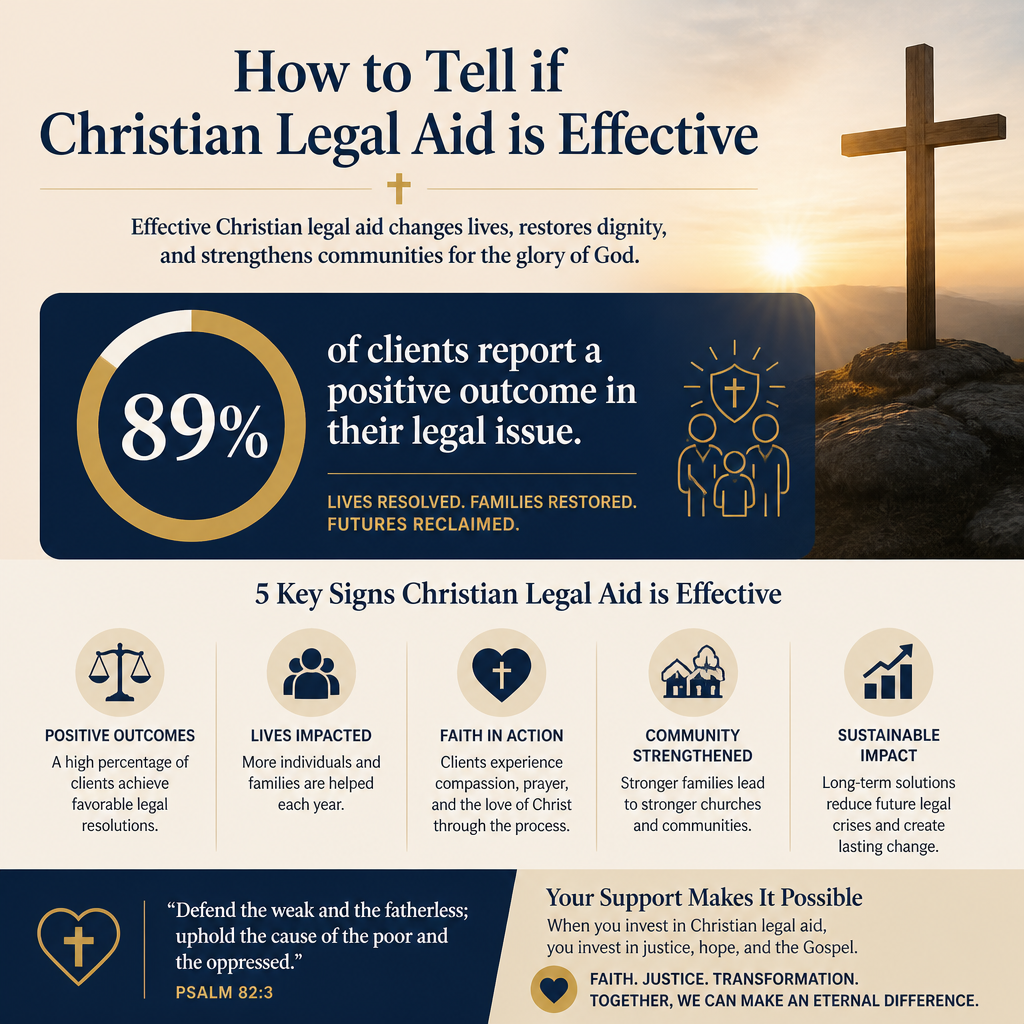
Knowing how to tell if Christian legal aid is effective requires more than counting cases closed or celebrating a few dramatic victories. Legal work sits at the intersection of mercy and justice, where outcomes can be slow, contested, and shaped by forces outside any ministry’s control. Yet Scripture does not allow Christians to treat justice as optional: God commands his people to “give justice to the weak and the fatherless” and to “maintain the right of the afflicted and the destitute” (Psalm 82:3, ESV). Donors therefore need standards rigorous enough to honor both the complexity of law and the moral urgency of loving our neighbors well.
Christian legal aid ministries operate in a field where impact is real but not always easily measured. A protective order can prevent violence; a stable immigration status can keep a family intact; a cleared criminal record can open the door to employment and housing. At the same time, a faithful attorney may lose a case because the law is narrow, the facts are disputed, or the resources are thin. Effectiveness is not perfection. It is faithful, competent service that produces verifiable benefits over time, under honest governance, and with integrity consistent with Christian witness.
Define effectiveness for legal aid before you evaluate it
Distinguish legal wins from neighbor love
Some donors instinctively treat effectiveness as “win rate.” That can be meaningful in certain practice areas, but it is often an inadequate proxy. A ministry can lose a hearing and still protect a client from exploitation through counsel, safety planning, referrals, or helping the client understand options. Conversely, a ministry can “win” a settlement yet leave a client confused, unsupported, or financially harmed. Christian legal aid is not only about being right; it is about serving rightly.
Scripture’s concern is not only that justice be done, but that it be done without partiality and without corruption. “You shall do no injustice in court” (Leviticus 19:15, ESV) sets a standard that includes process, truthfulness, and the ethical use of power. For donors, this means effectiveness should be evaluated as a blend of legal competence, client care, and principled conduct.
Ask what problem the ministry claims to solve
Legal aid can mean several different things: direct representation, brief advice clinics, mediation, legal education, policy work, or a combination. Each model has different time horizons and different metrics that make sense. A deportation defense clinic will measure differently than an expungement ministry, and both differ from a policy-oriented religious liberty organization.
Donors can press for clarity without demanding simplistic metrics. The essential question is whether the ministry can state, in concrete terms, who it serves, what legal services it provides, and what changed condition it aims to produce for clients or communities. Vague mission statements make it difficult to hold anyone accountable.

Look for verifiable outcomes that match the ministry’s theory of change
Seek outcomes that are observable and appropriately framed
Strong legal aid ministries track outputs (how many clients served) and outcomes (what changed for those clients). Outcomes should be stated in ways that are both measurable and honest about limitations. Examples include: protection orders obtained, benefits successfully appealed, lawful status secured, housing retained, guardianship established, or records expunged. When case outcomes cannot be shared due to confidentiality, a ministry can still report aggregated results and anonymized case categories.
Donors should also expect ministries to avoid inflated causal claims. A stable job after expungement may be a plausible downstream effect, but it is influenced by local labor markets, individual circumstances, and time. Effectiveness is strengthened when a ministry names these limits rather than speaking as if a single legal intervention fixes a life.
Attend to the justice gap the ministry is addressing
The demand for civil legal help far exceeds supply, especially for low-income Americans. The Legal Services Corporation’s Justice Gap research has repeatedly documented that a large share of low-income households experience civil legal problems and receive insufficient legal help in most cases, which is part of why triage and prioritization matter in legal aid work (Legal Services Corporation).
In practice, a ministry’s effectiveness is partly revealed by how it allocates scarce capacity: which cases it takes, which it refers, and how it sets priorities. A ministry that accepts every case without regard to competence, safety, or feasibility may appear busy while doing preventable harm. A ministry that turns people away should be able to explain why, and what alternatives it provides.
Evaluate competence, ethics, and spiritual integrity in the actual practice of law
Confirm legal quality and professional accountability
Law is a regulated profession for good reason. Donors should verify whether services are provided by licensed attorneys, supervised legal staff, or properly trained volunteers operating under the rules of professional responsibility. The ministry should have clear policies on confidentiality, conflicts of interest, client consent, and document retention. These are not bureaucratic preferences; they are protections for vulnerable people.
Effectiveness also shows up in case strategy and specialization. Legal aid is increasingly complex: immigration law, housing law, family law, and benefits appeals each have their own procedural demands. A ministry does not need to do everything, but it should know what it can do well, and it should have referral relationships for what it cannot.
Assess whether the ministry’s Christian witness is integrated, not performative
Christian legal aid is distinct not because it is less professional, but because it is more accountable. When ministries speak about serving “in Jesus’ name,” donors should look for evidence that the organization’s culture reflects gentleness, truthfulness, and respect for the image of God in every client. This includes the hard cases: clients who are difficult, frightened, angry, or morally complicated.
Christians genuinely disagree about how explicit spiritual care should be in legal settings. Some ministries offer prayer and pastoral referral when welcomed; others focus on exemplary service and partner with churches for discipleship and care. What is not negotiable is coercion. If a ministry provides legal help conditioned on religious participation, donors should scrutinize the ethics and the potential harm to witness.
For donors comparing ministries within Christian Legal Services Ministries, the most reliable signal is usually consistency: a clear statement of faith, leadership that understands both law and ministry, and a record of serving clients without favoritism or manipulation.
Test stewardship through finances, governance, and transparency
Reject simplistic overhead thinking and examine real stewardship
Legal aid can be staff-intensive. Attorneys, paralegals, case management systems, malpractice insurance, and secure data practices cost money. Donors should resist treating low administrative spend as a spiritual virtue. The nonprofit sector has broadly recognized the “overhead myth,” articulated in the joint letter signed by GuideStar, Charity Navigator, and the Better Business Bureau, which cautions donors against using overhead ratios as a primary measure of performance (Candid GuideStar).
Stewardship is better evaluated by questions such as: Are financial statements timely and audited when appropriate? Are restricted gifts honored? Is executive compensation defensible and disclosed? Are there clear internal controls? A ministry that handles client trust and legal risk must be especially disciplined in governance.
Look for board independence and meaningful oversight
Effective Christian legal aid is rarely a solo endeavor. Governance should not be a formality that exists to satisfy filing requirements. Donors should look for a board that meets regularly, includes members with financial and legal literacy, and can demonstrate oversight of strategy, risk, and mission fidelity. Where there are related-party transactions, insider leases, or opaque consulting arrangements, effectiveness is threatened because credibility is threatened.
Across our verification work at Most Trusted, ministries that consistently meet The Most Trusted Standard tend to provide donors with clear, accessible documentation: leadership bios, program descriptions, financial reporting, and plain explanations of how decisions are made. Transparency does not guarantee effectiveness, but the lack of it reliably undermines confidence.
Look for client-centered evidence and community trust, not only organizational self-reporting
Ask how the ministry listens to clients and measures quality
Legal outcomes matter, but so does how clients are treated while outcomes unfold. Strong ministries gather feedback through surveys, post-case interviews, or structured follow-up—carefully designed to protect confidentiality and avoid coercion. They track timeliness, clarity of communication, and whether clients understood their options.
- Clear intake standards and triage criteria, explained without defensiveness
- Written client rights, confidentiality practices, and complaint processes
- Aggregated outcome reporting by case type over time
- Professional supervision and continuing education for staff and volunteers
- Documented referral networks for legal and social services
Donors should also ask whether the ministry recognizes secondary trauma and ethical strain among staff. Legal aid regularly confronts domestic violence, family separation, and systemic poverty. A ministry that ignores staff formation and care may burn out its workforce, harming clients and undermining long-term effectiveness.
Evaluate relationships with courts, churches, and credible partners
Community trust is difficult to manufacture and hard to replace once lost. Legal aid ministries that are effective over time tend to have stable partnerships with local churches, social service agencies, and, where appropriate, court systems and bar associations. These relationships often reveal whether the ministry is known for competence and integrity rather than conflict and self-promotion.
Donors can also learn from how a ministry handles public communication. Confidentiality will limit detail, but tone still matters. Ministries should not exploit clients’ stories. They should speak about vulnerable people with dignity, avoid sensationalism, and show restraint in claims about their own heroism.
FAQs for How to tell if Christian legal aid is effective
Should donors prioritize ministries with the highest win rates?
Win rates can be informative in narrow contexts, but they are easily distorted by case selection and by the realities of certain legal fields. A ministry can “protect” its win rate by taking only straightforward matters, while another takes harder cases because the need is greater. Donors should prefer ministries that report outcomes by case type, explain their intake priorities, and demonstrate professional competence and ethical consistency.
What documents should a trustworthy Christian legal aid ministry provide donors?
At minimum, donors should expect a clear description of services, leadership and governance information, and recent financial reporting. Where feasible, ministries should also provide audited financial statements or an explanation of why an audit is not yet appropriate, aggregated outcome reporting, and policies that show how confidentiality, conflicts of interest, and client consent are handled. For donors assessing options within How to Give Wisely to Christian Legal Services, documentation that can be independently checked is usually more valuable than persuasive storytelling.
A disciplined way to give with confidence
Christian legal aid is effective when it delivers competent legal service, protects the vulnerable, and honors Christ through truthful, careful practice. Donors do not need to demand impossible certainty, but we should demand integrity: measurable outcomes where possible, honest limits where necessary, and governance strong enough to sustain the work over decades. That is the kind of justice Scripture commends, and the kind of stewardship Christian donors can support with confidence.



