
Comparing transparency across Christian legal services is not a secondary exercise in donor diligence; it is a test of whether a ministry’s public claims can bear the weight of Christian stewardship. These ministries often operate under genuine constraints—client confidentiality, active litigation, security risk, and the fragility of families in crisis. Yet Scripture’s insistence on honesty in weights and measures applies to ministries as surely as it does to merchants (Prov. 11:1). Christian donors are not asking for spectacle. We are asking for truth we can verify.
Transparency in legal aid and legal advocacy is also complicated by vocation. Christian attorneys and advocates are bound by professional ethics and, often, by court-imposed restrictions. A faithful ministry will not disclose what it cannot. But a faithful ministry can still disclose what it should: governance, financial stewardship, decision-making, program boundaries, and evidence that outcomes are pursued with integrity rather than marketed with exaggeration.
1. Start with definitions that match the ministry’s calling
Legal aid and legal advocacy require different transparency standards
“Christian legal services” can describe materially different work. Some ministries provide direct legal aid: immigration representation, family law assistance, expungements, housing defense, or help with protective orders. Others operate primarily in policy and litigation: appellate advocacy, religious liberty defense, or legislative engagement. Donors often confuse these categories and then apply the wrong questions.
For direct legal aid, transparency should prioritize who is served, what kinds of matters are accepted, what is declined, and what safeguards protect vulnerable clients. For advocacy and impact litigation, transparency should prioritize governance and strategy boundaries: who sets priorities, what theological commitments guide case selection, and how victories and losses are communicated without triumphalism or omission.
Confidentiality is not an excuse for opacity
Client privacy is real. A ministry that handles asylum or domestic violence cases may be endangering people by sharing too much. But confidentiality does not prevent a ministry from publishing clear program descriptions, an honest accounting of expenditures, or a principled explanation of how cases are selected. Mature transparency names what cannot be disclosed and then provides alternative evidence that is genuinely informative.
Across our verification work at Most Trusted, the ministries that meet The Most Trusted Standard tend to separate “client-protected details” from “donor-relevant oversight.” They do not treat confidentiality as a blanket justification for withholding ordinary governance and financial disclosures.

2. Evaluate financial transparency with disciplined expectations
Insist on primary documents, not summaries
A ministry’s financial transparency begins with documents that can be independently reviewed. For many U.S. nonprofits, that means providing the Form 990 (or an equivalent for churches and certain religious organizations that are not required to file) and audited financial statements when size and complexity warrant. Summaries, graphics, and “impact pages” can be helpful, but they are not a substitute for primary records.
When a Christian legal ministry is structured as a church or an integrated auxiliary and does not file a Form 990, donors should not treat this as automatically disqualifying. The question becomes whether the ministry provides an alternative level of credible disclosure: independently reviewed financial statements, a conflict-of-interest policy, board accountability, and clear reporting on the use of restricted gifts.
Do not reduce stewardship to a single ratio
Donors still ask about “overhead,” and the question is understandable. But the nonprofit sector has had to reckon with how simplistic overhead thinking can distort incentives. Charity Navigator, Candid, and the BBB Wise Giving Alliance jointly warned that focusing primarily on overhead can do “more damage than good,” because it pressures organizations to underinvest in essential infrastructure and measurement Charity Navigator.
Christian legal services can be unusually staff-intensive. Experienced attorneys, accredited representatives, and case managers are costly, and they should be. What matters is whether costs are governed well and explained clearly: salaries set through independent oversight, budget categories that are intelligible, and fundraising that is truthful about what a gift actually supports.
Donors can use a simple discipline when comparing ministries: ask whether the ministry’s reporting allows a reasonably informed outsider to understand how money is raised, how it is held, and how it is spent—without relying on marketing language.
3. Compare governance transparency where the real risks concentrate
Board independence and conflict-of-interest discipline
Legal ministries face particular governance risks because of reputational gravity: high-profile cases, politically charged narratives, and the temptation to personalize the mission around a few prominent figures. Transparency here is not performative; it is protective. Donors should look for an identifiable board, clarity on how board members are selected, and evidence of independence from paid leadership.
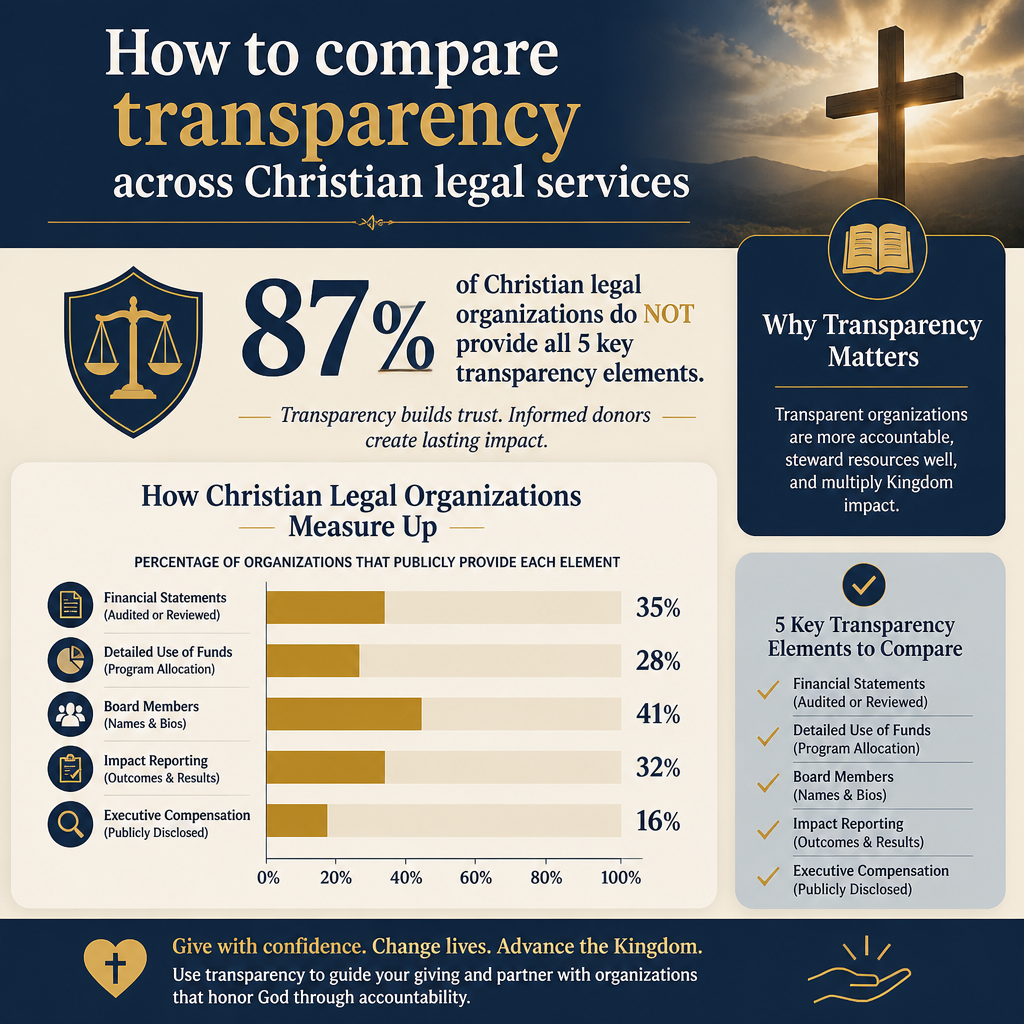
At a minimum, transparent governance includes publicly available leadership information, conflict-of-interest disclosures or policies, and a clear separation between board oversight and staff execution. Where a ministry is closely tied to a law firm, a denomination, or a network of affiliated entities, donors should be able to see how related-party transactions are handled and reviewed.
Accountability when controversy comes
Christian legal services often attract scrutiny. When controversy arises—whether over strategy, public statements, or client outcomes—opaque ministries tend to respond with deflection or spiritualized dismissal. Transparent ministries respond with concrete accountability: clarifying what happened, what policies governed the decision, what was learned, and what is changing. There is a difference between refusing to litigate a dispute in public and refusing to answer substantive questions at all.
Christians genuinely disagree about certain legal strategies and public posture. Donors should not demand uniformity. But donors should demand honesty about who holds authority, how decisions are made, and what constraints shape the ministry’s work.
4. Ask for effectiveness evidence that fits legal work
Outputs, outcomes, and what is actually controllable
Legal work is difficult to measure without flattening it. A single case can consume months; a policy win can affect thousands; a loss can still protect precedent or expose injustice. Transparent ministries avoid both extremes: they do not promise results they cannot control, and they do not hide behind complexity to avoid evaluation.
Donors can ask for an outcomes framework appropriate to the ministry’s category. For direct legal aid, that might include case resolution types, time-to-service benchmarks, client satisfaction processes, and referral pathways for needs beyond the legal scope. For litigation and policy work, it might include the nature of legal interventions, coalition participation, public education work, and an honest record of wins, losses, and partial outcomes.
Clarity about the ministry’s theology of justice and mercy
Transparency is also theological. A Christian legal ministry should be able to articulate how its work relates to biblical categories such as justice, mercy, and truth-telling. Scripture does not permit the people of God to manipulate facts for a righteous cause. “Therefore, having put away falsehood, let each one of you speak the truth with his neighbor” (Eph. 4:25). Donors should listen for language that honors truth even when it complicates fundraising.
For donors comparing options within Christian Legal Services Ministries, the strongest signal is often not a polished impact story but a disciplined explanation of scope: what the ministry does, what it will not do, and why those boundaries serve clients and honor Christ.
5. Use a consistent comparison checklist across ministries
What to request before giving at meaningful levels
Transparency comparisons become manageable when donors standardize what they ask. A ministry does not need to publish everything. It does need to answer reasonable questions without evasiveness, especially when it solicits significant gifts.
- Clear organizational structure: legal entity type, affiliations, and any related organizations that share staff, brand, or funding
- Board disclosure: board member list, independence indicators, and governance policies that address conflicts of interest
- Financial documentation: Form 990 when applicable, audited statements when appropriate, and an intelligible annual report
- Program scope and boundaries: case types served, eligibility criteria, and what is referred elsewhere
- Outcome reporting: credible metrics suited to legal work, with limits and attribution stated plainly
Where Most Trusted’s verification work fits
Many donors do not have the time to run due diligence at this level across multiple ministries. Most Trusted exists to meet that need as an independent verification service for Christian nonprofits. Our evaluations apply The Most Trusted Standard, a 15-criteria framework covering Faith Foundation, Financial Integrity, Governance and Leadership, and Transparency and Effectiveness. The aim is not to replace discernment, but to ground it in evidence that can be checked.
Donors comparing transparency across this space often benefit from placing each ministry’s disclosures side-by-side and asking a simple question: does this organization behave as though it expects to be examined? The ministries worth long-term partnership typically do.
For additional donor decision-making in this area, many readers begin with How to Give Wisely to Christian Legal Services, especially when sorting ministries by model, risk profile, and reporting credibility.
FAQs for How to compare transparency across Christian legal services
Is it reasonable to expect detailed impact reporting from a ministry that must protect client confidentiality?
Yes, if “detailed” means substantively informative rather than personally identifiable. A ministry can protect clients while still publishing case category counts, general outcomes, service timelines, and descriptions of safeguards. When confidentiality is cited, donors should ask what alternative evidence of oversight and effectiveness is being provided in its place.
Should donors avoid Christian legal ministries that do not file a Form 990?
Not automatically. Some religious entities are not required to file. The question is whether the ministry provides comparable transparency through other means: independently reviewed financial statements, clear governance disclosures, and credible reporting on how funds are received and spent. Absence of a Form 990 should increase diligence, not necessarily end it.
A donor’s goal is confidence grounded in truth
Christian legal services can be a high-mercy, high-stakes form of ministry. They also sit near pressures that tempt organizations toward secrecy, overstatement, or personality-driven governance. Comparing transparency across ministries is one of the most practical ways donors can honor both prudence and love: prudence that tests claims, and love that insists on integrity for the sake of those being served. The ministries most worthy of partnership typically welcome that scrutiny because they understand it as part of faithful stewardship before God.



