

How donors fund family law services through Christian legal aid is ultimately a question of whether the church will underwrite justice for families who cannot purchase it. Family courts are where custody, protection orders, child support, adoption, and marital dissolution are decided, often in days that feel like a lifetime. For many low-income families, the difference between stability and chaos can turn on whether someone competent stands beside them.
Scripture does not treat such moments as marginal. God’s people are commanded to “seek justice” and “bring justice to the fatherless” (Isaiah 1:17). The mandate is not abstract. It touches paperwork, hearings, safety planning, and the slow work of restoring order after betrayal, violence, or abandonment. Christian legal aid in family law is one of the places where mercy and prudence meet.
Family courts are not spiritually neutral spaces
Family law concentrates vulnerability
Family law is where the vulnerable frequently arrive without advocates. In the United States, there is no general right to counsel in civil cases, even when basic needs are at stake. The Legal Services Corporation reports that low-income Americans receive “inadequate or no legal help for 92% of their substantial civil legal problems.” Legal Services Corporation
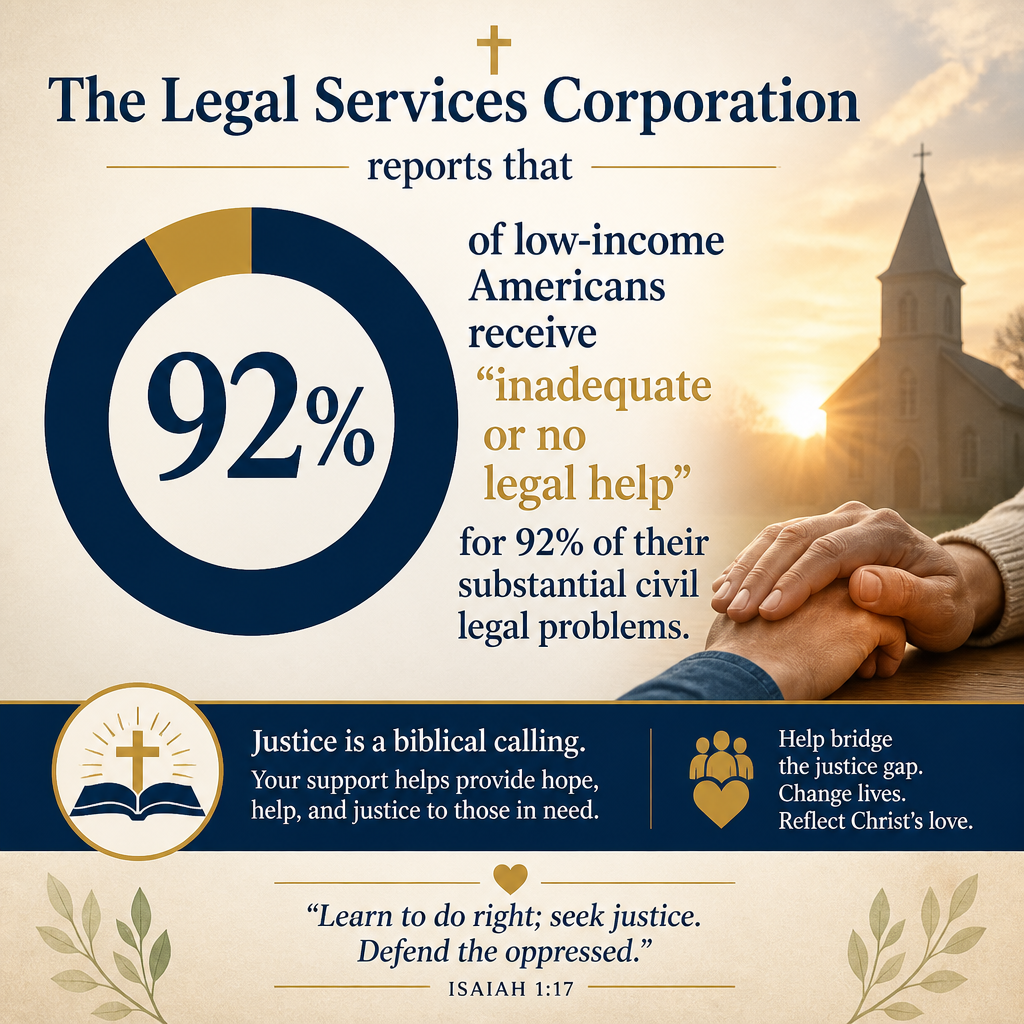
That gap is not merely a technical deficit. It means parents navigating custody without understanding evidentiary standards. It means survivors seeking protection orders without knowing what documentation matters. It means children’s futures shaped by whoever can pay for representation. Christian donors do not need to imagine a distant system; many congregations already carry these burdens in prayer requests, emergency housing, and pastoral counseling. Family courts are where those burdens become legally fixed.
Christian legal aid serves both mercy and order
Christians can disagree about the best policy frameworks for family law. Some emphasize no-fault divorce reform; others emphasize access to protective orders; still others focus on adoption processes or child support enforcement. What is less disputable is that families in crisis need both compassion and competent navigation of a complex system. Legal aid that is explicitly Christian brings not only technical skill but a pastoral understanding of repentance, reconciliation, and safety—without confusing forgiveness with the suspension of accountability.
Within Christian Legal Services for Family and Life Issues, the strongest ministries treat family law as a discipleship-adjacent work: not because court is church, but because decisions made there can either restrain evil or expose families to it. Donor funding makes that stabilizing work possible at scale.

What donor dollars actually pay for in family law legal aid
Representation is costly because diligence is costly
Donors sometimes assume “legal aid” means a few brief consultations. In family law, responsible help usually requires more: conflict screening, intake, document collection, pleadings, negotiation, hearings, and follow-through with orders. A protection order case may involve safety planning and coordination with shelters. A custody case may require careful attention to schooling, medical records, and parenting plans. A contested divorce often involves assets, debt, and ongoing support obligations.
When donors fund Christian legal aid, they typically underwrite staff attorneys, accredited representatives where applicable, paralegals, and victim advocates; they also underwrite malpractice coverage, case management systems, translation services, and secure data practices. Good work is not glamorous, but it is measurable: filings made on time, orders obtained, agreements properly structured, and families less exposed to predatory dynamics.
Brief advice and full-scope services both matter
Not every case requires court representation. Some families need a well-crafted letter, a document review, or a clear explanation of options before they sign something that will bind them for years. Other cases require sustained advocacy because the opposing party has counsel, the facts are contested, or safety is at risk. Donors can fruitfully support a portfolio approach in which ministries offer both limited-scope services and full representation, triaging cases by urgency and potential impact.
Because needs always exceed capacity, Christian legal aid ministries also invest in referral networks and training. That may include equipping pastors and lay leaders to recognize when a situation requires legal intervention, especially in domestic abuse contexts where pastoral instincts toward reconciliation can unintentionally place someone in danger.
- Direct casework for protection orders, custody, divorce, and child support matters
- Clinic-based legal advice that prevents avoidable harm before it reaches court
- Language access so non-English speakers can meaningfully participate in proceedings
- Trauma-informed advocacy aligned with safety and legal realities
- Referral partnerships with shelters, counseling centers, and pro bono attorneys
Why family law legal aid is a donor opportunity with moral clarity
Justice for the vulnerable is a biblical test
Family law touches the biblical categories Scripture repeatedly names: the protection of children, the restraint of violence, and the defense of those who cannot defend themselves. Proverbs warns against partiality in judgment and commands God’s people to “give justice to the weak and the fatherless” (Psalm 82:3). Christian donors often support crisis pregnancy care, adoption, and foster care; family law legal aid is adjacent to those commitments because it addresses the legal conditions in which families either fracture or heal.
This is also a setting where Christian witness must be disciplined. The goal is not to “win” at any cost. The goal is to seek truthful outcomes, pursue lawful protection, and honor the dignity of all parties—including opponents—without surrendering the responsibility to confront wrongdoing.
It is less expensive to prevent collapse than to fund consequences
The field has had to reckon with a practical question: should donors fund direct legal intervention when there are also needs for counseling, housing, and food? The answer is not either-or. Yet legal clarity can prevent spiraling costs and harms. When child support orders are correctly entered, when custody arrangements are stabilized, or when protective orders are in place, other services become more effective. It is a form of structural mercy.
Research on civil legal aid commonly finds downstream economic effects such as reduced homelessness and improved safety outcomes, though results vary by jurisdiction and program design. The core donor case does not need inflated claims. The moral claim is sufficient: access to justice should not be rationed strictly by ability to pay, especially when children’s welfare and personal safety are at stake.
How Christian donors can evaluate family law legal aid ministries wisely
Capacity and compassion must be matched by governance
Family law legal aid invites both gratitude and scrutiny. It involves confidential data, high-emotion conflicts, and the risk of mission drift toward either activism without pastoral theology or pastoral sentiment without legal competence. Donors should expect mature ministries to have written policies for client eligibility, conflict of interest screening, confidentiality, and referral when a case exceeds competence or capacity.
At Most Trusted, our work is not to tell donors what to feel; it is to help donors give with confidence. Ministries that meet The Most Trusted Standard tend to show clear doctrinal commitments, credible financial reporting, independent board oversight, and transparent explanations of what outcomes they do and do not claim. Those marks matter in legal aid because the stakes are high and the opportunities for confusion are many.
Ask for evidence that is appropriate to family law
Family law outcomes are not always reducible to simple counts. A ministry may lose a case on the merits and still provide life-preserving counsel that prevents a survivor from returning to danger. A settlement may be more just than a trial victory. Donors should look for reporting that respects these realities while still providing verification-grade clarity.
Concrete indicators can include: number of clients served by case type; waitlist size; average time from intake to first legal action; safety protocols for abuse cases; pro bono attorney engagement; and audited financial statements. For comparative context, the American Bar Association has described the “justice gap” as persistent and significant, reinforcing that triage and prioritization are not signs of indifference but of limited supply meeting overwhelming demand. American Bar Association
Funding models that sustain the work without distorting it
General support protects integrity
Restricted gifts can be appropriate, particularly for discrete clinic days, translation capacity, or technology upgrades. But in family law legal aid, general operating support is often the most faithful form of funding because it allows leadership to allocate resources where urgency is greatest. A week with an influx of protection order filings should not become a budget crisis because funds were locked to a different program line.
Donors should also be aware that certain funding streams—government contracts, court-related grants, or local partnerships—can carry compliance requirements that shape reporting and sometimes messaging. Some Christian ministries navigate these arrangements carefully; others avoid them to protect theological clarity. Christians genuinely disagree about the best approach. What matters is that the ministry is transparent about constraints and candid about how it preserves its Christian identity.
Pro bono partnerships extend reach but do not eliminate cost
Many Christian legal aid organizations rely on volunteer attorneys. This can be an excellent model, especially when the ministry provides strong training, supervision, and case support. Yet pro bono does not mean “free.” Coordinating volunteers, maintaining quality control, and ensuring ethical compliance requires paid staff and durable systems. Donor funding is what turns goodwill into dependable capacity.
For donors who want a broader view of the ecosystem, Christian Legal Services Ministries includes organizations that differ in structure—some are church-embedded clinics, some are independent nonprofits, and some are networks that place cases with attorneys. Funding decisions should align with the donor’s convictions and the ministry’s demonstrated ability to carry the load responsibly.
FAQs for How donors fund family law services through Christian legal aid
Should donors fund legal representation for divorce cases, or only for abuse and child protection?
Many donors prioritize abuse-related cases because the safety stakes are immediate. That instinct is understandable and often wise. Yet divorce and custody proceedings frequently intersect with economic coercion, housing instability, and long-term access to children. A responsible Christian legal aid ministry will triage, prioritizing safety and children’s welfare while also recognizing that fair orders in “ordinary” cases can prevent ongoing harm. Donors can ask how the ministry screens for abuse, how it handles reconciliation counseling referrals, and how it avoids enabling wrongdoing under the banner of “peace.”
What is a credible way to measure impact in family law legal aid?
Credible reporting blends quantitative and qualitative evidence without exaggeration. Quantitative measures include clients served by case type, orders obtained, and resolution timelines. Qualitative measures include documented safety planning practices, client satisfaction processes that protect confidentiality, and examples of systemic barriers addressed through partnerships. Donors should be cautious of ministries that promise guaranteed legal outcomes; ethical representation cannot pledge results. The more trustworthy ministries explain their theory of service clearly and publish financial and governance information that can be verified.
Stewardship that strengthens families under pressure
Christian donors often ask where a gift can meaningfully protect families when cultural pressures and personal sin both take their toll. Funding Christian legal aid in family law is one concrete answer: it places competent help where fear and confusion are most concentrated. The church cannot replace the courts, but it can ensure that the vulnerable are not alone in them, and that justice is pursued with truth, restraint, and mercy.



