
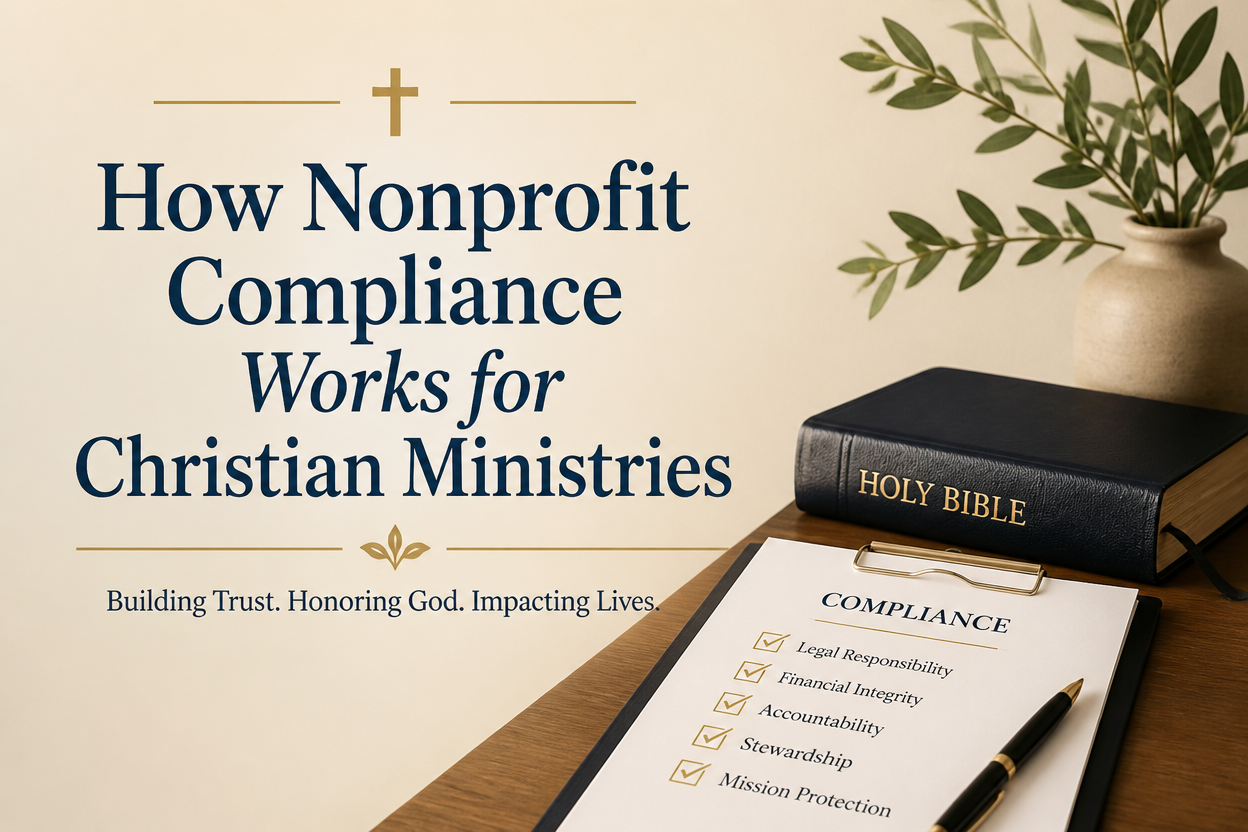
How nonprofit compliance works for Christian ministries is not a side concern for lawyers and accountants; it is part of moral stewardship. Donors are not only funding programs. They are entrusting resources dedicated to God’s purposes, and Scripture treats such trust with seriousness: “Moreover, it is required of stewards that they be found faithful” (1 Corinthians 4:2). Compliance is one of the ordinary, testable ways faithfulness is expressed in public life.
Christian donors also sense the tension. Many ministries operate under spiritual urgency and limited staff, often across borders and regulatory regimes. Yet urgency never cancels accountability. Wise donors learn to distinguish between administrative burden that distracts from mission and governance discipline that protects mission from avoidable scandal, waste, and drift.
Compliance is stewardship under law and before God
Why ministries cannot treat compliance as merely secular
Nonprofit compliance is often described as “keeping the IRS happy.” That framing is too small. For Christian ministries, compliance is one expression of living “above reproach” in a watching world (1 Timothy 3:2). When a ministry handles donations properly, files truthful reports, honors employment law, and follows restrictions on charitable assets, it is practicing institutional integrity.
The New Testament does not reduce integrity to private sincerity. Paul took pains to avoid even the appearance of mishandling funds: “We want to avoid any criticism of the way we administer this liberal gift” (2 Corinthians 8:20). The point is not bureaucracy for its own sake. The point is credible witness, protection of the vulnerable, and confidence that gifts are governed with care.
What compliance is and what it is not
Compliance is the set of legal and fiduciary obligations that come with being a charitable organization: how money is received, recorded, restricted, and spent; how decisions are made and documented; how conflicts are disclosed and managed; how fundraising is represented to the public; and how required reports are filed with civil authorities.
Compliance is not a substitute for spiritual maturity. A ministry can be compliant and still unwise or ineffective. But noncompliance is rarely neutral; it tends to compound into governance failures that eventually touch finances, credibility, and mission.

The core compliance obligations most Christian ministries face
Federal tax and charitable status responsibilities
Most US-based Christian ministries operate as 501(c)(3) public charities or as church-related entities with different filing norms. For many organizations, the annual IRS Form 990 functions as a public accountability document: it reports revenue sources, program spending, governance practices, and key compensation. Failure to file for three consecutive years results in automatic revocation of exempt status, which can be catastrophic for donor confidence and operations. The IRS states this rule plainly in its guidance on automatic revocation for non-filing organizations: IRS.
Churches and some church-affiliated ministries can be exempt from filing Form 990, but that exemption should not be confused with exemption from accountability. Sophisticated donors often ask for voluntary transparency when a filing is not required, because the underlying stewardship questions do not disappear.
State registration, fundraising compliance, and reporting
Many states regulate charitable solicitation, requiring registration before fundraising and periodic renewals. A ministry that solicits across multiple states—especially online—may have obligations in more jurisdictions than leaders assume. The regulatory map is uneven, and compliance can be burdensome. Yet the donor’s concern is straightforward: is this ministry authorized to solicit, and does it tell the truth about what gifts will accomplish?
For donors, a practical signal is whether the ministry can clearly identify where it is registered, how it handles restricted gifts, and whether it provides timely, accurate receipts and acknowledgments.
Employment, safeguarding, and operational compliance
Compliance also includes employment law, proper classification of workers, payroll tax discipline, and—where relevant—mandatory reporting and safeguarding protocols. For ministries serving children, survivors of trauma, or other vulnerable populations, safeguarding is not a “best practice” add-on. It is a moral obligation, and often a legal one, with serious consequences for failure.
When donors evaluate a ministry’s trustworthiness, these operational disciplines matter because they reveal whether leaders are willing to submit the organization to hard constraints for the sake of others’ good.
Where Christian ministries most often stumble
Restricted gifts, designated giving, and donor intent
One recurring compliance and integrity risk is confusion around restricted gifts. Donors frequently give for a specific purpose—“Bible translation in this language,” “scholarships for this school,” “disaster relief for this region.” When a ministry accepts a restricted gift, it has an obligation to use it as designated or seek appropriate permission to redirect it. Treating restrictions casually can become both an accounting problem and a discipleship problem, because it trains the organization to blur lines it has promised to honor.
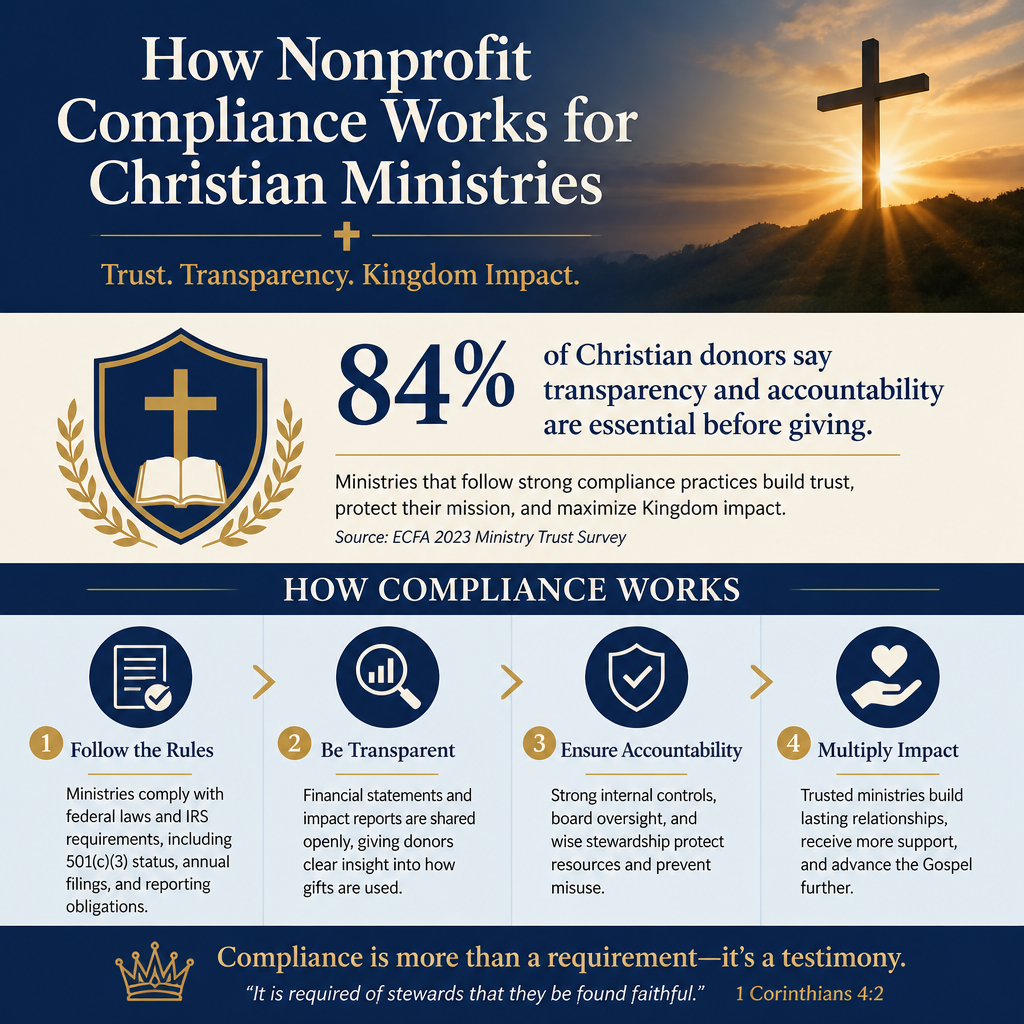
What this means in practice is that reliable ministries maintain systems that track restrictions, document approvals, and report back in concrete terms. Donors should expect clarity, not marketing fog.
Conflicts of interest and family-run governance
Christian ministry often grows out of calling, relationships, and trust built over years. That is a strength, but it creates predictable governance pressures: boards composed primarily of friends, family members employed by the ministry, and decision-making that is undocumented because it is relationally understood.
Conflicts of interest are not automatically sinful; they are often unavoidable in close communities. The issue is whether they are disclosed and managed. Mature governance practices include written conflict-of-interest policies, recusal where needed, and documentation that shows decisions were made for the mission rather than for insiders.
Fundraising claims and the temptation to over-promise
Donors are rightly moved by urgent needs, and ministries are tempted to compress complex outcomes into simple promises. But charitable solicitation is not exempt from truthfulness. Overstating impact, implying guarantees, or using images and stories without proper permission can become both a compliance hazard and a credibility failure.
The harder question is not whether a ministry is passionate. The harder question is whether it is truthful under pressure.
What mature compliance looks like in ministries that deserve confidence
Disciplined governance that serves mission
Across our verification work at Most Trusted, we observe that the ministries most worthy of sustained donor confidence treat compliance as a governance discipline rather than a last-minute administrative scramble. They schedule filings, maintain clean records, and ensure the board understands its fiduciary duties. They can explain, without evasiveness, how oversight works and what happens when problems are discovered.
Governance maturity also shows up in the willingness to invite scrutiny: independent audits or reviews where appropriate, board minutes that reflect real oversight, and clear boundaries around executive authority.
Financial integrity with transparent constraints
Donors sometimes assume “low overhead” is the same as integrity. The field has had to reckon with the damage caused by that assumption. In 2013, leading evaluators warned against judging charities primarily by overhead ratios in the “Overhead Myth” open letter, emphasizing that administrative and fundraising expenses can be necessary for effectiveness and accountability: Charity Navigator.
For Christian donors, the more relevant question is whether spending patterns align with truthful strategy and whether controls reduce the risk of misuse. A ministry can spend modestly on administration and still lack basic safeguards. Another can invest appropriately in finance and compliance and thereby protect the mission.
Transparent reporting that treats donors as partners in stewardship
Transparency is not merely posting a few numbers on a website. It is a posture of truthful communication. Ministries that earn confidence tend to publish accessible financial statements, explain major categories of expense, describe program outcomes with appropriate humility, and acknowledge limitations. When things go wrong, they correct publicly rather than quietly.
Donors looking for a broader view of how legal accountability intersects with ministry operations will find useful context within Christian Legal Services for Churches and Ministries, where compliance is treated as part of a wider ecosystem of governance and risk.
How donors can evaluate compliance without becoming compliance officers
Questions that reveal whether a ministry is governed with care
Donors are not responsible to run an audit. But donors can ask for signals that a ministry takes compliance seriously. A small set of questions often clarifies more than a stack of glossy materials:
- Are required filings current, and can the ministry provide them without defensiveness?
- Does the board include independent members who are not paid staff or close family?
- How are restricted gifts tracked, and how does the ministry handle changes in program realities?
- What financial controls exist for approvals, reimbursements, and separation of duties?
- What safeguarding policies and reporting protocols exist for vulnerable populations?
These questions are not cynicism. They are the ordinary due diligence of Christian stewardship.
How independent verification can serve donor confidence
Many donors want to give generously without living in suspicion. That is a reasonable desire. Independent verification can help donors avoid both naïveté and paralysis by focusing attention on evidence. Most Trusted evaluates ministries against The Most Trusted Standard, a 15-criteria framework across Faith Foundation, Financial Integrity, Governance and Leadership, and Transparency and Effectiveness. The goal is not to replace discernment, but to support it with verifiable signals.
For donors seeking a wider lens on this ministry category, Christian Legal Services Ministries provides additional context for how legal accountability and Christian mission frequently meet in real organizational decisions.
FAQs for How nonprofit compliance works for Christian ministries
Is nonprofit compliance mainly about filing forms, or does it affect ministry outcomes?
Compliance includes filings, but it reaches further: governance discipline, financial controls, safeguarding, and truthful fundraising practices. These are not peripheral. They shape whether a ministry can sustain its work over time without preventable crises, and they shape whether donors can trust that gifts are used as promised.
What should donors do if a ministry is spiritually compelling but has weak compliance practices?
Weak compliance is not always malice; it is often immaturity, rapid growth, or underinvestment in administration. Donors can ask direct questions, request documentation, and look for evidence of correction. If leaders minimize concerns, resist oversight, or repeatedly fail basic obligations, the prudent course is to redirect giving toward ministries that demonstrate both spiritual seriousness and operational faithfulness.
Compliance is one of the ordinary places faithfulness is tested
Christian donors give because the gospel is true and the needs are real. That is not sentiment; it is conviction. But conviction does not negate the ordinary disciplines that protect a ministry’s witness. Nonprofit compliance is one of those disciplines—quiet, often costly, and deeply connected to the biblical requirement that stewards be found faithful.



