
How Christian legal services handle employment disputes matters because churches and ministries are both spiritual communities and employers with real authority over people’s livelihoods. Employment conflict is rarely only about policy; it is often entangled with conscience, doctrine, pastoral care, and civil law. Donors who care about the Church’s witness should care about how ministries respond when an employee alleges discrimination, retaliation, wrongful termination, wage violations, or harassment.
At their best, Christian legal services bring a distinctly Christian moral seriousness to a setting that can quickly become adversarial. They resist the false choice between “protect the ministry at all costs” and “capitulate to every claim.” They aim for truth-telling, lawful process, and neighbor-love under pressure, remembering that “a good name is to be chosen rather than great riches” (Proverbs 22:1). In practice, that means early fact-finding, careful governance, and a willingness to correct wrong without theatrics.
Employment disputes are governance crises, not merely HR problems
Employment law is one of the most common ways a ministry’s internal culture becomes visible to outsiders. A single dispute can trigger regulatory scrutiny, loss of donor confidence, and congregational fracture. Christian legal services typically begin by reframing the matter: this is not only an HR file; it is a governance test of how authority is exercised and restrained.
For donors, this frame is not abstract. A ministry’s ability to sustain mission over decades depends on whether its leaders can respond to conflict without denial, scapegoating, or fear-driven secrecy. Across our verification work at Most Trusted, we observe that ministries with mature governance structures do not wait for litigation to clarify decision rights, documentation norms, and escalation pathways. They build those habits before the crisis.
Common dispute patterns Christian counsel sees
Most employment disputes are not novel in legal theory, but they are complex in ministry settings. Faith-based organizations may have doctrinal expectations for certain roles, volunteer-to-staff transitions that blur boundaries, and pastoral relationships that complicate supervision. Christian legal services routinely encounter:
- Disputes following performance management that was verbally handled but poorly documented
- Harassment or hostile work environment allegations, sometimes involving spiritual authority misuse
- Classification and wage-and-hour issues for employees treated like “ministry” rather than labor
- Retaliation claims after an employee reports concerns internally
- Conflicts around religious standards, social media conduct, or moral clauses in employment agreements
The legal categories are familiar; the pastoral and reputational dimensions are not. When Christian legal services are effective, they help ministries name both dimensions without collapsing one into the other.
The ministry exception is real, but it is not a blanket immunity
U.S. law recognizes that religious organizations have constitutional protections in selecting certain leaders and teachers of the faith. The “ministerial exception” has been affirmed by the Supreme Court in cases such as Hosanna-Tabor and Our Lady of Guadalupe, but its application depends on role and function, not on a ministry’s preferences. A wise Christian legal services team will not treat that doctrine as a rhetorical shield; they will treat it as a carefully bounded protection that must be applied with integrity.
That integrity protects ministries as well. Overreaching claims to exemption can backfire in court and in public perception, and they can tempt leaders to shortcut fair process internally. Donors should expect ministries to be candid about where faith-based discretion applies and where ordinary employment compliance is simply obedience to legitimate civil authority (Romans 13:1).

Christian legal services start with triage and truth before strategy
Employment disputes often move faster than leadership expects. Deadlines for agency responses, preservation of evidence, and internal communication discipline begin immediately. Christian legal services typically start with a structured triage: what happened, what evidence exists, what policies apply, who has decision authority, and what immediate harm needs to be stopped.
This is also where ministries are tempted to spiritualize what should be investigated. Some leaders default to “we should forgive and move on,” while others default to defensiveness. Christian legal services should refuse both shortcuts. Scripture calls for truthful witness and impartiality: “You shall do no injustice in court” (Leviticus 19:15). That command is not suspended when the accused is a gifted staff member or a major donor’s relative.
Protecting people and preserving evidence
The first responsibility in serious allegations, especially harassment or coercion, is safety and non-retaliation. Christian legal services may recommend temporary separation of parties, adjustments to reporting lines, or administrative leave while facts are gathered. These steps are not admissions of guilt; they are basic care for people and stewardship of the ministry’s credibility.
They will also insist on evidence preservation: emails, chats, personnel files, performance reviews, and security footage where applicable. Many ministries have informal communication habits, including pastoral texts and late-night messaging that erode boundaries. Legal counsel’s role is to stop further harm and prevent accidental spoliation that can turn an internal dispute into a legal catastrophe.
When to investigate and who should do it
Not every dispute requires an external investigator, but many do. A credible investigation is especially important when allegations involve senior leaders, when there is a pattern claim, or when the ministry’s own HR function lacks independence. Christian legal services can help boards weigh credibility, conflicts of interest, and reporting expectations. Independence is not cynicism; it is a form of prudence.
For donors assessing ministry health, credible investigatory capacity is a meaningful signal of seriousness. It connects directly to the governance and leadership expectations within The Most Trusted Standard: leaders must be accountable, and the organization must be able to examine itself without self-protection.
Faith commitments shape process, but they do not erase legal duties
Christians genuinely disagree about how passages such as 1 Corinthians 6 apply to modern employment disputes. Some interpret Paul’s warning against lawsuits among believers as a broad prohibition; others see it as a call to pursue reconciliation and church-based adjudication where appropriate, without denying that civil courts have a role when rights and protections are at stake. Christian legal services serve ministries best when they acknowledge that tension directly rather than flattening it.
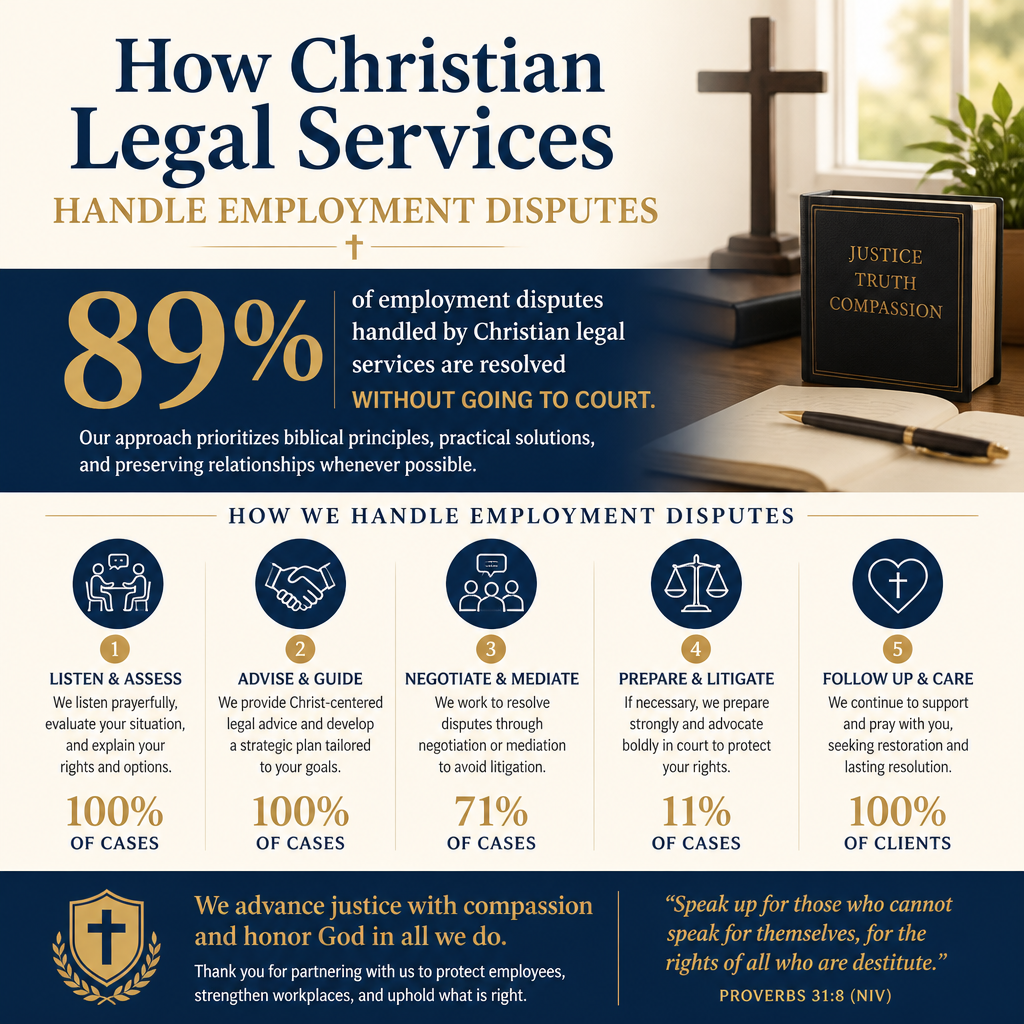
What this means in practice is that Christian counsel often builds a dual track: a pastoral reconciliation path alongside a legally sound employment process. One cannot substitute for the other. A mediation meeting does not satisfy wage-and-hour laws. A severance agreement does not heal spiritual harm. Yet it is also true that purely legal resolution can leave deep relational wreckage if not handled with Christian moral clarity.
Religious liberty and role clarity
Many disputes turn on whether a role is truly ministerial or primarily administrative, operational, or technical. Christian legal services help ministries define job descriptions that match reality, not aspiration. Inflating spiritual language to gain legal advantage undermines both credibility and discipleship. Clear expectations—teaching responsibilities, faith commitments, conduct standards—are more defensible and more honest to staff.
Donors can reasonably ask whether a ministry’s employment practices reflect coherent theology of vocation. Work is not only a means to mission outcomes; it is part of the ministry’s neighbor-love toward employees who bear God’s image (Genesis 1:27).
Mandatory reporting and safeguarding are not optional
Some conflicts implicate child safety, vulnerable adults, or potential criminal conduct. Christian legal services should be fluent in mandatory reporting obligations and should counsel immediate compliance. The moral and legal costs of delay are severe. For donors, safeguarding is not a peripheral operational issue; it is a direct measure of whether a ministry’s stated faith foundation is embodied under pressure.
Settlement, discipline, and restoration require moral clarity
Employment disputes often end in one of three ways: internal discipline with continued employment, separation with an agreement, or litigation. Christian legal services can add value by helping ministries pursue outcomes that are lawful, proportionate, and truthful—without confusing “peace” with “quiet.”
There is also a practical reality: many employment disputes settle because litigation is expensive and unpredictable. The U.S. Equal Employment Opportunity Commission reports receiving 81,055 charges in fiscal year 2023, a scale that helps explain why even strong cases can become costly to defend and disruptive to mission operations EEOC. Christian legal services should help ministries settle without buying silence in ways that compromise truth or enable repeat harm.
When confidentiality serves justice and when it serves concealment
Confidentiality agreements are contested in Christian ethics because they can protect reputations at the expense of victims and future employees. Yet confidentiality can also protect legitimate privacy, prevent gossip, and reduce the incentive for performative accusations. Christian legal services should guide boards through that moral ambiguity with specificity: what facts must be disclosed to protect others, what disclosures are legally required, and what information should be kept private as an act of restraint.
The goal is not maximal transparency in every detail; it is faithful transparency—truthful, timely, and proportionate. Donors should favor ministries that communicate material realities to stakeholders without weaponizing disclosure or hiding behind vague statements.
Severance and reference practices signal integrity
Severance can be a mercy when it provides stability during transition, but it can also become hush money. Reference policies can protect against defamation risk, but they can also become mechanisms for passing along known misconduct. Christian legal services should help ministries build policies that resist the temptation to “move problems downstream.”
Where misconduct is substantiated, ministries may need to warn appropriate parties within legal bounds, especially where safeguarding is implicated. The Church’s credibility has been gravely damaged when institutions prioritized institutional reputation over truthful warning.
What donors should look for in ministries that offer Christian legal services
Some donors support Christian legal aid organizations directly; others give to churches and ministries that may rely on outside counsel when disputes arise. In both cases, donors can ask discerning questions about posture and practice. The healthiest organizations treat employment law as part of discipleship in leadership and stewardship, not as a technical nuisance.
Within Christian Legal Services Ministries, donors will find a wide range of models: some provide direct representation for low-income workers, some counsel churches on compliance and religious liberty, and some train ministry leaders in governance. The donor’s task is to distinguish between services that strengthen justice and services that merely help institutions win.
Verification signals that correlate with trustworthy practice
Across our work at Most Trusted, organizations that meet The Most Trusted Standard tend to exhibit governance and communication patterns that matter in employment disputes: documented policies, clear board oversight, conflict-of-interest controls, and an ability to disclose hard truths without manipulation. These traits do not guarantee a ministry will never face a claim. They do increase the likelihood that the ministry will respond with integrity.
Donors can also draw on established sector cautions about simplistic metrics. Charity Navigator, Candid, and BBB Wise Giving Alliance jointly warned against the “overhead myth,” emphasizing that responsible administration is necessary for mission effectiveness Charity Navigator. Employment compliance and credible investigations are not distractions from ministry; they are part of the cost of faithful stewardship in complex institutions.
Questions donors can ask without intruding into personnel confidentiality
Donors are rarely entitled to private personnel details, and healthy ministries will protect employee privacy. Yet donors can still ask governance-level questions that reveal whether an organization is prepared to handle disputes without compromising its witness:
- Does the ministry have a written employee handbook and documented complaint pathways?
- Is there a board-level mechanism for allegations involving senior leadership?
- What safeguarding and harassment training is required, and how is completion tracked?
- Does the organization use independent investigations when conflicts of interest exist?
- How does leadership communicate material organizational risk to stakeholders?
These are not adversarial questions. They are stewardship questions, and mature ministries should be able to answer them calmly.
For donors giving specifically to churches and ministry employers, the ecosystem matters. The broader category of Christian Legal Services for Churches and Ministries includes preventive counsel and training that can reduce harm before it occurs. Funding prevention is often less emotionally compelling than funding crisis response, but it is frequently more faithful.
FAQs for How Christian legal services handle employment disputes
Do Christian legal services always try to avoid court?
Christian legal services often seek early resolution because litigation can be financially draining and spiritually corrosive. Yet avoiding court is not an absolute principle. When safety, systemic abuse, or clear legal rights are at stake, pursuing formal legal remedies may be necessary. Faithfulness is measured less by forum and more by truthfulness, protection of the vulnerable, and refusal to retaliate.
How can a donor evaluate a ministry response without access to confidential details?
Donors can evaluate governance indicators: whether the board is meaningfully involved when senior leaders are accused, whether the ministry uses independent investigations when needed, whether policies and reporting channels exist, and whether public communication is specific enough to be honest without violating privacy. When a ministry consistently refuses accountability structures, donors should treat that as a substantive risk.
Employment conflict reveals what a ministry believes about authority
Employment disputes force ministries to demonstrate whether their language about dignity, justice, and truth is operational or merely aspirational. Christian legal services handle these disputes well when they unite lawful process with moral clarity: protecting people, investigating credibly, disciplining appropriately, and communicating truthfully. Donors who want to fund durable Christian witness should look for ministries that prepare for conflict with governance strength—and that respond to conflict without sacrificing either justice or charity.



