
How a Christian attorney helps with bylaws is rarely a glamorous question, but it is a consequential one. For mature Christian donors, bylaws are not administrative trivia; they are the written architecture that shapes whether a ministry can keep faith with its mission when money, personalities, and pressure increase.
Bylaws sit at the intersection of theology, governance, and stewardship. They determine who has authority, how leaders are chosen and removed, how conflicts are handled, and what protections exist when a founder departs or a crisis hits. Scripture does not give model bylaws, but it does require ordered life in the church and integrity in leadership. “All things should be done decently and in order” is not a call to bureaucracy; it is a call to faithful administration that serves the body rather than the ambitions of any one person.
Bylaws are a spiritual and fiduciary document, not mere paperwork
Order protects mission when emotion runs high
Nonprofits and churches often draft bylaws at formation, file them away, and then revisit them only when something goes wrong. A Christian attorney helps a board name the predictable stress points before they become moral crises: a disputed removal of an executive leader, a disagreement about doctrinal boundaries, a divided board vote about a major asset, or a whistleblower complaint that tests whether the ministry’s stated values are enforceable.
In practice, bylaws operationalize stewardship. They define who may bind the organization, what decisions require board action, and what checks exist against impulsive spending or informal commitments. For donors, that structure matters because it is one of the few durable protections available when leadership changes and institutional memory fades.
Law and theology must be aligned rather than competing
Church and ministry leaders sometimes assume legal counsel will be secularizing by default. That concern is not imaginary; Christians genuinely disagree about how aggressively a ministry should use civil structures, and there are settings where “rights” language can displace the harder work of discipleship. Still, bylaws necessarily function within state nonprofit statutes, IRS requirements, and, for churches, specific constitutional principles about ecclesial authority and property.
A Christian attorney’s distinctive value is not a prooftext appended to a standard template. It is careful alignment: ensuring the ministry’s doctrinal commitments, authority structures, and disciplinary processes are written in a way that is both legally intelligible and faithful to the ministry’s ecclesiology. The goal is clarity that prevents avoidable disputes and reduces the likelihood that a ministry will be forced to resolve internal spiritual questions in a secular court.
Where a Christian attorney adds concrete value to governance
Board authority, delegation, and accountability
Many governance failures are not financial scandals at first. They begin as ambiguous authority: a board that exists in name only, a founder who cannot be corrected, or an executive team that effectively governs without oversight. A Christian attorney helps translate a board’s intent into enforceable rules: quorum, voting thresholds, delegation to committees, and required documentation for major decisions.
For donors who underwrite growth, this is not an abstract concern. Growth increases complexity: more staff, more restricted gifts, more facilities, more public scrutiny. Bylaws that were “good enough” at $250,000 in annual revenue can become dangerously thin at $5 million.
Conflict of interest, related-party transactions, and private benefit
Bylaws should not carry the whole compliance burden, but they should support a ministry’s conflict-of-interest discipline. The IRS is explicit that 501(c)(3) organizations must be organized and operated exclusively for exempt purposes and that earnings may not inure to private individuals. A Christian attorney helps ensure the bylaws work in tandem with policies that address related-party transactions, compensation decisions, and recusal processes, reducing the risk of private benefit problems that can harm a ministry’s witness as well as its legal standing.

When donors evaluate a ministry, governance credibility is often revealed in these details: whether insiders can approve their own contracts, whether the board documents decisions, and whether the ministry can demonstrate that it treats donor resources as a trust rather than a personal entitlement.
Bylaws can reduce preventable donor risk when ministries scale
Membership models, voting rights, and congregational dynamics
Church bylaws often hinge on membership: who qualifies, who votes, and what decisions require congregational action. Ministries outside the local church face parallel questions: whether “members” exist at all, whether donors receive any governance rights, and how advisory bodies relate to the legal board. A Christian attorney helps a ministry avoid hybrid structures that sound inclusive but create confusion or unintended liabilities.
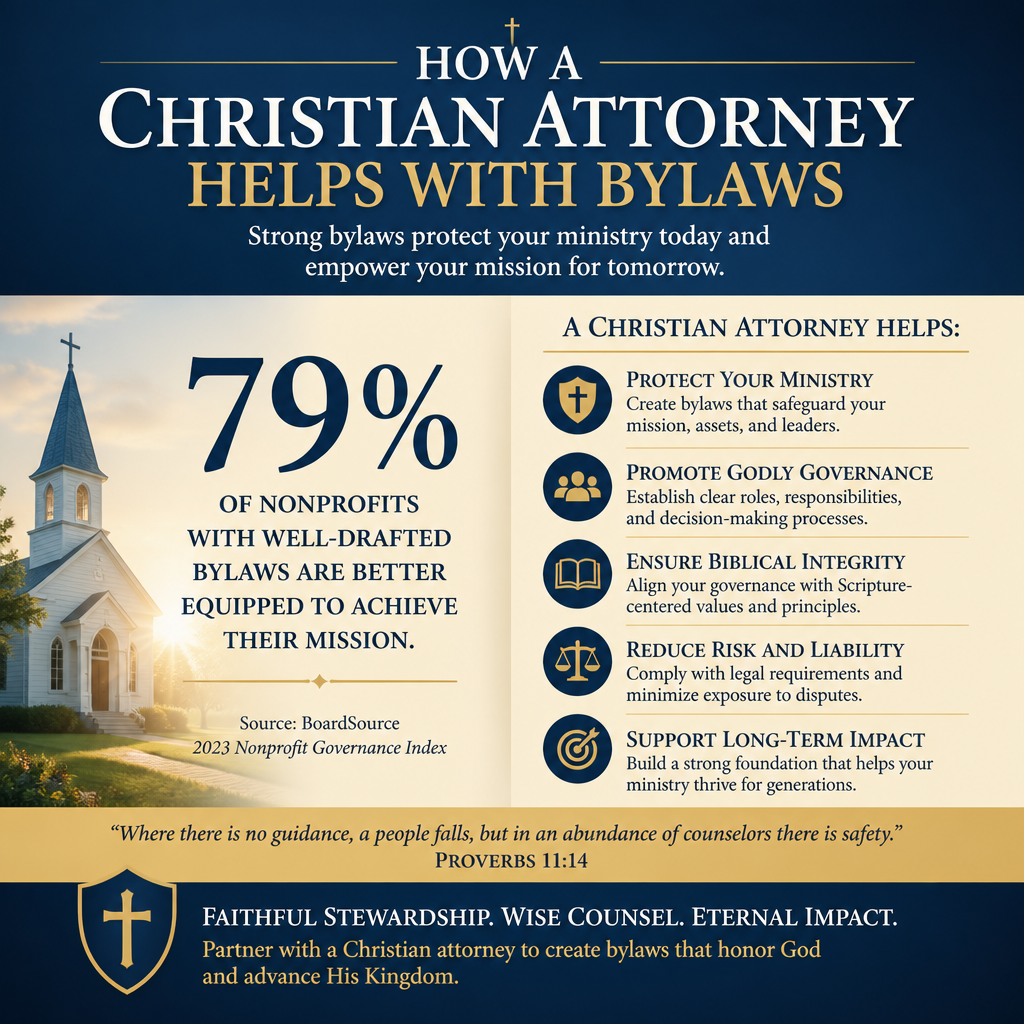
Churches and ministries also must consider state law variation. Some states treat membership nonprofits differently from non-membership nonprofits. The same bylaw language can have different legal effects depending on jurisdiction. Counsel who understands both the legal environment and the church’s polity can prevent errors that are expensive to unwind.
Succession planning and founder transitions
Many ministries are built through extraordinary personal sacrifice, and founders often carry spiritual authority as well as operational control. That reality can be a gift to the church. It can also create fragility when a founder’s role is undefined, permanent, or insulated from accountability. A Christian attorney helps boards articulate terms, limits, and succession pathways that honor the founder’s calling while protecting the ministry from becoming a personality-driven institution.
This is one reason donors often ask whether a ministry can outlive its charismatic leader. Healthy bylaws do not guarantee humility, but they can make humility structurally possible.
What donors should look for in bylaw strength and legal posture
Signals of governance maturity donors can verify
Donors are not responsible for running a ministry, but donors are responsible for wise stewardship. The ministries that meet The Most Trusted Standard tend to treat governance documents as living instruments: reviewed periodically, aligned with actual practice, and consistent with other policies and disclosures. When our team evaluates governance and leadership, bylaws are not the only artifact we consider, but they often reveal whether accountability is real or aspirational.
For donors assessing Christian Legal Services Ministries, it helps to understand whether legal counsel is used defensively to preserve power or constructively to protect mission and people. We have seen both patterns in the field, and the difference shows up in board independence, transparency, and the ministry’s willingness to document decisions.
A practical checklist for donor conversations
Donors rarely need a copy of bylaws, but donors can ask questions that indirectly test whether bylaws and practice match. For example:
- Does the board review bylaws on a defined cadence, and were there substantive updates in the last few years?
- How are board members selected, trained, and evaluated, and what is the process for removal?
- Is there a documented conflict-of-interest policy that board members sign annually?
- How does the ministry approve executive compensation, and who is recused from those decisions?
- What happens if the executive director and board chair disagree on a major decision?
These questions are not adversarial. They are a form of stewardship, akin to asking how restricted gifts are tracked or how safeguarding policies are enforced.
How Most Trusted evaluates governance without substituting for legal counsel
Verification clarifies trust, counsel clarifies compliance
Most Trusted is not a law firm, and verification is not a replacement for competent legal counsel. A Christian attorney ensures a ministry’s bylaws and practices are legally coherent in its jurisdiction. Our role is different: we help donors give with confidence by evaluating ministries against The Most Trusted Standard, a 15-criteria framework that examines faith foundation, financial integrity, governance and leadership, and transparency and effectiveness.
What this means in practice is that donors can distinguish between a ministry that has professionalized accountability and one that has simply accumulated documents. Bylaws that exist only on paper are common. Bylaws that are implemented, understood by the board, consistent with financial controls, and reflected in public disclosures are a stronger indicator of integrity.
Where this fits in the broader landscape of Christian legal service
Christian donors often support legal ministries that defend religious liberty, provide counsel to churches, or expand access to justice. Each of these categories carries distinct governance risks, because legal work can invite political attention, restricted funding, and reputational volatility. A ministry’s internal governance must be able to carry that weight without quietly centralizing power or obscuring decision-making.
For readers comparing ministries in Christian Legal Services for Churches and Ministries, the question is not whether an organization has bylaws, but whether its governance is consistent with a biblically serious understanding of stewardship and accountability.
FAQs for How a Christian attorney helps with bylaws
Should donors ask to see a ministry’s bylaws?
Sometimes, but not always. Many ministries will share bylaws on request, and a mature organization will not treat reasonable governance questions as hostility. Still, bylaws can be technical and may not answer donor questions about actual practice. Donors are often better served by asking how the board functions in reality, what policies govern conflicts of interest and compensation, and whether the ministry is willing to provide governance documentation consistent with its size and complexity.
Are church bylaws mainly a legal necessity, or do they shape spiritual health?
They shape both. Bylaws cannot create spiritual vitality, but they can reduce preventable harm by clarifying authority, accountability, and discipline when conflict arises. When aligned with Scripture and a church’s polity, bylaws can protect the congregation from favoritism, financial mismanagement, and leadership volatility, supporting the kind of ordered life Paul expects in the household of God.
Bylaws are one of the quiet places where integrity is proven
Donors often fund visible ministry outcomes: a program launched, a church planted, a case defended, a family served. Yet many ministry collapses begin in quiet governance failures that donors never see until the damage is public. How a Christian attorney helps with bylaws is ultimately about preventing that kind of failure by putting authority under discipline, aligning law with theology, and giving boards tools to lead with clarity.
For donors seeking faithful confidence, governance is not secondary to mission. It is one of the ways mission is protected over time. Readers assessing this field more broadly will find additional context in Christian Legal Services Ministries.



