
How donor support funds Christian legal appeals is not a peripheral question for serious Christian stewardship. Appeals work is often the moment when a ministry’s convictions meet the state’s coercive power, and the costs rise quickly as cases move from trial courts to appellate courts.
For Christian donors, the moral logic is clear: Scripture assumes a world where the powerful can twist process against the weak, and it repeatedly commends honest advocacy. “Give justice to the weak and the fatherless; maintain the right of the afflicted and the destitute” (Psalm 82:3). Legal appeals are not automatically righteous, and litigation can become a substitute for discipleship. Yet there are real instances where faithful presence in the courts is a form of neighbor love and institutional protection for the church’s mission.
Appeals are where precedent is set and costs concentrate
Most contested religious-liberty and conscience cases do not end at a first ruling. Appeals are where legal arguments are refined, errors are corrected, and precedent is set for whole regions or the nation. What this means in practice is that donors often underwrite the most consequential stage of a case, even when the underlying dispute began as a local conflict.
Why appeals matter for the church’s long-term freedom
Trial courts decide disputes; appellate courts frequently decide rules. A decision at the appellate level can shape how religious exemptions are interpreted, how nondiscrimination laws interact with conscience claims, and what procedural protections religious organizations receive. The result is that appeals work often has a “public good” quality: the ministry’s client is a person or institution, but the outcome can affect many ministries that never appear in court.
Christians genuinely disagree about strategy here. Some argue that wins in court can harden cultural resistance and that legal efforts should be secondary to evangelism and pastoral care. Others respond that ordered liberty is one of the conditions under which evangelism and mercy ministry can operate without coercion. Mature legal ministries typically hold both truths: they pursue limited, carefully chosen cases while investing heavily in non-litigious counsel, peacemaking, and preventive compliance.
Why the price rises as cases advance
Appeals compress a large amount of specialized work into demanding deadlines: reviewing extensive records, writing briefs that meet strict rules, coordinating amici, and preparing for oral argument. Ministries may also fund continuing client support and public communications because the appellate process can be slow, stressful, and reputationally costly for families, churches, and Christian schools.
In practice, a ministry’s legal budget is often less about “hours billed” and more about readiness: maintaining qualified appellate counsel, research capacity, secure data practices, and a triage process that can discern which cases should move forward. Donors are not merely paying for activity; they are sustaining a capacity that can be deployed when a case reaches a turning point.

Donor dollars fund a disciplined chain of work from record to ruling
Appeals feel abstract until donors see the sequence of concrete tasks involved. The appellate process is constrained by the trial record, governed by procedural rules, and shaped by strategic judgment about which arguments to press and which to forego. Appeals are rarely won by volume; they are won by precision.
The essential components of an appellate effort
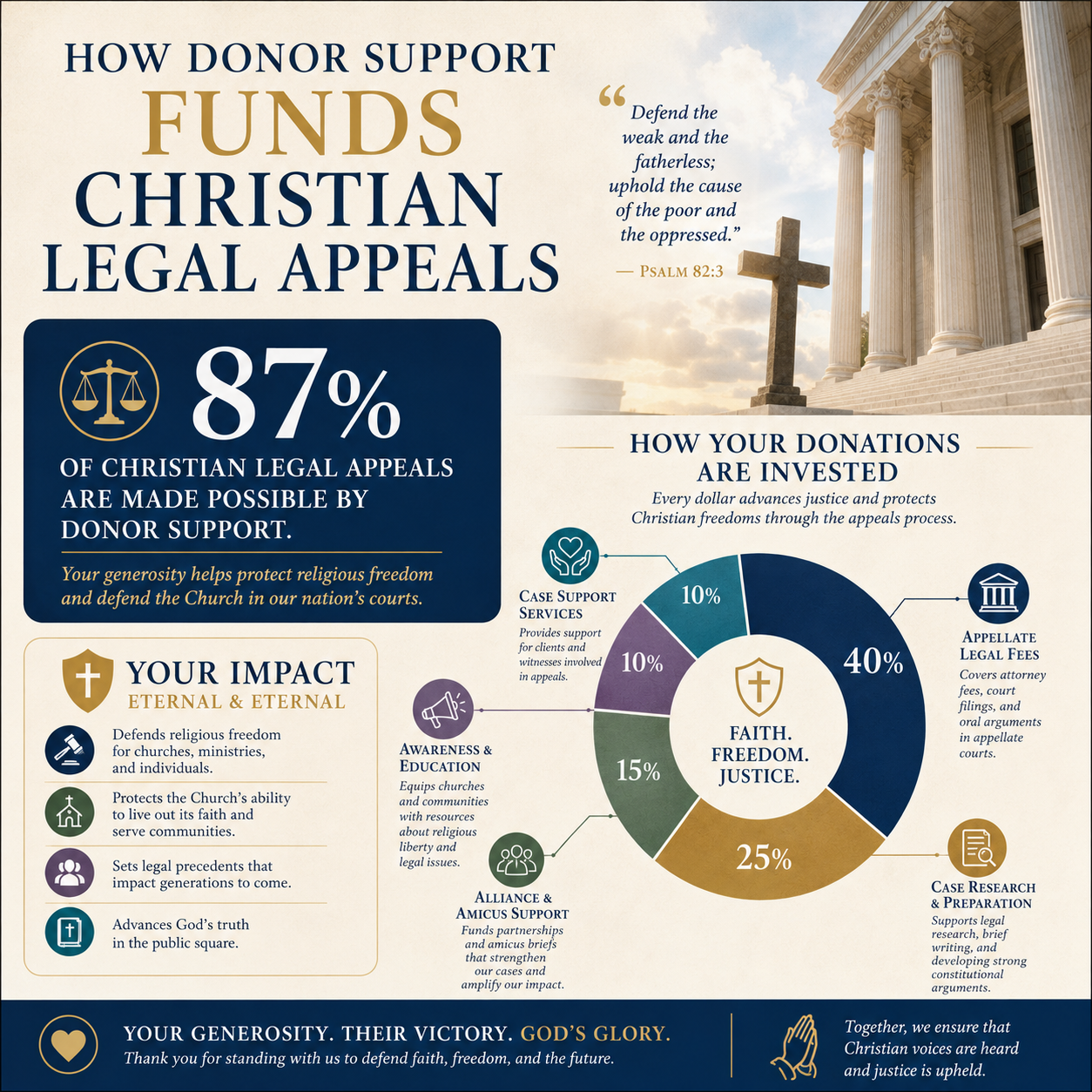
Strong Christian legal ministries tend to allocate donor funding across several interlocking needs. While every case differs, a disciplined chain of work usually includes the following:
- Record analysis to identify appealable issues and preserve arguments within procedural limits
- Brief writing and editing that integrates constitutional, statutory, and administrative precedent
- Amicus coordination to help courts understand broader implications without duplicating arguments
- Moot courts and oral argument preparation to stress-test claims under hostile questioning
- Client care and risk counsel for employment, licensing, and reputational exposure during litigation
Funding also supports less visible work: secure document management, conflict checks, expert consultation, and ongoing training for attorneys and allied staff. Donors should not assume that a “lean” budget always signals health. In legal work, chronic underinvestment can produce avoidable procedural mistakes and ethical strain.
Why these ministries often choose fewer cases than donors expect
Many requests for help never become appeals. A responsible ministry must evaluate legal merits, client credibility, downstream precedent risk, and the likely impact on vulnerable people. A poor case can create bad law. That reality can disappoint donors who want a ministry to “fight everything.” Prudence is not timidity; it is stewardship in a system where one published decision can reshape a whole field.
For donors seeking to understand this field more broadly, we encourage engagement with Christian Legal Services Ministries, where the range of legal aid, policy advocacy, and religious-liberty work becomes clearer in context.
Faithful legal advocacy requires restraint, not only resolve
Christian giving is not only about outcomes; it is about the manner of witness. Appeals work creates temptations: to overpromise, to weaponize public outrage, or to treat opponents as enemies rather than neighbors. Donors should expect Christian legal ministries to measure success not merely by wins, but by fidelity to truth, integrity of process, and the care of those harmed by conflict.
Truthfulness and the ethics of persuasion
Appellate courts rely on candor. Misstating facts or overreaching on precedent can destroy credibility, not only for one case but for a ministry’s long-term ability to be heard. Theologically, Christians have additional obligations: “Therefore, having put away falsehood, let each one of you speak the truth with his neighbor” (Ephesians 4:25). Donor funding should support rigorous internal review, not merely aggressive rhetoric.
We also encourage donors to ask whether a ministry’s communications reflect the moral seriousness of Christian speech. Some public advocacy ecosystems reward escalation and caricature. Appeals work, by contrast, rewards careful reasoning. Ministries that cannot govern their public language often struggle to govern their legal strategy.
When litigation is not the best first step
The field has had to reckon with the limits of litigation. Many disputes are better addressed through policy clarification, negotiated settlements, internal church discipline, or improved governance practices. Even when a case is legally strong, the pastoral costs can be high for clients who become public symbols. Donors should look for ministries that counsel clients honestly about those costs rather than recruiting them into a cause.
There is also a genuine debate about how legal pressure interacts with cultural change. Some legal victories can provoke regulatory workarounds. Some losses can clarify legislative pathways. A mature ministry speaks candidly about those trade-offs and does not treat every case as a referendum on the entire faith.
What wise donors should evaluate before funding appeals work
Because appeals are expensive and consequential, donors should apply a higher standard of diligence, not a lower one. This is where verification helps. Most Trusted exists to help donors give with confidence by evaluating ministries against The Most Trusted Standard, a 15-criteria framework spanning faith commitments, financial integrity, governance, and transparency and effectiveness.
Signals of credibility in a legal appeals ministry
Across our verification work, we find that healthy legal ministries tend to make their decision processes and financial realities legible to donors. They do not hide behind complexity. They also demonstrate clear accountability structures, especially when cases draw public attention.
Practical due diligence includes reviewing a ministry’s Form 990 and audited financials where available. The Internal Revenue Service requires many nonprofits to make their Form 990 publicly accessible, and the agency explains the form’s purpose and availability on its site (IRS Form 990 resources). Donors should also verify whether the ministry’s board is active and independent, whether related-party transactions are disclosed, and whether executive compensation is governed by a documented process.
Budget discernment beyond simplistic overhead instincts
Christian donors often feel the moral pressure to minimize “overhead.” Legal appeals work complicates that instinct. Training, supervision, compliance, secure systems, and quality control are not luxuries; they are guardrails. The sector has repeatedly warned against simplistic overhead ratios, including the joint statement commonly referred to as the Overhead Myth from Charity Navigator, Candid, and the Better Business Bureau Wise Giving Alliance (Charity Navigator on the Overhead Myth).
Donors can still ask hard questions: Are reserves appropriate? Is litigation spending aligned with mission priorities? Does the ministry have a policy for declines and referrals? Does it avoid turning legal defense into a fundraising engine that requires perpetual conflict? Those are governance questions as much as financial ones.
Appeals funding strengthens institutions that protect ministry for the long term
Appeals are not only about one client’s relief; they are often about the durable freedom of Christian institutions to operate according to their convictions. That includes churches, Christian schools, pregnancy help organizations, foster and adoption ministries, and Christian employers navigating complex regulatory environments. The result is that donor-funded appeals can function as a form of institutional defense for the church’s public mission.
The institutional stakes are not theoretical
Religious-liberty disputes frequently touch funding eligibility, accreditation, licensing, employment standards, and compelled speech. These are not abstract “culture war” categories; they determine whether ministries can hire according to faith commitments, teach a Christian view of the human person, and provide services without violating conscience.
At the same time, institutional defense can be mishandled. Ministries must resist the temptation to treat every adverse regulation as persecution. Courts and regulators often operate from competing goods: nondiscrimination norms, public access, and professional standards. Christian legal ministries earn trust when they acknowledge those goods and still argue, carefully, for space where Christian conviction can be practiced without coercion.
How donors can connect appeals funding to measured impact
Impact in appeals work is not always visible in a quarterly metric. Some outcomes are precedential rulings; others are settlements that quietly protect a school or church. Some are deterrent effects, where a clear legal posture discourages unjust enforcement. Donors should expect ministries to report candidly on wins and losses, and to explain why a loss may still clarify the path forward.
For donors comparing ministries in this area, it can help to understand the broader ecosystem of Christian Legal Services and Religious Liberty, including direct legal aid, training, policy work, and preventive counsel. Appeals are one instrument in a wider field of Christian advocacy and service.
FAQs for How donor support funds Christian legal appeals
Does funding legal appeals count as a distinctly Christian form of giving?
It can, when the work is ordered toward truth, justice, and protection of the vulnerable, and when the ministry conducts itself with Christian integrity. Scripture commends just process and honest advocacy, and Christian institutions have legitimate interests in freedom of conscience and worship. The test is not whether a case is politically charged, but whether the ministry’s legal posture and public witness remain faithful to Christian truthfulness and neighbor love.
What should donors ask before supporting an appeals fund?
Donors should ask how cases are selected, what safeguards exist against creating harmful precedent, how the ministry cares for clients under public scrutiny, and what accountability governs messaging and finances. Reviewing Form 990s, audited statements, and governance disclosures is a prudent start, along with verifying whether the ministry meets a clear standard such as The Most Trusted Standard used by Most Trusted.
Giving that sustains faithful presence in the courts
Donor support funds Christian legal appeals by sustaining the specialized capacity required to pursue truthfully argued, strategically restrained, and pastorally aware advocacy at the level where precedent is made. When ministries conduct this work with integrity, appeals funding becomes one means of protecting Christian institutions and vulnerable neighbors from coercion, without confusing legal victory with the Kingdom of God itself.



