
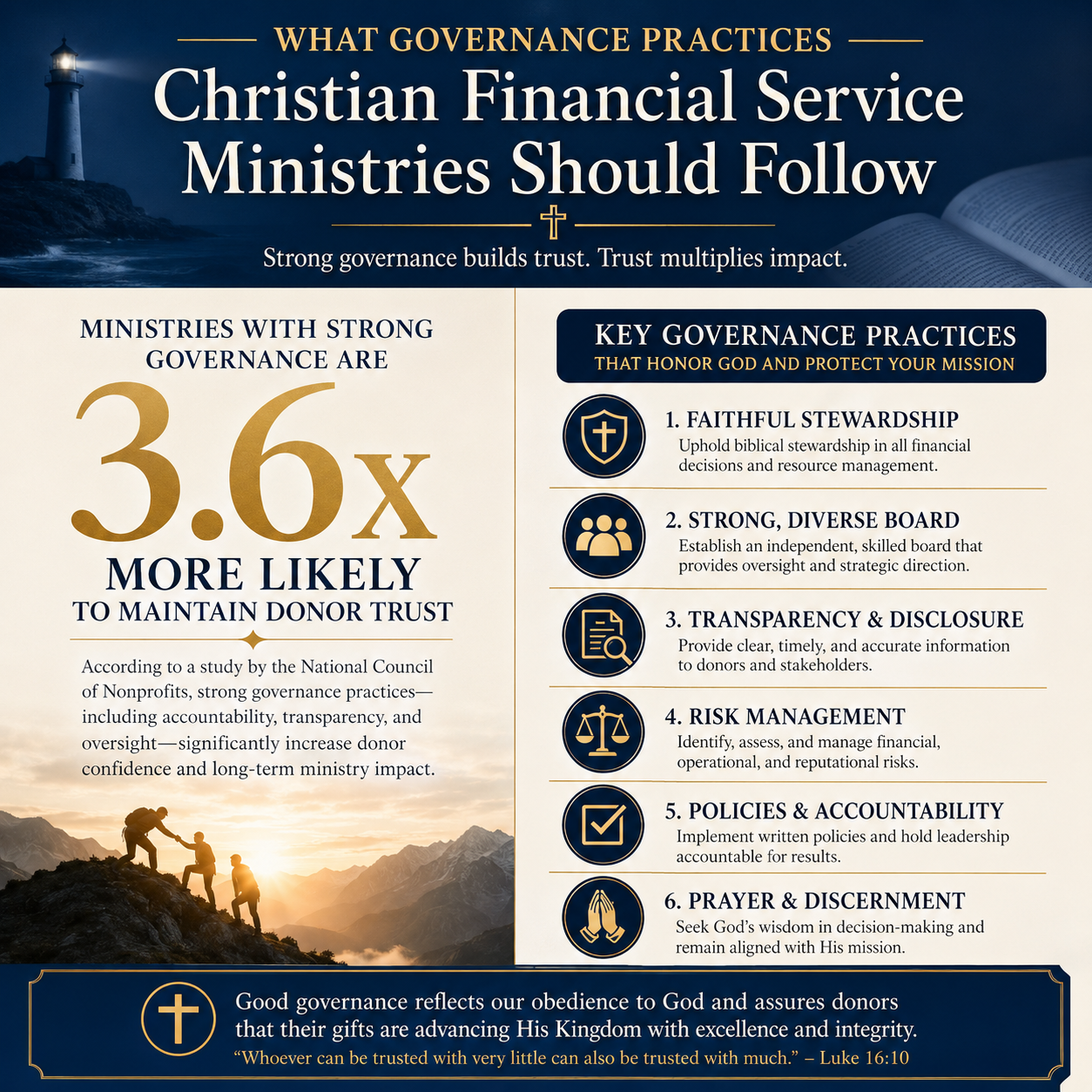
Governance practices Christian financial service ministries should follow are not secondary compliance questions; they are a direct test of whether a ministry handles other people’s money with fear of God, love of neighbor, and institutional sobriety. Donors give in good faith, often sacrificially, and they are right to expect that a ministry’s board, leadership, and controls are ordered toward stewardship rather than personality, expediency, or public relations.
Financial-service ministries carry a distinctive risk profile. Whether the ministry provides counseling, debt relief, benevolence distribution, lending, investment guidance, or payroll and bookkeeping support for churches, the work can touch regulated activities, private financial data, conflicts of interest, and intense pastoral pressure to “help” quickly. Scripture’s warnings about partiality and dishonest scales are not abstractions here (Prov. 11:1). Governance is the structure that keeps compassion tethered to truth.
1. Begin with a board that can govern rather than simply endorse
A ministry may have sincere leaders and still drift into preventable failures if the board is not equipped, independent, and spiritually mature enough to exercise real oversight. Donors should not confuse a prestigious roster with a governing board. The question is whether the board can make hard decisions, ask unwelcome questions, and insist on evidence.
Board independence must be real, not nominal
Across our verification work at Most Trusted, ministries that meet The Most Trusted Standard tend to define independence clearly, enforce it consistently, and document it publicly. The board should not be dominated by family members, employees, major vendors, or close friends whose loyalty is primarily personal. The New Testament pattern assumes accountable leadership, not unchallengeable founders (Acts 15:1–29 shows a public, deliberative process under spiritual authority).
Independence also has a practical meaning: board members should have no undisclosed financial ties to the ministry, and any related-party transaction should be rare, competitively priced, and formally approved with recusals recorded in minutes. In financial services, even small conflicts can become structural.
Competence is a form of neighbor-love
Christian donors sometimes hesitate to speak about expertise, fearing it signals trust in “worldly” wisdom. Yet competence is one way we honor the people whose resources we steward. For financial-service ministries, boards should include members who understand accounting, risk, privacy, banking or payments (as relevant), and nonprofit governance. A board that cannot read financial statements is not a spiritual virtue; it is a governance liability.

2. Establish financial controls that assume temptation and prevent cover-ups
Christian governance begins with the doctrine of sin applied soberly to systems. The goal is not suspicion for its own sake; it is protection for donors, staff, beneficiaries, and leaders. Even mature Christians can rationalize shortcuts when under pressure, and ministries are often under pressure.
Segregation of duties and approval thresholds
At minimum, no one person should be able to authorize, execute, and reconcile the same transaction stream. That includes disbursements, reimbursements, payroll, and any benevolence funds. Approval thresholds should be written, consistently applied, and reviewed annually. When ministries claim controls are “informal but effective,” donors should interpret that as an invitation for preventable error and, in the worst cases, fraud.
The same logic applies to credit cards, wire transfers, and donor-restricted funds. Controls should be designed for the ministry’s actual operations, not generic templates. If a ministry operates at a national scale, the controls should reflect that scale.
Independent audit or review, with a board-level finance committee
Many donors have learned to fixate on “overhead.” The field has had to reckon with the fact that simplistic overhead ratios can punish responsible governance and encourage underinvestment in controls. Charity Navigator, Candid, and the BBB Wise Giving Alliance jointly warned against using overhead as a primary indicator of nonprofit performance in the Overhead Myth letter (Charity Navigator).
For financial-service ministries, an independent audit is often the clearest baseline, and it should be overseen by the board through a finance or audit committee that meets regularly and documents decisions. If an audit is not appropriate for the ministry’s size, an independent financial review can still provide meaningful third-party scrutiny. Donors should expect the board to receive management letters, track remediation, and document follow-through rather than treating the audit as a formality.
- Written internal control policies and annual board review
- Segregation of duties for receipts, disbursements, and reconciliation
- Documented approval limits for expenses, benevolence grants, and contracts
- Independent audit or review with board-level oversight
- Clear handling of donor restrictions and restricted fund reporting
3. Govern the ministry’s promises, not only its finances
Financial-service ministries trade in trust. Their products and counsel can shape family stability, debt decisions, and a donor’s sense of moral responsibility. Governance must therefore supervise not only budgets but also claims, counsel quality, and how outcomes are represented to the public.
Truthful marketing and disciplined claims
Donors should expect a ministry to avoid exaggerated promises about debt freedom, investment performance, or “guaranteed” outcomes. Where outcomes are reported, the methodology should be described plainly: who was counted, over what time period, and with what attrition. The Federal Trade Commission’s work on truth-in-advertising standards illustrates the basic public principle: claims must be truthful, not misleading, and substantiated (Federal Trade Commission). Christian ministries are not exempt from the moral substance of that standard simply because their motives are religious.
Governance should require leadership to present the board with evidence for major public claims and to correct errors publicly. A donor’s confidence is strengthened when a ministry treats accuracy as discipleship.
Guardrails for counseling, benevolence, and power dynamics
When a ministry provides financial counseling or coaching, the governance question becomes: who supervises the counselors, how is counsel standardized, and what happens when counsel is disputed? Ministries should have written standards, training, and a documented escalation process for complaints. For benevolence decisions, governance should prevent favoritism and protect dignity. James’s warning about partiality is aimed at the church’s instinct to honor certain people more than others (James 2:1–7). Financial-service ministries face that temptation routinely when need and visibility collide.
Donors evaluating this space often benefit from orienting themselves to the broader accountability conversation in Christian Financial Service Ministries, where the field’s recurring risks and donor questions appear in predictable forms.
4. Treat compliance and data privacy as stewardship, not as a distraction
Christians genuinely disagree about how much regulatory compliance should shape ministry operations, especially when compliance feels like a secular imposition. Yet when a ministry holds social security numbers, bank information, credit reports, giving records, or pastoral disclosures, privacy is not merely legal hygiene. It is love of neighbor expressed institutionally.
Data governance and breach readiness
Sound governance requires a written information security program proportionate to the ministry’s risk: access controls, encryption where appropriate, vendor management, and an incident response plan that the board understands. Even if a ministry is not formally covered by HIPAA or a banking regulator, donors should look for the same moral posture: restraint in data collection, care in storage, and transparency if something goes wrong.
The National Institute of Standards and Technology provides widely used cybersecurity guidance that many organizations adapt as a baseline (National Institute of Standards and Technology). A ministry does not need to speak in technical acronyms to act responsibly, but it should be able to describe its safeguards in plain language.
Vendor risk and outsourced finance functions
Many ministries outsource payroll, payment processing, database hosting, or even bookkeeping. Outsourcing can improve controls, but it can also create blind spots. Governance should require due diligence on vendors, written contracts that address confidentiality and breach notification, and a clear delineation of who owns what data. The board should know which vendors are critical to operations and what continuity plans exist if a vendor fails.
5. Make transparency a board practice, not a communications posture
Transparency is not simply posting a PDF. It is the disciplined habit of giving donors and stakeholders enough verified information to understand governance, finances, and effectiveness without spinning or selective disclosure. For Christian financial-service ministries, transparency is especially important because the work can be hard to see and easy to overstate.
Disclose governance and related-party realities plainly
Donors should be able to find board membership, leadership, conflict-of-interest policies, and a basic description of oversight structures. If a founder remains influential, the ministry should explain how that influence is bounded and supervised. If the ministry conducts related-party transactions, it should disclose them clearly. This is not cynicism; it is an application of walking in the light (1 John 1:7) to organizational life.
Connect dollars to outcomes with humility and evidence
Effectiveness reporting in financial discipleship and relief work can be contested. Some outcomes are measurable (completed counseling sessions, debt reduction, savings rates), while others are spiritual and relational and therefore harder to quantify. Mature governance acknowledges both. It does not pretend the measurable exhausts the meaningful, and it does not use the unmeasurable to excuse the unverifiable.
Donors who want to focus specifically on public accountability practices in this category often benefit from Accountability and Transparency in Christian Financial Service Ministries, where the standard expectations are clearer and easier to compare across organizations.
FAQs for What governance practices Christian financial service ministries should follow
Should a Christian financial service ministry be founder-led, or is that a red flag?
Founder leadership is not automatically disqualifying. The governance question is whether the founder is genuinely accountable to an independent board, whether related-party transactions are tightly controlled, and whether succession planning is real rather than aspirational. Donors should look for documented board authority, clear executive evaluation processes, and evidence that the ministry can make decisions that do not merely reflect founder preference.
What should donors ask for if a ministry says it cannot share much due to confidentiality?
Confidentiality is often legitimate in financial counseling and benevolence work, but it should not eliminate accountability. Donors can reasonably ask for audited or independently reviewed financial statements, governance policies, aggregated outcomes with defined methodology, and a clear description of privacy and security practices. A ministry can protect client data while still being transparent about controls, oversight, and results.
Conclusion
Christian financial service ministries sit at the intersection of pastoral care and material stewardship, where the consequences of weak governance are rarely theoretical. The governance practices worth insisting on are the ones that make truth easier to tell, temptation harder to indulge, and donor intent harder to ignore. When oversight is strong, a ministry’s compassion becomes more trustworthy, and donors can give with the settled confidence that their generosity is being handled as a sacred trust.



