
Naming successor advisors for a Christian DAF is one of the most consequential choices a donor makes after the initial funding decision. A donor-advised fund can preserve generosity across decades, but only if authority is handed to people who share your theological convictions, understand your intent, and can discern ministries with clarity rather than sentiment.
The Christian question is not merely administrative. Scripture treats stewardship as a moral reality before it is a financial one: “Moreover, it is required of stewards that they be found faithful” (1 Corinthians 4:2). Successor planning tests whether our giving is ordered toward faithfulness—or toward control, family dynamics, or a vague hope that “they will figure it out.”
1. Begin with authority and intent, not names
Clarify what a successor advisor may and may not do
Different DAF sponsors define successor roles differently. Some allow successors to recommend grants indefinitely; others limit the term, require minimum annual distributions, or convert the account to a designated fund at death. Before selecting people, confirm the legal and policy boundaries that will shape their decisions. A successor cannot carry out an intent that the sponsor’s documents do not permit.
What this means in practice is that “who” comes after you is downstream from “what authority they will have.” If successors can change charitable focus, add advisors, or recommend grants to a wide range of nonprofits, then discernment and alignment matter more than if the fund will be locked into a defined set of purposes.
Write an intent statement that can survive changing seasons
Wise donor intent is specific enough to guide and broad enough to endure. A rigid list of ministries can become obsolete. A vague statement like “support Christian causes” can invite drift. Many donors land well with a short intent statement that names theological commitments (for example, historic Christian orthodoxy), a giving emphasis (local church and global missions; mercy ministry; Christian education), and a posture (evidence of fruit, financial integrity, and accountable leadership).
For donors who want successors to use disciplined evaluation, it can help to name a decision standard rather than a destination list. Across our verification work at Most Trusted, we see donors protect long-term faithfulness when they define the kind of ministries they will support and the kind they will not—especially around governance, financial practices, and theological clarity. The ministries that meet The Most Trusted Standard tend to make their commitments and practices legible to outsiders, which reduces the burden on a successor who did not build the original network.

2. Choose successor advisors with spiritual maturity and relational clarity
Prioritize character and discernment over proximity
Many donors default to adult children because it feels natural. Sometimes it is also wise. Yet Scripture’s categories push beyond family proximity to the question of fitness: “If anyone does not know how to manage his own household, how will he care for God’s church?” (1 Timothy 3:5). The point is not that successors must be elders; it is that leadership—including in stewardship—requires proven character, stability, and sober judgment.
A successor advisor should be able to say “no” to a compelling story when the ministry is poorly governed, financially opaque, or theologically evasive. They should be able to resist the subtle pressure of friendships, social circles, and partisan capture. They should also have the emotional steadiness to handle family expectations without turning the DAF into a proxy battlefield.
Consider shared authority when unity is real, not presumed
Joint successors can either guard a fund or paralyze it. If siblings are aligned in faith and practice, shared authority can provide accountability. If relationships are strained, shared authority can turn giving into a slow conflict. This is not merely a personality issue; it is a stewardship risk. A DAF with high friction often defaults to inaction, and the habit of generosity quietly dies.
If you appoint multiple successors, confirm how the sponsor handles approvals. Does it require unanimous consent, majority rule, or independent authority? The best structure is the one that produces faithful action over time.
- Choose successors who share your theological center, not only your values vocabulary.
- Confirm they can evaluate governance and finances, not only program outcomes.
- Assess whether they can withstand relational pressure from friends and family.
- Prefer people who have demonstrated consistent generosity over many years.
- Match authority to competence: broader discretion requires higher discernment.
3. Reduce ambiguity by building a successor-ready giving process
Create a repeatable cadence rather than a private intuition
Many donors give from a set of unspoken instincts: which ministries feel trustworthy, which leaders seem steady, which reports appear credible. Successors inherit the account, not the intuition. A successor-ready plan turns personal instinct into a process that can be followed with integrity.
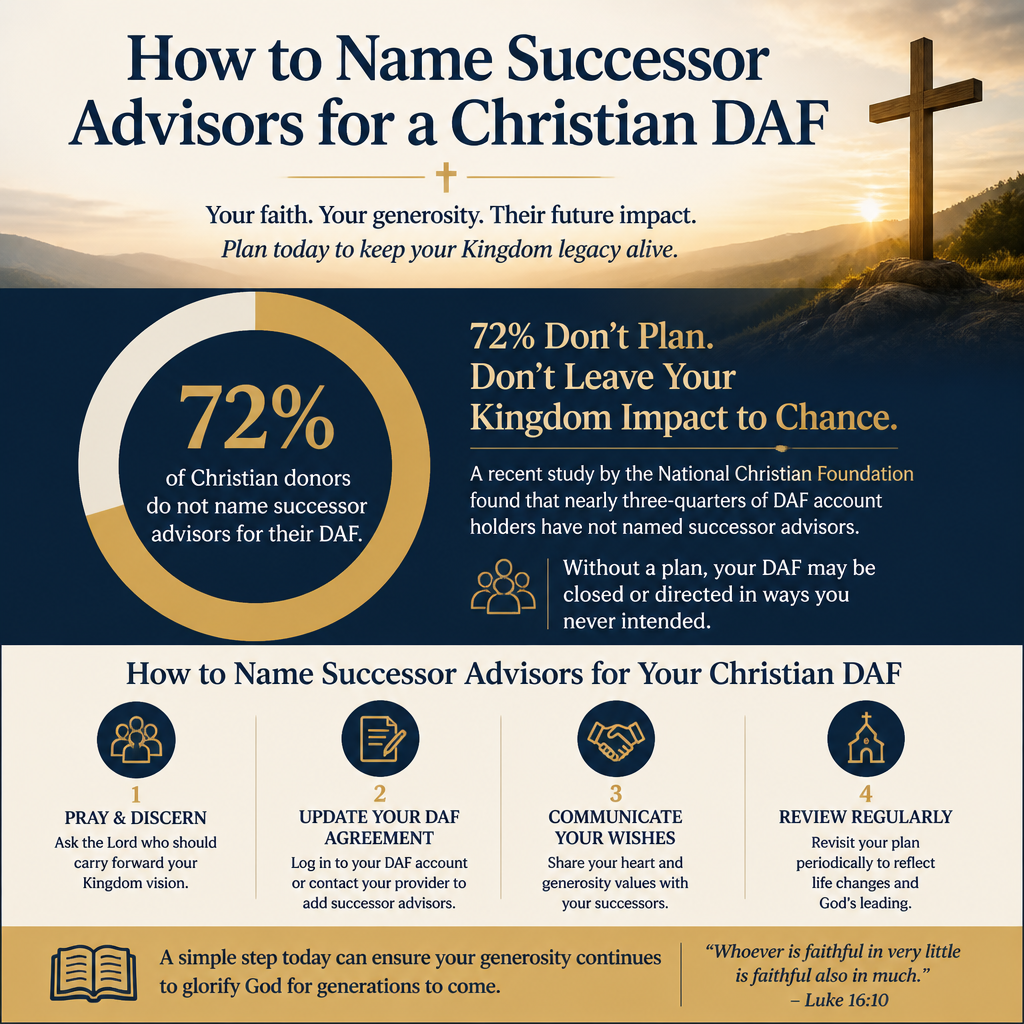
A simple cadence is often enough: one season each year for evaluation, one season for grant recommendations, and a periodic review of whether giving is staying aligned with your intent. If your successors are busy parents or demanding professionals, design something they can actually execute.
Use third-party verification to lower the discernment burden
Christian donors face an information problem. Many ministries do meaningful work, but not all can demonstrate governance strength, financial integrity, and truthful communication. Outsiders also cannot easily assess whether stated theology meaningfully governs practice.
That is where independent verification becomes a form of care for your successors. Most Trusted evaluates ministries against The Most Trusted Standard, a 15-criteria framework covering Faith Foundation, Financial Integrity, Governance and Leadership, and Transparency and Effectiveness. A successor advisor who is not a specialist can still make decisions grounded in verifiable evidence rather than charisma, social proof, or assumptions.
For broader context on how Christian donors use donor-advised funds for long-term stewardship, see Christian Donor-Advised Funds.
4. Anticipate the predictable tensions that derail legacy giving
Family expectations and the temptation to treat the DAF as an inheritance
A DAF is not a family asset; it is a charitable vehicle. Yet families often experience it emotionally as part of the estate. If successors feel they are being trusted, they tend to protect the intent. If they feel controlled, they may disengage or quietly redirect giving when they can.
It is wise to speak plainly with potential successors before naming them. Ask whether they want the responsibility. Ask what they believe the fund should accomplish. If answers reveal major divergence, it is better to know early than to discover it after your death when documents are final and relationships are tender.
Mission drift and theological drift are not the same problem
Some donors fear “mission drift” in the sense of changing causes. The harder drift is theological. A successor may keep funding “good works” while drifting from a Christian account of the gospel, the church, and human flourishing. Christians genuinely disagree about strategy—whether to prioritize evangelism or mercy, local church or parachurch, domestic work or global missions. But the distinction between Christian and merely adjacent philanthropy matters if the DAF was funded as an act of worship.
One practical safeguard is to identify non-negotiables for funding: confessional clarity, meaningful accountability structures, and transparent reporting. Another is to encourage successors to keep the local church central. Christianity is not sustained by institutions alone; it is sustained through Word and sacrament in gathered communities.
For donors thinking through the broader responsibilities of family stewardship in this context, see Family and Legacy Giving Through Christian Donor-Advised Funds.
5. Document the plan with the seriousness it deserves
Coordinate beneficiary designations, estate documents, and sponsor paperwork
DAFs are governed by the sponsor’s agreements, and successor designations typically sit inside those forms. Estate documents can express intent, but they may not override sponsor policies. The basic discipline is alignment: make sure your successor advisor designations, your will or trust language, and any separate intent letters are consistent and current.
For complex estates, it is also wise to confirm whether your DAF will receive additional gifts at death and under what conditions. If the DAF becomes a primary charitable vehicle in an estate plan, ambiguity in successor authority is no longer a minor oversight; it is a material risk.
Plan for incapacity, not only death
Many stewardship failures happen during incapacity rather than after death. Consider naming an additional advisor who can act if you cannot, and ensure the sponsor has the paperwork required to recognize that person. A durable power of attorney may not control a DAF, depending on the sponsor; confirm in writing what the sponsor will honor.
Planning for incapacity is an act of humility. It acknowledges that stewardship is not only about what we mean to do, but what can be done when our strength is limited.
FAQs for How to name successor advisors for a Christian DAF
Should we name our children as successor advisors even if their convictions differ from ours?
If the fund is meant to express Christian stewardship grounded in specific theological commitments, naming successors who do not share those commitments usually produces drift. Some donors respond by naming a like-minded successor outside the family, or by limiting discretion through a clearer intent statement and a narrower giving scope, depending on what the sponsor allows. When family dynamics are complex, clarity and candor before documents are signed tends to preserve both relationships and faithfulness.
How many successor advisors should we name?
One successor is often simplest and most actionable. Multiple successors can provide accountability, but they can also create stalemate if approval rules are strict or relationships are strained. The right number is the number that will actually lead to faithful grants being recommended year after year under the sponsor’s decision rules.
A faithful successor plan is part of faithful giving
Naming successor advisors for a Christian DAF is ultimately a question of continuity: whether the generosity God cultivated in one generation will be carried forward with integrity in the next. The most responsible plans name capable people, define authority plainly, and reduce ambiguity through a repeatable process and verifiable standards. That kind of planning does not guarantee faithfulness, but it does remove unnecessary obstacles to it.



