
Questions about how donor-advised funds support Christian counseling ministries usually arise when donors want both pastoral seriousness and administrative clarity. A donor-advised fund can be a disciplined way to fund counseling work that is often quiet, complex, and difficult to measure without reducing it to mere outputs.
Christian counseling sits near the intersection of spiritual care and clinical responsibility. It deals with trauma, marriage strain, addiction, depression, grief, and abuse disclosures—often under conditions that require confidentiality and careful safeguarding. Because the work is not always visible, donors rightly ask how to give in a way that is generous, accountable, and aligned with Christian conviction.
Why donor advised funds fit the pastoral and practical realities of counseling ministry
Counseling is relational work that resists simplistic metrics
Counseling outcomes are real, but they are rarely immediate and not always quantifiable in a way that should be publicly reported. A ministry can report appointment volume and completion rates, but it should not disclose details that would compromise counselees. Donor-advised funds can help by allowing donors to commit meaningful resources without pressuring ministries to turn sacred and sensitive care into publicity or oversharing.
Scripture treats persons as whole and morally responsible, not as data points. The pastoral task includes wise care for souls, and the church has historically understood that some of the most consequential ministry happens out of public view. A giving vehicle that supports long-term investment, rather than episodic reaction, better fits that reality.
DAFs reduce friction for planned, sustained generosity
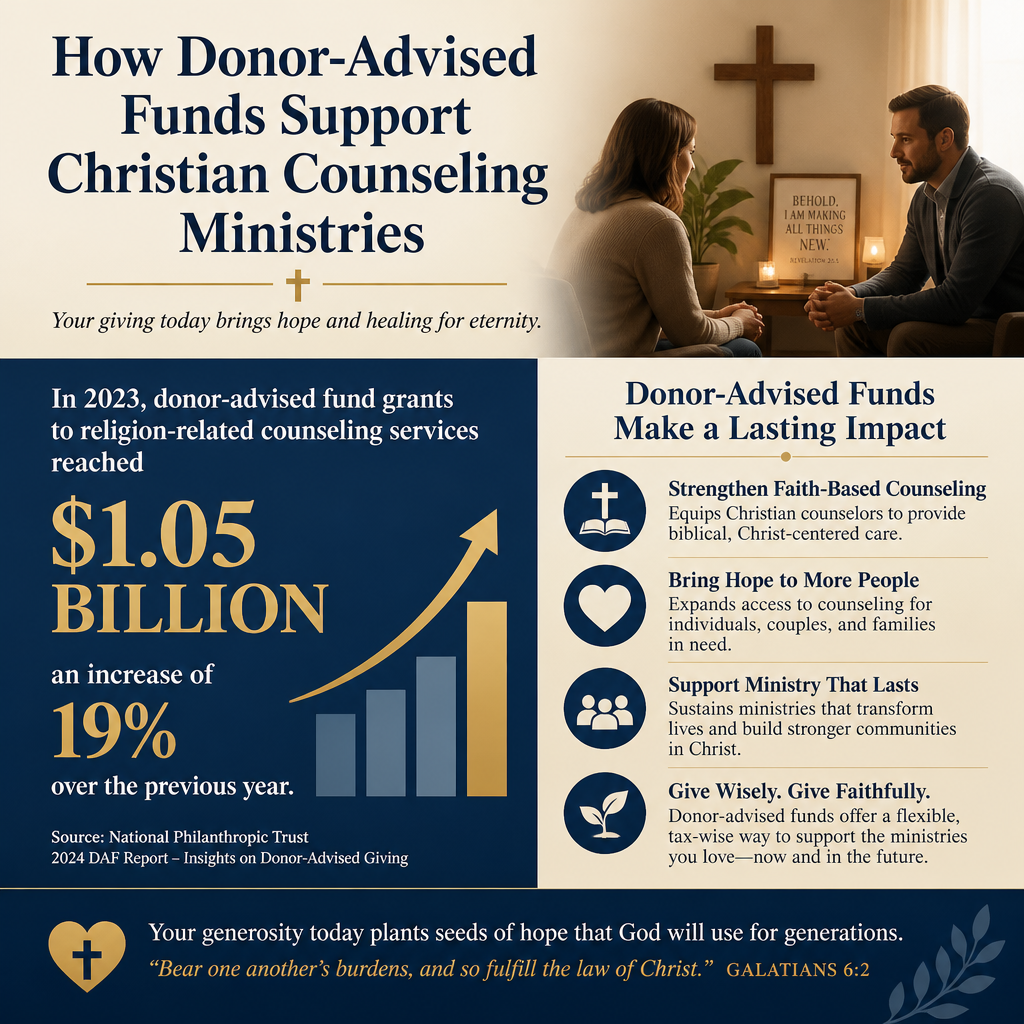
A donor-advised fund typically lets donors contribute to a sponsoring organization, receive a charitable deduction at the time of contribution, and then recommend grants to ministries over time. This can steady support for counseling centers that face uneven demand and fluctuating payer mixes. While the details differ by sponsor, the practical effect for many donors is steadier giving rhythms and simpler administration during busy seasons of life.
That administrative simplicity matters for Christian households trying to practice deliberate stewardship rather than impulsive giving. Jesus’ teaching on treasure and the heart assumes that money will either disciple us or be discipled by us. A DAF is not spiritual formation by itself, but it can support a more intentional pattern of generosity.

How DAF grants can strengthen the financial health of counseling ministries
Stable funding underwrites the less visible costs of care
Christian counseling ministries carry costs that donors do not always see: clinical supervision, continuing education, licensure compliance, secure record systems, background checks, and referral coordination. These are not distractions from mission; they are part of what it means to provide competent, ethical care in a broken world.
Some donors have been taught to treat “overhead” as suspect. The field has had to correct that assumption. Charity evaluators and watchdogs have argued that administrative and capacity costs are often essential to effectiveness, including in a well-known joint statement commonly referred to as the “Overhead Myth” (Charity Navigator home: https://www.charitynavigator.org/). For counseling ministries, capacity spending is frequently synonymous with safety and quality.
DAFs can support subsidy models without distorting them
Many counseling ministries subsidize care so that those with limited income can receive help. The subsidy can be structured through sliding-scale fees, scholarship funds, church partnerships, or a combination. DAF grants can fund these subsidies in a way that avoids the awkwardness of direct donor-to-counselee relationships, which can compromise dignity or blur boundaries.
Donors should also recognize that subsidy models can be misunderstood. If a counseling ministry is too dependent on designated gifts that only fund sessions for “the needy,” it may underfund the infrastructure that makes those sessions responsible and effective. The healthier pattern is to fund the whole mission: both direct care and the systems that uphold it.
What wise DAF giving requires from donors who want integrity and accountability
DAFs do not replace due diligence
A donor-advised fund is a vehicle, not a verdict. It does not certify that a ministry is theologically faithful, ethically sound, or operationally trustworthy. The harder question is how donors can evaluate counseling ministries that operate with necessary confidentiality and sometimes limited public reporting.
Across our verification work at Most Trusted, we find that donors gain clarity when they separate three questions that are often confused: whether a ministry is faithful to its Christian identity, whether its finances and governance are trustworthy, and whether its programs show credible evidence of fruit. Our evaluations apply The Most Trusted Standard, a 15-criteria framework spanning faith foundation, financial integrity, governance and leadership, and transparency and effectiveness, so donors can give with confidence without demanding the wrong kinds of disclosure.
Key questions to ask before recommending a DAF grant
Before you recommend a grant to a counseling ministry, the basic stewardship questions should be asked with the same seriousness you would bring to any Christian work, and with additional attention to safeguarding and clinical competence. A short set of checks can prevent avoidable harm:
- Does the ministry clearly articulate its Christian commitments and how those commitments shape counseling practice?
- Are counselors appropriately trained and supervised for the kinds of cases they accept?
- Are safeguarding policies clear, especially regarding abuse disclosures and mandated reporting?
- Is governance credible, with independent oversight and documented conflict-of-interest practices?
- Are finances transparent enough for a donor to understand revenue sources, reserves, and major expenditures?
Some of these questions are spiritually motivated, others are fiduciary, and most are both. Christian love of neighbor includes the duty not to fund preventable negligence.
Structuring DAF support for counseling ministries without creating unintended pressure
Designations and restrictions should be used sparingly
DAFs make it easy to designate grants for specific purposes. In counseling work, however, heavy restrictions can backfire. A donor may want to fund “sessions,” but a ministry may need funds for supervision hours, secure software, training in trauma-informed care, or a part-time intake coordinator so that high-risk cases are triaged properly. Restriction can unintentionally privilege visible activities over the real constraints that determine quality.
This does not mean donors should be indifferent. It means restrictions should be aligned with the ministry’s own strategy and budget, not a donor’s assumptions about what counts as “real ministry.” The Overhead Myth critique has been helpful here: effectiveness often depends on capacity, not the suppression of it (BBB Wise Giving Alliance home: https://www.give.org/).
Multi-year commitments strengthen care and reduce crisis fundraising
Counseling ministries can become reactive when funding is sporadic. Staff turnover, incomplete training, and overloaded caseloads are predictable outcomes of instability. Multi-year DAF grants—whether formal pledges or annual recommended grants—can help create the conditions for faithful, steady care. The goal is not institutional preservation for its own sake; it is the sustained provision of wise counsel and protection for vulnerable people.
What this means in practice is that donors can view counseling support as a long obedience rather than an emergency response. The church is called to bear one another’s burdens, and that bearing typically happens over time, not only in moments of acute crisis.
Connecting DAF generosity to Christian discernment about counseling itself
Christians disagree about models, credentials, and the language of mental health
Christians genuinely disagree about how to integrate biblical counseling, pastoral care, and clinically informed therapy. Some ministries emphasize Scripture’s sufficiency and are cautious about psychological frameworks; others integrate evidence-based modalities while remaining explicit about Christian anthropology and moral responsibility. Donors should not assume that a “Christian counseling” label settles these differences.
A wise approach is to evaluate whether a ministry’s stated theology and counseling model are coherent, honest, and consistent with historic Christian teaching, and whether the ministry is clear about what it does and does not provide. Donors can honor legitimate diversity while refusing ambiguity that hides real convictions.
DAF giving can be part of ordered stewardship across a portfolio of ministry commitments
Many mature donors use DAFs as one element in a broader giving strategy that includes the local church, global missions, mercy ministry, and specialized care such as counseling. Counseling ministries frequently serve believers and nonbelievers alike, and they often become a point of contact for evangelism, reconciliation, and restoration that does not fit tidy categories.
For readers seeking a broader view of the field, we track patterns and verification considerations across Christian Counseling Ministries, including how different organizations describe their theological commitments and safeguarding practices. For donors who are thinking specifically about practical giving decisions and what to fund, we also maintain a set of resources under How to Give to Christian Counseling Ministries.
FAQs for How donor-advised funds support Christian counseling ministries
Can we use a donor-advised fund to give to a specific counselor or to cover an individual’s counseling bill?
In most cases, DAF grants must go to qualified charitable organizations and cannot provide a private benefit to a specific individual. If a counseling ministry has an established scholarship fund and discretion over awards, a DAF grant can often support that fund without the donor directing aid to a named person. Donors should confirm the rules with their DAF sponsor and the receiving ministry to avoid compliance problems and to protect counselee confidentiality.
What should we expect a trustworthy Christian counseling ministry to disclose if confidentiality limits program reporting?
Confidentiality should not mean opacity. A trustworthy ministry can typically disclose governance structure, leadership accountability, financial statements or summaries, safeguarding policies, counselor qualifications, and a clear description of its counseling model and referral boundaries. Donors can also look for evidence of independent oversight and transparent handling of complaints. Across our work applying The Most Trusted Standard, these categories of disclosure are often the difference between necessary privacy and avoidable secrecy.
A disciplined way to fund quiet, consequential work
Donor-advised funds support Christian counseling ministries best when they are used for sustained, discerning generosity rather than for control or convenience. Counseling is a ministry of presence, truth-telling, and patient restoration, often in situations where the wounds are deep and the risks are real. A DAF can help donors fund that work with stability and care, while serious evaluation ensures that our giving strengthens what is faithful and protects those who are vulnerable.



