
Christian reconciliation ministries help restore trust by doing what most organizations cannot: they create a spiritually serious, structured process for naming harm, telling the truth, and pursuing repair without turning reconciliation into denial. Donors often sense the stakes intuitively. When conflict calcifies inside a church, a family business, a Christian school board, or a mission team, the damage rarely stays “internal.” It spreads into giving patterns, volunteer attrition, public witness, and sometimes the credibility of the gospel in a community.
Trust is not restored by sentiment or speed. Scripture treats reconciliation as costly moral work: Jesus ties worship itself to relational repair (Matthew 5:23–24), and Paul describes God’s reconciling action in Christ as the model and the mandate for the church (2 Corinthians 5:18–19). Reconciliation ministries exist because those commands meet real-world complexity: power imbalances, trauma histories, financial pressures, and leaders who may be sincerely repentant—or persistently unsafe.
Reconciliation is not conflict avoidance or image management
Many donors have funded “peacemaking” initiatives only to watch them become a public-relations exercise: encourage civility, avoid hard facts, protect leaders, move on. That pattern does not produce trust; it produces cynicism. Christian reconciliation ministries, when faithful to their calling, resist the false choice between peace and truth. Biblical peace is not the absence of conflict but the presence of justice, repentance, and restored communion where possible.
Trust is moral before it is emotional
In Christian settings, trust is often treated as a feeling we should recover quickly. Scripture frames it differently. Trust is bound to truthfulness, integrity, and faithfulness over time (Ephesians 4:25). Reconciliation ministries help communities move from “we want to feel unified again” to “we must tell the truth about what happened, who was harmed, and what repair requires.”
The harder question is what happens when the truth is costly—when it implicates leadership decisions, governance failures, or patterns of spiritual control. Ministries that are serious about reconciliation do not promise painless outcomes. They promise a disciplined process oriented toward repentance, protection of the vulnerable, and clarity.
Restoration is sometimes possible, and sometimes the faithful outcome is separation
Christians genuinely disagree about how quickly relational restoration should be offered after wrongdoing. The New Testament holds together both the call to forgive (Matthew 18:21–22) and the sober recognition that some people persist in divisive or destructive behavior (Titus 3:10). Trust cannot be commanded into existence. Reconciliation ministries that restore trust well are willing to say, with pastoral seriousness, that forgiveness and access are not identical, and reconciliation may require boundaries, removal from authority, or third-party oversight.

The best reconciliation work is structured, not improvised
When conflict becomes entrenched, informal conversations rarely reverse it. Parties have rehearsed narratives, supporters have formed coalitions, and leaders feel existential threat. Effective reconciliation ministries bring structure: clear stages, agreed-upon facilitation, documented commitments, and measurable next steps. This is not bureaucracy. It is a form of neighbor-love that reduces harm and increases clarity.
Common elements that tend to rebuild trust
Across our verification work at Most Trusted, we observe that reconciliation efforts gain credibility when the process is intelligible to those most affected, not merely to insiders. While methods differ, several elements recur in ministries that regain trust over time:
- Explicit commitments to truth-telling, including timelines and documentation
- Safeguards against coercion, especially where spiritual authority is involved
- Space for lament and acknowledgement of loss, not only problem-solving
- Concrete repair plans with owners, deadlines, and accountability
- Independent facilitation when leadership is part of the dispute
These practices align with a biblical anthropology that takes sin seriously, including self-deception. They also align with what conflict-resolution research recognizes: trust is rebuilt through consistent, observable behavior over time, not through a single meeting.
Why “neutrality” is not the goal
Some donors hesitate when they hear that a reconciliation ministry is “not neutral.” In practice, neutrality can become indifference to harm. Christian reconciliation work should be impartial in process—giving each party voice and resisting favoritism—while being morally clear about coercion, deception, exploitation, or retaliation. The ministry’s commitment is not to keeping everyone equally comfortable; it is to walking toward the truth in a way that honors God and protects neighbors.
Power, abuse, and accountability are the credibility tests
Reconciliation language can be weaponized. In churches and ministries, victims have been pressed to “forgive and forget” while perpetrators remained in authority. Donors have learned to ask sharper questions, and the field has had to reckon with that scrutiny. Where abuse is alleged—spiritual, sexual, financial, or otherwise—reconciliation ministries must be prepared to prioritize safety, reporting obligations, and long-term accountability over quick relational closure.
Why donors are right to be cautious
Trust is especially fragile when the conflict involves leaders, because leaders control information and systems. Donors often underwrite institutions with strong public brands, but crises reveal whether governance and culture can bear the weight of truth. Surveys have shown that clergy trust has declined in the broader public over time; in Gallup’s long-running ratings of honesty and ethics, “clergy” has trended downward from earlier highs, reflecting a wider skepticism toward institutions that claim moral authority.Gallup
This does not mean churches are uniquely untrustworthy. It means reconciliation ministries must work in a context where confidence is harder to earn. A credible ministry will insist on clear boundaries: who has decision rights, who controls the narrative, and what consequences follow if commitments are broken.
When reconciliation requires external expertise
Not every conflict is best handled within a church’s internal structures. Trauma dynamics, mandated reporting laws, and complex HR realities can exceed a congregation’s competence. Wise reconciliation ministries know when to involve licensed counselors, professional investigators, or legal guidance. Donors should see that not as secular drift but as prudence. Scripture honors competence and honest counsel (Proverbs 15:22), and the church’s witness is strengthened when it refuses to confuse spiritual language with institutional self-protection.
Those who want a broader view of the field often begin with The Mission and Impact of Christian Peacemaking Ministries, where the range of models and their implications for donors become clearer.
What donors should examine before funding reconciliation ministries
Because reconciliation is relational and outcomes are difficult to quantify, donors can be tempted to give based on compelling stories alone. Stories matter, but mature stewardship asks for more than narrative resonance. The question is whether the ministry has the theological, organizational, and ethical capacity to pursue reconciliation without causing secondary harm.
Clarity of theology and clarity of practice should match
A ministry may speak eloquently about forgiveness, unity, and peace while lacking operational safeguards. Donors should ask how theology becomes procedure: How are facilitators trained? How are conflicts screened for abuse dynamics? What happens when one party refuses truth-telling? What documentation is kept, and who sees it? How does the ministry prevent conflicts of interest when the disputing institution is also the payer?
Jesus warns against public displays that conceal private disorder (Matthew 23:27–28). The application is not cynicism; it is discernment. Reconciliation ministries that deserve trust will welcome scrutiny because their work depends on credibility.
Why verification matters for donor confidence
Most Trusted exists to help donors give with confidence by evaluating Christian nonprofits against The Most Trusted Standard, a 15-criteria framework spanning Faith Foundation, Financial Integrity, Governance and Leadership, and Transparency and Effectiveness. In reconciliation work, these areas are not abstract. Financial integrity affects whether parties suspect profit motives. Governance affects whether facilitators can act without undue pressure. Transparency affects whether outcomes are reported honestly, including partial or failed reconciliations.
Across our verification work, we observe that ministries that meet The Most Trusted Standard tend to describe their methods plainly, disclose leadership and oversight structures, and communicate limitations without defensiveness. That posture is not merely professional. It is consonant with Christian truthfulness.
How reconciliation ministries can measure progress without reducing people to metrics
Donors often ask for results: “How many reconciliations did you achieve?” Counting restored relationships can reward superficial closure and punish patient truth-telling. Yet the absence of any measurement invites unaccountable practice. The task is to measure what can be measured while honoring the dignity and complexity of human conflict.
Better indicators than simple success rates
Verifiable evidence suggests that outcome measurement is most trustworthy when it includes process integrity, not only end states. Reconciliation ministries can report:
- Completion rates of agreed-upon reconciliation processes, with reasons for non-completion
- Participant feedback gathered in ways that reduce coercion and retaliation risk
- Compliance with safeguarding protocols and reporting standards
- Evidence of implemented repair plans months later, not only immediate agreements
Donors can also look for transparency about hard cases. A ministry that never reports failures is likely redefining failure out of existence.
The public witness dimension donors cannot ignore
Trust restoration is not only for the immediate parties. Church conflict often spills into broader community perceptions of Christianity. Research has repeatedly shown that many outsiders associate Christianity with judgmentalism and hypocrisy, an environment where public scandals and unmanaged conflict reinforce existing skepticism.Barna Reconciliation ministries serve the church’s witness when they help communities practice repentance, justice, and repair in ways that are visible and credible.
For donors supporting this space, it is worth understanding the wider landscape of Christian Conflict Resolution Ministries, including how different approaches handle authority, discipline, and safeguarding.
FAQs for How Christian reconciliation ministries help restore trust
Should donors fund reconciliation efforts when allegations involve abuse?
Donors should fund only those efforts that prioritize safety, lawful reporting, and independent accountability. In abuse contexts, “reconciliation” must not be used to pressure victims into silence or proximity. A credible reconciliation ministry will distinguish forgiveness from restored access, involve appropriate external expertise, and insist on consequences for wrongdoing, including removal from authority where warranted.
What should donors do when a ministry claims unity but refuses transparency?
Unity claims without meaningful transparency are not reliable indicators of health. Donors can ask for clear explanations of process, oversight, and how outcomes are evaluated. When a ministry declines reasonable disclosure—especially about governance, conflicts of interest, or safeguarding—donors should treat that as a material risk and consider directing support toward organizations with verifiable accountability, including those evaluated through Most Trusted and The Most Trusted Standard.
A faithful path to trust restoration is slower and more credible
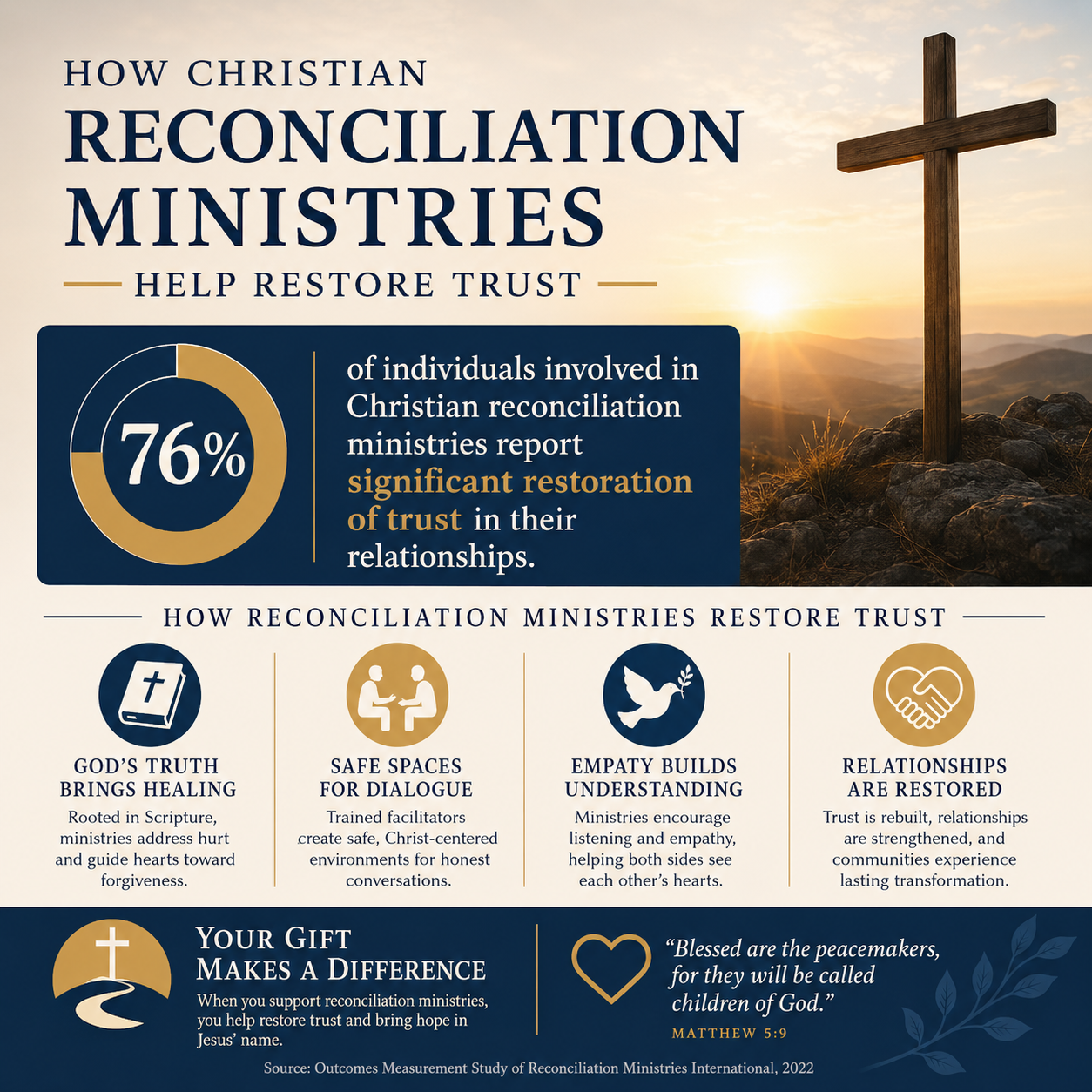
Christian reconciliation ministries help restore trust when they refuse shortcuts: no sentimental reconciliation without truth, no unity language that conceals coercion, no peace purchased at the expense of the vulnerable. Donors who care about the church’s long-term credibility will look for ministries that combine theological seriousness with disciplined practice, because trust is rebuilt through observable integrity over time. That is the kind of reconciliation that can bear public weight and honor Christ.



